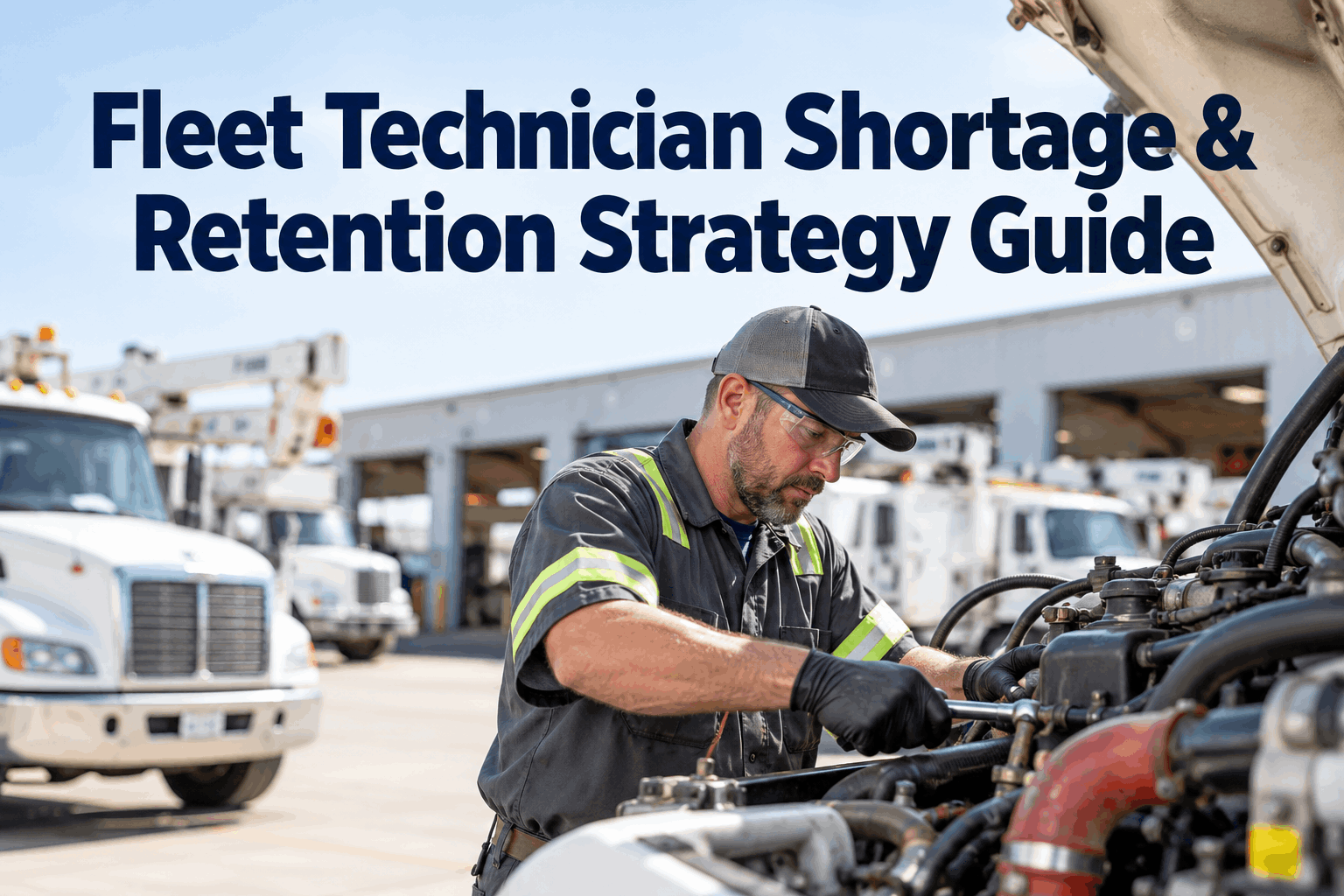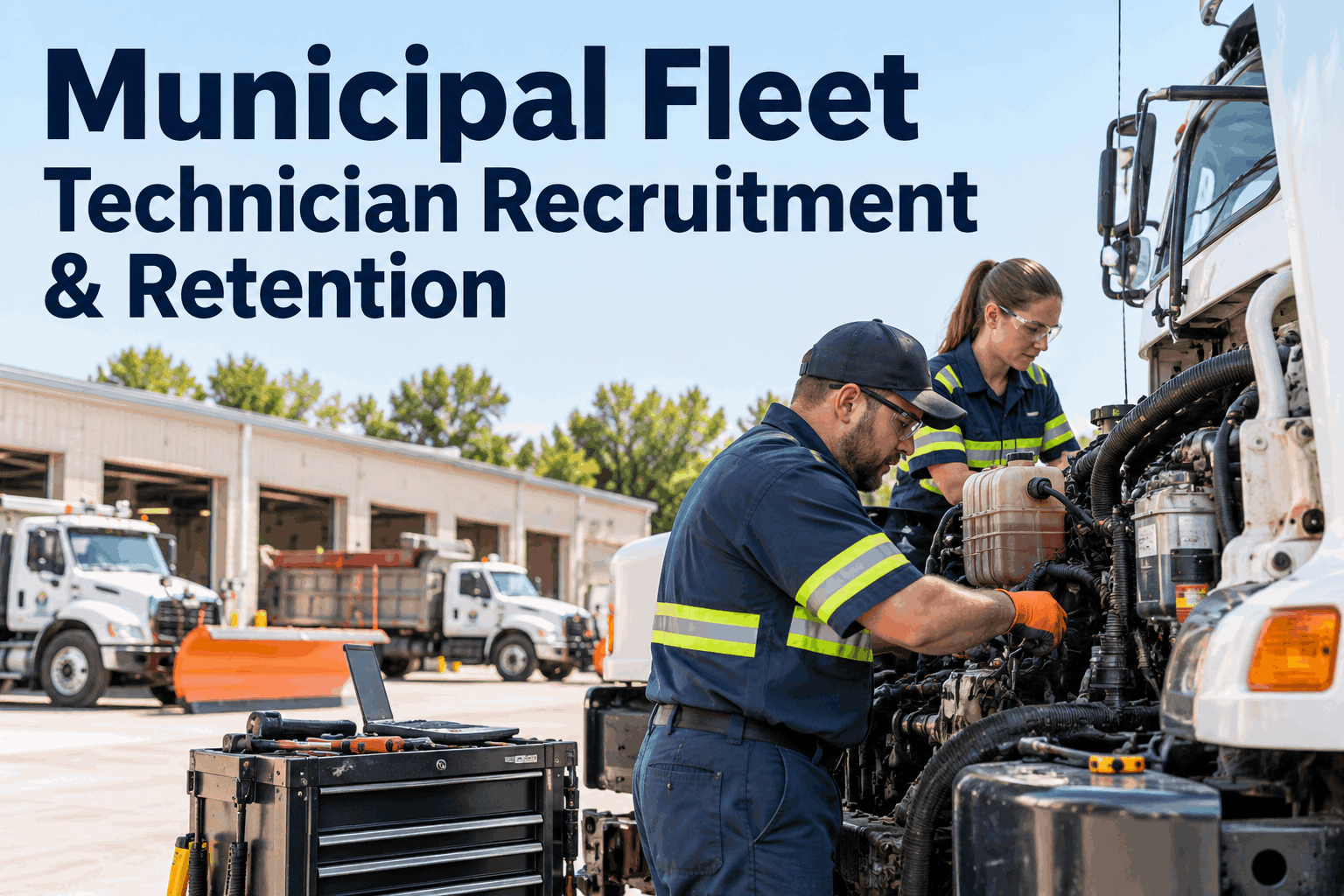
Municipal fleet technician recruitment is no longer only about posting an opening and waiting for qualified applicants. Public fleets compete for technicians while also working within established hiring processes, classifications and budgets. A stronger approach connects recruiting with onboarding, career development, shop conditions and the everyday maintenance workflow that determines whether good technicians want to stay.
Recruit Technicians for the Job. Retain Them for the Career.
Municipal fleets can strengthen technician recruitment and retention by improving the entire employee journey—from the first job posting and hiring process to onboarding, productive shop work, skills development and advancement.
Clear role, realistic requirements and complete employment proposition.
Reduce avoidable delays and give new technicians a structured start.
Parts, procedures, work information and tools available when needed.
Visible skills growth, qualifications, mentoring and career opportunities.
A technician vacancy affects more than the staffing chart
A municipal shop may feel a vacancy through slower preventive maintenance, longer repair queues, greater dependence on overtime or vendors, reduced specialist coverage and less time for experienced employees to mentor developing technicians. That makes municipal fleet staffing an operational issue as well as a human-resources issue.
The effect can spread across the maintenance operation.
Remaining technicians absorb more scheduled and unscheduled work.
Preventive work competes with urgent repairs for available technician hours.
Electrical, diagnostic, heavy-equipment or other capabilities may have limited backup.
Experienced staff have less time for mentoring and structured knowledge transfer.
The practical response is not simply “recruit harder.” Fleet leaders should examine why candidates enter the pipeline, where hiring slows down, how quickly new employees become productive and what conditions influence experienced technicians to remain with the organization.
Find where qualified candidates disappear
Fleet technician recruitment can fail at several points before a candidate ever reaches the shop. A job description may screen out people unnecessarily, an application may be difficult to complete, interviews may take too long to schedule or approvals may allow another employer to make an offer first.
Does the right technician know the position exists?
Are requirements clear, relevant and understandable?
Can the agency move qualified applicants through the process efficiently?
Does the candidate understand the complete role and employment package?
Measure the elapsed time between these stages. The goal is not to bypass required public-sector hiring controls; it is to identify avoidable waiting, duplicated approvals, unclear ownership and communication gaps that make public sector mechanic hiring unnecessarily slow.
Do not describe a municipal technician job with salary alone
Compensation matters, but candidates also evaluate schedule, stability, benefits, leave, retirement programs, commute, tools, shop conditions, training and opportunities to progress. Municipal employers should communicate the complete employment proposition accurately instead of assuming candidates already understand public-sector benefits.
ScheduleHours, shifts and predictability
BenefitsEligible agency benefits and leave
DevelopmentTraining and technical progression
Work environmentTools, facilities and workflow
Public serviceKeeping community assets operating
Stop designing every vacancy around the fully finished technician
When every opening expects years of experience across multiple systems, the candidate pool can become unnecessarily narrow. Some vacancies genuinely require experienced specialists. Others can support a development pathway in which a candidate enters with foundational capability and grows through structured training, mentoring and qualification.
Build relationships with automotive, diesel and equipment programs before students begin their final job search.
Create a structured path combining supervised shop experience with progressive technical development.
Evaluate transferable mechanical, electrical, military, industrial or equipment experience against actual job needs.
Recruit technicians whose existing capabilities match specialist, senior or immediately productive positions.
Instead of asking only, “Does this candidate already know everything?” ask, “What must this person know on day one, and what can our fleet realistically develop after hire?”
Build tomorrow's technician before you need tomorrow's vacancy filled
Trade-school relationships, internships and apprenticeship pathways can create a longer-term workforce pipeline. The strongest programs define what an employee should learn, who provides supervision and how responsibility grows as competency develops.
Shop orientation, safety practices, inspections and foundational maintenance.
FOUNDATIONPerform defined tasks with appropriate guidance from experienced technicians.
EXPOSUREShow competency across assigned maintenance skills and shop procedures.
DEVELOPMENTMove toward greater independence, technical depth and career progression.
RETENTIONRecruitment does not end when the candidate accepts
The transition from applicant to productive technician is one of the most important parts of fleet technician retention. New employees should understand the shop, fleet, expectations, procedures, systems and development path without having to reconstruct everything through trial and error.
Shop rules, safety expectations, fleet overview, tools, systems and key contacts.
Assign a mentor, introduce work-order expectations and provide access to procedures and maintenance information.
Review early work, identify technical gaps and assign appropriate training or supervised experience.
Discuss progress, obstacles, qualifications, workload and the next development milestone.
A new technician should not spend the first weeks discovering where information lives. Standardized procedures, accessible maintenance history and clear work orders help employees understand how the fleet expects maintenance to be performed and documented.
Hiring a technician is expensive if the workflow makes the job harder than it needs to be
HVI helps municipal fleet teams organize work orders, maintenance information, qualification records and parts data so technicians and supervisors can spend less time reconstructing information around each maintenance job.
Know what needs attention before work begins.
Review prior service and recurring issues.
Reduce searching and waiting around planned repairs.
Give technicians a consistent operational reference.
Look beyond the exit interview
Technician retention strategies should examine what employees experience every day. Compensation and benefits matter, but so do supervision, workload, tools, facility conditions, parts availability, information access, recognition, schedule expectations and whether employees can see a future inside the organization.
Experience
Is the shop consistently operating in crisis mode, or can work be planned and prioritized?
Can technicians get what they need without excessive searching, waiting or improvisation?
Are procedures, asset history and work-order details accessible when maintenance begins?
Do technicians receive clear priorities, useful feedback and support for difficult work?
Can employees build skills, qualifications and greater technical responsibility over time?
Can a technician see a realistic next step without having to leave the organization?
Show technicians where they can go next
A career ladder gives employees and supervisors a shared picture of progression. The exact classifications will depend on the municipality, but the principle is simple: advancement should be connected to defined responsibilities, demonstrated skills, qualifications and organizational needs.
Foundation skills, shop practices and supervised maintenance.
Independent responsibility for defined routine maintenance and repair work.
Complex diagnosis, specialist capability and support for developing employees.
Technical leadership, mentoring, advanced systems or specialized fleet expertise.
A leadership path for employees interested in planning, people and shop operations.
Do not make management the only meaningful promotion. A strong fleet technician career path can also reward deeper technical expertise, mentoring ability and specialist capability.
Make technician growth visible instead of leaving it in separate files
Training records, certifications and internal qualifications become more useful when supervisors can see them during workforce planning. Qualification visibility can support development discussions, identify upcoming renewal needs and show where the shop has limited technical coverage.
A simple operational view of what an employee has completed and what should happen next.
Jordan T.Fleet Technician
HVI can support the operational side of workforce development by helping teams maintain qualification information alongside the maintenance environment where those skills are used. See how HVI can support qualification visibility and fleet workflows.
Ask what a good technician experiences at 10:00 a.m. on a difficult Tuesday
Retention is easier to discuss as an annual HR metric than as an everyday operational experience. But technicians experience the organization one work order, one parts request, one supervisor interaction and one repair problem at a time.
Assignment clear?Useful work-order information
YESHistory available?Prior service and repair context
YESParts available?Required repair items located
CHECKProcedure accessible?Consistent maintenance reference
YESWork captured?History preserved for the next repair
YESUse mentoring as both a development and retention strategy
Experienced technicians hold practical knowledge about recurring failures, specialized equipment, local operating conditions and repair approaches. A mentoring structure can transfer that knowledge while giving senior employees a visible role in developing the next generation of the shop.
- Complex diagnostics
- Asset-specific knowledge
- Repair judgment
- Local fleet history
Shadow → practice → feedback → document
- Structured exposure
- Supervised practice
- Faster knowledge transfer
- Visible development path
The goal is not to turn every experienced employee into a full-time instructor. Instead, identify high-value knowledge, pair people intentionally and preserve important procedures and maintenance history so the same lesson does not have to be rediscovered repeatedly.
FLEET MANAGER INSIGHTRecruitment brings a technician through the shop door. Retention depends on what happens after that—whether the employee has the information, parts, support and development opportunities needed to do good work and see a future with the fleet.
Use a small scorecard that leads to action
Recruitment and retention metrics should help managers find a problem that can be investigated. Avoid turning one percentage into a verdict on the workforce. Combine hiring, staffing, development and shop information to understand what is changing.
Give technicians a maintenance workflow worth staying for
HVI brings work orders, parts information, maintenance history, procedures and qualification visibility closer together so fleet teams can improve the operating environment around technicians—not just the recruiting message used to attract them.
Work OrdersClear maintenance demand
Parts & HistoryInformation at the job
ProceduresConsistent workflow
QualificationsWorkforce visibility
A practical 12-month technician workforce cycle
Municipal fleets do not need to rebuild every workforce process simultaneously. Use a recurring cycle that connects immediate vacancies with longer-term workforce development.
Plan
Vacancies, retirement exposure, skills gaps and critical positions.
Review postings, hiring stages, schools, apprenticeships and outreach.
Training, mentoring, qualifications and technical career progression.
Shop friction, employee development, coverage and next-year risks.
Municipal fleet technician recruitment and retention FAQs
How can municipal fleets improve technician recruitment?
Start by reviewing the complete candidate journey. Make job requirements clear and relevant, communicate the full employment package, measure delays between application, interview and offer, build relationships with trade schools and consider structured apprenticeship or entry-level pathways where appropriate. The objective is to remove avoidable barriers without weakening the qualifications genuinely required for the position.
What helps municipal fleets retain skilled technicians?
Retention can be influenced by compensation and benefits as well as supervision, schedule, workload, facility conditions, tools, parts availability, access to maintenance information, training and career progression. Fleet leaders should evaluate the full technician experience rather than treating turnover as a recruiting problem alone.
Should a municipal fleet create a technician apprenticeship program?
An apprenticeship or structured development pathway can be useful when a fleet needs to build its own technician pipeline. A strong program defines entry requirements, supervision, training, progressive responsibilities, competency expectations and advancement. Municipalities should design any formal apprenticeship in accordance with applicable employment, labor and program requirements.
How can fleets create a technician career path?
Define progression around increasing technical capability, responsibility and organizational needs. A pathway might include apprentice or entry technician, technician, senior technician, lead or specialist roles and an optional supervisory track. Qualifications, demonstrated competency, mentoring and specialized skills can help make advancement expectations more visible.
How does HVI support technician recruitment and retention?
HVI supports the maintenance environment around the workforce by helping fleet teams organize work orders, maintenance history, parts and inventory information, procedures and qualification records. Better operational visibility can help supervisors provide technicians with clearer information while preserving maintenance knowledge as employees develop and responsibilities change.
Recruit for today. Develop for tomorrow. Improve the work technicians experience every day.
Municipal fleet technician recruitment and retention work best as one connected workforce strategy. Improve the hiring pipeline, create realistic entry paths, structure onboarding, build technical careers and remove unnecessary friction from the maintenance workflow.
RecruitBuild the pipeline
EnableImprove the workday
DevelopGrow capability
RetainKeep experience