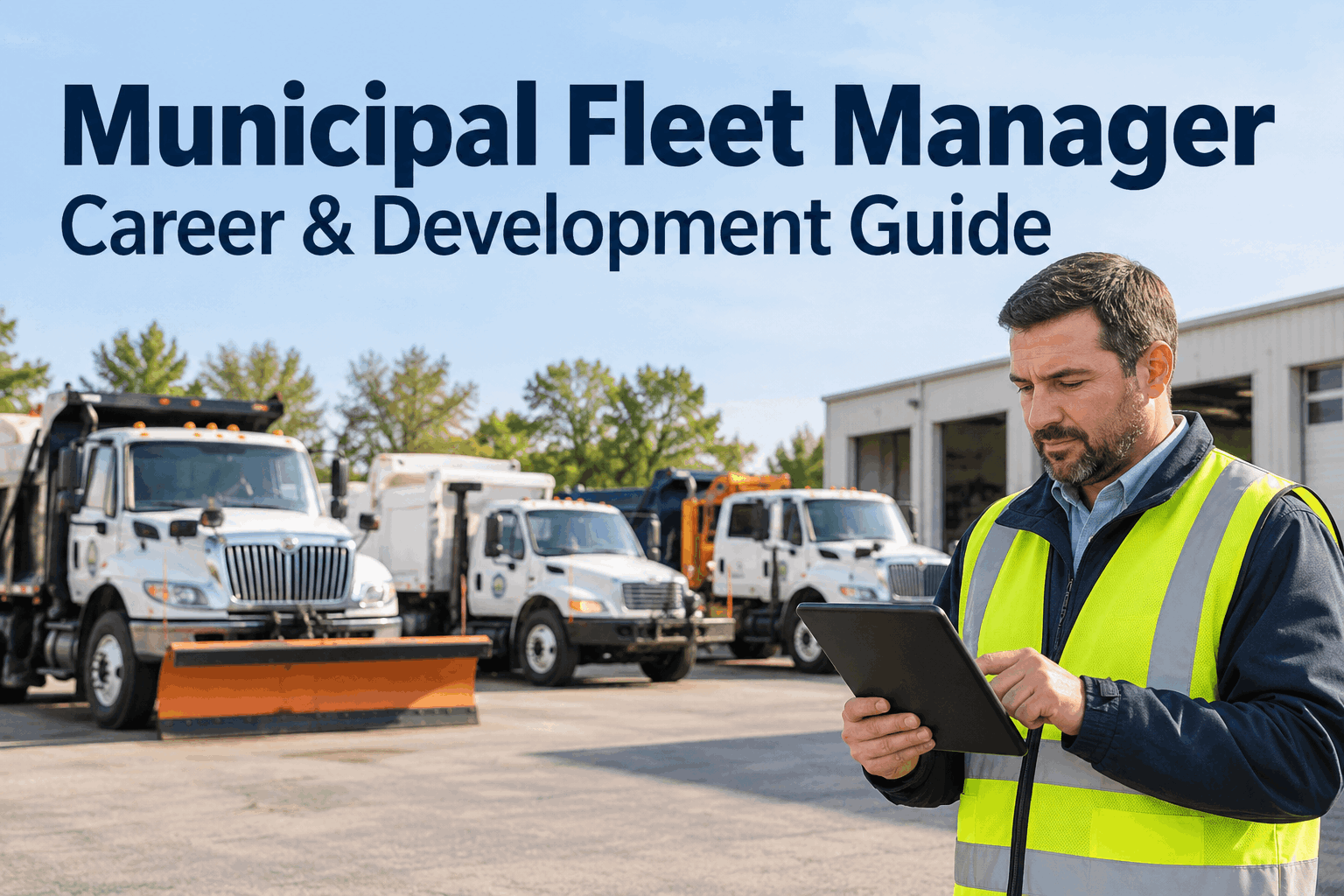
A shop supervisor can know every truck in the yard, understand why a PM is overdue, and be the person everyone calls when a difficult repair comes in—and still feel unprepared when the next role adds budgets, procurement, employee development, performance reporting, and meetings with department leadership. That gap is where municipal fleet manager development matters: preparing experienced fleet professionals for the management decisions they will be expected to own before the promotion happens.
Build the Next Municipal Fleet Manager Before You Need One
Technical experience builds credibility. Fleet leadership requires something broader. See how future public fleet managers can develop financial, analytical, workforce, procurement, communication, and strategic skills before stepping into the role.
Municipal fleet manager development changes the questions you own
A technician may spend the day asking how to repair an asset correctly. A supervisor asks how to get today's workload through the shop. A municipal fleet manager has to go further: What is driving cost? Which assets should be replaced? Where is downtime coming from? Is the workforce ready for the next five years? Those questions require a different layer of development.
“Can we solve the problem?”
“What should the organization do?”
This is why promoting the best technician and expecting management skills to appear automatically can create a difficult transition. Future managers need practical exposure to the business side of fleet operations. Municipalities evaluating how to make that information easier to see can also book an HVI demo to review a connected fleet workflow.
A municipal fleet manager career path should broaden responsibility in stages
There is no single route into public fleet management. Some leaders come from maintenance. Others build experience through operations, administration, procurement, asset management, or public works. The common thread is that responsibility becomes wider at each stage.
Technician / Fleet Specialist
Build strong equipment knowledge, inspection discipline, preventive maintenance awareness, repair judgment, and an understanding of how vehicle availability affects public services.
Lead Technician / Shop Supervisor
Coordinate daily work, assign resources, coach employees, resolve scheduling conflicts, and start using work-order and maintenance information to manage shop performance rather than only individual repairs.
Municipal Fleet Manager
Take responsibility for budgets, procurement, vendor relationships, compliance, performance reporting, asset replacement planning, staffing priorities, and relationships with departments that rely on the fleet.
Fleet Director / Senior Leader
Connect day-to-day fleet performance to capital strategy, policy, workforce planning, technology investment, organizational risk, sustainability goals, and long-term service requirements.
Seven fleet manager skills to develop before the promotion
A development plan becomes more useful when it identifies specific competencies instead of simply promising “more management experience.” The goal is to let emerging leaders practice these responsibilities while experienced managers can still coach them.
Fleet Operations
Understand inspections, maintenance workflows, PM compliance, asset availability, shop capacity, and the operating needs of customer departments.
Financial Management
Learn operating budgets, lifecycle cost, repair-versus-replace decisions, cost variance, capital requests, and how to explain why fleet spending changes.
Data & Analytics
Learn to distinguish a useful KPI from noise, identify recurring maintenance patterns, investigate cost drivers, and turn operating records into decisions.
Procurement & Contracts
Understand specifications, purchasing processes, vendor performance, outsourced work, service agreements, and the operating impact of procurement decisions.
Workforce Leadership
Practice coaching, accountability, workload planning, qualification visibility, training decisions, succession planning, and difficult employee conversations.
Risk & Compliance
Understand inspection controls, safety procedures, documentation, corrective actions, driver or operator reporting, and how inconsistent processes create organizational risk.
Communication & Executive Reporting
Translate shop activity into language finance teams, public works directors, department heads, and senior leadership can use: service impact, cost, risk, resource needs, and recommended action. Teams that want to see how operational information can be centralized can review HVI with a fleet specialist.
Fleet leadership already spans multiple management disciplines
Current professional-development frameworks reinforce the same point: public fleet leadership extends well beyond vehicle maintenance.
NAFA's CAFM program currently organizes professional development across eight fleet-management disciplines.
APWA says its redesigned CPFP structure will use three stackable microcredentials.
APWA states that current CPFP eligibility applications remain available through December 31, 2026.
APWA says the updated stackable certification program is planned for late 2027.
A practical 24-month municipal fleet manager development plan
A future manager should not encounter budgeting, vendor management, performance reporting, and employee development for the first time after receiving the title. A staged plan gives them progressively larger responsibilities while experienced leaders are still available to coach and challenge their decisions.
Move from completing work to reading operations
Give the employee responsibility for a small set of operational measures and recurring reviews.
Connect maintenance activity with money
Add exposure to the financial and purchasing decisions behind the shop.
Practice workforce leadership
Move beyond task assignment and give the candidate responsibility that requires coaching and communication.
Test strategic judgment
Assign a project that requires evidence, tradeoffs, a recommendation, and communication with stakeholders.
The value of this approach is exposure. A developing manager gets to see how inspection findings become repairs, how maintenance history affects replacement discussions, and how daily shop decisions appear in management reporting. Municipal teams can start using HVI for structured fleet records when they are ready to move away from disconnected processes.
Give future fleet leaders one clearer view of the work
HVI connects inspections, maintenance activity, preventive maintenance, parts, fuel, and fleet records so supervisors and managers can spend less time assembling information and more time learning what it means.
Teach developing managers to turn fleet activity into decisions
More data does not automatically create better fleet leadership. The development opportunity is learning how to move from an individual record—an inspection defect, a repair, a fuel transaction, a parts issue—to a management question about cost, availability, risk, or resources.
Capture
What is happening?
- Inspections
- Defects
- Work orders
- PM activity
Connect
What is the context?
- Parts usage
- Labor activity
- Fuel information
- Asset history
Interpret
Why does it matter?
- Repeat failures
- Cost drivers
- PM performance
- Operational risk
Decide
What should change?
- Prioritize work
- Allocate resources
- Improve procedures
- Support planning
Develop analytical habits, not dashboard habits
A dashboard does not make someone a better manager. The useful skill is asking why a number changed, what is driving the pattern, whether it is isolated or recurring, and what action the evidence supports.
Translate shop activity into management language
Finance and public works leadership may not need every repair detail. They need the service impact, cost, risk, resource requirement, and recommended response. That translation is a core government fleet leadership skill.
When records are scattered across paper forms and spreadsheets, developing this analytical habit becomes harder because managers spend time assembling the story before they can analyze it. A short HVI walkthrough can show how inspections and maintenance information connect inside one fleet workflow.
Where municipal fleet management training and certification fit
Formal education can broaden a manager's knowledge beyond the problems they encounter every day. It works best when training is paired with practical assignments, mentoring, and responsibility inside the fleet operation.
Public-works-specific development
APWA provides fleet-services career resources and the Certified Public Fleet Professional pathway. Its fleet career material reflects progression from technical and support roles toward supervisory and management responsibilities.
APWA is also transitioning the CPFP program. Its current information says eligibility applications for the existing model remain available through December 31, 2026, while a new stackable program is planned for late 2027.
Review APWA fleet career resources →Broader fleet-management disciplines
NAFA's Certified Automotive Fleet Manager program currently covers eight disciplines: asset management, business management, financial management, information management, maintenance management, professional development, risk management, and vehicle fuel management.
The breadth is useful for development planning because it demonstrates how quickly a fleet manager's responsibility extends beyond maintenance operations alone.
Review NAFA CAFM disciplines →Do not start developing the next fleet manager when the current one leaves
A vacancy is the worst time to discover that one person holds the budget history, vendor knowledge, replacement logic, reporting process, and unwritten rules that keep the fleet moving. Succession planning should transfer both responsibility and institutional knowledge while experienced leadership is still available.
Standardized procedures and accessible fleet records are part of that transfer. They reduce dependence on memory and give the next manager a clearer operating baseline. If your team is trying to make that transition, you can see how HVI centralizes day-to-day fleet information.
Find employees with judgment, curiosity, credibility, and leadership potential.
Compare technical strengths with financial, analytical, and people-management gaps.
Add budgets, vendors, reporting, procurement, and cross-department assignments.
Document procedures and organize fleet records so knowledge survives personnel changes.
Give emerging leaders meaningful decisions before the promotion happens.
Before promotion, can the future municipal fleet manager do these things?
A title is not a development plan. These questions provide a more practical test of whether an emerging leader has been exposed to the decisions that come with municipal fleet management.
Explain the fleet's biggest cost drivers without relying only on anecdotal experience.
Review inspection and maintenance information and identify an operational pattern.
Lead a difficult performance or accountability conversation with an employee.
Explain a fleet issue clearly to someone without a maintenance background.
Compare repair, replacement, and vendor options using documented information.
Document a repeatable procedure another employee can follow consistently.
Prioritize competing work when people, parts, time, or budget are constrained.
Present a recommendation and explain the evidence and tradeoffs behind it.
A fleet system can support development by making the operation easier to understand
HVI is not a leadership course or fleet manager certification. Its role is operational. It gives supervisors and managers a connected view of the activities they are responsible for understanding: inspections, defects, work orders, preventive maintenance, parts, fuel, safety, and asset history.
That matters for development because a future manager can learn from actual operating information rather than waiting for someone to assemble separate spreadsheets. The goal is not to stare at software; it is to see how one decision affects the rest of the fleet.
Municipal teams looking to standardize that information can start a free HVI account and begin building a more consistent operating record.
Visibility
Help municipal fleet leaders spend less time chasing records
Bring inspections, maintenance workflows, PM schedules, parts, fuel, and fleet history into a connected operating environment that managers can use for day-to-day decisions and reporting.
Municipal fleet manager development FAQs
What skills should a municipal fleet manager develop?
A municipal fleet manager should develop a combination of fleet operations knowledge, budgeting, cost analysis, procurement, data interpretation, workforce leadership, risk awareness, vendor management, and communication skills. Technical knowledge remains valuable, but management responsibility requires the ability to connect fleet activity with broader organizational priorities.
What is a typical municipal fleet manager career path?
There is no single municipal fleet manager career path. Many professionals progress from technician, fleet specialist, lead, or shop supervisor roles into management. Others enter through operations, administration, procurement, or asset management. The important development step is progressively adding financial, analytical, people, and strategic responsibility.
How can a municipality prepare future fleet managers?
Municipalities can identify potential leaders early and give them practical exposure to budgets, fleet performance data, procurement, vendors, employee development, procedures, capital planning, and cross-department projects before a management vacancy occurs. Mentoring and progressively larger assignments can expose skill gaps while experienced leaders are still available to coach them.
Is fleet management certification required to become a municipal fleet manager?
Requirements vary by municipality and position. Professional credentials can provide structured fleet-management education and demonstrate professional development, but employers may also consider relevant experience, leadership capability, education, technical knowledge, and qualifications established for the specific role.
How can fleet management software support manager development?
Fleet management software can give developing managers structured exposure to inspections, work orders, preventive maintenance, parts usage, fuel information, safety records, and asset histories. The software does not replace leadership development, but consistent operating information gives future managers better material for practicing analysis, prioritization, reporting, and evidence-based decision-making.
Municipal fleet manager development should begin before the title changes
Technical fleet knowledge is a strong foundation, but future managers also need time to build financial awareness, analytical judgment, workforce leadership, procurement experience, communication skills, and strategic perspective. Those capabilities are easier to develop through real assignments than through a rushed transition after a vacancy appears.
Municipalities can make that progression stronger by documenting procedures, organizing fleet information, and giving emerging leaders responsibility for interpreting real operating results. If clearer fleet visibility is part of that development plan, book a demo to see how HVI supports connected municipal fleet operations.
Give fleet managers a clearer operating picture
See how HVI connects inspections, work orders, preventive maintenance, parts, fuel, safety, and fleet records so municipal teams can manage day-to-day work with better information.