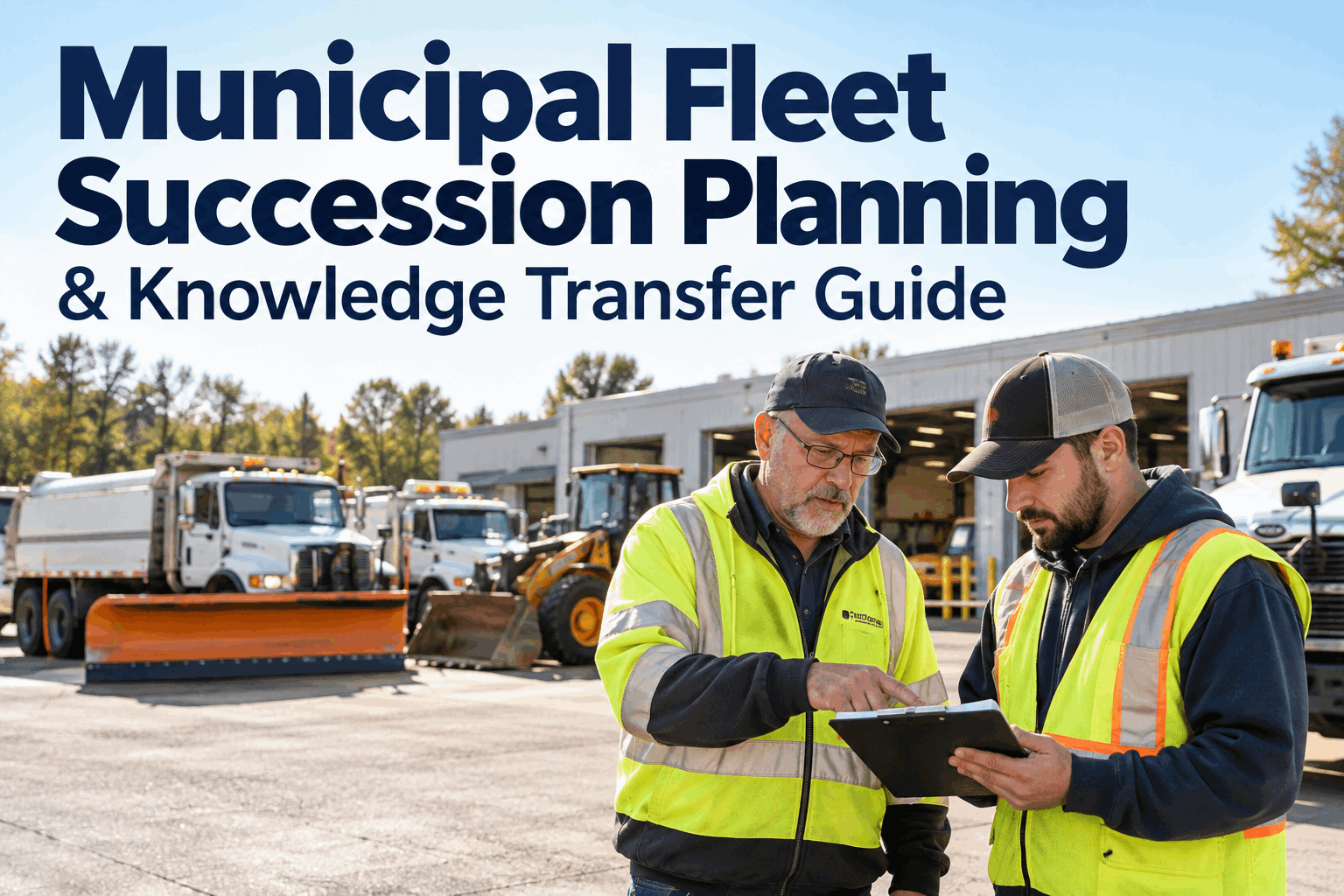
Municipal fleet succession planning becomes urgent when the person preparing to retire is also the person everyone asks about an unusual engine fault, an old snowplow attachment, a difficult vendor or the reason a preventive maintenance procedure was changed years ago. The goal is not simply to replace that employee—it is to keep valuable fleet knowledge available after responsibilities change.
When Experience Walks Out the Door, What Stays With the Fleet?
Experienced technicians and fleet leaders carry years of asset history, diagnostic judgment, maintenance decisions and operating context. Strong succession planning turns that knowledge into records, procedures and development opportunities before a retirement or departure creates a gap.
A vacancy is visible. Lost institutional knowledge often isn't.
Municipal workforce planning usually sees the position that may become vacant. Fleet operations have another layer of risk: years of unwritten knowledge can disappear with the person who held that position.
Why certain assets have shortened PM intervals
Recurring failures that do not appear in the OEM manual
Vendor and supplier history for difficult components
Seasonal equipment setup and operating practices
Department-specific service expectations
Diagnostic lessons accumulated over many repairs
If a critical employee left tomorrow, ask what the replacement could learn from your records without calling that person. The harder that question is to answer, the greater the knowledge-transfer dependency.
Start with the roles where departure would create the biggest operational gap
Not every position carries the same continuity risk. A practical municipal fleet succession planning process combines departure exposure with the amount of specialized knowledge concentrated in that role.
Low near-term departure risk, but important expertise is concentrated in one person.
High departure exposure combined with knowledge that would be difficult to replace quickly.
Knowledge is broadly shared and departure exposure is currently limited.
Departure risk is higher, but knowledge can be transferred through structured development.
Capture the fleet knowledge that a job description cannot hold
Job descriptions explain responsibilities. They rarely explain why Unit 214 receives an extra cooling-system check, which supplier finally solved a recurring electrical problem or what an experienced technician looks for when a familiar failure pattern returns.
Repairs, modifications, repeat defects, component replacements and unusual operating history tied to individual vehicles and equipment.
Symptoms, observations and repair context that help the next technician understand recurring or difficult problems faster.
Repeatable steps, local practices and quality checks used to perform important maintenance work consistently.
Part selections, substitutions, warranty experience and supplier knowledge that influence repair decisions and lead times.
Preparation for snow, heat, special events and other seasonal workloads that experienced staff may perform almost automatically.
Who can perform specialized work today, where skill gaps exist and which employees need broader exposure before taking on more responsibility.
Don't wait for the retirement announcement to start knowledge transfer
U.S. Office of Personnel Management guidance treats succession planning and knowledge management as ongoing workforce practices. Its guidance recommends identifying mission-critical occupations, understanding competencies and gaps, developing talent and creating methods for collecting, transferring and managing knowledge before the need becomes urgent.
Which positions and skills would create the greatest continuity problem if they became unavailable?
Determine the technical and leadership capabilities needed to keep the operation functioning.
Compare the knowledge required with the depth currently available across the team.
Use mentoring, job shadowing, documentation and development assignments before the transition.
The best handover document is the record your fleet builds every day
A retirement interview can capture useful context, but it should not carry the entire burden of institutional knowledge transfer. The stronger approach is to make documentation part of inspections, repairs and maintenance while experienced employees are still doing the work.
Capture condition, defects, photos and observations.
Record what technicians found and why action was needed.
Keep labor, parts, actions and notes tied to the asset.
Turn repeat lessons into procedures and maintenance tasks.
Use the documented history when developing the next employee.
When maintenance history is accessible, the next technician does not have to begin every diagnosis from zero. HVI's service-history workflow keeps prior repairs, dates, mileage and technician information associated with the asset, helping useful maintenance context remain available after staffing changes.
Transfer responsibility in stages, not on the employee's final Friday
Knowledge transfer works better when the successor has time to observe, perform the work, receive feedback and eventually make decisions with less supervision. The transition should therefore move through several levels rather than one final handover meeting.
The experienced employee explains important routines, decisions and fleet-specific context while the successor observes.
The successor performs important work while the experienced employee coaches and fills knowledge gaps.
The successor handles realistic decisions and demonstrates the technical or leadership capabilities the role requires.
Responsibilities shift with procedures, history and reference information still accessible after the incumbent leaves.
A retirement notice should trigger a focused countdown
If a departure is already approaching, prioritize the knowledge that would be hardest to reconstruct later. The objective is not to document every conversation an employee has ever had; it is to preserve the information that materially affects fleet continuity.
- Critical responsibilities
- Specialized assets
- Recurring problems
- Key procedures
- Update procedures
- Complete service notes
- Document unusual practices
- Organize reference material
- Job shadowing
- Mentored assignments
- Scenario walkthroughs
- Decision practice
- Successor demonstrates work
- Records are accessible
- Ownership is reassigned
- Remaining gaps have owners
Could the next employee answer these questions without calling the retiree?
This is a practical way to test whether fleet knowledge has become organizational knowledge or still lives primarily with one person.
What major work has already been performed on this asset?
Which problems have repeated, and what was tried previously?
Why was this maintenance procedure changed?
Which parts were installed during the previous repair?
What should a technician look for when this symptom returns?
Who on the current team is prepared to take over this responsibility?
Documentation is part of workforce resilience
“The most difficult knowledge to replace is usually not a specification you can look up. It is the history behind the decision — what failed before, what the team tried, what worked and what should be watched next time. If that context is documented as the work happens, the next technician inherits a starting point instead of a mystery.
This is where fleet knowledge management and maintenance management overlap. A useful maintenance record does more than prove that work occurred. It gives the next employee context for future decisions. HVI's current technician workflow includes complete service history with dates and mileage, previous parts information and notes from other technicians, making asset history available during diagnosis rather than separating it from daily maintenance work.
Municipal fleet succession planning FAQs
What is municipal fleet succession planning?
Municipal fleet succession planning is the process of preparing for future changes in critical fleet roles while developing employees and preserving the operational knowledge required to keep maintenance, equipment and fleet services functioning. It includes more than naming replacements; it also addresses competencies, development needs and institutional knowledge transfer.
What fleet knowledge should be captured before an employee retires?
Prioritize knowledge that would be difficult or expensive to reconstruct. This can include asset-specific maintenance history, recurring failure patterns, diagnostic experience, specialized procedures, parts and supplier context, seasonal practices, regulatory responsibilities and important cross-department workflows.
When should a fleet begin retirement knowledge transfer?
Knowledge transfer should be an ongoing operating practice rather than something that begins only after a retirement notice. OPM workforce guidance similarly recommends designing strategies for collecting, transferring and managing knowledge throughout work activities instead of waiting until a critical employee's departure makes the need urgent.
How can municipal fleets develop future managers and technicians?
Start by identifying the competencies required in critical roles and comparing them with current workforce capability. Job shadowing, mentoring, cross-training, temporary assignments and progressively broader responsibilities can then give potential successors practical experience before they are expected to perform the role independently.
How can HVI help preserve municipal fleet knowledge?
HVI maintains asset and maintenance information such as service history, work orders, repair activity, parts information, inspection records and technician notes in digital fleet workflows. Keeping this history associated with the asset can help useful maintenance context remain accessible when technicians, supervisors or responsibilities change.
The employee may retire. The maintenance history shouldn't.
Succession planning becomes stronger when institutional knowledge is captured through everyday fleet work. HVI helps teams maintain service history, repair records, inspections and maintenance information around the asset so the next employee has context to build from.
Service history retained
Repair context accessible
Maintenance records stay with assets