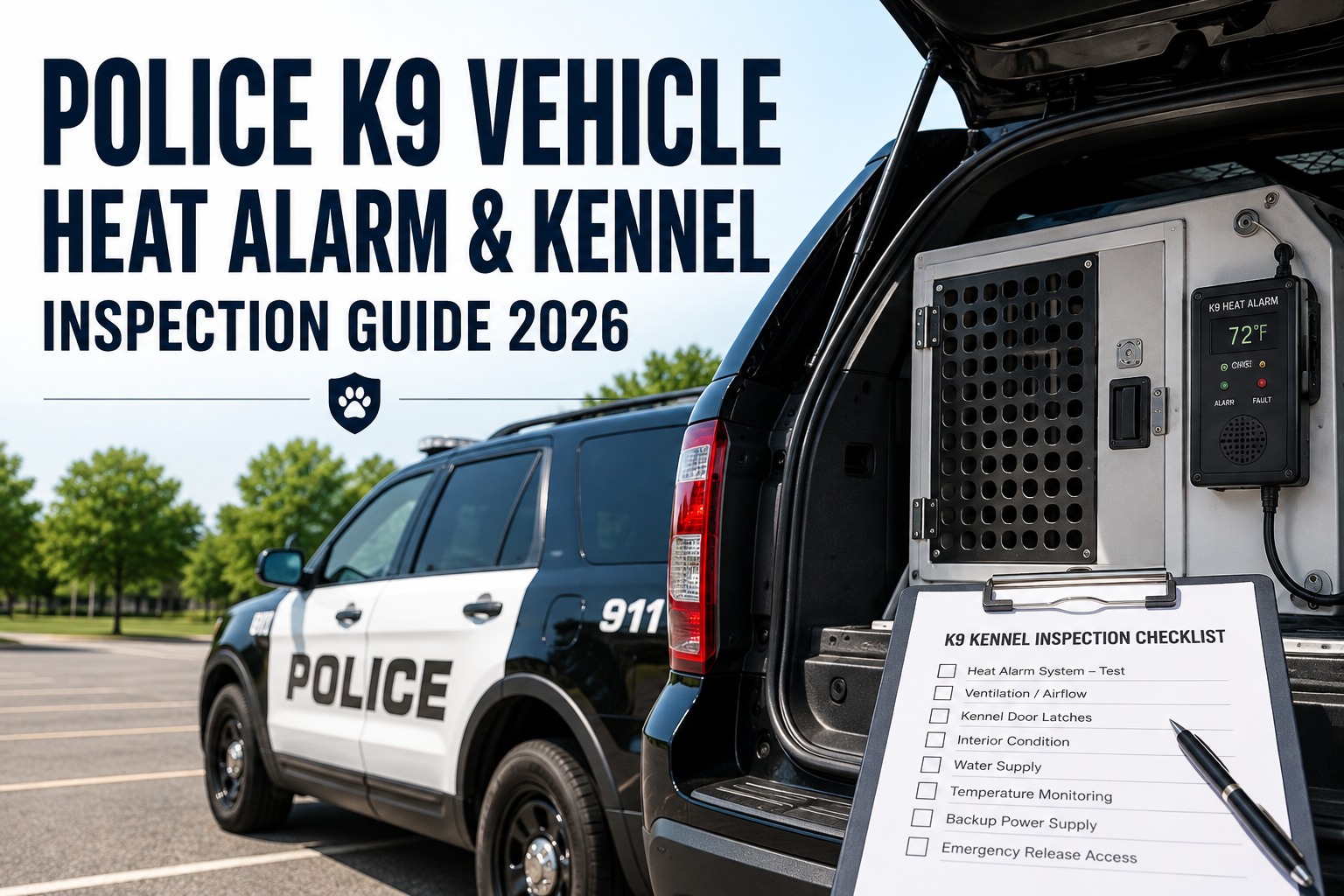
It is 2:14 a.m. and your K9 handler is on the side of a county highway with a flat tire and an erratic HVAC relay. The kennel temperature is climbing, the Ace K9 heat alarm is chirping, and the paper DVIR on the dashboard was filled out six hours ago in a parking garage with no cell service. Police K9 vehicle inspection is not just another box on the daily vehicle inspection report — it is the single highest civil liability exposure on a law enforcement fleet, because a missed latch test or a dead temperature sensor can end a handler's career and cost a municipality millions. A daily K9 unit daily check that covers the heat alarm, kennel hardware, and HVAC redundancy is the only defense, and seeing a digital K9 template built for your exact vehicles is the fastest way to make that defense stick.
K9 FLEET SAFETY & LIABILITY
The in-car heat alarm only protects the dog if someone tested it this morning.
Paper checklists cannot prove a Hot N Pop sensor cycled or a kennel latch held under load. A digital police K9 vehicle inspection stamps every reading with a time, a GPS location, and a photo — the evidence your department needs when a civil suit lands.
THE REAL COST OF A MISSED CHECK
What a skipped K9 kennel inspection actually costs your fleet
Every number below is tied directly to a line item a Director of Maintenance or Safety & Compliance Manager has to defend in a budget meeting or a courtroom.
DAILY CHECK BREAKDOWN
Police K9 vehicle inspection checklist: every point that needs a daily test
A K9 unit is not a standard patrol car. The daily inspection has to cover life-safety hardware that a normal DVIR ignores entirely. These are the four tiers every handler and shop foreman must verify before the kennel is loaded.
Heat Alarm System
- Ace K9 or Hot N Pop panel powers on, displays current kennel temp, and shows no fault codes
- High-temperature setpoint tested by warming the sensor — horn, lights, and fan override must activate
- Backup battery voltage logged; a dead cell here is the single most common silent failure
Kennel & Latch
- Kennel door latch fully cycled under load — a half-throw latch is the one that springs open in a crash
- Pop door remote fires from inside the cab and from the rear release handle, no more than a 1-second delay
- Kennel floor and drain pan clear of obstruction; a blocked pan traps heat and triggers false alarms
HVAC Redundancy
- Front and rear A/C output verified at the kennel vent with a thermometer — a 15-degree split means a failing compressor
- Engine-running interlock and fan relay tested so the kennel fan runs even if the main climate control is off
- Vehicle failsafe mode confirmed — engine shuts down and windows drop if interior hits the critical setpoint
Power & Telemetry
- Auxiliary battery isolator holding charge and switching cleanly when the main battery drops below 12.2V
- Telematics or alarm-modem signal confirmed — if the pager cannot reach the handler, the alarm is useless at a scene
- All wiring harnesses behind the partition inspected for chafing from body armor and kennel frame vibration
PAPER VS. DIGITAL EVIDENCE
Why a paper K9 unit daily check fails in court and in the shop
A clipboard DVIR says a check was done. It proves nothing about the conditions, the sequence, or the person who signed off. Here is what actually changes when the same checklist moves to a mobile K9 vehicle safety app.
| Inspection point | Paper DVIR binder | HVI digital inspection |
|---|---|---|
| Heat alarm test | Box ticked "OK" — no proof the sensor was actually heated | Temperature reading logged with timestamp, GPS, and handler photo |
| Kennel latch cycle | Visual glance; failure only found after door opens in a hard stop | Photo of latch in closed position, tied to a required work-order if loose |
| HVAC output | "A/C works" — no vent temperature recorded for trend analysis | Actual degree reading stored and trended across days for early failure |
| Pop door remote | Checked if remembered; battery dies with no alert | Remote test logged and overdue alert pushed if skipped two shifts |
| Audit response time | Days of pulling binders from trunks and patrol supervisor offices | Full year of records exported in seconds, filtered by unit or handler |
See HVI running on your own K9 units — book a 30-minute demo
We will load your actual SUV or truck profile, your heat-alarm make, and your kennel configuration so you can watch a real K9 inspection flow start to finish.
HOW HVI HELPS
How HVI closes the K9 vehicle liability gap
HVI turns the four-tier K9 check into a guided, timestamped, photo-backed record that lives in the cloud and follows the asset — not the binder. These are the four capabilities that matter most to a K9 fleet.
Pre-loaded K9 inspection templates
HVI ships with a police K9 vehicle inspection template that already covers Ace K9, Hot N Pop, and kennel latch cycles, so handlers do not build a checklist from scratch. Every field forces a reading or a photo, which means a skipped heat-alarm test is impossible to hide at the end of a shift. You can start logging inspections free and customise the template for your specific SUV or truck build in minutes.
Defect-to-work-order in one tap
When a handler flags a weak pop door or a flickering HVAC relay, HVI instantly spins that defect into a work order routed to the shop foreman — no text messages, no lost slips of paper. The work order carries the photo, the GPS location, and the unit's full PM history so the technician walks out with context, not a blank stare.
Overdue and skip alerts
If a K9 unit daily check is not started within the first hour of a shift, HVI pushes an alert to the patrol supervisor and the site supervisor. That single ping is what catches the dead backup battery on a Tuesday morning before it becomes a Wednesday afternoon tragedy. You can walk through the alert routing on your own units in a live demo.
Audit-ready, court-ready records
Every inspection is stamped with a timestamp, a GPS pin, and the handler's digital signature, stored in a cloud CMMS that cannot be edited after submission. When internal affairs, a city attorney, or an insurance auditor asks for six months of K9 heat-alarm tests, you export the whole file in seconds instead of hunting trunks for binders.
PING-CHECK WORKFLOW
The 5-step K9 heat alarm ping-check every shift should run
The ping-check is the single most skipped step on a paper DVIR because it takes two minutes and nobody can prove it was done. On a mobile app, it takes the same two minutes but leaves a permanent, timestamped trail.
Power on and read baseline temperature
Handler starts the Ace K9 or Hot N Pop panel, confirms the display is alive, and logs the current kennel temperature as the baseline reading before the vehicle has moved.
Trigger the high-temp sensor
Using the panel test mode or a controlled heat source, the handler warms the sensor past the setpoint and confirms the horn, lights, and fan override all activate within the designed window.
Verify the failsafe and pager signal
The handler confirms the engine-shutdown sequence arms and the pager or telematics modem sends a signal to the remote receiver the handler actually carries, not one sitting in a desk drawer.
Log the backup battery voltage
The auxiliary battery is the silent failure point. The handler reads the voltage off the panel or a meter and enters the number — HVI trends it across days so a slow die is caught before it hits zero.
Sign and submit with GPS and photo
The handler snaps a photo of the panel showing "System OK," signs digitally, and submits. The record is locked, timestamped, and pushed to the supervisor dashboard before the kennel is loaded. You can see this exact workflow mapped to your alarm brand in a short demo.
DO AND DON'T
K9 HVAC inspection: what protects the dog and what kills the case
Do this every shift
- Record an actual vent temperature number, not just "A/C works"
- Test the fan relay with the engine both running and off
- Check the kennel drain pan — a blocked pan is a hidden heat trap
- Log the backup battery voltage and trend it over weeks
- Tie a failed reading to a work order before the unit leaves the lot
Never do this
- Sign a paper DVIR that says "all OK" without opening the kennel
- Skip the ping-check because the alarm "chirped on startup"
- Assume the telematics pager works because the modem light is green
- Let a weak latch go another day because "it still holds"
- Rely on a single HVAC compressor with no redundancy for a dog carrier
KEY TAKEAWAYS
Police K9 vehicle safety comes down to proof, not promises
A criminal justice K9 fleet lives and dies on the quality of its daily inspection record. The hardware — the Ace K9 heat alarm, the Hot N Pop system, the kennel latch, the HVAC relay — is only as reliable as the last person who tested it and the record that proves the test happened. Paper binders cannot survive a civil deposition, and group-chat photos cannot survive an audit. A digital police K9 CMMS gives every handler a guided, timestamped, photo-backed trail that turns a routine check into defensible evidence, and turns a fleet manager's biggest liability into a closed gap. The shift from paper to a mobile inspection app is not a convenience upgrade; it is the difference between proving you did your job and hoping someone believes you did.
We had three K9 SUVs with paper DVIRs that said the heat alarm was fine every single day for a year. When we switched to HVI and forced an actual temperature reading, we found one unit had a dead backup battery and a sensor that had not tripped in six months. That is the day I stopped trusting a clipboard.
Sgt. Daniel Reyes, K9 Unit Supervisor, Regional Sheriff's Office (mixed fleet of 12 patrol SUVs and 3 transport vans)
FREQUENTLY ASKED QUESTIONS
Police K9 vehicle inspection: what handlers and fleet managers ask
How often should a police K9 heat alarm system be tested?
What is a K9 ping-check and why does it matter?
Does HVI work with Ace K9 and Hot N Pop heat alarm systems?
Can a digital DVIR protect a department in a K9 liability lawsuit?
How long does it take to roll out HVI for a K9 fleet?
Stop trusting clipboards with a $3 million liability
Book a 30-minute demo and watch HVI run a full police K9 vehicle inspection on your own units — heat alarm, kennel latch, HVAC, and pop door, all timestamped and photo-backed.
Free to start — Works on any phone — No card needed