Your first electric patrol car rolls out of the motor pool at 06:00 with 96% charge, and by 10:40 the sergeant is radioing dispatch asking if the unit can still cover its zone. That moment is where every police fleet EV pilot lives or dies. Departments testing the Ford Mach-E Police Interceptor and the F-150 Lightning Pro are discovering that range numbers on a spec sheet and range across a real 10-hour shift are two very different things — and the gap between them is where public safety risk, overtime cost and charging chaos pile up. The fix is not more spreadsheets: it is a live shift-versus-range picture for every unit, every day, which is exactly what you can see in a 30-minute walkthrough of HVI's EV patrol dashboard before your next pilot review meeting.
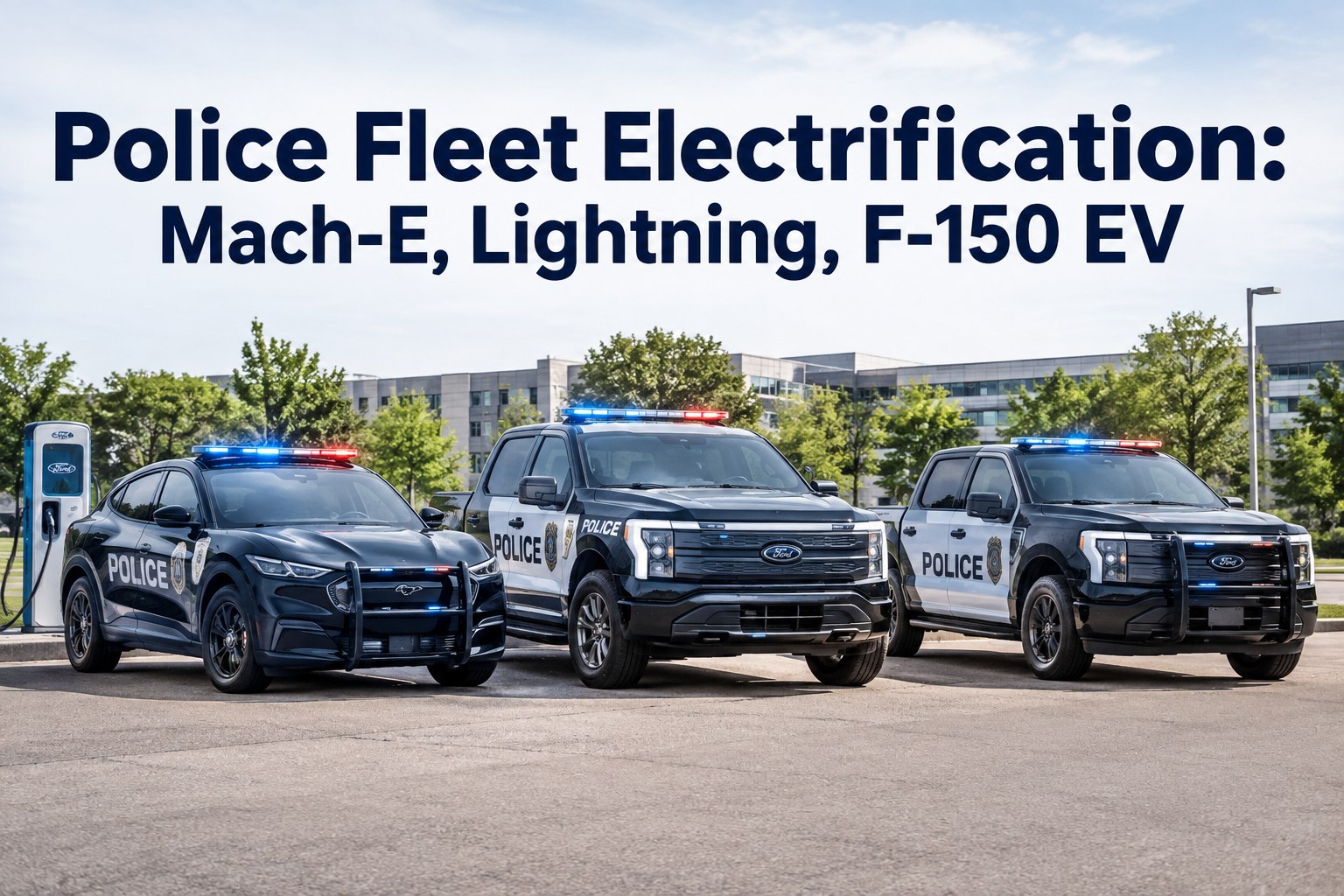
Police Fleet Electrification
Can an EV patrol car actually finish a 10-hour shift?
The Mach-E Police and F-150 Lightning Pro are ready for duty. The question is whether your charging plan, shift patterns and maintenance records are. Here is the data from real pilots — and the dashboard that answers the range question before your officers ask it.
The Real Numbers
What police fleet EV pilots are actually showing
Early adopters like the NYPD — which added Mach-E GT units to its fleet — and Bargersville, Indiana, which ran one of the first Tesla patrol pilots in the US, have published enough real-world data to draw clear lessons. Four numbers matter most to your budget and your shift coverage.
Mach-E Police rated range
The MY24 Mach-E Police Interceptor carries a 224-mile pursuit-rated estimate. Real patrol duty with idle time, climate control and emergency lighting typically trims usable range by 20–35%.
Lightning Pro range band
The F-150 Lightning Pro spans 230 miles standard to 320 miles extended range. Payload, light bars, prisoner partitions and winter temperatures all eat into that figure fast.
Fuel savings per unit per year
Bargersville's pilot reported roughly $6,000 a year saved per EV unit on fuel and maintenance combined — the figure that gets council approval, if you can prove it with your own logs.
DC fast-charge window
A 20–80% DC fast charge takes 30–45 minutes. If that charge happens mid-shift instead of between shifts, you have lost a patrol unit for the better part of an hour.
Spec Sheet vs Shift
Ford Mach-E Police vs F-150 Lightning: which fits which duty?
Neither vehicle is "the police EV" — they solve different problems. The Mach-E is a pursuit-rated sedan replacement; the Lightning is a supervisor, K-9, or utility truck that doubles as a mobile power source. Match the unit to the duty cycle before you match it to the charger.
| Factor | Mach-E Police (MY24) | F-150 Lightning Pro |
|---|---|---|
| Rated range | 224 miles, pursuit-rated | 230 mi standard / 320 mi extended |
| Best-fit duty | Urban patrol, traffic units, command staff | Rural patrol, K-9, supervisors, event support |
| Idle load tolerance | Good — low draw at curbside idle | Excellent — can power scene lighting and gear from Pro Power outlets |
| Winter range impact | Moderate — heat pump helps | Heavier — larger battery buffer offsets some loss |
| Upfit complexity | Police package from factory, standard upfit path | Truck upfitters familiar; watch payload with partitions |
| Charging strategy | Depot Level 2 overnight, DC fast as backup | Depot Level 2; extended range covers double shifts |
The departments that struggle are the ones that assign EVs to the wrong duty cycle first — a 224-mile unit on a rural beat with no mid-shift charger is a complaint waiting to happen. If you want to model your own duty cycles against these ranges, book a demo and bring your shift schedule — the team will map it live.
Range Anxiety Is a Data Problem
Why EV patrol range anxiety is really a tracking failure
Officers do not distrust the battery — they distrust not knowing. When the state of charge at shift start lives in the car, the charge history lives in the charger's app, and the shift mileage lives in dispatch logs, nobody can answer the only question that matters: will this unit finish this shift?
Shift start: baseline capture
The officer's pre-shift inspection records state of charge, estimated range and any charging faults from the overnight session. A unit that left the charger at 78% instead of 100% is flagged before wheels roll, not at mile 90.
Mid-shift: live range vs remaining duty
Mileage and charge data feed a shift-versus-range view per unit. When projected range drops below remaining shift miles plus a safety buffer, the supervisor sees it with hours to spare — enough time to swap units or schedule a 20-minute top-up.
Post-shift: charge history and exceptions
Every charging session is logged against the unit: start and end state of charge, kWh delivered, duration, cost. Missed charges, failed sessions and vampire drain show up as exceptions, not mysteries.
Monthly: the report council actually wants
Fuel dollars avoided, maintenance dollars avoided, uptime per unit, range performance by season. This is the evidence that turns a 2-car pilot into a 20-car purchase order — and it is exactly the view you get when you walk through the EV patrol dashboard on a demo call.
Worked Example
What one missed charge actually costs a 40-unit department
Run the arithmetic once and the case for tracking writes itself. Take a mid-size municipal department running 40 patrol units, four of them EVs in a pilot.
Now multiply by the two or three missed or partial charges a month that most pilot coordinators admit they only discover by accident. A department losing six unit-shifts a month to charging surprises is spending $900–$1,500 monthly on a problem a charge-history log catches at 06:05 — before the officer ever leaves the lot. Departments that start logging inspections and charges free in HVI typically surface their first silent charging failure inside the first week.
See your whole EV pilot on one dashboard
Range vs shift, charge history, inspection compliance and maintenance cost per unit — live, per vehicle, audit-ready. Bring your pilot roster and we will map it in 30 minutes.
Electric Patrol Car PM
EV police vehicle PM: what changes and what does not
An electric patrol car deletes the oil changes, transmission services and spark plugs — and adds a new set of failure points that paper PM sheets were never built to track. Here is the honest split.
Gone from the PM sheet
- Engine oil and filter every 5,000–7,500 miles
- Transmission fluid and filter services
- Spark plugs, coils, belts and exhaust work
- Fuel system and emissions repairs
- Most brake pad replacements — regen braking cuts pad wear dramatically
New on the PM sheet
- Battery health and state-of-charge logging per shift
- Charging cable, port and depot charger inspection
- Coolant service for battery thermal management
- High-load tire rotation — EV torque and weight wear patrol tires faster
- Software and firmware update verification
- 12V auxiliary battery checks — the number-one EV no-start cause
The trap is assuming "less maintenance" means "no maintenance schedule." Tires, 12V batteries and thermal-system coolant all fail on their own clocks, and an EV patrol unit that will not start at shift change is downtime exactly like a dead Crown Vic was. HVI schedules preventive maintenance by date, mileage or usage with due and overdue alerts, so the new PM items live in the same system as your diesel units — see how mixed-fleet PM scheduling works in a live demo.
How HVI Helps
The HVI EV patrol dashboard: four tools, one answer per unit
Shift-vs-range tracking
Start-of-shift charge, projected range and remaining duty miles per unit, with automatic flags when the math stops working. Supervisors act at hour two, not hour eight.
Charge history per vehicle
Every session logged — kWh, duration, cost, exceptions. Missed overnight charges trigger alerts before roll call, and the monthly cost-per-unit report builds itself.
Digital pre-shift inspections
Officers complete a photo-backed EV-specific checklist on any phone in under five minutes. Defects convert to work orders instantly — no paper, no texted photos, no lost reports.
Pilot-to-council reporting
Uptime, cost per mile, fuel and maintenance dollars avoided, compliance rate — exportable proof that your pilot works, in the format budget committees ask for.
Rollout Playbook
A 90-day police EV pilot that produces defensible data
The pilots that get expanded are the ones that treat data collection as seriously as the vehicles. This timeline is the pattern that works.
Baseline and duty-cycle mapping
Log current fuel and maintenance cost per gas unit, map every beat's daily mileage, and assign EVs to duty cycles that fit 70% of rated range — not 100%. Set up digital pre-shift inspections before the cars arrive.
Live operation with daily logging
Every shift starts with a digital inspection capturing charge state; every charge session is logged. Track exceptions daily — missed charges, range shortfalls, charger faults — and fix the pattern, not the incident.
Stress-test the edges
Deliberately run the hardest realistic duty: double-shift coverage, a hot-day or cold-snap week, a special event with extended idle. This is where the Lightning's onboard power and the Mach-E's idle efficiency earn their keep — or expose the gap.
Package the proof
Pull uptime, cost per mile, fuel avoided, maintenance avoided and officer feedback into one report. Departments that set this reporting up from day one with HVI walk into the budget meeting with numbers instead of anecdotes.
Key Takeaways
The bottom line on police fleet EVs
The vehicles are ready. The Mach-E Police's 224 pursuit-rated miles and the Lightning Pro's 230–320 mile band cover the overwhelming majority of patrol duty cycles — Bargersville and the NYPD have shown the savings are real, in the region of $6,000 per unit per year. What separates a pilot that expands from one that stalls is not the hardware: it is whether you can prove range reliability, charging discipline and cost savings with timestamped, per-unit records. A police fleet EV program without a shift-versus-range dashboard is a pilot flying on hope. With HVI, every charge, inspection, work order and dollar lives in one audit-ready system — the same CMMS that runs your gas and diesel units — so the question "did the EVs work?" has a data-backed answer in one click. If you are planning or defending a pilot right now, create a free HVI account and log your first EV inspection today.
My gripe was never the cars — it was the guessing. An officer would hand me the keys and say "it feels low," and I'd have no idea what it charged to last night or what it did yesterday. Now I check one screen at 05:45: charge state, yesterday's miles, open defects. If a unit missed its charge, I swap it before roll call and it never becomes a story. The number I watch is charge sessions completed versus scheduled — if that drops under 97%, I want to know why that week, not at the quarterly review.
Dan Whitaker — Fleet Manager, mid-size municipal police department (140+ units, mixed gas and EV)
FAQ
Police fleet EV questions, answered
Can a Ford Mach-E Police handle a full patrol shift on one charge?
Is the F-150 Lightning Pro a realistic police vehicle?
How do you track EV patrol car range and charging across a fleet?
What maintenance does an electric patrol car still need?
What does a police EV pilot actually save per year?
Run your EV pilot on proof, not hope
HVI gives your department shift-vs-range tracking, charge history, digital inspections and audit-ready cost reports — for EVs, gas units and everything in between, on any phone in the lot or on the roadside.
Free to start — Works on any phone — No card needed