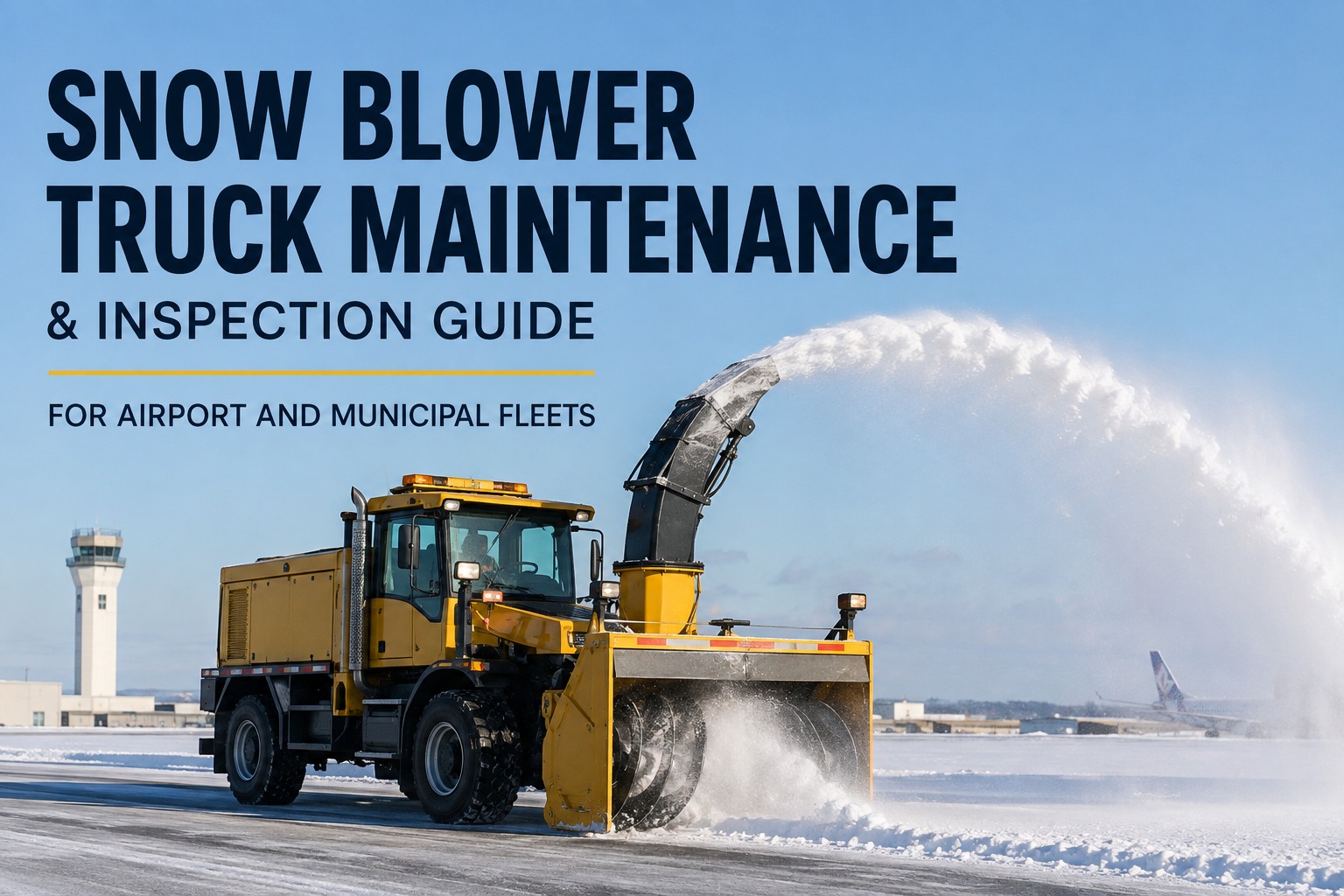
A snow blower truck sits idle for eight months, then in one weekend becomes the single machine between an airport runway and a ground stop — or a municipal arterial and a city that can't move. That flip from dormant to mission-critical is why snow blower truck inspection is a different discipline from ordinary fleet PM. You don't warm up on the job. The first storm is the audit. This guide covers the pre-season readiness ladder, six-zone inspection anatomy, and the storm-cycle protocol. Book a demo
Snow Blower Truck Inspection & Maintenance
A first-storm failure is a public event. This is the readiness system that prevents it.
You know the pattern. The unit passed a walkaround in April, went into the back of the yard, and hasn't turned a wheel since. In November, a mechanic pulls the tarp off and finds a chafed hydraulic line, a chute rotation motor that seized while sitting, and shear pins that were never replaced from last February's ice event. The storm arrives Friday. That's not a maintenance problem — it's a readiness problem. The fix is a system, not a walkaround.
The pre-season readiness ladder
Best-in-class airport and municipal snow fleets don't inspect once. They climb a five-rung ladder starting 90 days before the season's first forecast storm. Each rung compounds on the ones below it. Skip a rung and you're doing the whole ladder inside a 48-hour storm window — which is when failures happen.
-
T−90Deep post-season strip & inspect
Every unit comes out of storage. Full teardown of auger housing, impeller, chute assembly. Corrosion, chafing, cracked welds, and de-icing chemical damage documented per unit. This is your parts-order trigger — long-lead items (auger bearings, chute rotation gearboxes, hydraulic cylinders) need to be on order now, not in November.
-
T−60Drivetrain & hydraulic system rebuild
Auger drive chains re-tensioned or replaced. Hydraulic fluid sampled and analyzed — not just topped off. Hoses inspected under pressure, not visually. PTO couplings, driveshafts, U-joints re-greased. All hydraulic filters replaced regardless of hour meter.
-
T−30Wear-parts pre-stage
Shear pins, cutting edges, skid shoes, auger paddles, chute deflector seals staged in the shop with quantities matched to last season's actual burn rate. If you burned 40 shear pins last February, you have 60 in the bin by October 15.
-
T−14Cold-start & load test
Every unit started from cold, warmed to operating temp, and run through a full hydraulic function test — chute rotation full sweep, auger engagement under load, blower discharge distance tested against a marked target. Any unit that fails goes back to the rebuild queue immediately.
-
T−0Operator walkaround & sign-off
Operator-level inspection: fluids, lights, mirrors, wipers, defrost, cab heater, tire chains staged, radio checked. Digital sign-off attached to the unit's record. Any deferred defect flagged and routed to the standby maintenance shift.
The ladder is boring until you notice what it prevents: no unit ever reaches the storm with an unknown state. When the dispatcher pulls up a unit at 3am, its readiness score is already in the record. That's the whole game. Book a demo to see the ladder as a live dashboard
Where snow blower trucks actually fail
A snow blower is a very simple machine doing a very violent job. Wet snow at 5,000 tons per hour is roughly the same load profile as feeding a wood chipper wet green logs continuously for four hours. Failure clusters in six specific places on nearly every unit — different in root cause but predictable in location. Your snow blower inspection checklist should hit each of these zones before the season starts, and again after every significant event.
Auger & impeller assembly
Bent paddles from ingested runway debris (FOD), cracked welds on the auger flighting, worn shaft bearings, and shear pins that snapped mid-event and were replaced with a wrong-grade pin. Inspection focus: paddle straightness, weld cracks under paint, bearing play at both shaft ends, shear pin part number match to spec.
Hydraulic system
Chafed hoses at articulation points, seal failure on chute rotation cylinders after long dormant storage, contaminated fluid from condensation during off-season, and cold-weather cavitation on undersized suction lines. Inspection focus: hose routing under full articulation, cylinder rod pitting, fluid sample analysis, filter differential-pressure gauge reading.
Chute & deflector
Seized rotation motors, cracked chute housing from ingested ice chunks, worn deflector cables, and frozen mechanisms because deflector seals allowed water intrusion. Inspection focus: full 180-degree rotation under load, deflector movement through full range, seal integrity, ice-guard mounting hardware.
Chain drive & gearbox
Stretched drive chains, worn sprockets, gearbox oil that never got changed between seasons, and mounting bolt fatigue from sustained vibration. Inspection focus: chain deflection under 10 lb pull, sprocket tooth wear against a fresh part, gearbox oil condition and level, mounting bolt torque check.
Cutting edge & skid shoes
Worn-through cutting edges that damage the runway surface, misadjusted skid shoes that dig into pavement, and mounting hardware corroded by de-icing chemical exposure. Inspection focus: cutting edge thickness measured, skid shoe clearance set per pavement type, mounting bolt condition.
Carrier vehicle & PTO
The truck the blower is mounted on — often the forgotten half. PTO engagement issues, cab heater failure (operator safety), defroster failure, tire chain damage from prior season, and lighting that's cracked or dim. Inspection focus: full DVIR-style walkaround on the carrier plus PTO smooth engagement under load.
The pattern is consistent across fleets we work with: 66% of in-storm failures come from the top three zones alone. A pre-season program that hits those three deep — and hits the other three at a walkaround level — catches most of what would otherwise become a 3am dispatch call. Start a free trial to build these six zones into a custom digital inspection form
The three-phase storm-cycle protocol
Once the season starts, inspection is not a monthly PM anymore — it's a cycle wrapped around every event. Airport and municipal fleets running the tightest availability numbers use a three-phase protocol that treats each storm as a discrete inspection event with a defined before, during, and after.
Pre-storm activation
T−24 to T−2 hours- Weather trigger: forecast confirmed within storm response window per the airport's Snow & Ice Control Plan (SICP)
- Fluid top-off: fuel, DEF, hydraulic reservoir, chain oil, gearbox oil
- Cold start & function check — every unit, no exceptions
- Wear-parts pre-position on the truck: spare shear pins, cutting edges, hand tools
- Operator briefing & digital pre-trip DVIR sign-off
During-event monitoring
Active storm hours- Operator radio check every 30 minutes; anomalies flagged real-time
- Shift-change inspection at operator swap: fluids, chain tension, chute function
- Fueling & wear-parts refresh built into every shift change
- Standby maintenance shift on-call — not on-site rotating
- Digital fault log kept per unit for post-event review
Post-storm reset
T+0 to T+48 hours- Full wash-down — de-icing chemical is corrosive if left on
- Post-event inspection: all six failure zones re-walked
- Work orders opened for every deferred defect before the next forecast
- Wear-part burn rate logged — feeds next event's pre-position
- Unit returned to "ready" state or moved to standby maintenance queue
The three phases feed each other. Post-storm data drives the next pre-storm briefing. That feedback loop is impossible on paper — the forms get lost, the spare parts burn rate never makes it into next month's order, the deferred defect list quietly grows until it becomes a mid-event failure. Digitizing the loop is where the reliability actually comes from. See the three-phase workflow inside HVI
FAA & municipal compliance context
For airport operators, this isn't optional discipline — it's regulated. FAA Advisory Circular 150/5220-20A (Airport Snow and Ice Control Equipment) sets procurement and readiness expectations. AC 150/5200-30D (Airport Winter Safety and Operations) requires that equipment be inspected after each use to determine whether additional maintenance is needed, and that snow & ice control equipment be stored in a facility maintaining at least 50°F to prolong service life and enable rapid response. 14 CFR Part 139.313 requires certificated airports to maintain a written Snow and Ice Control Plan.
For municipal fleets, the compliance layer is different but the operational stakes are similar: DOT reporting on winter arterial availability, insurance carriers asking about documented PM programs after any incident, and OSHA-driven safety documentation for cold-weather operator work. Every one of these audits is a documentation audit — the inspection either happened and is on record, or it didn't. Paper forms are the weakest link. Book a demo to see the audit-trail view , or start free and build audit-ready records from day one.
From a maintenance supervisor who lived the paper version
We ran 14 rotary blowers and 22 plow trucks on paper for years. Every October the same fire drill — boxes of last winter's inspection sheets, half of them water-damaged, half missing operator signatures. When the FAA asked for records after an incident review, we spent two weeks reconstructing paperwork we should have had in an afternoon.
Moving to a digital DVIR and PM tracker changed one specific thing: every unit's readiness state is now a number, not a guess. Our dispatcher pulls up the yard board at 4am and knows which units are ready, which are in PM, which have a deferred defect. First-storm surprises dropped to nearly zero last season.
Frequently asked questions
How often should a snow blower truck be inspected during the winter season?
Best practice for airport and municipal snow fleets is a three-tier inspection cadence during the active season. First, a pre-trip DVIR-style walkaround by the operator before every dispatch — fluids, lights, chute function, tire chains, cab systems, spare parts on board. Second, a shift-change inspection at every operator swap during an active event, covering hydraulic fluid, drive chain tension, chute rotation, and any faults logged during the prior shift. Third, a full post-event inspection within 48 hours of any significant snow event, covering all six primary failure zones (auger/impeller, hydraulics, chute assembly, chain drive/gearbox, cutting edge/skid shoes, and the carrier vehicle). In addition, a scheduled preventive maintenance service every 100–200 operating hours per manufacturer specifications applies year-round. FAA AC 150/5200-30D specifically directs that equipment be inspected after each use to determine whether additional maintenance or repair is necessary — this "after each use" cadence is the bar for certificated airports and a strong reference standard for municipal operations as well.
What are the most common snow blower truck failure points?
Across airport and municipal snow fleets, failures cluster in six zones. The auger and impeller assembly is the most frequent point of failure — bent paddles from ingested foreign object debris, cracked welds on auger flighting, worn shaft bearings, and shear pins that snapped and were replaced with wrong-grade substitutes. The hydraulic system is second: chafed hoses at articulation points, seal failure on chute rotation cylinders after long dormant storage, contaminated fluid from off-season condensation, and cold-weather cavitation. Third is the chute and deflector assembly — seized rotation motors, cracked chute housing from ingested ice chunks, and frozen mechanisms from water intrusion past worn seals. The remaining three zones (chain drive and gearbox, cutting edge and skid shoes, and the carrier vehicle including PTO) account for the balance. Roughly two-thirds of in-storm failures trace back to just the top three zones, which is why a pre-season inspection program that goes deep on those three catches most of what would otherwise become a mid-event dispatch call at 3am.
What FAA regulations apply to airport snow removal equipment?
Three FAA references matter most for airport snow blower and snow removal equipment operations. FAA Advisory Circular 150/5220-20A (Airport Snow and Ice Control Equipment) sets procurement standards, equipment classifications (rotary plows, displacement plows, sweepers, material spreaders, carrier vehicles), and readiness expectations for federally-funded snow equipment. AC 150/5200-30D (Airport Winter Safety and Operations) covers operational procedures, requires equipment inspection after each use, and recommends storage buildings maintain at least 50°F to prolong service life and enable rapid response. 14 CFR Part 139.313 requires Part 139 certificated airports to prepare, maintain, and carry out a written Snow and Ice Control Plan (SICP) as part of their airport certification manual. AC 150/5220-18A covers building specifications for storage and maintenance of snow equipment. The use of AC 150/5220-20A is mandatory for equipment purchased with federal grant monies through the Airport Improvement Program (AIP) or Passenger Facility Charge (PFC) program. Municipal operations don't fall under FAA rules but often reference these ACs as industry best practice.
Can a CMMS help manage snow removal fleet maintenance?
Yes — and for seasonal, high-consequence equipment like snow blowers it's arguably more valuable than for year-round assets, because paper systems fail the loudest when the equipment sits dormant for eight months and then goes into critical service. A CMMS like HVI handles the specific workflows snow fleets need: digital pre-trip and post-trip DVIR forms customized per unit type (rotary blower, plow truck, sweeper, material spreader), preventive maintenance scheduling by operating hours or calendar date, one-click work orders generated automatically from failed inspection items, parts and inventory tracking so wear-part burn rates from last season inform this season's purchasing, fuel log tracking, safety incident reporting, and audit-ready documentation with timestamps and digital signatures. For airport operators, the audit trail specifically addresses the AC 150/5200-30D requirement that equipment be inspected after each use — every inspection is on record with the operator's signature and any deferred defects routed into a live work order queue. For municipal fleets, the same documentation supports insurance carrier reviews and any DOT winter operations reporting required at the state or local level.
What should be on a pre-season snow blower inspection checklist?
A defensible pre-season snow blower inspection checklist walks the full six-zone anatomy of the machine plus the carrier vehicle. Auger and impeller: paddle straightness, weld crack inspection under paint, shaft bearing play, shear pin part number verification against spec, auger housing integrity. Hydraulic system: hose routing checked under full articulation, cylinder rod condition, fluid sample analysis (not just visual inspection), filter differential pressure, reservoir condition. Chute assembly: full 180-degree rotation test under load, deflector movement through full range, seal integrity, ice-guard mounting, rotation motor function. Chain drive and gearbox: chain deflection measurement, sprocket tooth wear comparison to a fresh reference part, gearbox oil condition and level, mounting bolt torque check. Cutting edge and skid shoes: cutting edge thickness measurement, skid shoe clearance set per pavement type, mounting hardware condition. Carrier vehicle: full DVIR walkaround including fluids, lights, mirrors, wipers, defrost, cab heater (operator safety), tire condition, chains staged, PTO smooth engagement under load, radio, warning lights. Every item should be captured digitally with a pass/fail state and any fail auto-routed to a work order before the season starts.
Your first storm shouldn't be your first inspection
Every hour a rotary blower or plow truck spends broken during an event is a runway closed, an arterial impassable, or a public event you didn't want. HVI turns paper snow-fleet inspections into a live readiness system — pre-season ladder, in-season three-phase cycle, and audit-ready records for FAA, DOT, insurance, and post-event review. Live in under two weeks. Ready before the season is.
No credit card · No hardware · Setup in minutes