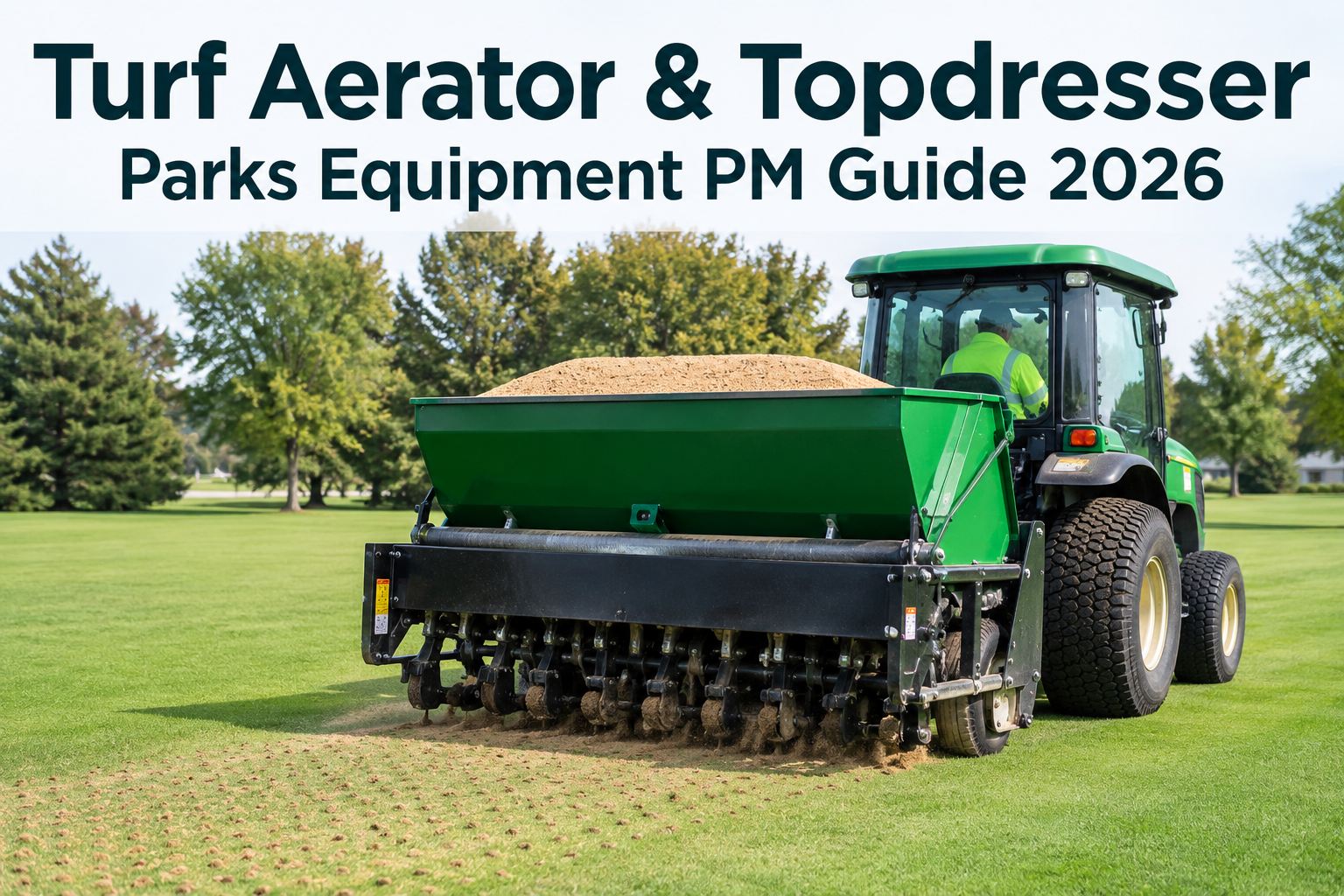
Your turf aerator maintenance problem is not that the machines break. It is that they sit in a dark corner of the parks depot for eight months, then get dragged out in March and run flat out for six weeks straight. That is when the Ryan Lawnaire IV throws a chain at 6am on the first sports field of the season, the Toro ProCore 648 solenoid sticks halfway through the golf greens, and the JRCO topdresser conveyor bearing seizes with a full hopper of sand. Every one of those failures was visible in October. None of them were written down. This guide gives you the exact off-season preventive maintenance schedule for aerators, topdressers and seeders, the hour intervals that actually matter, and how parks and municipal fleets are using a 30-minute walkthrough of seasonal PM triggers to make sure spring never starts with a breakdown again.
Parks & Municipal Turf Fleet PM Guide
What if your aerator fleet passed every spring start-up without a single work order?
Turf equipment has the strangest duty cycle in any fleet: long idle months, then a brutal short season. Off-season PM is the only window you get. Here is the schedule, the intervals and the system that catches bearings, chains and solenoids before the maintenance blitz.
The Real Cost Of Seasonal Neglect
Why turf aerator maintenance fails in parks fleets
Four numbers explain why a $40 bearing turns into a lost week of spring scheduling.
The Seasonal Problem
The off-season storage trap for topdresser parks equipment
Idle machines do not stay frozen in time. They quietly get worse.
What storage does to the machine
- Bearing grease separates and hardens, so the first spring run is on dry metal.
- Drive chains develop stiff, rusted links that stretch and jump sprockets.
- Solenoid and electrical contacts corrode, causing intermittent no-fire faults.
- Conveyor belts take a set and crack at the fold points.
- Fuel left in the tank gums carburettors and injectors over winter.
What a 2-hour off-season PM prevents
- Fresh grease in every bearing before storage, not after the failure.
- Chains cleaned, tensioned and lubricated so spring start-up is clean.
- Solenoids tested and contacts cleaned while there is no time pressure.
- Belts inspected and tensioned with photos logged for the record.
- Fuel stabilised or drained so the engine fires first pull in March.
Machine-By-Machine Schedule
Aerator, topdresser and seeder PM intervals that matter
These are the intervals working parks fleets build their seasonal PM around. Log every one against engine hours, not the calendar.
| Machine | Component | Interval | What happens if you skip it |
|---|---|---|---|
| Ryan Lawnaire IV aerator | Tines | Every 40 hrs | Worn tines tear instead of core, turf damage, rework |
| Ryan Lawnaire IV aerator | Drive chain | Every 25 hrs | Chain stretch, snap under load, machine down mid-job |
| Toro ProCore 648 | Coring head solenoid | Annually | Head will not fire, greens crew standing idle |
| JRCO topdresser | Conveyor bearing | Every 100 hrs | Bearing seizes, belt burns, load dumped on the field |
| Topdresser / spreader | Conveyor belt & tension | Pre-season | Cracked belt fails under a full hopper of sand |
| Overseeder / slicer | Blades & seed metering | Pre-season | Uneven seed rate, bare patches, wasted seed |
The pattern is always the same: the failure is cheap and the downtime is expensive. A set of aerator tines costs very little. A sports field that has to be closed and re-done because the turf was torn costs a crew day, a rescheduled contractor and a complaint to the parks director. If you want to see how these intervals look as automatic due and overdue alerts, you can book a demo and walk through it on your own units.
The Off-Season Workflow
How to run a turf fleet winterisation and spring start-up
Six steps, done once a year, that remove almost every spring breakdown.
End-of-season inspection, before storage
As each aerator, topdresser and seeder comes off its last job, run a full digital inspection with photos. Capture tine wear, chain condition, bearing play, belt cracks and any leaks while it is still warm and dirty, because that is when faults show.
Turn defects into work orders immediately
Every defect flagged in the inspection becomes a work order the same day. No paper note that gets lost in a drawer for five months. Parts are ordered in the off-season when there is no rush and no premium freight.
Service, grease and repair in the quiet months
Do the bearing repacks, chain replacements, tine changes and solenoid tests between November and February. This is the only window where the machine being down costs you nothing.
Stabilise fuel and protect electrics
Drain or stabilise fuel, disconnect batteries, clean electrical contacts and cover the machines. Corrosion and gummed fuel systems are the two most common no-start causes in spring.
Pre-season start-up inspection
Two to three weeks before the first scheduled job, run a start-up inspection on every unit. Fire the engine, cycle the coring head, run the conveyor, and confirm every off-season work order is closed with a photo.
Track hours in season, trigger PM automatically
Once the season starts, log engine hours so the 25, 40 and 100-hour intervals fire as due alerts instead of being guessed. This is where most paper systems fall apart, and where a CMMS earns its keep.
You can set this exact loop up in HVI in an afternoon and start logging inspections free on the phones your crew already carries.
See your whole turf fleet's PM status on one screen
Book a 30-minute demo and we will load one of your aerators or topdressers into HVI live, with its real PM intervals and seasonal triggers.
How HVI Helps
How HVI keeps parks turf equipment ready
Four capabilities built for exactly this seasonal, mixed-fleet problem.
Seasonal fire triggers
Set PM schedules by date, engine hours or season. HVI fires the winterisation inspection when the season ends and the start-up inspection before the first spring job, so nothing relies on someone remembering.
Photo-backed digital inspections
Crews inspect on any phone, capture tine wear, chain condition and belt cracks with photos, and every record is timestamped and audit-ready. No paper binders, no text-message photos that vanish.
Defect-to-work-order in one tap
A flagged bearing or stretched chain becomes a work order instantly, with parts attached. Off-season repairs get done in the quiet months instead of being rediscovered in March.
One platform for the whole mixed fleet
Aerators, topdressers, mowers, trucks, trailers and loaders all live in the same system. You see cost per asset, uptime and overdue PM across the entire parks fleet, not in five separate spreadsheets.
If you manage a municipal or sports field fleet and want to see this on your own equipment, book a demo and bring your toughest unit.
A Worked Example
What one seized topdresser bearing really costs
A small, real-world bit of maths that parks managers recognise immediately.
One seized JRCO conveyor bearing easily clears $500 and a lost day. The 100-hour grease that prevents it takes ten minutes. Across a fleet of six topdressers and aerators, skipping off-season PM is routinely a $3,000 to $5,000 spring, every spring.
Key takeaways for your turf fleet
- Turf aerator maintenance is a seasonal problem. The failures happen in spring but the causes happen in storage.
- Track the real intervals: 40-hour tines, 25-hour chains, 100-hour conveyor bearings, annual solenoids.
- Do the work in the off-season when downtime is free, not in March when it is expensive.
- Use a CMMS with seasonal triggers so the schedule runs itself and every inspection is photo-backed and audit-ready.
You can sign up free and build your first turf PM schedule today, or book a demo to see the seasonal triggers in action.
"Every March used to start the same way. Two aerators down, a topdresser with a cooked bearing, and me on the phone begging for parts. Now I do one inspection round in November, the work orders write themselves, and spring is boring. Boring is exactly what I want. I track one number: zero breakdowns in the first two weeks. We have hit it three years running."
— Mark Delaney, Fleet & Maintenance Manager, municipal parks and recreation department
Common Questions
Turf aerator & topdresser PM FAQs
How often should you replace aerator tines?
What is the most common spring failure on a topdresser?
Should turf equipment PM be tracked by hours or by calendar?
How do I stop spring no-start problems on parked equipment?
Can one system manage aerators, mowers, trucks and trailers together?
Make this the last spring you start with a breakdown
Put your aerators, topdressers and seeders on seasonal PM triggers and see every due and overdue item on one screen.
Free to start · Works on any phone · No card needed