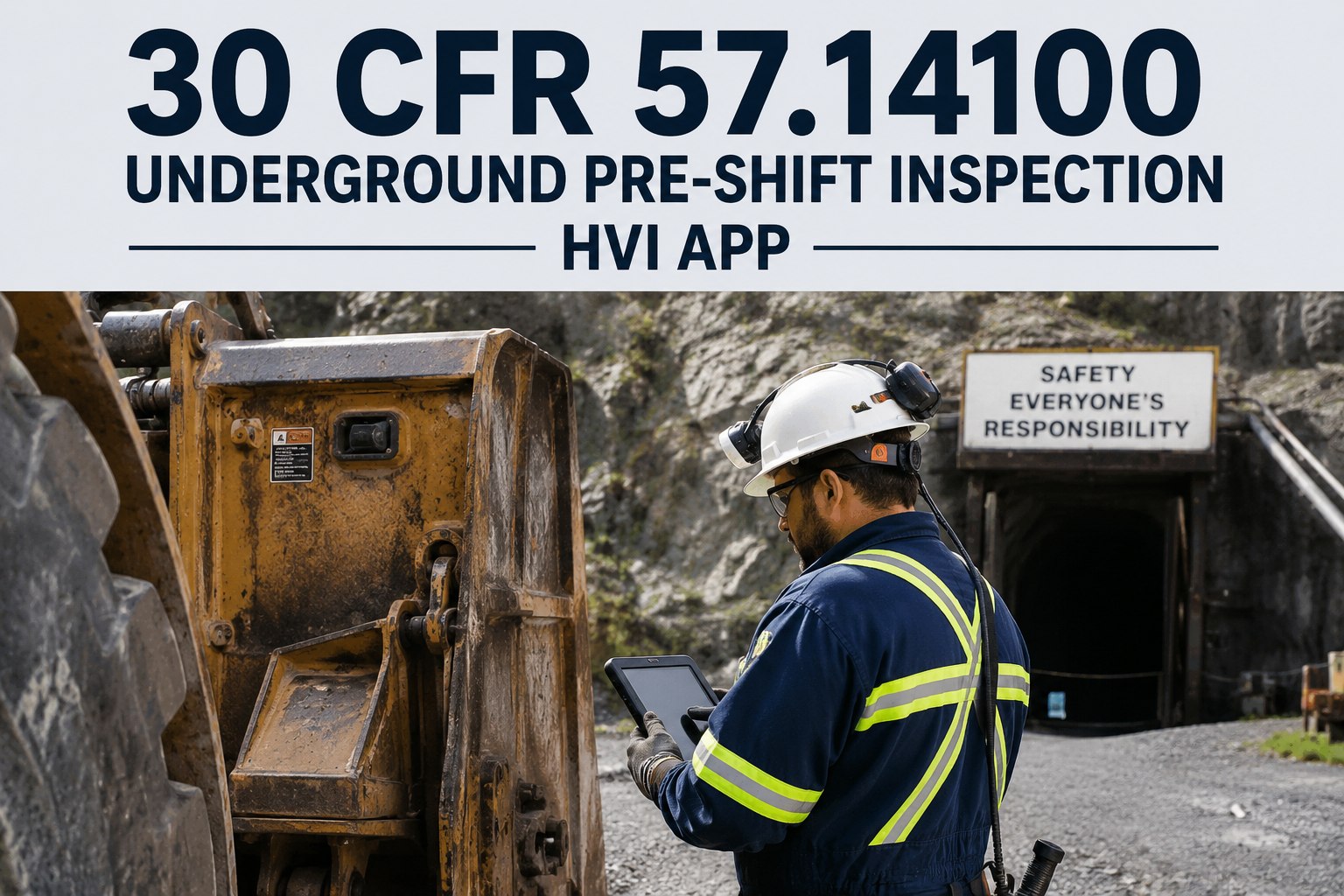
When the shaft cage drops you three levels down at 5:40 a.m., the last thing on your mind is MSHA's citation history on 30 CFR 57.14100 — until the inspector pulls up at the portal and asks for the last sixty days of underground equipment inspection records. That is the moment a clipboard full of smudged checkboxes turns into a liability. The underground pre-shift inspection rule mirrors the surface standard in language, but the conditions where it has to be applied — zero signal, wet cab paper, four MSHA visits a year instead of two — make documentation structurally harder. If you are the maintenance or safety manager carrying that risk, you can see how HVI handles 57.14100 on your own units or read on for the practical breakdown.
Underground inspections run on paper because the signal does not reach the face — and MSHA knows it
Four mandatory inspections a year. Zero bars at the working face. One clipboard between you and a citation. The rule is not the problem — the documentation gap is.
What 57.14100 actually requires of underground self-propelled mobile equipment
The rule is deceptively short: before a piece of self-propelled mobile equipment goes into service underground, a competent person must inspect it for defects that affect safety. Any defect found must be reported, and the equipment must be tagged out and not used until the defect is corrected. The language parallels the surface pre-shift standard — but the underground environment changes how you prove it was done.
Competent-person inspection before use
Every shift, every piece of self-propelled mobile equipment — scoop trams, LHD loaders, jumbo drills, bolters, utility trucks, scissor lifts — must be inspected by a competent person before it goes into service. Not "periodically." Not "when time allows." Before use, every shift.
Defect reporting and written record
Defects affecting safety must be reported. The record needs to show what was found, when, on which asset, by whom, and what was done about it. A verbal heads-up to the shifter does not satisfy the standard — MSHA asks for the paper.
Tag-out until corrected
If a defect is found, the equipment is tagged out of service. No "we will fix it after this one muck cycle." The tag stays on until the defect is corrected and the equipment is signed back in — and the return-to-service needs a name and a timestamp.
Records available for inspection
Inspection records must be retained and made available to MSHA on request. With four regular inspections a year underground — double the surface frequency — a twelve-month gap in your records is not a clerical problem. It is a citation pattern.
Why underground equipment inspection documentation fails where surface does not
The rule reads the same. The jobsite does not. Three structural conditions underground make the paper binder — and most "digital" apps — fail when an MSHA inspector is standing at the portal asking for yesterday's LHD inspection.
Zero connectivity at the face
Most cloud inspection apps assume a data connection. Underground, there is none — not at the working face, not in the haul drift, not in the remuck bay. A tablet that shows a spinner when the operator taps "Submit" gets put back in the rig and the paper form comes out. Genuine offline-first capture — fill, sign, photograph, store locally — is the only digital model that survives a shift underground. When you walk through HVI's offline mode on your own equipment, the sync-to-surface step is the part worth watching.
Double the inspection frequency
MSHA conducts regular inspections of underground metal and nonmetal mines four times a year — compared with twice a year for surface operations. That doubles the documentation surface area. A missing week is not one gap; across four inspection cycles it is a pattern the inspector has seen before and will cite.
Hazards surface fleets do not carry
Underground equipment operates under ventilation dependence, fire-suppression requirements, and escape-way constraints that surface trucks never face. A pre-shift inspection underground is not just "brakes, tires, lights" — it is onboard fire-suppression system charge, scrubber condition on diesel units, and clearance along the designated escape route. Miss those line items and the inspection form is incomplete even if every checkbox is ticked.
The real cost of paper-based underground pre-shift inspections
Paper is not free. It is just slow to bill you. The cost shows up in three places: the labor to transcribe shift forms into the compliance binder, the MSHA citation when a form is missing or illegible, and the unplanned downtime when a defect that was "noted" on paper never made it to a work order. If you want a side-by-side before you look at the HVI platform on a call, these are the numbers that tend to move the conversation.
A 12-piece underground fleet running two production shifts. At a conservative 4 minutes per form to transcribe, file, and later retrieve during an MSHA visit, that is 96 minutes of clerical time per shift — roughly 1,152 hours per year of skilled labor spent moving checkboxes from paper to binder. At a loaded shop rate of $55/hour, the paper process costs over $63,000 a year before a single citation or breakdown is counted. That is the floor — the cost of doing it the slow way. A single 57.14100 citation for inadequate records adds hundreds to thousands per occurrence, and the unplanned breakdown from a defect that never became a work order costs far more in lost production.
Underground mobile equipment and inspection concerns covered by 57.14100
"Self-propelled mobile equipment" is a broad category underground. The inspection template you use has to cover the full class — not just the haul trucks — plus the underground-specific systems that a surface DVIR does not address. If you are moving off a generic checklist, the template structure is something you can review with HVI on a short call before rollout.
Equipment classes under the rule
- LHD (load-haul-dump) loaders and scoop trams
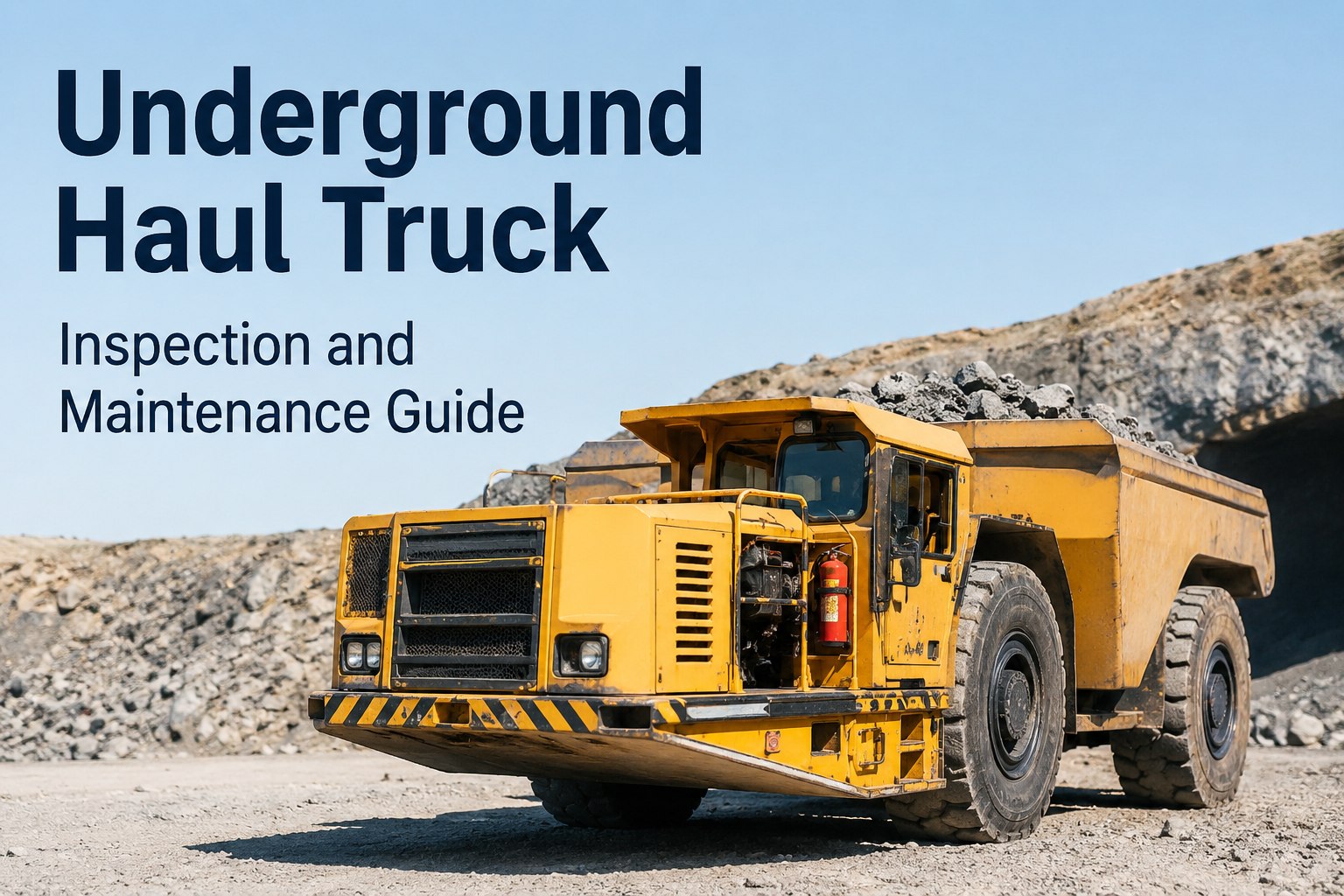
- Underground haul trucks and articulated dumpers
- Jumbo drills and bolting rigs
- Scissor lifts and utility vehicles
- Anfo loaders and charging trucks
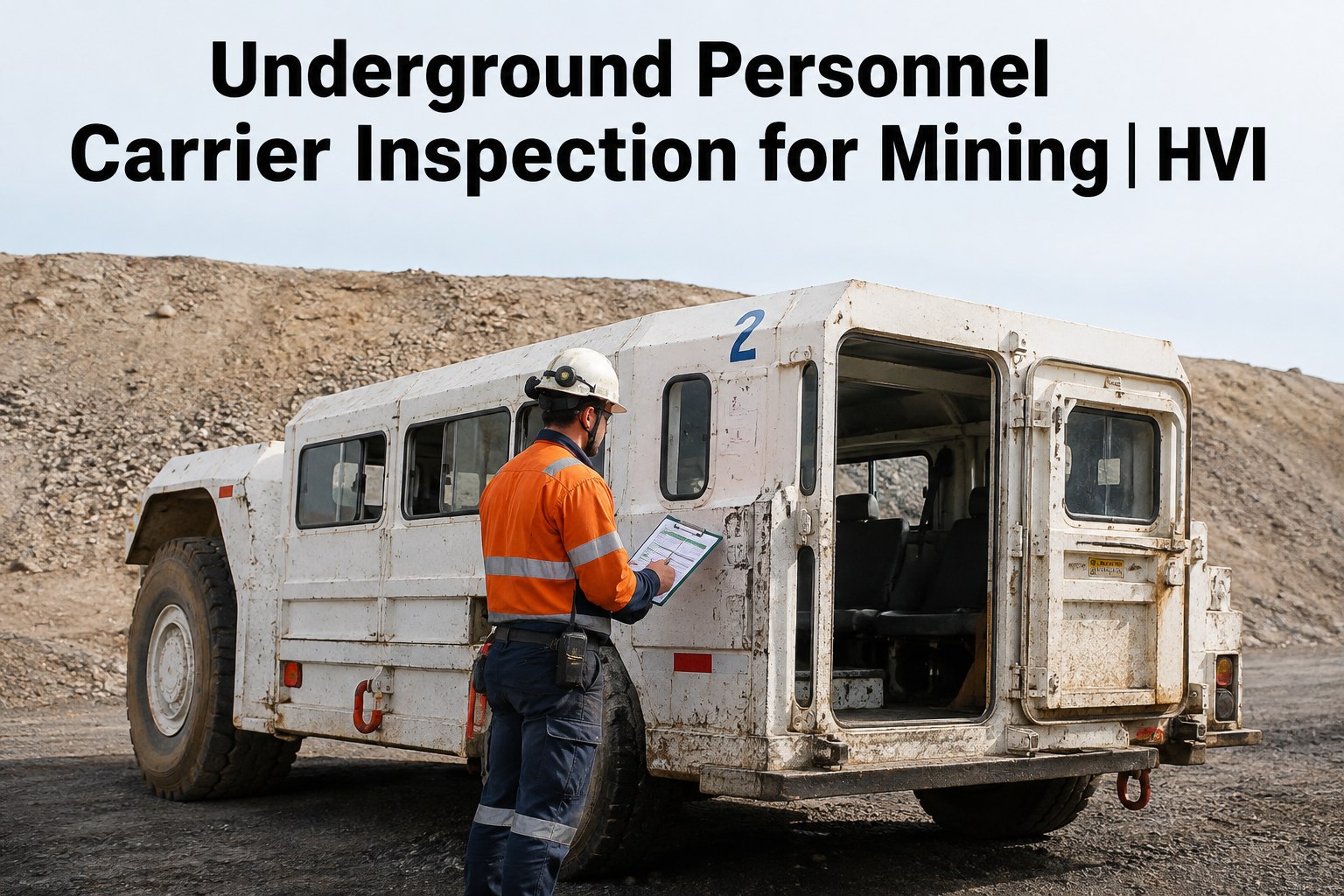
- Personnel carriers and scissor trucks
Inspection concerns beyond surface DVIR
- Onboard fire-suppression system charge and cylinder gauge
- Diesel exhaust scrubber / DPM condition on permitted units
- Ventilation tubing and airflow at the equipment station
- Escape-way clearance and route marking along the travelway
- Ground support condition at the working face and muck bay
- Emergency stop, beacon light, and audible alarm function
Paper binder vs. offline-first digital inspection underground
Most "digital inspection" marketing shows a driver tapping a phone in a sunny truck-stop parking lot. That is a surface use case. Underground, the question is whether the app works with zero signal, stores the record on the device, and syncs the moment the operator surfaces. If it cannot do all three, it is worse than paper because it gives a false sense of compliance.
| Documentation task | Paper binder | Offline-first app (HVI) |
|---|---|---|
| Capture inspection at the face | Pen on wet paper, illegible entries common | Tap, photo, signature on device — no signal needed |
| Defect-to-work-order flow | Form sits in shifter's pocket, defect remembered verbally | Defect flagged on submit, work order auto-created on sync |
| Tag-out and return-to-service record | Cardboard tag, manual log entry, often back-dated | Digital tag with timestamp, sign-off name, and corrective note |
| MSHA audit retrieval | Flip through 60 days of binders, hope the page is there | One-click audit export filtered by date, asset, or inspector |
| Photo evidence of defect | None, or a phone photo in a group chat that gets deleted | Geotagged, timestamped photo attached to the inspection record |
| Inspector identity and signature | Scrawled initials, sometimes missing | Captured signature and user ID, tamper-evident |
See HVI capture a 57.14100 inspection offline — book a 30-minute demo
We will run the underground equipment template on your own asset list, show the offline capture and sync-on-surface flow, and export a sample audit pack on the call.
How HVI maps to 30 CFR 57.14100 underground requirements
HVI was built for the signal-dead zone. Every capability below exists because a fleet or safety manager needed to prove an inspection happened — with photo, signature, and timestamp — in a place where no cloud connection reaches.
Full offline capture with photos and signatures
Inspectors complete the full 57.14100 template on a phone or tablet at the face — checkboxes, defect notes, photographs, and a captured signature — with zero signal. The record is locked on the device with a timestamp and syncs the moment the operator returns to surface. Nothing is lost, nothing is back-dated, and nothing depends on a Wi-Fi network that does not exist three levels down. You can start logging inspections free and test the offline flow on your next shift.
Underground equipment templates
Pre-built inspection templates cover LHD loaders, scoop trams, jumbo drills, bolters, haul trucks, and utility vehicles — each with the underground-specific line items surface DVIRs miss: fire-suppression charge, scrubber condition, escape-way clearance, beacon and alarm function. Templates are editable, so when your mine's ground-control plan adds a requirement, the form changes in minutes, not at the next print run.
Sync on surfacing, defect-to-work-order
When the device reconnects at the portal or in the dry, completed inspections upload and any flagged defect automatically generates a work order in the CMMS — no re-entry, no "I'll tell the mechanic when I see him." The work order carries the photo, the asset ID, the inspector's name, and the timestamp from the moment the defect was found.
One-click audit export
When MSHA arrives, you do not dig through binders. Filter by date range, asset, or inspector and export a complete, photo-backed, timestamped audit pack in seconds. Every inspection, every defect, every tag-out and return-to-service — in one file. If you want to see the audit export format on your own data, we can run it live on a demo call.
From inspection at the face to MSHA-ready record: the 57.14100 documentation chain
A defensible 57.14100 record is a chain, not a form. If any link is missing — the inspector identity, the timestamp, the defect photo, the tag-out, the corrective action — the record is incomplete and MSHA can cite the gap. Here is what each link looks like in HVI versus on paper.
Inspection initiated at the face
Operator opens the HVI app on device, selects the asset and shift template. No signal required — the form loads from local storage. On paper, this is the clipboard pulled off the hook in the cab.
Defects documented with photo and note
Defect line items trigger a photo prompt and free-text description. The photo is embedded in the record with timestamp — not a separate file in a group chat. On paper, a checkbox and a scrawled note that may or may not reach the surface.
Signature captured on device
Inspector signs on screen. The signature, user ID, and timestamp are bound to the record. On paper, initials in a box — often missing or illegible after a wet shift.
Tag-out applied, equipment held
If a safety defect is flagged, a digital tag-out is generated with the defect reference. The equipment is held out of service in the system. On paper, a cardboard tag and the honor system.
Sync on surfacing, work order auto-created
Device reconnects at the portal. Inspection uploads; flagged defect becomes a work order with photo, asset, and priority. On paper, the form sits in a pocket until the shifter remembers to hand it in.
Corrective action recorded, return-to-service signed
Mechanic completes the repair, closes the work order, and signs the return-to-service on the same record. The full chain — inspect, flag, tag, repair, return — is one auditable thread. On paper, it is three different logs that may never be reconciled.
30 CFR 57.14100 compliance: what matters and what to fix
The underground pre-shift inspection rule is not harder than the surface version because the language is different — it is harder because the environment makes documentation harder and MSHA checks twice as often. The fix is not more paperwork; it is a documentation tool that works where the signal does not.
The rule mirrors surface — competent-person inspection, defect reporting, tag-out, records retained. The legal bar is the same; the operational bar is higher.
Four MSHA visits a year means missing records are found faster and cited more often. A documentation gap underground is twice as likely to surface during an inspection.
Offline-first is non-negotiable. Any inspection app that needs a signal to submit will be abandoned by shift three. The record must capture, store, and sync — in that order.
The audit pack is the deliverable. When MSHA asks, the question is not whether you inspected — it is whether you can prove it, with photos, signatures, and timestamps, in the next five minutes.
Always verify current MSHA guidance and your mine's approved ground-control and ventilation plans. The summary above reflects the structure of 30 CFR 57.14100; specific application depends on your operation and the inspector's interpretation. Book a walkthrough if you want to map HVI to your site's specific compliance requirements.
"We ran paper DVIRs underground for nine years because every app we tried died the second you went past the portal. The inspector would show up and I'd spend half a day pulling binders. What changed it was an app that actually works offline — the operator fills it at the face, it syncs when they surface, and when MSHA comes I export the whole month in one file. That is the only feature that mattered to me. Everything else is a bonus."
30 CFR 57.14100 underground inspection — common questions
What does 30 CFR 57.14100 require for underground mobile equipment?
It requires that all self-propelled mobile equipment underground be inspected by a competent person for defects affecting safety before being placed into service. Defects must be reported, the equipment tagged out and not used until corrected, and a written record of the inspection retained. The rule applies across all underground metal and nonmetal operations and covers LHD loaders, haul trucks, drills, bolters, and utility vehicles. See how HVI structures the template for these equipment classes.
How often does MSHA inspect underground mines under this standard?
MSHA conducts regular inspections of underground metal and nonmetal mines four times per year — double the twice-yearly frequency for surface operations. This higher frequency means documentation gaps are discovered and cited more often. Keeping 365 days of inspection records photo-backed, timestamped, and exportable on demand is the practical defense. You can start building that record free with HVI.
Can digital inspection apps work underground with no cell signal?
Only if they are genuinely offline-first. The app must load templates, capture entries, take photos, collect signatures, and store the completed record on the device — all without a data connection. The record syncs to the cloud when the device returns to a connected area. HVI is built on this model: full offline capture with sync-on-surface, so the operator never sees a loading spinner at the working face.
What is the difference between 57.14100 and the surface pre-shift inspection rule?
The core requirements — competent-person inspection, defect reporting, tag-out, and written records — are structurally similar. The differences are operational: underground equipment operates under ventilation dependence, fire-suppression requirements, and escape-way constraints that surface equipment does not. MSHA also inspects underground mines four times a year versus twice for surface, which doubles the documentation burden and the frequency at which records are reviewed.
What records does MSHA expect to see during an underground inspection?
MSHA expects to see inspection records showing the date, the equipment inspected, the inspector's identity, any defects found, the tag-out action taken, and the corrective action with return-to-service sign-off. Records should be legible, retained, and retrievable — not stuffed in a binder with missing pages. Photo evidence of defects and a timestamped signature strengthen the record significantly when the inspector reviews it.
Stop defending paper inspection records to MSHA — move to HVI
Offline capture at the face. Auto work orders on sync. One-click audit export. See it run on your underground fleet in 30 minutes.
Free to start — Works on any phone — No card needed