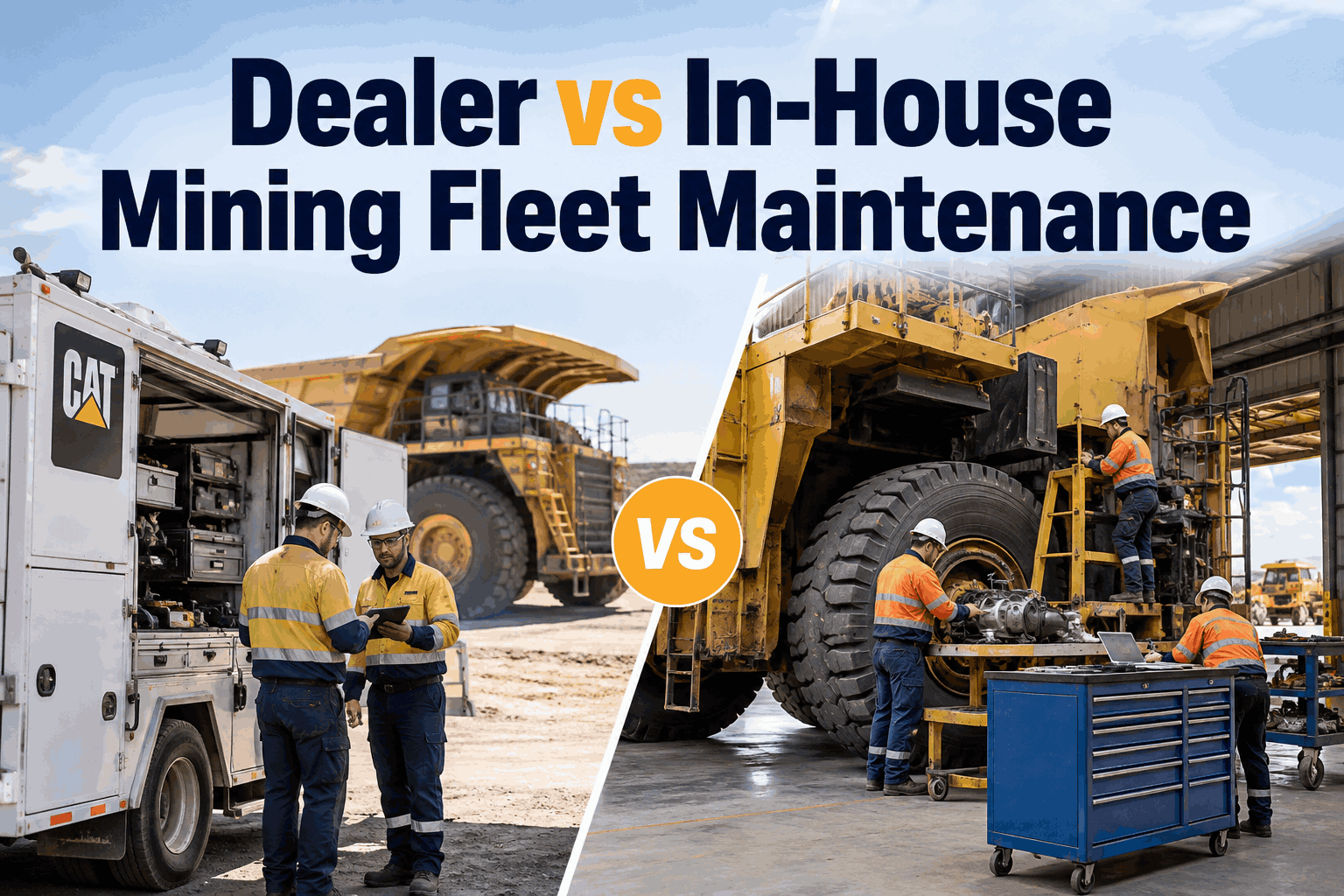
Dealer vs in house maintenance is rarely a mine-wide yes-or-no decision. Routine preventive maintenance may fit an internal workshop, while specialized diagnostics, major component rebuilds or jobs requiring OEM tooling may favor dealer support. The better decision is made job by job using actual labor, parts, tooling, downtime, capability,and maintenance-cost history.
Dealer or In-House? Compare the Cost Behind the Repair Invoice
A lower labor rate does not automatically mean a lower maintenance cost. Compare who can complete the job, how long the machine will be unavailable, what resources are required and what similar work has actually cost your fleet.
People, workshop bays, tooling, parts and current workload.
Specialist expertise, tooling, technical support and rebuild capacity.
Mining maintenance sourcing works best as a flexible strategy. A mine may perform routine work internally, use dealer support for advanced diagnostics or major rebuilds, and shift additional work outside when workshop capacity becomes constrained. The goal is to place each maintenance job where it can be completed reliably at the best overall operational outcome.
Dealer vs In House Maintenance Should Be Decided by Work Type
A mine may have an experienced maintenance workforce and still choose dealer support for selected jobs. Likewise, using a dealer for major rebuilds does not mean routine inspections, lubrication and planned services need to leave the mine workshop. Different maintenance work demands different levels of expertise, tooling and capacity.
Repeatable work may suit the mine workshop when trained people, parts and tools are already available.
Compare technician capability, current workshop demand, parts availability and expected repair duration.
Complex systems may require diagnostic equipment, software or specialist experience that is not held on site.
Rebuild facilities, test equipment, technical standards and turnaround requirements become major considerations.
Looking at previous maintenance events makes this decision less subjective. Instead of relying only on assumptions about internal or dealer performance, managers can review how similar work was completed previously. See how HVI keeps internal and dealer maintenance history together for easier comparison.
Run Mining Maintenance Decisions Through Five Practical Gates
Price should not be the first filter. Before comparing quotations or internal labor estimates, determine whether each option has the capability and capacity to complete the work within the required operating window.
Review technician skills, technical procedures, diagnostics, tooling and testing requirements.
Check bay loading, technician availability, planned services and existing corrective work.
Consider diagnosis, parts lead time, mobilization, repair, testing and return-to-service time.
Include labor, parts, consumables, transport, tooling, external charges and other attributable costs.
Consider technical complexity, repeat repairs, support arrangements and operational consequence.
A workshop may have technicians capable of completing a repair but still lack the available bay space or labor hours to perform it when production needs the machine back. Both questions belong in the sourcing decision.
Open work orders and upcoming preventive maintenance provide useful context when deciding whether more work should stay inside the workshop. HVI's maintenance management workflows help teams see active maintenance demand alongside equipment history. See how HVI can bring workshop workload and asset history into maintenance sourcing decisions.
Mining Maintenance Costs Extend Beyond Labor and Parts
A dealer invoice is highly visible because it arrives as a direct external cost. Internal maintenance can appear cheaper because technician labor, workshop resources, stocked parts, tooling and delays may sit across different budgets. A fair comparison needs the same cost lens on both sides.
Internal labor hours or dealer and contractor service charges.
Replacement parts, components, fluids and consumables required for the job.
Tooling, diagnostics, workshop equipment, transport and mobilization requirements.
Elapsed time from maintenance demand through repair, testing and return to service.
Repeat faults, follow-up repairs and additional maintenance after the original job.
Downtime can materially change the decision. An internal team may respond quickly when technicians and parts are available on site. Dealer support may offer specialist troubleshooting, technical resources or rebuild capability that shortens a difficult repair. The useful comparison is the actual performance available for that job and site—not a universal assumption that one model is always faster.
Consistent work-order records make this comparison much stronger over time. See how HVI can connect maintenance costs, work history and downtime information for better make-or-buy analysis.
A Hybrid Mining Fleet Maintenance Model Can Protect Workshop Capacity
The strongest maintenance strategy may sit between full outsourcing and doing everything internally. A mine can deliberately retain work that builds useful internal capability while using dealers or specialist providers where expertise, rebuild infrastructure or temporary capacity would be expensive to reproduce.
Frequent work that benefits from being close to daily operations.
Planned work where technicians, tools and parts are already established.
Repeatable corrective work supported by internal experience and resources.
Work can move between strategies as workshop demand, expertise, urgency and equipment risk change.
Useful where the site lacks the required diagnostic expertise or equipment.
Specialist facilities, testing capability and component expertise may add value.
External resources can absorb work when internal maintenance demand peaks.
Keep work in-house because the mine has the capability and capacity to perform it effectively—not simply because it has always been done internally. Use dealer support where external expertise, infrastructure or additional capacity creates a better maintenance outcome.
Parts consumption should also remain visible when evaluating internal maintenance costs. HVI's parts and inventory management can help connect material usage with maintenance activity. See how HVI keeps internal and externally supported maintenance visible in the same fleet record.
Use Maintenance History to Decide What the Mine Should Keep In-House
Maintenance sourcing decisions often become permanent through habit. A certain component has always gone to the dealer, or a particular repair has always stayed in-house. Historical maintenance records give managers an opportunity to test whether those choices still make sense.
Compare similar completed maintenance events rather than judging one isolated repair.
Review labor, parts and external charges using a consistent method.
Compare total elapsed downtime instead of only hands-on repair hours.
Look for repeat work, related failures and follow-up maintenance.
Check whether internal repair demand delayed PM or other priority work.
This is where maintenance software becomes more useful than a simple list of completed work orders. Connecting maintenance events to individual assets allows managers to review repeated job families and identify where deeper cost or sourcing analysis is warranted.
Review sourcing decisions as fleet age, technician capability, workshop loading, dealer support and equipment mix change.
Build Your Mining Maintenance Strategy Around Evidence, Not Habit
Dealer vs in house maintenance should not be reduced to dealer labor rate versus technician wage. Mining fleets need to consider capability, workshop capacity, parts, tooling, response time, downtime, technical risk and the outcome of previous repairs.
HVI helps bring work orders, parts records and maintenance history together so managers have better operational evidence for deciding what to retain internally, what to outsource and where a hybrid maintenance model makes sense.
Everything
Everything
Dealer vs In House Maintenance FAQs
Is in-house mining equipment maintenance cheaper than dealer maintenance?
Not automatically. In-house maintenance may avoid some external labor and mobilization charges, but the mine still needs to account for technician labor, parts, workshop capacity, tooling, training, diagnostics and downtime. Dealer support may cost more for some services while providing specialist expertise, tooling or rebuild capability that the mine would otherwise need to develop. Comparable historical job costs provide a stronger basis for the decision than labor rate alone.
What mining maintenance work should stay in-house?
Work is a stronger candidate for in-house maintenance when the mine has the required technicians, tooling, procedures, parts support, workshop capacity and experience to perform it effectively. Routine inspections, preventive maintenance and common repairs may fit this model at some mines, but the appropriate scope depends on equipment and site capability.
When should a mine use dealer maintenance support?
Dealer or specialist support may deserve consideration when work requires advanced diagnostics, specialized tooling, component rebuild facilities, technical expertise or additional capacity that is not practical to maintain internally. Response time, parts support, commercial terms and expected downtime should also be considered.
Can a mine combine dealer and in-house maintenance?
Yes. A hybrid model can keep repeatable maintenance and site-critical capability inside the mine while using dealer or specialist resources for selected diagnostics, rebuilds, component work or workload overflow. The sourcing model can also change as workshop demand, fleet age and internal capability change.
How can HVI help compare dealer vs in-house maintenance?
HVI helps mining teams maintain work orders, asset maintenance history, parts records and related maintenance information in one system. Those records provide a stronger foundation for reviewing comparable jobs, maintenance demand and cost patterns. HVI supports the analysis with operational records but does not automatically determine which sourcing option is best for a particular repair or contract.