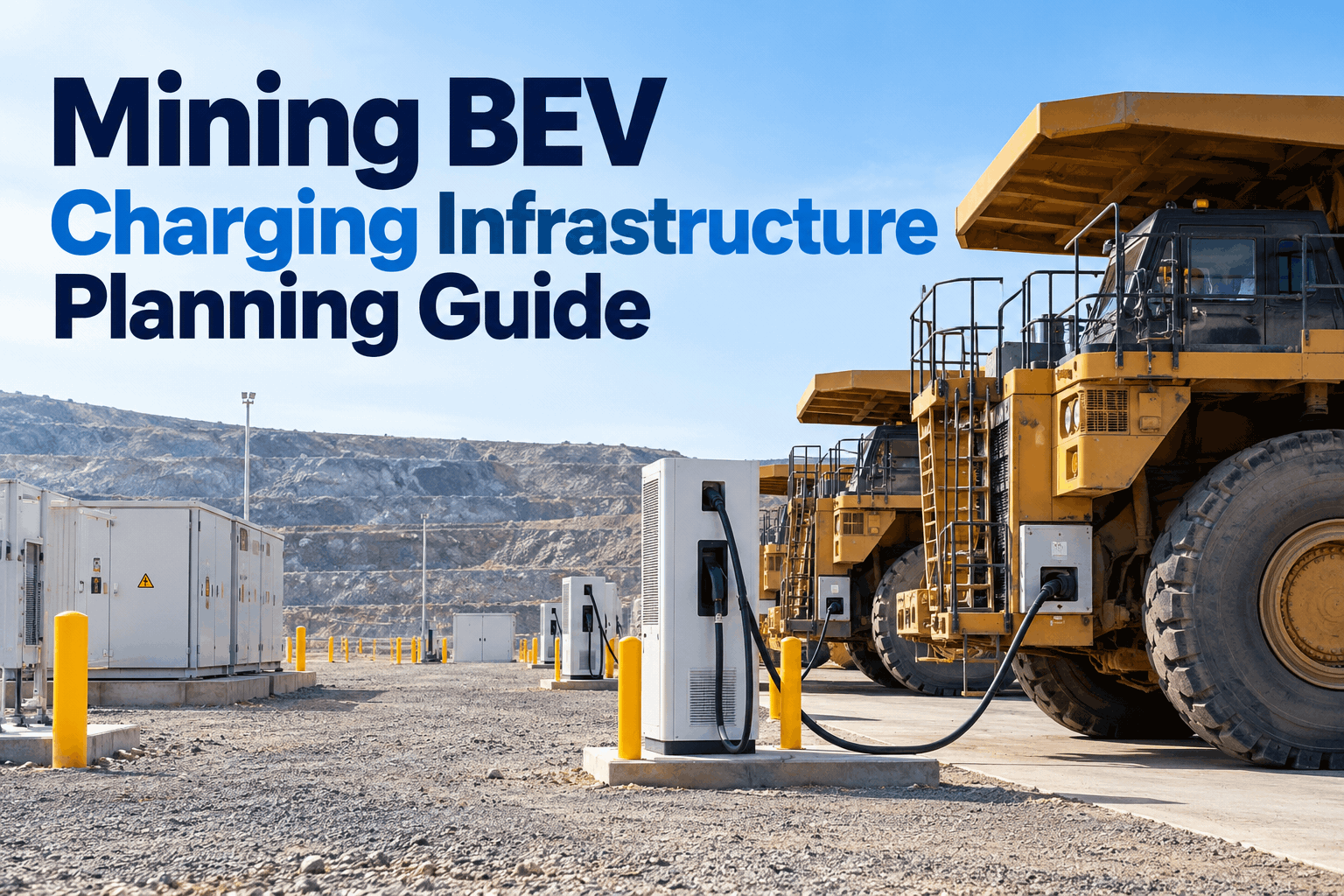
Mining BEV charging infrastructure is not simply a question of buying enough chargers. At a surface mine, charging must fit haul cycles, shift changes, electrical supply, traffic movements and maintenance windows without undermining production. A reliable plan starts with measured truck duty cycles and a realistic site power study. Book a demo to organize mining fleet asset and maintenance records with HVI as you prepare the operating data behind that plan.
Mining BEV Charging Infrastructure: Plan the Power Around the Haul Cycle
Build a charging strategy that respects route energy, shift windows, station access and maintainability—before chargers become a production bottleneck.
Answer with route data, available charging time, real equipment specifications and an electrical feasibility study—not charger nameplate power alone.
Why Mine Charging Needs a Site-Specific PlanA charger can be technically powerful and operationally unusable
Unlike depot vehicles that return to a predictable parking space each evening, mine trucks operate across changing elevations, loading points and shift patterns. A loaded uphill run can draw much more energy than an empty return; a congested ramp can change both travel time and charging opportunity. Mine planners must also allow for road changes as the pit develops, weather-related traction demand, auxiliary loads, battery operating limits and equipment availability.
Charging capacity is therefore a production-system decision, not a stand-alone electrical purchase. Fleet managers should compare proposed charging schedules with actual dispatch patterns, maintenance plans and the number of trucks that must remain available during peak output. Electrical engineers must independently verify power quality, protection, grounding, cable routing and applicable codes. Mine operations and maintenance teams then decide how the installations will be inspected, accessed and repaired safely.
How many usable kilowatt-hours does each truck need between charging opportunities?
How much dwell time is genuinely available after travel, queueing and connection?
What can the charger, battery and site distribution network sustain together?
Map the Charging Network to the MineA route-based illustration of where charging opportunities and conflicts appear
Start with the physical mine layout. A convenient point on a drawing may be a poor charging location if it forces trucks off the productive route, adds difficult turning movements or exposes electrical assets to blasting, dust, flooding or mobile-equipment traffic. The illustration below is a conceptual layout—not an engineering drawing.
Good candidate locations
Look for planned dwell periods near dispatch transitions, maintenance areas or routes where charging access does not disrupt production. Assess stable ground, drainage, turning radii, service-vehicle access, emergency response, communications and electrical proximity.
Locations that create hidden costs
A charger may be cheaper to install near an existing electrical room but expensive to use if each truck loses productive minutes driving there. Similarly, placing all chargers at one station can create queues or a single point of failure.
Calculate Charger Capacity Without Confusing Power and EnergyA practical first-pass calculation to test charging-window feasibility
Charger capacity is commonly stated in kilowatts (kW), a measure of power. Battery energy is measured in kilowatt-hours (kWh). A first-pass charging estimate divides the energy that must be restored by the usable charging time and accounts for losses. It is a screening calculation, not a guarantee of charging performance: vehicle acceptance limits, battery temperature, state of charge and charger derating may reduce actual power.
In this simplified example, a charger rated below roughly 356 kW would not meet the assumed energy target within the stated window. A charger rated above that value still needs confirmation of the truck's allowable charging curve, battery temperature constraints, cable configuration and available site power. Do not use this calculation as a final equipment specification.
Run the calculation for the whole fleet
One truck rarely tells the full story. Build a separate row for each truck class and duty cycle: energy consumed per operating period, state-of-charge reserve, charging duration, expected charging efficiency, time-of-day arrival and peak overlap. Then evaluate the number of simultaneous sessions, charger utilization and operational redundancy. A charger that meets one truck's needs may still fail the fleet when multiple trucks arrive together.
Start with actual utilization and maintenance history rather than optimistic schedules. HVI can help organize vehicle and equipment records, inspections and maintenance costs; specialist mine-energy and charging models are still needed for electrical and battery-specific calculations. Book a demo to review mining equipment records and maintenance tracking in HVI.
Design Around Charging Windows, Not Just Charger CountA schedule can fail even when the combined charger rating looks sufficient
Mine fleets often concentrate charging demand at shift changes, breaks or maintenance handovers. If several trucks arrive at the same time, the usable window can disappear in a queue. The operating plan must therefore account for connection and disconnection, travel to the station, charger occupancy, recovery from delays and the possibility that one charger is out of service.
Use a dispatch-informed timetable to stagger charging or provide enough independent bays to absorb overlap. Evaluate whether some vehicles can charge during longer scheduled stops rather than during the busiest shift turnover. If battery swapping, opportunity charging or dynamic charging is considered, assess each against its actual equipment, infrastructure and safety requirements instead of assuming the methods are interchangeable.
A robust schedule includes an exception plan: what happens when a truck returns with lower-than-expected charge, a charger is unavailable, the power supply is curtailed or a vehicle is diverted to a longer haul? Define who decides which truck charges first and what production trade-off is acceptable. These are operating-policy decisions that must be coordinated with the mine's dispatch and electrical teams.
What the Mine Electrical Study Must ConfirmCharging feasibility extends beyond the station fence
Electrical engineers should examine available supply, load growth, feeder capacity, transformers, protection systems, earthing, power quality and the resilience of the site distribution network. They must also consider whether the mine relies on a utility connection, on-site generation, renewable sources or a combination. Charging schedules that appear feasible in a spreadsheet may create a demand peak that requires expensive network upgrades.
Connected load
Model simultaneous charging, auxiliary loads and any other major site consumers rather than simply adding all charger nameplate ratings.
Power resilience
Assess interruptions, backup arrangements, safe shutdown behavior and recovery priorities if the electrical supply becomes constrained.
Physical protection
Plan cable routes, bollards, vehicle clearance, drainage, dust controls and safe separation from mobile-equipment movements.
Future expansion
Reserve practical space and electrical pathways for later chargers without paying prematurely for infrastructure the mine may never use.
Site engineers should specify chargers and power equipment using OEM requirements and applicable electrical and mining safety rules. Consider electrical-room access, isolation points, thermal conditions, inspection clearances, spare parts and the skill sets required for safe servicing. A station that is difficult to maintain can reduce fleet availability even if its initial charging performance is excellent.
Budget for the Entire Charging SystemAvoid comparing charger purchase prices with diesel fuel costs alone
The capital budget should include more than dispensers. Mine charging infrastructure may require utility or generation upgrades, substations, switchgear, cabling, civil works, traffic changes, communications, commissioning, fire and emergency planning, training and future relocation. Operating costs can include purchased electricity, demand-related charges, inspections, service contracts, spare parts, charger downtime and support equipment.
Chargers, transformers, switchgear, distribution equipment, cable management, earthworks and installation labor.
Electricity tariffs, demand peaks, power losses, site generation, curtailment exposure and potential storage options.
Preventive inspections, service visits, replacement parts, planned outages, cleaning and specialist electrical support.
Truck travel to charge, waiting time, spare vehicle requirements, dispatch changes and downtime during outages.
Evaluate costs per operating hour, tonne moved or another mine-relevant production denominator. Compare equivalent haulage work, not just fuel expenditure before and after electrification. Use sensitivity cases for electricity price, truck utilization, charger availability and mine life. Where costs are uncertain, show ranges and assumptions rather than presenting a single precise return-on-investment figure.
HVI's equipment records and maintenance cost tracking can support the ongoing asset-cost picture. It does not replace an engineering cost estimate or a financial model for electrical infrastructure. Book a demo to explore mining maintenance cost records with HVI before setting your reporting baseline.
Preventive Maintenance for Charging-Support EquipmentCreate clear ownership before the first charger is commissioned
Charging assets need a documented maintenance strategy covering routine condition checks, periodic specialist inspections, defect reporting, calibration or testing where specified, and corrective work. The exact procedures and intervals must come from the charger OEM, electrical engineer, applicable standards and the mine's risk assessment. Unqualified personnel must not open energized electrical enclosures or undertake high-voltage diagnostics.
Visible damage, blocked access, connector condition, cleanliness and reported faults
Electrical testing, internal repairs and OEM-prescribed servicing
Visible wear, strain, contamination, storage and safe routing
Repair or replacement to manufacturer and electrical safety requirements
Blocked intakes, abnormal noise, leaks and alarm indications
Cooling-system diagnosis, service and performance verification
Area condition, enclosure damage, signage and restricted access
Protection testing, isolation procedures and authorized electrical maintenance
Markings, barriers, surface condition, drainage and emergency access
Engineering changes to layout, guarding and traffic management
For each asset, define an owner, inspection method, defect priority, work-order path, required competence and evidence of closure. Keep charger faults separate from vehicle faults so repeated interruptions can be attributed correctly. Track maintenance costs by asset and document how outages affect fleet operations, while relying on specialist charging and electrical systems for live diagnostic and protection functions.
Turn Charging Faults Into Traceable Maintenance WorkAn operational record should connect the observation to the repair
Maintenance planning is easier when the team can see whether an issue is new, recurring or linked to a specific charger or truck. A clear workflow prevents a minor defect from being forgotten across shifts and helps distinguish electrical problems from operational misuse or access constraints.
Operator or inspector records a visible issue or reported charger fault.
Authorized staff determine safe status, priority and appropriate isolation.
Create and route the maintenance task to qualified personnel.
Record service evidence and confirm authorized return to use.
Use consistent defect categories such as connector damage, blocked cooling, communications issue, enclosure damage or access obstruction. Never treat a software work-order status as authorization to energize equipment: electrical safety decisions belong to qualified personnel under the mine's procedures. HVI can provide inspection, preventive maintenance and maintenance-record workflows, while specialist systems retain responsibility for charger operation and high-voltage control.
As the asset base expands, review recurring failures and maintenance spend by charger location, equipment model and operating conditions. Sign up free to organize mining equipment inspections and maintenance records.
A Practical Four-Phase Charging Infrastructure RoadmapMake each investment decision depend on evidence from the previous phase
Measure the baseline
Collect route distance, elevation, payload, duty cycles, idle time, maintenance history and energy estimates from vehicle suppliers. Identify seasonal changes and the minimum availability the mine must protect. Document what is measured and what remains an assumption.
Model and engineer
Test candidate charging sites, arrival overlap, charging windows, equipment compatibility and electrical demand. Commission qualified engineering reviews of network capacity, safety, traffic access and environmental exposure before final procurement.
Pilot under real shifts
Use a limited deployment to compare actual energy use, charging duration, station availability and production effects with forecasts. Record interruptions and work orders so design changes are based on evidence rather than anecdote.
Scale with maintenance capacity
Expand only after proving operating fit and establishing inspection ownership, spare parts, specialist support, training and contingency procedures. Reassess charging placement as haul routes and the mine plan evolve.
Define stage gates before each phase: evidence quality, electrical approval, operating performance, maintenance readiness and economic viability. A pilot that misses production or safety requirements should lead to redesign, not automatic expansion. The best long-term plan is one that can adapt as the pit changes and equipment technology matures.
How HVI Supports a Growing Electric Mining FleetKeep equipment history and maintenance discipline connected to the transition
Mining BEV charging infrastructure involves multiple specialist systems. Dispatch platforms coordinate haulage, battery management systems monitor vehicle batteries, charging systems manage power delivery and electrical protection equipment maintains network safety. HVI has a different role: organizing fleet and equipment assets, preventive maintenance, inspections, maintenance records and associated costs.
One consistent record of what was inspected, serviced and repaired
Register applicable equipment as assets, plan maintenance tasks, document inspection findings, track corrective work and retain service history. Use records to review repeated issues, maintenance workload and equipment expense across a mixed mining fleet.
Confirm the exact asset configuration and workflow for your operation during a product demonstration. Do not assume direct charger telemetry, live battery state of charge, automated load balancing or grid management are included. Those functions require purpose-built charging, battery and electrical platforms.
Mining BEV Charging Infrastructure FAQsAnswers to common planning, cost and maintenance questions
How do mines determine how many BEV chargers they need?
Estimate energy demand by truck and route, calculate usable charging windows, then model simultaneous arrivals, charger availability and production constraints. Confirm charging curves and site power limits with the relevant OEMs and electrical engineers. The final count should include an agreed contingency for charger outages and schedule disruptions.
Where should electric haul truck charging stations be located?
Locations should minimize unproductive travel and queues while allowing safe truck movements, emergency access, suitable ground conditions and feasible electrical connections. Charging may fit near shift handover, maintenance areas or planned stops, but the best choice depends on the mine layout and evolving haul routes.
What affects mining BEV charging infrastructure costs?
Major factors include chargers, transformers, switchgear, distribution upgrades, civil works, cabling, commissioning, energy tariffs, demand peaks, maintenance, spare parts and lost production time. Compare scenarios using equivalent haulage output and explicit assumptions rather than charger purchase price alone.
What maintenance do mining EV charging stations require?
Routine observations can include visible connector damage, cable routing, blocked ventilation, access conditions and reported faults. Qualified specialists must perform internal electrical work, testing and repairs according to OEM instructions and site safety procedures. Inspection intervals depend on the equipment, environment and applicable requirements.
Can HVI manage mine charging power or monitor battery charge levels?
HVI is positioned for asset records, equipment inspections, preventive maintenance, work orders and maintenance cost tracking. It should not be treated as a charger-control, battery-management or electrical protection system. A demo can establish which maintenance workflows suit your mine's charging-support assets.