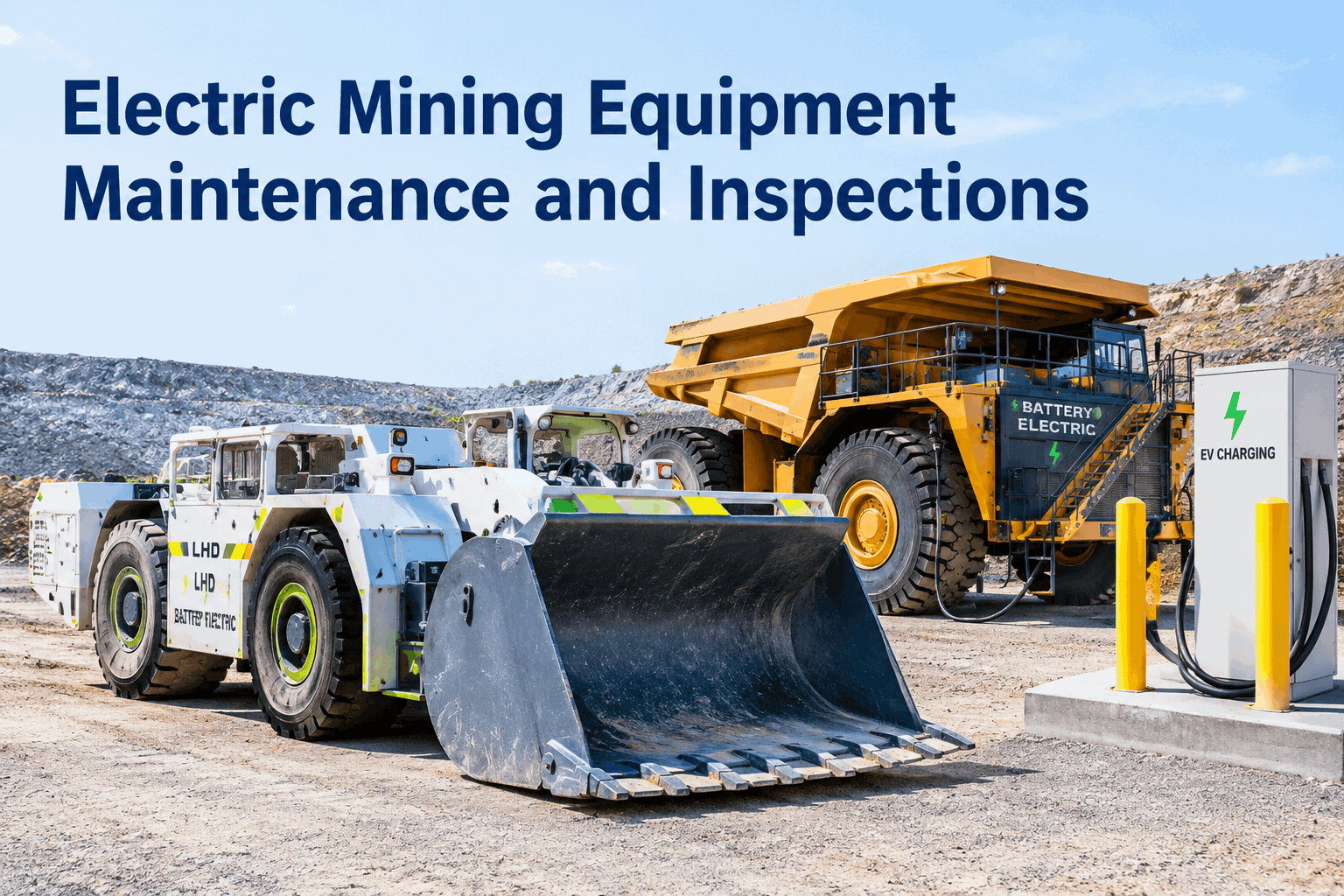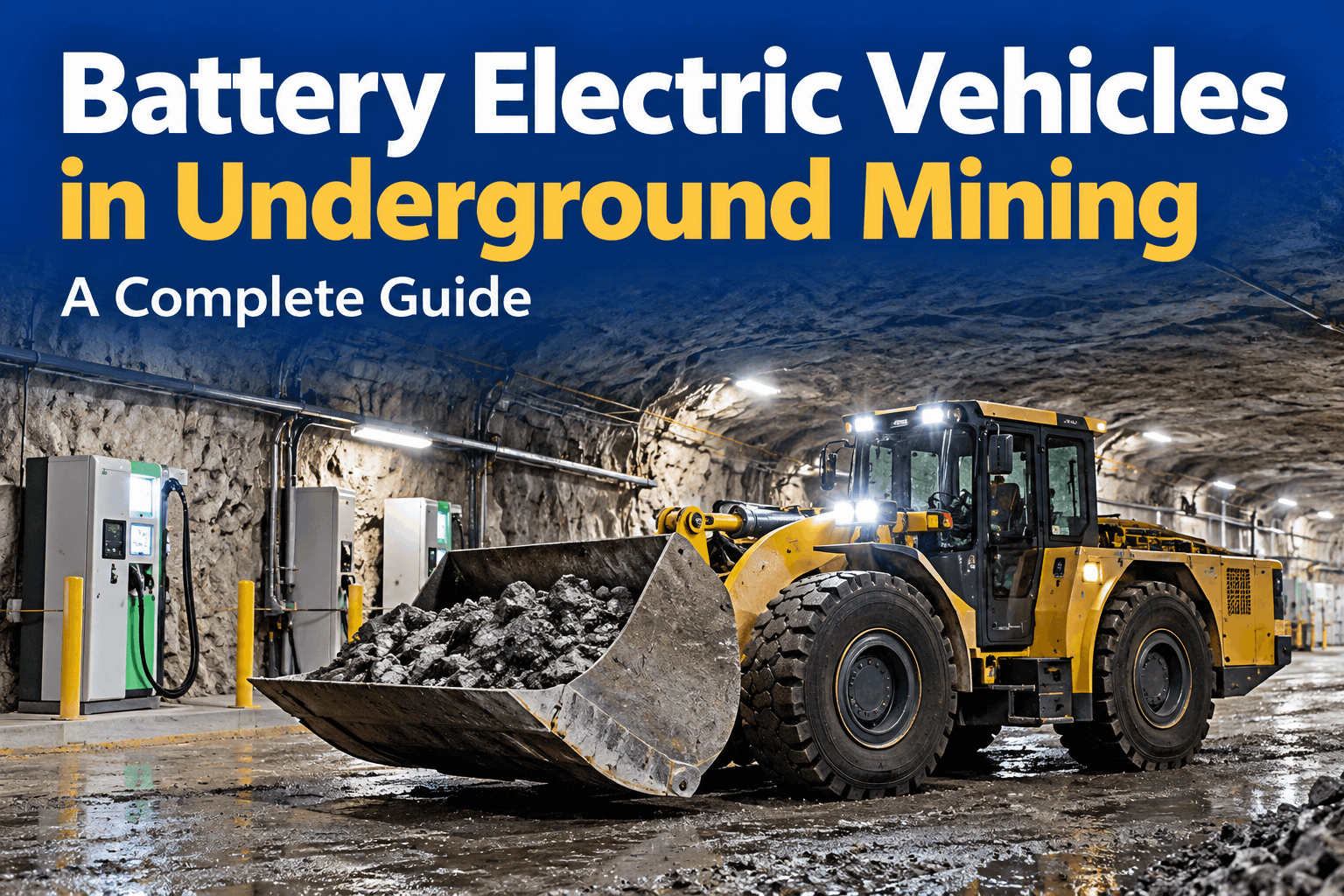
Battery electric vehicles in underground mining change more than the powertrain. They affect ventilation assumptions, shift planning, charging access, maintenance skills and the way a mine proves that equipment is ready to work. For operators evaluating electric loaders and haul trucks, the practical question is not simply whether a BEV can travel a ramp. It is whether the full mine system can support reliable production safely. Book a demo to explore underground fleet maintenance tracking with HVI.
Battery Electric Vehicles in Underground Mining: Build a Safer, More Reliable Fleet
From deep production levels to the charging bay, underground BEVs change ventilation planning, shift availability and maintenance routines. Build a practical inspection and service program around the equipment you operate.
Where Underground BEVs Change the Mine Follow the equipment from portal to production heading
A battery-electric fleet interacts with mine infrastructure at several points. The cross-section below is a conceptual operating map—not an engineering layout or a ventilation design.
The operational interfaces matter as much as the vehicle specifications. Charging can create new traffic at bays, route changes can alter energy use, and equipment faults can disrupt a tightly sequenced production cycle. Record those interfaces during the pilot rather than discovering them after fleetwide deployment.
Why Mines Are Considering Battery-Electric EquipmentDiesel exposure, ventilation demand and long-term operating strategy
Underground mines have a strong reason to evaluate battery electric vehicles: diesel engines add exhaust contaminants and heat to an environment where air movement is expensive and operationally critical. Replacing some diesel equipment can reduce tailpipe emissions at the point of use. However, a BEV does not eliminate the need for ventilation, dust management, heat control, fire planning or engineering assessment.
Air-quality opportunity
Removing diesel exhaust from selected equipment can change the contaminant load. Mine ventilation engineers must still establish the required airflow for the complete underground operation.
Operating environment
Electric drivetrains may change noise, local heat sources and service routines. The net effect depends on charging, battery cooling, equipment duty and site conditions.
Maintenance model
Engine-related tasks may decline while high-voltage isolation, cooling circuits, battery systems and electrical inspections require new competencies and procedures.
Those opportunities must be tested against purchase cost, infrastructure investment, energy tariffs, replacement components and production availability. A diesel-versus-electric comparison should use the same duty cycle, payload assumptions and mine layout—not an idealized brochure cycle.
Choose the Right Underground BEV Duty CycleMatch energy demand to the actual work, not the nameplate range
Start with a route-by-route profile. A battery-electric loader working short, repetitive cycles near a charging location presents a different problem from a haul truck climbing a long ramp under load. Capture operating hours, payload, elevation gain, queue time, idle time, travel distance and the time available for charging or battery exchange.
Bar lengths indicate relative planning attention only. They are not measured consumption or percentages.
Include temperature, road conditions, grade, regenerative braking behavior, battery reserve policy and battery aging in the energy model. The original equipment manufacturer (OEM) should provide validated operating envelopes. A route that works on a new battery at moderate temperature may have less margin after years of operation or during a hot, demanding shift.
Mine operators should also check whether a vehicle's dimensions, turning radius, braking capability, payload and service access suit the existing workings. Electrification does not remove normal vehicle-selection requirements. Book a demo to organize mining equipment records and inspection history in HVI.
Ventilation Planning: What Changes and What Does NotSeparate potential diesel-emission reductions from the full mine ventilation duty
BEVs have no diesel tailpipe emissions during electric operation, but mines must still control respirable dust, blasting gases, heat, humidity and other contaminants. Ventilation demand may change, yet the magnitude is site-specific and should be established through a qualified engineering assessment.
Battery and charging systems can also produce heat. Charger placement, electrical rooms, emergency access and thermal conditions must be evaluated with the mine ventilation and electrical teams. Never treat a lower diesel-emission load as permission to reduce airflow without the required analysis and approval.
- Diesel equipment removed or retained
- Airflow requirements for remaining hazards
- Charging and battery cooling heat loads
- Traffic routes and underground occupancy
- Emergency scenarios and applicable mine rules
A useful pilot records the actual equipment mix and duty hours before and after the change. Keep a clear distinction between potential ventilation savings, engineered changes that have been implemented and benefits that have been measured. This prevents a promising business case from turning into an unsupported savings claim.
Underground Charging and Shift ContinuityPlan charging windows, access, traffic and electrical capacity together
Charging infrastructure is not simply a collection of plugs. It needs electrical supply, appropriate protection, physical space, traffic separation, cable management, cooling and a maintainable location. The layout must account for mine-specific conditions such as dust, water ingress, ground support, emergency egress and equipment movement.
This simple division excludes tapering, temperature effects, charger and battery limits, losses, queue time and connection procedures. Actual schedules require OEM charging curves and site-specific design.
Check simultaneous charging demand rather than assuming every machine charges at a different time. A plan that fits each vehicle individually can still fail when several machines return at shift change. Evaluate staggered charging, opportunity charging, battery exchange where supported, spare-machine coverage and how the plan performs when one charger is unavailable.
Charger selection and electrical engineering belong to qualified specialists. HVI can support maintenance administration for equipment assets, inspections and repair history, but it is not a charger controller or electrical design tool.
Battery Safety and High-Voltage Maintenance BoundariesMake responsibilities explicit before equipment arrives underground
Battery-electric mining equipment introduces high-voltage systems and battery-specific hazards that require manufacturer procedures and trained personnel. Potential concerns include damaged battery enclosures, coolant leaks, insulation faults, unintended energization, thermal events and damaged charging connectors. A visible defect must not be treated as a routine cosmetic issue.
High-voltage isolation is not the same as ordinary lockout on a diesel vehicle. Follow the OEM's instructions, local mine regulations and approved energy-control procedures. Do not open battery packs, bypass interlocks, probe HV components or attempt thermal-event response without the required competence, equipment and site plan.
Emergency teams should know how to identify electric equipment, establish safe exclusion zones, contact the OEM and manage damaged batteries. Response plans should cover towing and recovery as well as stationary charging areas. Sign up free to start organizing BEV inspection and maintenance records with HVI.
An Underground BEV Preventive Maintenance ProgramKeep the familiar inspections; add battery-specific service controls
Battery-electric machines still need brakes, tires, steering, suspension, structures, hydraulics, fire protection, lighting and operator safety checks. Electric drivetrains can reduce some engine-specific work, but they do not make heavy mining equipment maintenance-free. Use the manufacturer's service intervals and the mine's risk assessment as the baseline.
Do not assign universal hourly intervals to battery systems: different OEMs, vehicle classes and chemistries have different requirements. Instead, configure service schedules against the correct asset model, operating hours and manufacturer guidance. Keep a record of what was inspected, the findings, who performed the work and when the machine returned to service.
Recurring issues deserve trend review. A repeated coolant alarm, charging-connector replacement or insulation-related warning may indicate an underlying reliability problem. HVI's inspections, preventive maintenance scheduling and equipment history can help maintenance teams organize the evidence for investigation; battery diagnosis itself remains with OEM tools and qualified personnel.
Underground BEV Shift-Readiness ChecklistA practical handoff between operators, maintenance and mine supervision
Use a consistent pre-shift inspection for every battery-electric loader, truck and support vehicle. Adapt these checks to the OEM procedure and your mine's electrical safety rules; this is an operational example, not authorization to work on high-voltage systems.
Visible battery enclosure
Look for impact damage, leaks, loose covers and unusual odors from a safe position. Isolate and escalate abnormalities.
Cooling and thermal alerts
Review operator-visible warnings and approved coolant inspection points; do not open energized components.
Charging interface
Check the accessible connector, cable condition and charging-area housekeeping using approved site procedures.
Brakes, tires and steering
Confirm conventional mobile-equipment safety systems remain fit for underground grades and haulage duty.
Alarms and operator display
Record warning indicators, fault messages and operating restrictions before equipment release.
Service status and defects
Verify outstanding defects and scheduled maintenance; route exceptions to the authorized maintenance team.
Capture inspection findings, assign corrective work and retain a traceable service history. Book a demo to explore underground BEV inspection checklists in HVI.
Protect Production Availability During the TransitionUse a maintenance feedback loop, not assumptions about electric uptime
Early BEV pilots often reveal operational issues that were not visible in the procurement model. Charging queues, connector wear, unfamiliar fault codes, technician availability and spare-part lead times can affect production. Track downtime by cause rather than grouping every lost hour under “electric equipment.”
Useful measures include equipment availability, mean time to repair, repeat failures, planned versus unplanned work, inspection completion and charging-related delay. Define each metric consistently across diesel and BEV assets. For example, decide whether charging time is planned operational time or downtime before comparing availability figures.
Keep an equipment-level history that includes commissioning date, operating hours, major component replacements, maintenance costs and warranty actions. These records make fleet decisions more defensible, especially when the pilot includes several machines with different routes and workloads. Book a demo to review preventive maintenance and equipment history tracking in HVI.
Build a Credible Underground BEV Business CaseCompare whole-system costs and production outcomes
The acquisition price of a battery-electric loader or truck is only one part of the investment. A mine may need charging equipment, electrical upgrades, service-bay changes, technician training, spare components and new emergency arrangements. The operating case should include electricity prices, demand charges where applicable, diesel consumption, maintenance labor, parts, battery-related costs and changes in production capacity.
Diesel baseline
- Fuel and delivery underground
- Engine and aftertreatment service
- Ventilation and associated energy
- Equipment availability and production
Battery-electric scenario
- Electricity and charging losses
- Chargers and electrical infrastructure
- HV training, cooling and specialist service
- Battery lifecycle and production effects
Model at least a base case, a demanding-shift case and an infrastructure-outage case. Make assumptions visible and distinguish vendor projections from measured pilot results. Avoid claiming a universal maintenance-cost reduction or ventilation saving: the result depends on site geometry, electricity supply, diesel prices, duty cycle and the mine's implementation choices.
Once equipment is deployed, maintenance and asset-cost records provide evidence to revisit the business case. HVI can help organize fleet-level expenses and work history, while engineering and finance teams remain responsible for energy modeling and total-cost-of-ownership decisions.
A Practical Underground BEV Adoption RoadmapMove from a measured pilot to repeatable operating standards
Establish the baseline
Document current diesel equipment, duty cycles, service costs, ventilation assumptions, availability and operating constraints. Identify candidate routes and machines.
Engineer the interfaces
Work with qualified teams on charging, electrical supply, ventilation, fire response, recovery access and approved high-voltage service procedures.
Pilot and measure
Track shift energy use, charging delays, production, defects, maintenance labor, downtime and operator feedback against the baseline.
Standardize and scale
Refine inspection templates, OEM service schedules, spare-parts plans, technician training and management reporting before expanding the fleet.
Make the pilot decision criteria explicit before the first machine arrives. Agree on acceptable availability, charging-window performance, safety controls and cost assumptions. A technically successful demonstration is not necessarily a production-ready operating model; the scale-up decision should reflect real shift performance and maintenance support.
Where HVI Fits in Underground Electric Fleet OperationsOne maintenance record for electric and conventional mining assets
HVI supports the maintenance-management layer of a mixed underground fleet. Teams can organize asset records, perform equipment inspections, schedule preventive maintenance, track work orders and review maintenance history. These workflows matter during a BEV rollout because technicians and managers need a consistent record of defects and service work across both electric and diesel machines.
For example, an operator can report a visible charging-connector defect during an approved inspection. The maintenance team can document the issue, assign the appropriate specialist, record work performed and preserve the history for later reliability review. HVI does not interpret battery-management-system telemetry or authorize high-voltage work.
- Register each underground asset
- Use approved inspection checklists
- Schedule OEM-based preventive maintenance
- Record defects, work and repair costs
- Review recurring issues and asset history
When a mine scales from a small pilot to multiple electric equipment types, consistent maintenance documentation helps reduce the risk of losing service history across spreadsheets, shifts and contractors. Book a demo to see HVI mining equipment inspection and maintenance workflows.
Underground Mining BEVs: Frequently Asked QuestionsPractical answers for mine operators and maintenance managers
What are battery electric vehicles used for in underground mining?
Underground BEVs can include loaders, haul trucks and other support equipment. Suitability depends on duty cycle, mine geometry, charging strategy, vehicle specifications and the site’s safety and production requirements.
Do electric mining vehicles eliminate the need for ventilation?
No. BEVs can reduce diesel exhaust from equipment they replace, but mines still require ventilation for dust, gases, heat, personnel and other hazards. Any airflow changes require site-specific engineering and regulatory review.
How are underground mining BEV batteries maintained?
Follow OEM-approved inspections and service procedures for battery enclosures, cooling systems, charging interfaces and fault responses. High-voltage diagnostics, isolation and repair require authorized, trained personnel.
How should an underground mine plan BEV charging?
Assess actual shift energy demand, charging curves, simultaneous charging, electrical capacity, charger availability, underground space, traffic, cooling and emergency access. Use qualified electrical and mine engineering teams.
Can HVI manage underground BEV maintenance records?
HVI can support asset records, equipment inspections, preventive maintenance scheduling, work orders and maintenance history. It is not a battery-management system, ventilation design tool or charger-control platform.