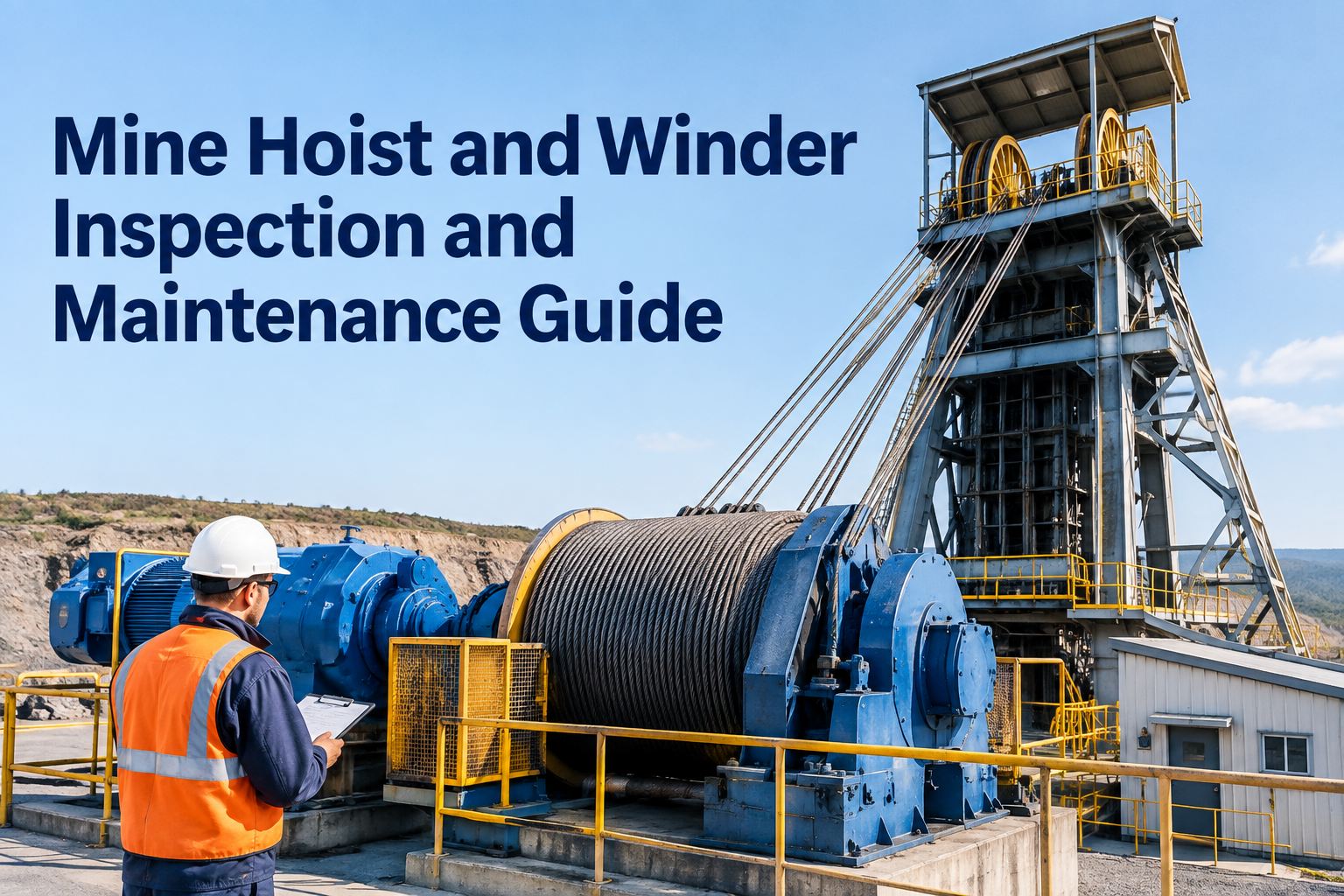
Every other machine in the mine moves rock. The hoist moves people — and that single fact changes everything about how it's inspected. A pump can fail and you lose production; a hoist rope failing while a cage of miners hangs in the shaft is a fatality. That's why mine hoist inspection isn't held to a reliability standard, it's held to a statutory one: the rope, the brakes, and the overtravel protection are examined on a legally mandated clock, and every check has to be a defensible, dated, certified record an inspector can demand. This guide covers the critical systems, the inspection intervals, and the records regime that keeps hoisting safe and compliant. Book a demo to see audit-ready hoist records.
The One Machine in the Mine That Carries People
A hoist isn't maintained like production equipment — it's maintained like a life-support system. The inspections run on a mandated schedule, the failures are catastrophic, and the records aren't paperwork — they're the proof that lets you legally put people in the cage.
Mine hoists — drum winders and friction (Koepe) winders alike — are the lifeline of an underground operation, raising and lowering people, ore, and materials through the shaft. Because a hoisting failure is among the most catastrophic events a mine can suffer, personnel hoisting is governed by specific regulations worldwide, with mandated inspection intervals, safety-device requirements, and statutory record-keeping. Sound hoist maintenance means two things done together: rigorously inspecting the critical systems, and capturing every inspection as the certified, audit-ready record the law and the safety of your people both demand.
The rope comes firstthe most safety-critical component in the mine
Nothing on a hoist matters more than the winding rope. It's the single component holding the conveyance and everyone in it, and it's under constant cyclic stress, bending over sheaves and winding onto drums thousands of times. Hoist rope inspection is consequently the most tightly specified inspection in mining — a defined regime of visual examination plus non-destructive testing, with hard discard criteria.
Under regulations such as 30 CFR Subpart R, each rope in service is visually examined along its entire active length at least every 14 days for broken wires, corrosion, wear, and poor lubrication — with extra attention at the stress points: near attachments, where the rope crosses sheaves, where it leaves the drum, at drum crossovers, and at change-of-layer regions.
At least every six months, non-destructive testing — typically magnetic flux leakage — or rope diameter measurement detects the internal wire breaks and loss of metallic area that a visual check can't see. Combined visual-plus-MFL is the industry standard for high-consequence hoist ropes, because neither method alone sees everything.
Ropes are retired against defined limits — broken wires per lay length, diameter reduction, corrosion, and distortion — drawn from standards like ISO 4309 and national mining regulations. A rope not examined in the prior 14 days must be re-examined before anyone is hoisted on it. When in doubt, the rope comes out; splicing hoist ropes is prohibited.
The discipline here is unforgiving by design: rope inspection findings must be recorded, dated, and kept in a rope record book, because a hoist rope's history — its measurements trended over time — is how you prove it's still safe and know exactly when to change it. Capturing those measurements consistently, with photos of any defect, is the backbone of a defensible rope program. Book a demo to capture rope measurements and photos over time
Brakes & safety devicesthe systems that must never fail silently
If the rope is what holds the load, the brakes and safety devices are what stop a bad situation from becoming a fatal one. These are the systems that have to work the one time they're needed — and like a standby that's never tested, a safety device that's never proven is only an assumption. Regulations require them to be tested, and hoist maintenance revolves around keeping them demonstrably functional.
The brake system must bring a loaded conveyance to a stop within its design distance from any point in the shaft. Inspect brake linings, hydraulics or air, linkages, and holding capacity — and test stopping performance, don't just assume it.
Overwind/overtravel devices must stop the hoist before the conveyance reaches a danger point; shafts beyond a set depth also require overspeed protection. Both are tested to confirm they actually trigger — the whole point is that they fire when everything else has failed.
On friction (Koepe) winders, where the rope drives by friction over the sheave rather than winding on a drum, slip-detection systems must be calibrated and functioning — rope slip is a specific and serious hazard unique to this hoist type.
The depth indicator must accurately show conveyance position throughout shaft travel, and the signal or communication system between shaft stations and the hoist operator must function reliably — both are safety-critical, not conveniences.
Every one of these tests produces a result that must be recorded and, in many jurisdictions, certified. A brake test isn't done until it's documented — because the record is what proves, to a regulator and to yourself, that the system was verified before the next person stepped into the cage. Start free and log safety-device tests as certified records
Drums, sheaves & conveyancesthe mechanical path the rope and people travel
The rope and safety devices get the headlines, but they don't work in isolation — the drums, sheaves, and conveyances they run on directly affect rope life and personnel safety. Wear in any of them shortens rope life or endangers the load, so they belong in every hoist inspection.
Inspect the drum face and grooving for wear that damages rope — smooth drums can develop grooves and impressions that prevent proper winding, and lagging may need resurfacing or replacement. Poor winding accelerates rope wear and can cause the layering problems that abuse the rope.
Head and deflecting sheaves must turn freely, sit in proper alignment, and have sound flanges, grooves, and bearings — no cracks or broken flanges. Fleet angle and alignment matter, because a misaligned sheave grinds the rope and wears both. Bearing condition is a classic early warning.
Inspect cages and skips, the rope attachments and safety-device connections, gates, and the protective bonnet required over man cages. The connection between rope and conveyance is a critical stress point — and the attachment hardware is inspected as carefully as the rope itself.
The headframe structure must be free of corrosion, cracking, and distortion at critical members, and the shaft itself — guides, buntons, dividers, and sump — inspected for damage, misalignment, and obstructions that could foul the conveyance.
None of these are one-off checks. Each is part of the recurring inspection regime, and each finding — a worn groove, a cracked flange, a bearing on the turn — needs to be recorded and, where it affects safety, acted on before the hoist carries people again. Book a demo to template the full hoist and shaft inspection
Records are the compliancewhy the paper trail is the whole point
Here's what makes hoist maintenance genuinely different from every other machine on site: with a hoist, the record isn't documentation of the work — the record substantially is the compliance. Regulations built around personnel hoisting mandate not just that inspections happen, but that they're logged in specific statutory records: the hoist certificate, the rope record book, the hoisting machinery log, the operator's log. An inspection that happened but wasn't recorded, in the eyes of a regulator, effectively didn't happen.
That raises the bar on record quality in a way condition-based equipment never demands. Rope measurements have to be captured and trended, so a diameter reduction approaching the discard limit is visible before it's a crisis. Certifications and their expiry dates have to be tracked, so a lapsed hoist certificate never lets an out-of-date machine carry people. Photo evidence of defects has to attach to the record, so a finding is proven, not just asserted. And the whole history has to be instantly producible when an inspector arrives — because with hoisting, audits aren't rare events, they're a routine part of being allowed to operate. A digital system turns this from a filing-cabinet liability into a strength: templated statutory inspections, measurements and photos captured on the device, certification tracking with expiry alerts, and an audit-ready record exported in seconds. Book a demo to see certification tracking and audit-ready export Or start free and put your hoist records beyond reproach
From a hoisting engineer responsible for the shaft
With every other asset, the maintenance is the thing and the paperwork is the afterthought. With the winder it's inverted — the inspection and the record are the same act. If I can't produce a dated rope exam for the last fourteen days and the six-monthly NDT, I legally cannot wind people, no matter how good the rope actually is. The record is the permission.
We used to run it all on logbooks and a spreadsheet, and audits were a nightmare of digging. Now the rope measurements trend automatically, the certificates flag before they expire, and every brake test has a photo and a timestamp attached. When the inspector comes, I hand over a clean history in minutes. On a machine that carries people, that's not convenience — it's the difference between operating and being shut down.
Frequently asked questions
How often must mine hoist ropes be inspected?
Hoist ropes are inspected on a mandated, layered schedule because they are the most safety-critical component in the mine. Under personnel-hoisting regulations such as the US 30 CFR Part 56/57 Subpart R, each wire rope in service must be visually examined along its entire active length at least once every fourteen calendar days for structural damage, corrosion, wear, and improper lubrication, with particular attention to stress points including near the rope attachments, where the rope rests on sheaves, where it leaves the drum, at drum crossovers, and at change-of-layer regions. In addition, at least once every six months, non-destructive testing — commonly magnetic flux leakage — or rope diameter measurement must be performed to detect internal deterioration a visual check cannot see. If any condition reducing rope strength is found, the affected portion must be examined daily. Importantly, before any person is hoisted on a newly installed rope or one that has not been examined in the previous fourteen days, that rope must first be examined. Exact intervals and discard criteria vary by jurisdiction and by standards such as ISO 4309, but the principle is universal: frequent visual inspection combined with periodic non-destructive testing, all documented in a rope record.
What safety devices does a mine hoist require?
A mine hoist used for personnel is required to have several safety devices, all of which must be tested and kept demonstrably functional. Overwind or overtravel protection must stop the hoist before the conveyance travels past a safe point in the shaft, preventing the cage from being wound into the headframe or dropped past the loading point. Hoists in deeper shafts must additionally have overspeed protection that intervenes if the conveyance moves too fast. The brake system must be capable of bringing a loaded conveyance to a stop within its design distance from any point in the shaft, and brake performance is tested rather than assumed. Friction, or Koepe, winders — where the rope is driven by friction over the sheave instead of winding onto a drum — require calibrated, functioning slip-detection systems, because rope slip is a hazard specific to that design. A depth indicator must accurately show the conveyance's position throughout its travel, and a reliable signal or communication system must connect the shaft stations with the hoist operator. Because these devices exist precisely for the moment when something else has already gone wrong, regulations require them to be regularly tested and the results recorded, so their readiness is proven rather than presumed.
What is the difference between a drum hoist and a friction (Koepe) winder?
The difference lies in how the rope transmits the load and drive. In a drum hoist (drum winder), the winding rope is physically attached to and wound onto a rotating drum; as the drum turns, rope wraps on or off it to raise or lower the conveyance. This means the drum face, its grooving or lagging, and the way the rope layers onto itself in multi-layer drums are important inspection points, since poor winding accelerates rope wear. In a friction winder, also called a Koepe winder, the rope is not wound onto a drum but instead passes over a driving sheave, with the conveyance on one side and a counterweight (or a second conveyance) on the other; the sheave drives the rope purely by friction. The critical consequence is that friction winders can suffer rope slip over the sheave, which is a specific and serious hazard, so they require calibrated slip-detection systems and careful attention to the friction lining and rope tension balance. Rotation-resistant rope constructions are often used on friction winders and multi-layer drums to manage torque and prevent rope rotation. Both types are subject to the same overarching personnel-hoisting inspection and record requirements, but their mechanical inspection focus differs according to how each handles the rope.
Why are records so important for hoist compliance?
Because with a hoist, the record is not merely documentation of the maintenance — it substantially is the compliance. Personnel-hoisting regulations mandate not only that specific inspections and tests occur on schedule, but that they are recorded in defined statutory records such as a hoist certificate, a rope record book, a hoisting machinery log, and an operator's log. From a regulator's standpoint, an inspection that was performed but not properly recorded effectively did not happen, and a lapsed certificate can prohibit the machine from carrying people regardless of its actual condition. This places unusually high demands on record quality. Rope measurements must be captured accurately and trended over time so that a diameter reduction approaching the discard limit becomes visible well before it is a crisis. Certification expiry dates must be tracked so an out-of-date machine is never used for hoisting. Evidence of defects, ideally including photos, must attach to the inspection so findings are proven rather than merely asserted. And the entire history must be producible on demand, because for hoisting operations, audits and inspections are a routine condition of being allowed to operate rather than occasional events. A digital records system is valuable here specifically because it makes statutory inspections repeatable, keeps measurements and photos attached to each check, alerts on expiring certifications, and lets a complete, audit-ready history be exported in seconds.
What are the key components of a mine hoist to inspect?
A complete mine hoist inspection covers several interdependent systems. The winding rope is foremost, examined visually and by non-destructive testing against defined discard criteria, since it directly supports the conveyance and everyone in it. The brake system and safety devices — overtravel and overspeed protection, and on friction winders slip detection — are tested to confirm they will function when needed. The drums are inspected for face and groove wear and lagging condition that affect how the rope winds and wears. The head and deflecting sheaves must turn freely, be properly aligned, and have sound flanges, grooves, and bearings, since a worn or misaligned sheave grinds the rope. The conveyances, cages and skips, along with their rope attachments, gates, and the protective bonnet over man cages, are inspected because the rope-to-conveyance connection is a critical stress point. The control system, depth indicators, and the signalling and communication system between shaft stations and the operator must all function reliably. Finally, the headframe structure and the shaft itself — guides, buntons, dividers, and sump — are inspected for corrosion, cracking, distortion, misalignment, and obstructions. Each of these belongs in a recurring, documented inspection regime, because they work as a system and a weakness in any one can endanger the whole.
Keep your hoist inspections certified, dated, and audit-ready
HVI builds your statutory hoist and winder inspections into custom templates, captures rope measurements and defect photos on the device, trends rope condition toward discard limits, tracks every certification with expiry alerts, and keeps the whole history audit-ready. When an inspector asks for the fourteen-day rope exams, the six-monthly NDT, or the brake-test record, you export a clean, dated history in seconds. On the one machine that carries people, that's the difference between operating and shutting down. Live in under two weeks.
No credit card · Certification tracking & audit-ready records from day one · Built for underground operations worldwide