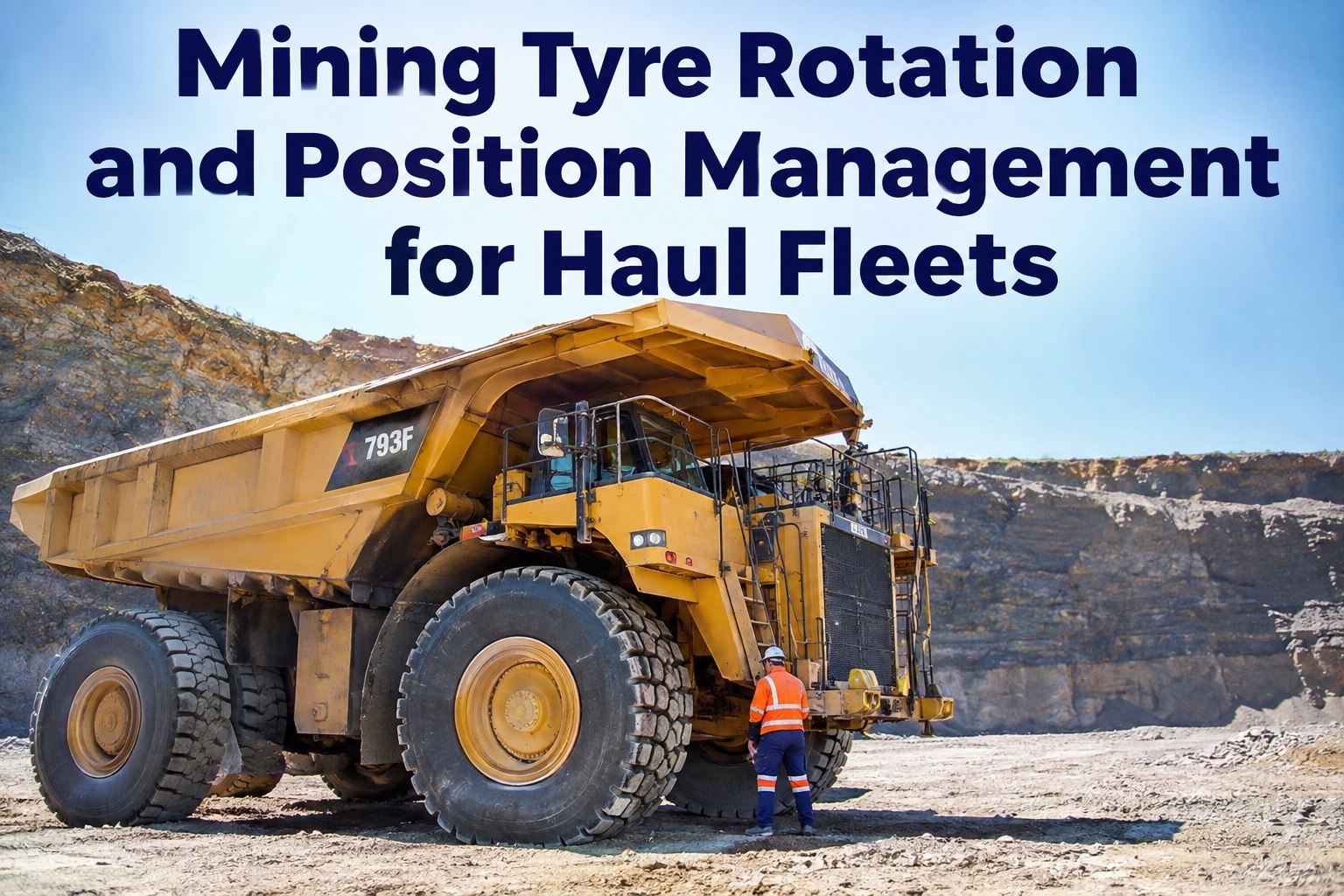
Tyres are one of the biggest consumable costs on any mine site, yet most operations still track them by truck number instead of by serial and position. That single blind spot hides the wear patterns that would tell you which positions burn rubber fastest, which operators scrub shoulders early, and which roads are cutting tread life short. Mining tyre rotation and position management only works when you follow each tyre as an individual asset across its full life, not as a line item under a machine. If you want to see how serial-level tracking changes the maths on tyre cost per hour, walk through it on your own fleet in a 30-minute demo.
Are your tyres wearing out by position, not by brand?
Drive, steer and trailing positions wear at different rates and in different patterns. If you track tyres by truck instead of by serial and position, you cannot see the rotation windows that would extend fleet-average life by thousands of hours.
The real cost of not tracking tyres by serial and position
Every tyre that comes off early without a reason code is money you cannot recover. Here is what the gaps look like in practice.
Why drive, steer and trailing positions wear at different rates
A tyre on the drive axle scrubs and heats differently than one on the steer. If you do not rotate, the drive positions burn out first and you scrap tyres that still have 40% tread left on the shoulders.
Steer Positions
Wear on the shoulders from turning and side load. Tread depth drops slower than drive, but irregular wear from alignment or pressure issues shows here first. Rotate steer tyres to trailing positions once shoulders reach 60% of original depth.
Drive Positions
Fastest wear rate due to torque, heat and scrub. Centre tread wears first. On haul trucks with rear duals, the inner and outer can wear unevenly if pressures drift. Rotate drive tyres across the axle or to trailing positions every 1,000-1,500 hours.
Trailing Positions
Slowest wear, mostly even tread loss. Good landing spot for tyres rotated off steer or drive. Watch for flat spotting if the truck sits loaded for long periods. Trailing positions can add 20-30% more life to a tyre that started on drive.
Why you must track tyres as individual assets, not by truck
A tyre moves between positions and machines over its life. If your records stop at the truck level, you lose the history that tells you whether the tyre, the road, the operator or the pressure caused the failure.
Mount and record
Log the serial number, position, machine, date, tread depth and pressure at install. Photo the sidewall and tread. This is the baseline.
Inspect and measure
Every PM or tyre check, record tread depth at three points, pressure, and any cuts, chips or irregular wear. Flag tyres approaching rotation or removal thresholds.
Rotate and track
When you rotate, update the position and machine in the tyre's history. The serial stays constant; only the location changes. This is where most paper systems break.
Remove and categorise
Every removal gets a reason code: worn out, cut, impact damage, bead failure, irregular wear, or other. This data feeds your scrap analysis and tells you where to focus.
HVI's Tire Management module tracks each tyre as an individual asset with a unique identifier and full history across positions and machines. You can start logging tyre serials and positions free and see the wear patterns within the first month.
What your removed tyres tell you about roads, pressures and operators
Every tyre that comes off early is a data point. If you categorise removal reasons, you can see whether the problem is operational or product-related.
| Removal Reason | What It Looks Like | Root Cause | Fix |
|---|---|---|---|
| Irregular wear | Shoulder scrub, cupping, feathering | Alignment, pressure drift, or mismatched duals | Check alignment, tighten pressure checks, match duals within 3mm tread depth |
| Cut or chip damage | Tread cuts, sidewall chips, chunking | Road conditions, rock spillage, or operator route choice | Improve road maintenance, adjust routes, retrain operators on hazard avoidance |
| Impact break | Sidewall bulge or rupture | Hitting rocks, potholes, or windrows at speed | Operator coaching, speed limits on rough sections, better road grading |
| Bead or rim damage | Bead separation, rim flange wear | Underinflation, overloading, or poor mounting practice | Enforce pressure checks, verify load limits, audit mounting procedures |
| Heat separation | Tread or belt separation, bluing on sidewall | Sustained overloading or underinflation causing heat buildup | Reduce loads, increase pressure monitoring frequency, check for slow leaks |
| Worn out (full life) | Even tread wear to minimum depth | Normal end of life | This is the goal. Track hours and cost per hour to benchmark performance. |
If more than 20% of your removals are cuts, impacts or irregular wear, the problem is operational, not the tyre. HVI's Analytics module tracks removal reasons across your fleet so you can see the split and act on it. Book a demo to see how scrap analysis works on your own data.
Why matching within a position set matters more than brand loyalty
Mismatched duals or uneven tread depths across an axle force one tyre to carry more load and scrub. That tyre wears faster and can fail early, taking its mate with it.
Do
- Match duals within 3mm tread depth and 5 psi pressure
- Keep tread depth across an axle within 6mm
- Rotate as a set when one tyre in a dual pair is removed
- Record tread depth at three points (inner, centre, outer) every check
Don't
- Mix brands or tread patterns in a dual position unless tread depth is identical
- Run a new tyre next to a 50% worn tyre on the same axle
- Assume pressures stay matched - check both duals every shift
- Let a slow leak run for days because the tyre still looks round
Managing ultra-class tyre inventory when lead times run 6-12 months
Large OTR tyres are expensive and slow to replace. If you do not forecast removals and order ahead, you either run trucks on borrowed time or park them waiting for stock.
Forecast removals 90 days out
Use tread depth trends and removal history to predict which tyres will hit minimum depth in the next quarter. Order replacements now if lead time is 6+ months.
Track stock by size and position
Know what you have on hand, what is on order, and what is mounted. HVI's Parts and Inventory module tracks tyre stock across multiple sites and flags low inventory before you run out.
Plan rotations around stock availability
If you are short on a size, rotate to extend life on the positions that wear fastest. If you have surplus, rotate earlier to even out wear and reduce scrap.
Audit inventory monthly
Physical count against system records. Tyres walk off sites or get mounted without paperwork. A monthly audit catches the gaps before they cost you a truck-day.
A single unplanned tyre change on a 100-tonne truck costs 8-16 hours of downtime. At $500-$1,000 per hour in lost production, that is $4,000-$16,000 per event. Keeping the right stock on hand and rotating on schedule avoids most of those events. See how HVI tracks tyre inventory and forecasts removals in a live demo.
Turn tyre tracking from spreadsheets into a system that pays for itself
HVI's Tire Management, Parts and Inventory, and Analytics modules give you serial-level tracking, removal reason analysis, and cost per hour reporting in one platform.
Serial-level tyre tracking
Every tyre gets a unique ID and full history across positions and machines. See wear patterns, rotation history, and cost per hour by serial, not by truck.
Removal reason analytics
Categorise every removal and see the split between worn out, damage, and irregular wear. Spot whether the problem is roads, pressures, operators or product.
Inventory and forecasting
Track tyre stock across sites, forecast removals 90 days out, and get alerts when inventory runs low. Never park a truck waiting for a tyre again.
Cost per hour reporting
See tyre cost per operating hour by machine, position, and serial. Benchmark performance and prove ROI on rotation and pressure management programs.
What to do differently on Monday morning
Start tracking tyres by serial number and position, not by truck. A tyre moves over its life; your records must move with it.
Rotate every 1,000-1,500 hours or when tread depth differential within a position set exceeds 4-6mm. The labour cost pays back if it extends life by more than 10%.
Categorise every removal by reason. If more than 20% are cuts, impacts or irregular wear, the problem is operational, not the tyre.
Match duals within 3mm tread depth and 5 psi pressure. Mismatched duals wear faster and can fail early, taking both tyres out of service.
Forecast removals 90 days out and order ahead if lead times are long. A single unplanned change costs 8-16 hours of downtime and thousands in lost production.
Use a CMMS with tyre management built in, not spreadsheets. The data is only useful if it is current, accessible, and tied to work orders and inventory.
Mining tyre rotation and position management is not complicated, but it does require discipline and a system that tracks serials across positions and machines. The payoff is 15-20% lower tyre cost per hour and fewer unplanned changes. If you are still tracking tyres in a spreadsheet or on paper, sign up free and start logging serials today.
We used to scrap tyres with 40% tread left because the drive positions wore out first and we never rotated. Once we started tracking by serial and rotating every 1,200 hours, we cut tyre spend by 18% in the first year. The data showed us which operators were scrubbing shoulders and which roads were cutting tread. Now I check removal reasons every month and adjust routes or retrain as needed.
Mining tyre rotation and position management FAQs
How often should I rotate haul truck tyres?
What is the best way to track tyre serial numbers and positions?
How do I know if my tyre problem is operational or product-related?
Why does matching duals matter so much?
How far ahead should I order ultra-class tyres?
Stop scrapping tyres early and start tracking by serial
See how HVI's Tire Management, Parts and Inventory, and Analytics modules work on your own fleet. Book a 30-minute demo and we will walk you through serial tracking, rotation scheduling, and removal reason analysis.
Free to start - Works on any phone - No card needed