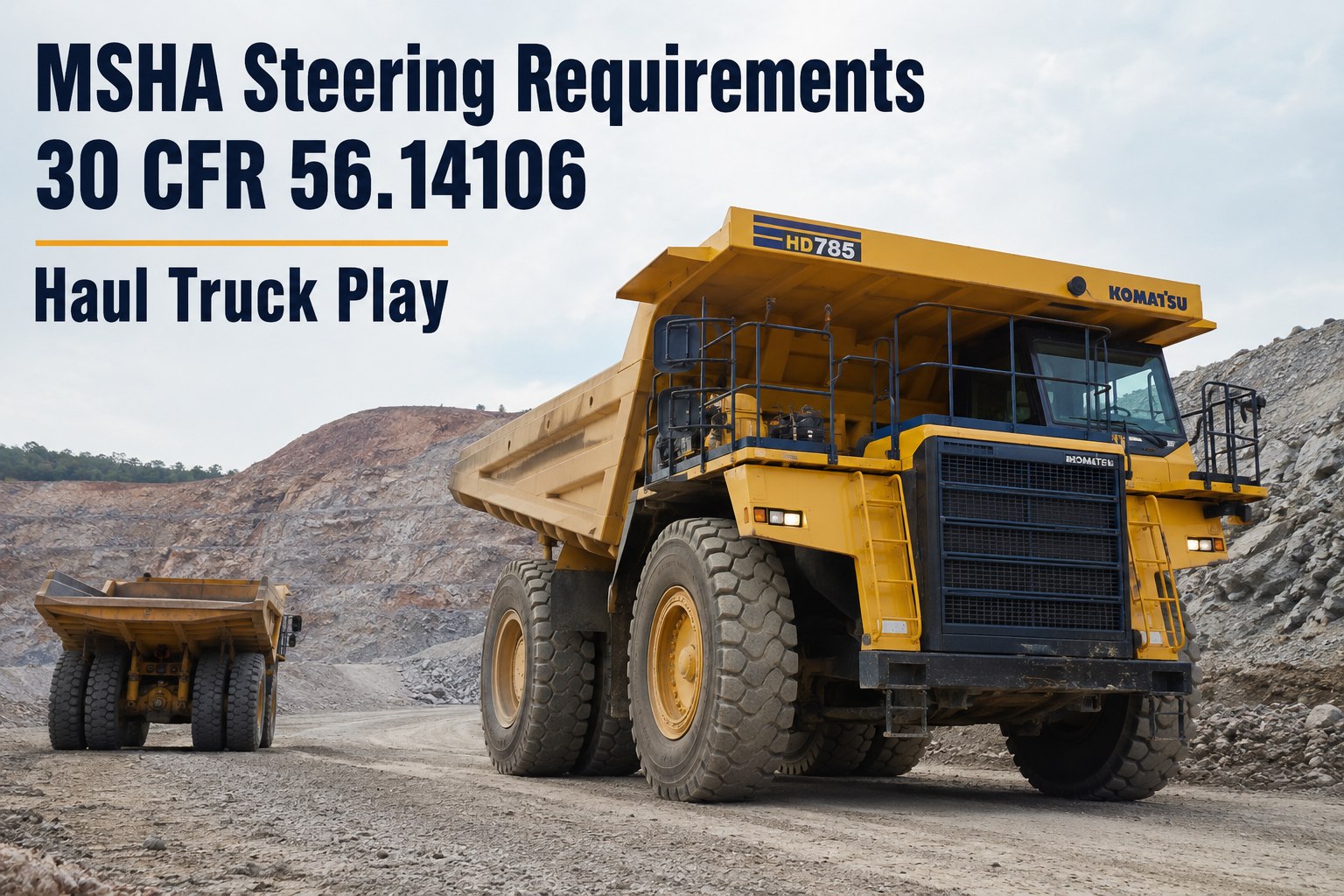
Steering defects on a loaded ultra-class haul truck on a ramp are a fatality mechanism, and the inspection point is one of the most subjective on the checklist unless you give operators a measurable standard. Under 30 CFR 56.14106, MSHA requires that steering operate smoothly with no excessive play or binding. Industry guidance puts the practical haul truck limit near two inches of play at the rim, which turns a judgment call into a hard measurement. If you have ever tried to defend a tag-out decision to a production supervisor without a recorded number, you know why a verifiable standard matters. You can walk through it on your own units to see how digital measurement standards hold up.
What does 30 CFR 56.14106 require for haul truck steering play?
The regulation demands smooth steering operation with no excessive play or binding. For heavy mobile equipment, loss of power steering assist during an operational test is an immediate tag-out condition.
Breaking down the MSHA steering requirement for mining equipment
30 CFR 56.14106 is short, but the consequences of getting it wrong are severe. The rule mandates that steering systems on mobile equipment operate smoothly, without excessive play, and without binding. The challenge for a maintenance manager is translating "excessive" into a number a night-shift operator can apply consistently at 3:00 AM.
Smooth Operation
The steering must move freely through its entire range. Jerky movements, sudden catches, or a steering wheel that fights the operator indicate internal cylinder failure or linkage binding.
No Excessive Play
Industry guidance sets the upper limit at roughly two inches of free movement at the wheel rim before the tires react. Anything beyond this means the operator is steering a delayed response.
Assist Reliability
If power steering assist drops out during the operational test, the truck is out of service. Steering a loaded haul truck manually on a ramp is not a safe fallback, it is a fatality mechanism.
How to perform a steering inspection on a haul truck
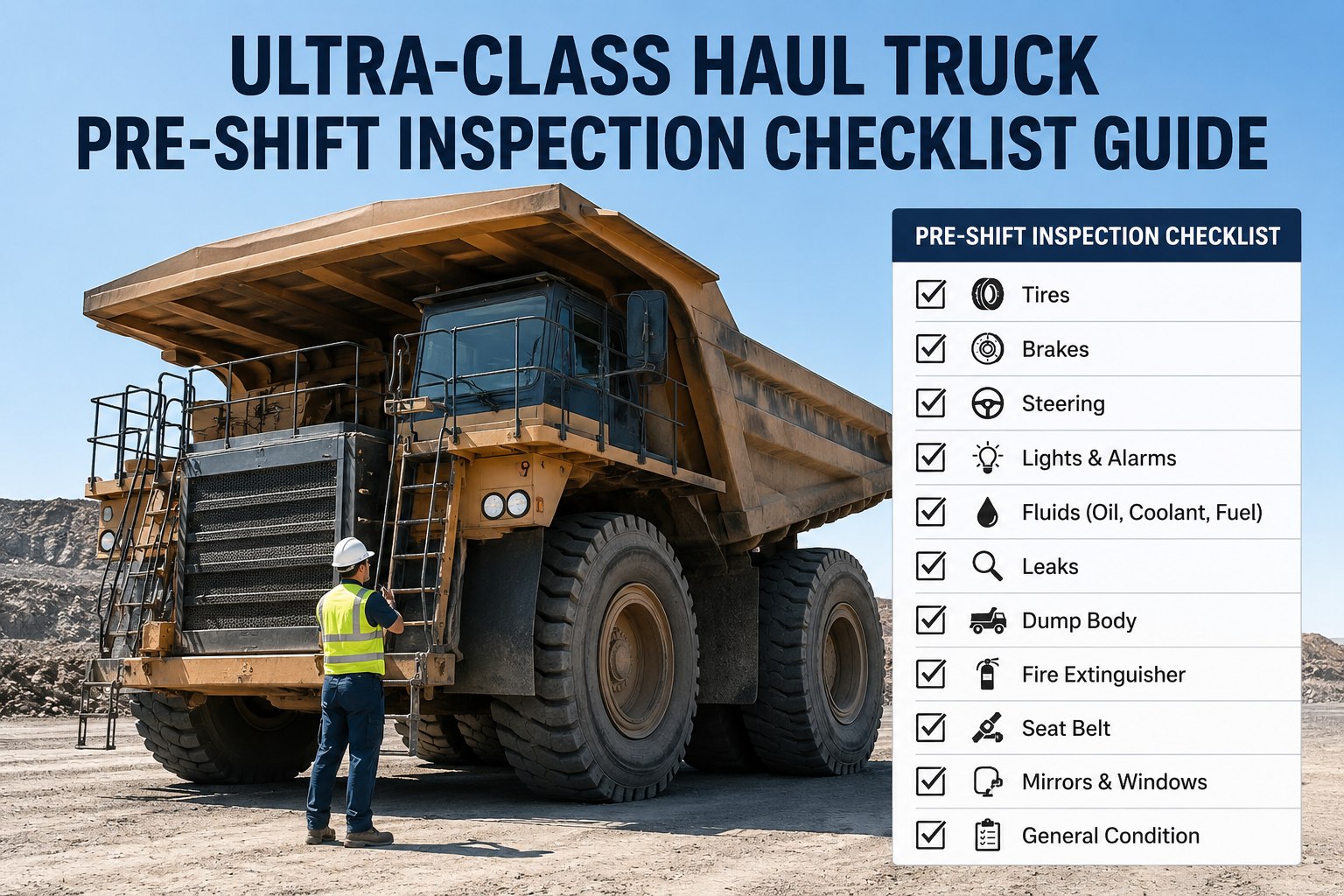
A proper steering inspection mining fleets can rely on requires more than turning the wheel side to side. You have to check the linkage, measure the free play, test the return-to-centre, and verify the assist under load. You can see the full inspection workflow on a live demo to understand how these steps map to a digital template.
| Inspection Point | Pass Condition | Fail / Tag-Out Condition | Citation Risk |
|---|---|---|---|
| Wheel Rim Free Play | Less than 2.0 inches of play | Greater than 2.0 inches or delayed tire response | High |
| Return to Centre | Wheel returns freely from full lock | Wheel binds, sticks, or fails to centre | Critical |
| Power Steering Assist | Assist remains active through full range | Loss of assist during operational test | Critical (Immediate Tag-Out) |
| Linkage and Cylinders | No visible leaks, tight connections | Leaking seals, loose tie rods, worn bushings | Medium to High |
Finding the developing cause of excessive steering play
Excessive play does not happen overnight. It develops as linkage wears, cylinder seals weep, and pivot points degrade. A robust haul truck steering check looks past the wheel to the physical components causing the delay. When operators note creeping play on their DVIR, your maintenance software should auto-generate a work order to inspect the tie rods and drag link before the truck hits the two-inch limit.
Inspect Drag Link and Tie Rods
Check for loose ball joints, worn bushings, and bent rods. Any movement here multiplies at the steering wheel.
Examine Steering Cylinders
Look for hydraulic seepage at the rod seals. Internal cylinder bypass causes delayed response and loss of assist under load.
Test Return-to-Centre Mechanics
Run the wheel through full range. If it binds or fails to return to centre, the steering valve or geometry requires immediate attention.
Verify Operational Assist
Run the operational test under loaded conditions. If assist drops, tag the truck out immediately and update the preventive maintenance schedule.
See how HVI enforces MSHA steering compliance
Stop relying on subjective paper checklists. Book a 30-minute demo to see how HVI digitizes your 8-section pre-shift inspection and auto-blocks dispatch on critical defects.
How HVI enforces haul truck steering check standards
Paper DVIRs let operators check a box without actually measuring the play. HVI forces measurable, photo-backed compliance. Steering checks are embedded directly in the brakes and steering section of the standard eight-section pre-shift template. When an operator flags excessive play or a loss of assist, HVI automatically blocks dispatch and generates a work order for the shop. You can start logging inspections free to see how the workflow locks down non-compliant units.
8-Section Pre-Shift Template
Steering is hard-coded into the required inspection flow. Operators cannot bypass the steering performance MSHA check to finish their DVIR faster.
Photo Evidence Requirements
If an operator flags a steering defect or tag-out, the app forces a photo capture. You get timestamped proof of the worn linkage or leaking cylinder for your audit binder.
Dispatch Auto-Block
When a critical defect like lost power steering assist is logged, the system auto-blocks dispatch. The truck cannot leave the yard until maintenance clears the work order.
Instant Defect-to-Work-Order
Flagged steering issues bypass manual data entry. The defect instantly becomes a tracked work order in your CMMS, routing straight to the shop foreman with parts availability.
If you want to map this to your specific mixed fleet, schedule a walkthrough with our team to review the template configurations.
Why subjective steering checks fail mining safety audits
If your inspection sheet just says "Check Steering," you are rolling the dice. A 40-truck fleet running paper DVIRs typically loses six truck-days a month to ambiguous defect reports that require a foreman to walk out and verify the condition in person. When a safety manager asks why a truck with a worn drag link was dispatched, a paper checkbox will not defend your decision.
Moving to digital inspections with forced photo evidence and strict measurement standards cuts that verification time to zero. Review your current inspection process with us to find the gaps.
Conclusion: Making MSHA 30 CFR 56.14106 measurable
Standardize the Measurement: Apply the two-inch rim play limit across all haul trucks to remove subjective judgment from the operator's hands.
Enforce the Tag-Out: Loss of power steering assist is non-negotiable. Dispatch must be automatically blocked until the defect is cleared by maintenance.
Prove the Inspection: Photo-backed digital DVIRs prove you caught the defect, protecting your operation during MSHA audits and internal safety reviews.
"Before we digitized the pre-shift, steering was always a fight. An operator would write 'feels loose,' and we would burn an hour sending a tech to verify it. Now the operator measures the play, snaps a photo of the cylinder if it is weeping, and the truck is blocked from dispatch before it even hits the ramp. It takes the argument out of the tag-out."
MSHA steering inspection 30 CFR 56.14106 FAQs
What is the exact steering play limit under MSHA 30 CFR 56.14106?
When is a steering defect considered an immediate tag-out condition?
How do I test for steering binding on heavy mobile equipment?
Where does the steering check belong in the pre-shift inspection?
Can digital inspection software prevent a truck with a steering defect from leaving the yard?
Book a Demo: See HVI on Your Fleet
Discover how cloud + mobile inspection software enforces MSHA compliance, kills paper DVIRs, and keeps your haul trucks running safely.
Free to start - Works on any phone - No card needed