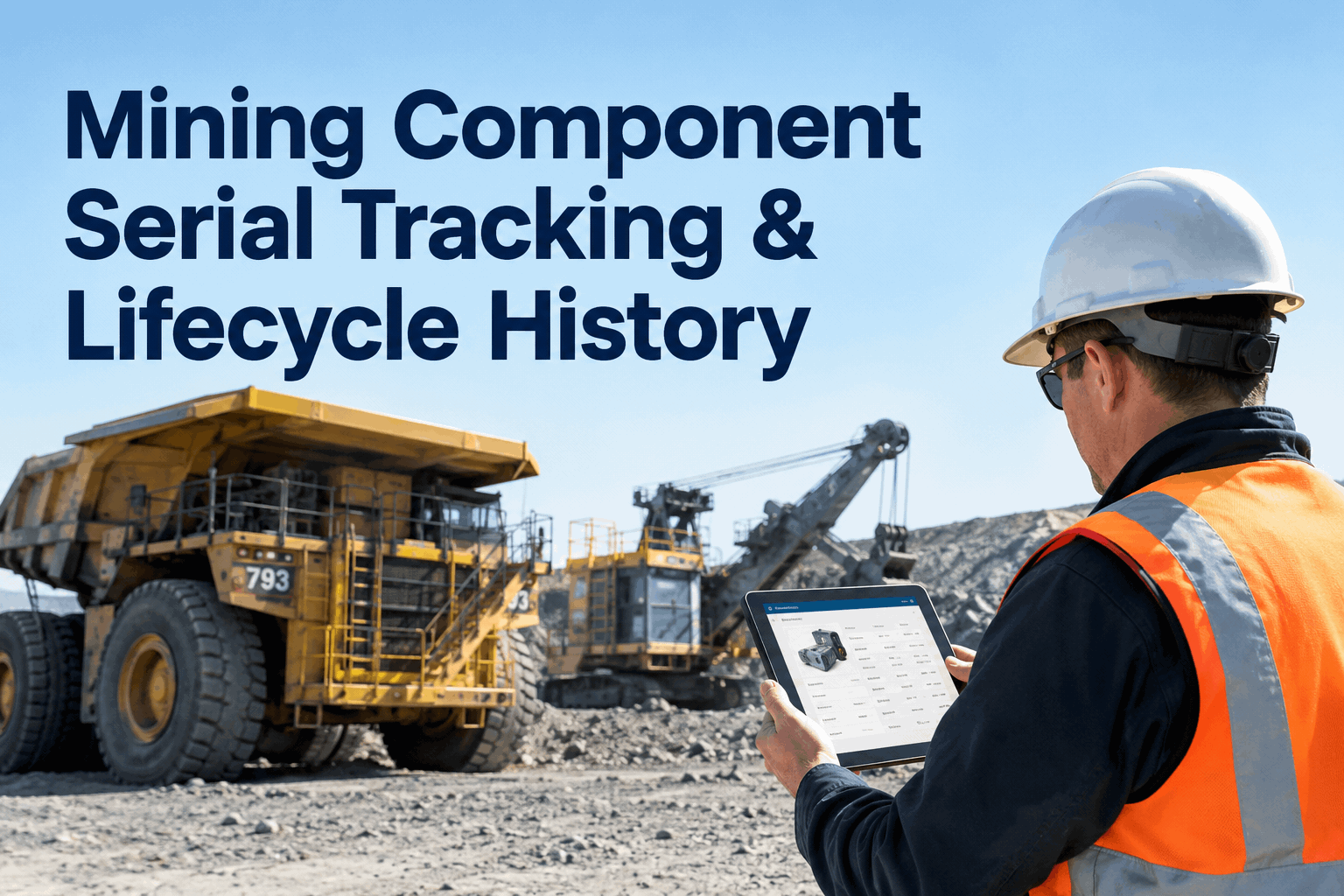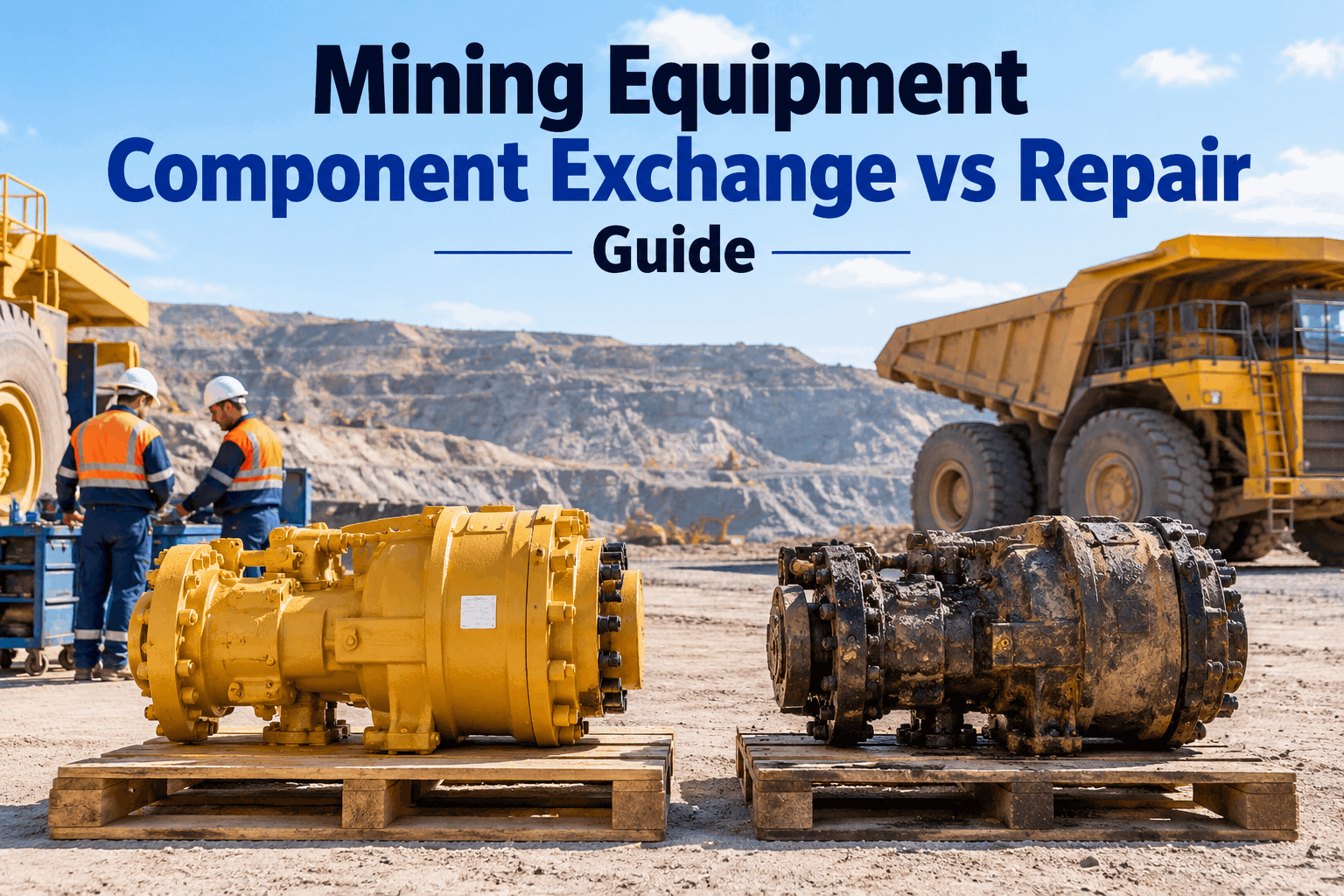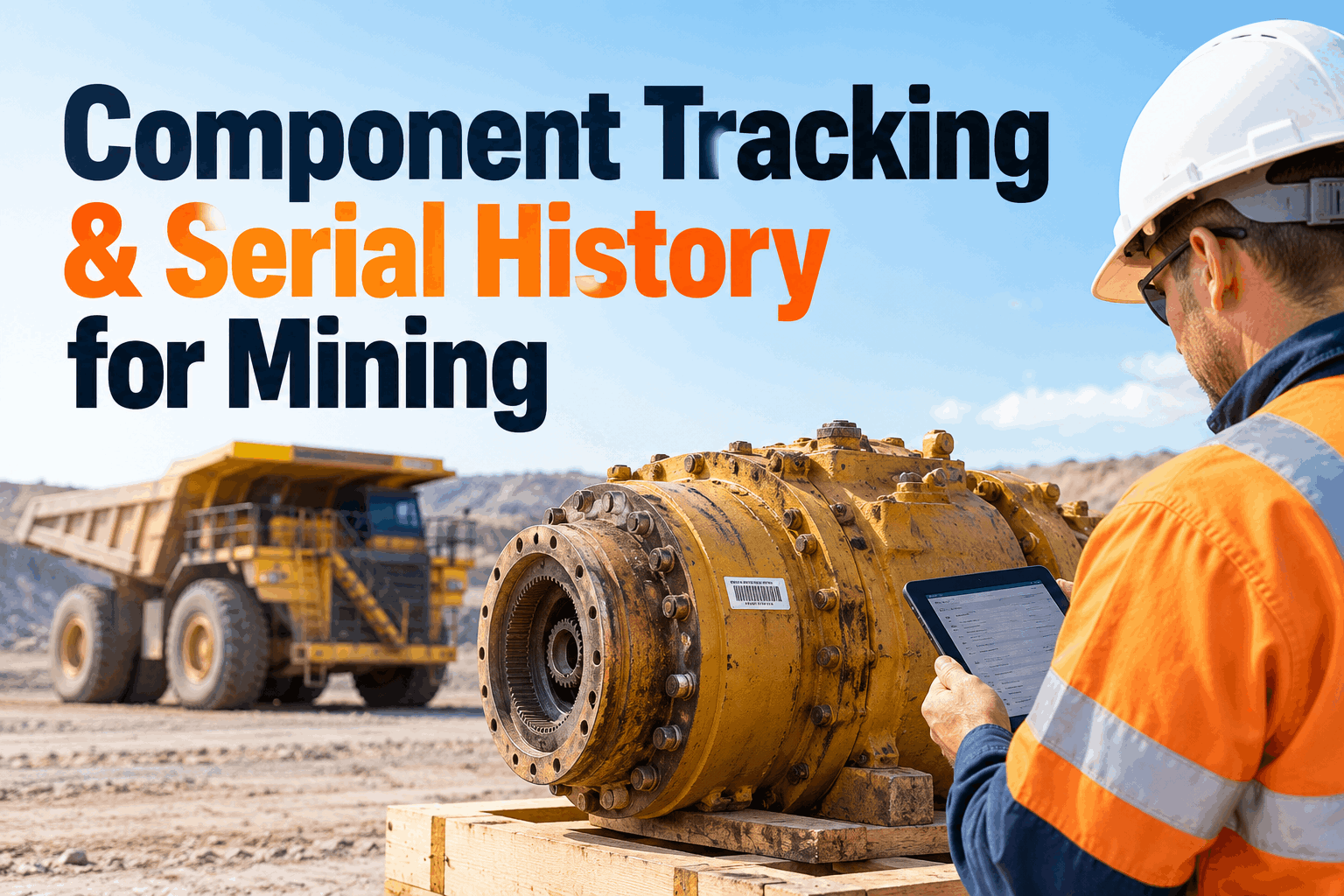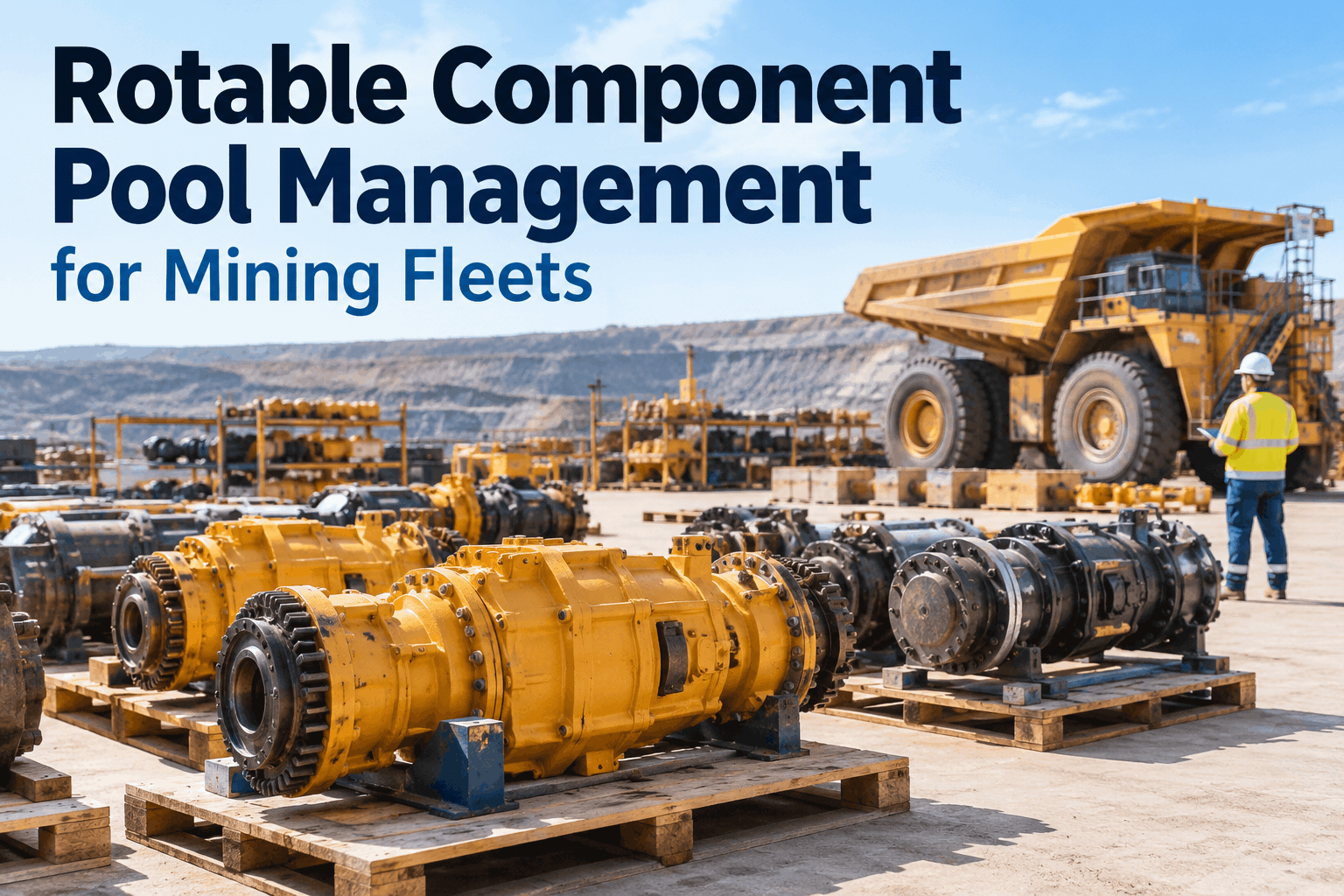
A rotable component pool is the set of major, repairable units — final drives, transmissions, hydraulic pumps, wheel motors — that a mine keeps circulating: pull a failed one, fit a ready one, rebuild the old one, and put it back in the pool for next time. Run well, it keeps haul trucks moving with almost no waiting on repairs. Run on a spreadsheet, units go missing, nobody knows which serial is where, and you over-stock some lines while a truck sits idle waiting on another. Book a demo of rotable pool tracking.
A Rotable Component Pool Only Works If You Know Where Every Unit Is
The pool isn't a shelf of spares — it's a circulating set of serialized, repairable units, each at a different point in its life. Lose track of one and the whole pool stops doing its job.
Most mines already run a rotable pool in practice — they just don't manage it as one. Units get swapped under pressure, written on a whiteboard or not at all, and six months later nobody can say how many final drives the mine actually owns, which ones are good, or which truck is running a unit that's overdue for rebuild. The parts are expensive and the stakes are high, yet the pool is tracked worse than the consumables bin. Getting it under control starts with treating every rotable unit as what it is: a serialized asset with a life of its own.
What belongs in a poolrotable components vs ordinary stock
Not every part belongs in a rotable pool. The pool is for units worth rebuilding and cycling — high-value, repairable, long-lead components where holding a ready spare beats waiting. Consumables don't belong; they're bought, fitted, and gone. Getting this split right is what keeps rotable inventory management from drowning in parts that should just be reordered.
- Final drives, transmissions, wheel motors
- Hydraulic pumps and large cylinders
- Engines and torque converters
- Repairable, high-value, long lead time
- Filters, hoses, seals, belts
- Fasteners, fluids, wear plates
- Low-cost, fit-and-forget items
- Managed by min-max reorder, not serial
This is a different question from how you stock the consumable and critical spares themselves — that's a lead-time-and-downtime-cost decision covered in our guide to stocking critical spares by downtime cost. A rotable pool is the repairable units that cycle. Explore tracking rotable units as serialized assets.
The circulation loophow one rotable unit cycles through the pool
A rotable component pool is a loop, not a shelf. Each unit moves through the same five states over and over, and the pool only works if you always know which state every unit is in. Lose visibility at any point in the loop and a "six-unit pool" quietly becomes a three-unit pool nobody planned for.
- 1In service — fitted to a machine, hours accruing against the serial.
- 2Removed — fails or hits change-out; a ready float unit takes its place.
- 3Rebuild — a work order opens; the unit is rebuilt in-house or sent out.
- 4Tested to float — verified to spec and returned to the ready shelf.
- 5Re-issued — fitted to the next machine that needs it; the loop repeats.
The swap at state 2 is what keeps the truck moving — that's the read our component exchange vs repair guide decision in action, and the pool is what makes a same-day swap possible. A unit only re-enters the float at state 4 once it's verified — see how a rebuild is proven to spec. Book a demo of the pool loop in HVI.
How many to floatsizing a rotable pool without over-capitalizing
The two failure modes of pool sizing are mirror images: float too few and a truck waits with no unit ready; float too many and millions in capital sits on a shelf. The right number isn't a guess — it falls out of three figures you either track or don't.
The trap is that most mines can't produce figure A or B with any confidence, so they size by gut and usually over-stock to feel safe. Track change-out frequency and rebuild turnaround per component and the pool size becomes arithmetic — and shrinks, because a faster, visible rebuild loop needs fewer units floating to cover the same demand. Explore change-out frequency from component history, and sign up free and start sizing on real numbers.
Is your pool in controlthe rotable-pool health checklist
A rotable pool is under control when you can answer every one of these without walking to the workshop. Run your own pool against the list — any "no" is where units go missing and capital leaks.
- Every rotable unit has a unique serial on record
- You know exactly how many units each pool holds
- Units are tracked as assets, not as a stock quantity
- You can name where every unit is right now
- Each unit's state (in-service / WIP / float / transit) is live
- Units sent to an outside rebuilder are tracked, not forgotten
- Hours and rebuild count follow each serial through the loop
- Rebuild work orders are linked to the specific unit
- A unit only returns to the float once verified to spec
- You track change-out frequency per component
- Rebuild turnaround is measured, not assumed
- Float count is set from demand, not from gut feel
When all twelve are a confident "yes," the pool runs itself and the capital tied up in it is justified. Book a demo to see the pool health view.
Where pools breakthe failure modes, and the record that prevents each
Rotable pools don't fail dramatically — they erode. Each of these is a records gap, which means each is preventable the moment every unit is tracked as a serialized asset with a live status.
The common thread is visibility: you can't manage a pool you can't see. Once each unit carries its own identity, location, status and history in one system, the erosion stops — and the pool becomes an asset you run deliberately instead of a cost you discover at audit. Explore rotable units in asset management.
The pool on recordwhat a tracked rotable pool looks like in practice
When every unit is a serialized asset, the pool's health reads off one view — utilization, turnaround, and where each unit sits in its life. Here's the kind of record that replaces the whiteboard.
That view is the difference between a pool you manage and a pile you react to. It's built from the same records HVI already keeps for work orders and assets — the pool is just those records, read by component. Explore rebuild work orders linked to each unit.
From a parts inventory manager running component pools on a haul fleet
For years our "rotable pool" was a whiteboard and a lot of walking to the workshop to see what was actually on the shelf. We over-stocked final drives because we were scared of a wait, and we still had waits — because two of the units we thought we owned had gone to a rebuilder and never come back. Once every unit had a serial, a location and a live status, the picture changed overnight. We found units we'd written off, right-sized the pool down by a third, and I stopped getting the 6am "is there a drive ready" call. The capital we freed up paid for the system several times over.
Rotable component pool — FAQs
What is a rotable component pool?
It's a set of major repairable units — final drives, transmissions, pumps — kept circulating: a failed one is swapped for a ready float unit, then rebuilt and returned to the pool for next time. It keeps machines running without waiting on each repair.
How is a rotable different from a normal spare part?
A rotable is high-value and repairable, so it's tracked by serial and cycled through rebuilds. A consumable — a filter or hose — is low-cost and fit-and-forget, managed by min-max reorder quantity. Pools are only for the rotables worth rebuilding.
How many units should a rotable pool hold?
Enough to cover demand while units are out being rebuilt: roughly change-out frequency times rebuild turnaround, plus a safety buffer. The key is measuring those figures — faster, visible turnaround means fewer units need to float.
Why do rotable pools lose track of units?
Because units are tracked as a stock quantity instead of as serialized assets. Without a live location and status per serial, units sent for rebuild get forgotten, float stock turns out to be on a truck, and nobody can size the pool. Visibility fixes all of it.
How does HVI help manage a rotable pool?
HVI doesn't hold or rebuild stock — it's the system of record. It tracks each rotable unit as an asset with its serial, location, status and full rebuild history, links rebuild work orders to the unit, and gives you change-out and turnaround data to size the pool.
Turn a pile of spare components into a pool you actually run
Every rotable unit as a serialized asset — its location, its status, its life history, and the rebuild work orders behind it — all in one view. Right-size the pool on real demand, stop losing units, and free the capital you've got sitting idle on a shelf.
No credit card · No hardware · Track every rotable unit by serial from day one