For years carriers ran electronic DVIRs in a legal grey zone, accepted in practice but never spelled out in the regulations. That ended on 23 March 2026. Under FMCSA's final rule FMCSA-2025-0115, an eDVIR app is now explicitly compliant under 49 CFR 396.11 and 396.13, and digital reports with timestamps, GPS and photo evidence are not merely permitted but materially more defensible than paper in an audit or a courtroom. If you are still carrying paper DVIR binders in the cab, the regulatory excuse to wait is gone — it is worth walking through the new rule on a live call before the next roadside inspection catches you out.
Paper DVIRs are no longer the safest option on the roadside or in court
The final rule makes electronic driver vehicle inspection reports explicitly compliant under 396.11 and 396.13. A digital report with a timestamp, GPS fix and defect photo is now the stronger record — easier to retrieve, harder to challenge, and built for the three-signature chain the regulation still requires.
- FMCSA-authorized digital reports under 396.11
- Timestamp and GPS capture on every defect
- Photo evidence attached at the point of capture
- Three-signature chain enforced electronically
Electronic DVIR compliance is now explicit — not a grey area
Until this final rule, inspectors and defence lawyers treated electronic DVIRs as permissible by interpretation rather than by letter. FMCSA-2025-0115 removes that interpretation gap. The text of 396.11 and 396.13 now expressly authorises an electronic record in place of a paper DVIR, provided the digital system enforces the same evidentiary chain the paper form always required. The mechanism matters: a paper report is a static sheet that can be back-filled, lost or altered. A digital report captured in an eDVIR app built for 396.11 carries a server-side timestamp, a GPS fix and a photo taken at the moment the defect was logged — three independent data points that are extremely difficult to fabricate after the fact.
The practical shift is defensive weight. In a roadside inspection, an officer can see the last inspection record on a screen, with the driver's digital signature and the mechanic's certification already attached. In litigation after an incident, the same record proves exactly when a defect was reported, who certified the repair, and when the next driver acknowledged it. That is materially stronger than a faded carbon copy pulled from a glovebox eight weeks later.
The three signatures an eDVIR must still enforce
Going digital does not remove the human accountability steps. The final rule preserves the three-signature chain — it simply requires that each signature be captured electronically, time-stamped and bound to the record.
Driver report
The driver completes the pre-trip or post-trip inspection in the app, logs any defects with a photo, and signs electronically. The report is locked with a timestamp and GPS location at the moment of signature.
Mechanic certification
When a defect is repaired, the mechanic signs the same digital record to certify the work was completed. No defect can be closed without this signature — the workflow will not allow it.
Next-driver acknowledgement
Before the next driver takes the unit out, they must review the report and acknowledge the repair. This closes the chain and creates a complete, auditable trail from defect to release.
The 90-day rule and the searchability advantage
The three-month retention requirement has not changed. What changes is how you survive it. A 40-truck carrier running paper DVIRs generates roughly 2,400 reports across a 90-day window — a stack no one can search quickly. When a DOT auditor asks for every report involving a specific vehicle in the last quarter, the paper answer is a half-day in a filing cabinet. The digital answer is a filter and a export.
Filter by vehicle
Pull every DVIR for a single unit across the full retention window in one view.
Filter by date
Isolate a single day, week or the full 90-day retention period in seconds.
Filter by driver
See a single driver's inspection history and defect-reporting pattern.
Filter by defect
Track recurring defects across the fleet — the same brake issue across ten units.
Paper vs a compliant eDVIR app: what you gain and what you lose
| Requirement | Paper DVIR | eDVIR app (396.11 compliant) |
|---|---|---|
| FMCSA authorization | Permitted by tradition | Explicitly authorized under final rule |
| Timestamp | Handwritten, can be back-filled | Server-side, tamper-evident |
| GPS location | Not captured | Captured on every report and defect |
| Photo evidence | Separate camera, no link to report | Bound to the defect record at capture |
| Signature chain | Three wet signatures, easily missed | Enforced — record cannot close without all three |
| 90-day retrieval | Filing cabinet, half-day to find | Filtered search in seconds |
| Defensibility in court | Faded carbon, weak provenance | Timestamp + GPS + photo + signature chain |
| CSA visibility | Quality invisible until inspection | DVIR quality tracked as a live metric |
The eDVIR implementation path for carriers still on paper
If you are running paper DVIRs today, the 23 March 2026 effective date is your transition window, not a cliff edge — but carriers that wait until the last week will be the ones scrambling at the roadside. A structured rollout takes four to six weeks for a mid-size fleet, and the payback starts the first time a driver logs a defect on their phone instead of a carbon sheet. Book a walkthrough of the rollout sequence before the deadline pressure builds.
Map your current forms
Pull every paper DVIR template in use across trucks, trailers and off-road equipment. Identify the defect categories, the signature blocks and any sector-specific items (bus interior, tanker valves, ag PTO) the digital form must replicate.
Build the digital template
Configure the eDVIR in the app to mirror your existing inspection sequence so drivers do not have to relearn the order. Add mandatory photo capture on critical defect categories and set the GPS and timestamp to automatic.
Pilot with two or three units
Run the app on a small set of trucks with your most experienced drivers for one to two weeks. Watch where they hesitate, which fields they skip and whether the signature chain closes cleanly when a defect is logged.
Roll out fleet-wide
Push the app to every driver and technician. Most drivers complete their first digital DVIR in under five minutes. Keep the paper forms as a backup for the first week, then retire them.
Audit the first 30 days
After a full month of digital reports, run a search by vehicle and by driver. You will immediately see which drivers are logging thorough inspections and which are rubber-stamping — the kind of pattern paper never reveals.
Your DVIR quality now carries its own CSA score
The final rule did not just legitimise the electronic format — it connected DVIR quality to the Compliance, Safety, Accountability framework. Inspection reports are no longer a back-office formality; they are a visible metric that reflects how rigorously your fleet catches and repairs defects before the roadside does.
Defects caught pre-trip vs post-trip
A high ratio of pre-trip catches to post-trip defects means drivers are finding problems before the unit leaves the yard — the pattern an auditor looks for.
Time from defect to repair certification
The gap between a driver reporting a defect and a mechanic certifying the fix is now measurable. Long gaps are a red flag in both CSA and internal uptime tracking.
Recurring defect rate by vehicle
If the same unit keeps showing the same brake or lighting defect across multiple DVIRs, the inspection data is telling you there is a deeper maintenance problem — before it becomes a roadside violation.
Signature-chain completion rate
The percentage of reports where all three signatures — driver, mechanic, next driver — are captured and time-stamped. Anything below 100 percent is a compliance gap.
A purpose-built eDVIR app for the 2026 rule
HVI was built to enforce exactly the workflow the final rule now requires. Every capability below maps to a specific line of 396.11 compliance — not a marketing checklist, but the mechanism that closes the gap between a paper binder and a defensible digital record.
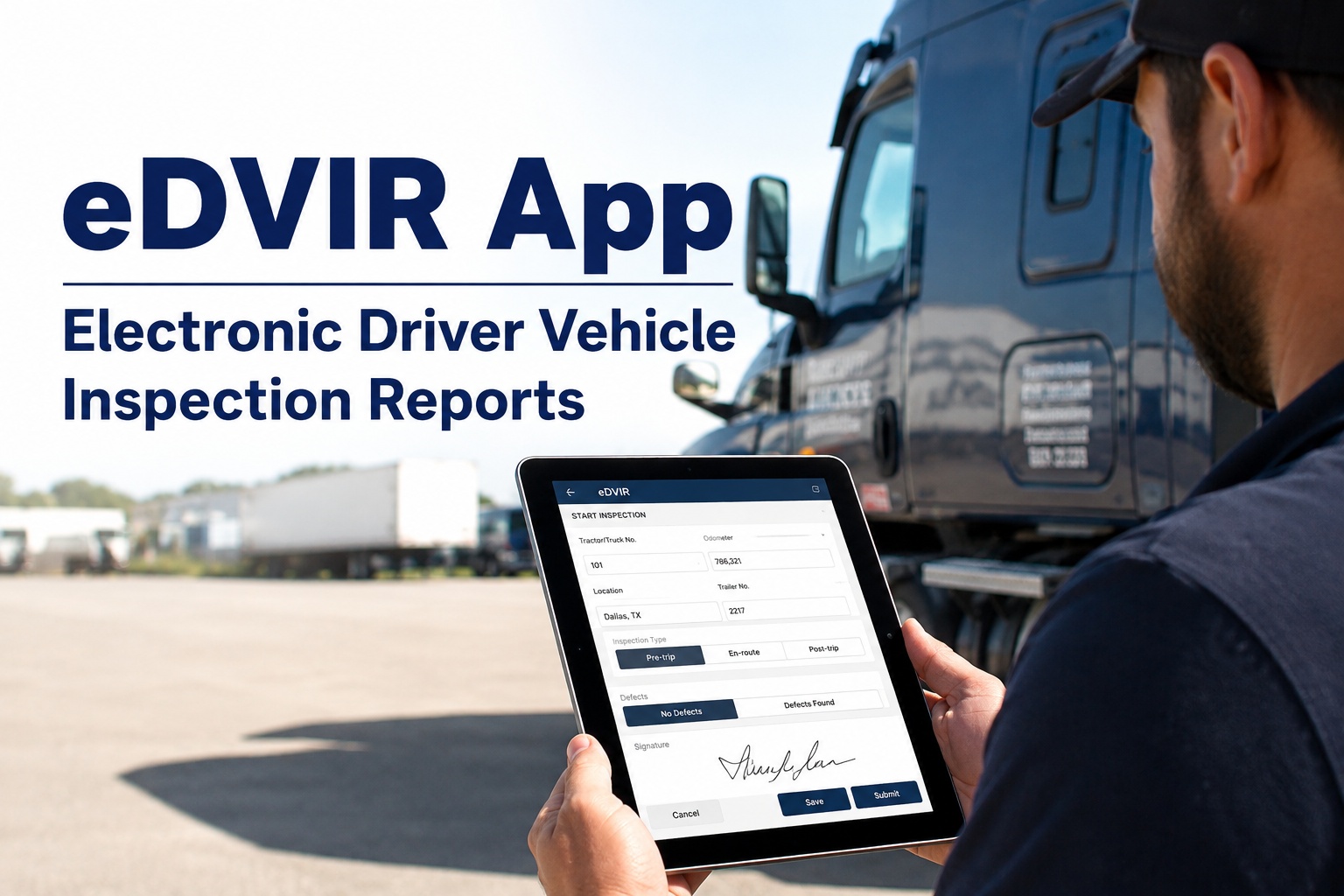
Enforced eDVIR workflow on any phone
Drivers complete the inspection on a phone or tablet in the cab, the yard or at a remote site. The form will not submit without the required fields, a signature and — for defects — a photo. No partial reports, no rubber-stamping.
Automated three-signature chain
The driver signs at report, the mechanic signs at repair certification, the next driver signs at acknowledgement. Each signature is time-stamped and bound to the record. The chain cannot close with a missing link.
Dispatch lock until repair certified
When a driver logs a defect, the unit is locked from dispatch until a mechanic signs off the repair. No driver takes out a unit with an open defect — the system enforces it, not a memo.
Photo and GPS capture on every report
Every defect carries a photo taken in the app and a GPS fix from the device. The evidence is bound to the record, not sitting in a separate text message or a driver's personal photo roll.
You can start logging compliant inspections free today, or see the full DVIR-to-work-order flow on a live call before you commit.
What the eDVIR rule means for your fleet right now
The legal grey zone is over
FMCSA-2025-0115 makes an electronic DVIR explicitly compliant under 396.11 and 396.13. There is no longer a regulatory reason to stay on paper.
Digital is more defensible
Timestamps, GPS and photo evidence create a record that is harder to challenge in an audit or in court than a paper form pulled from a glovebox.
The signature chain still rules
Driver, mechanic, next driver — three electronic signatures, each time-stamped. A compliant eDVIR app enforces the chain; paper relies on memory.
CSA is watching DVIR quality
Inspection report quality now carries its own visibility. Fleets that catch defects pre-trip and certify repairs fast will see the difference in their scores.
"We used to get a roadside inspection and someone would be in the yard flipping through a binder trying to find the last DVIR for that truck. Half the time the signature was missing or the carbon was unreadable. With the app, the inspector sees the last report, the photo of the defect and the mechanic's sign-off on the screen before I even get the call. That alone was worth the switch — and now it is the compliant way too."
— Martin Reyes, Director of Maintenance, a 60-truck regional carrier in the Midwest
eDVIR app questions fleet managers actually ask
Is an electronic DVIR now fully FMCSA compliant under the 2026 rule?
Yes. FMCSA-2025-0115, effective 23 March 2026, explicitly authorises electronic DVIRs under 49 CFR 396.11 and 396.13. An eDVIR app that captures the driver report, mechanic certification and next-driver acknowledgement electronically — with timestamps — is fully compliant. If you want to see how the workflow maps to the rule on your own units, book a demo and we will walk through it.
Do I still need the three signatures on a digital DVIR?
Yes. The final rule preserves the three-signature chain — driver report, mechanic repair certification and next-driver acknowledgement. The only change is that each signature is captured electronically and time-stamped. A compliant app enforces all three before the record can close.
How long must electronic DVIRs be retained?
The three-month retention requirement applies to electronic DVIRs exactly as it does to paper. The difference is retrieval: a digital record can be filtered by vehicle, date, driver or defect in seconds, whereas a paper report means digging through a filing cabinet for the same period.
Can drivers use the eDVIR app offline at a remote site?
A properly built mobile DVIR app works offline. The driver completes the inspection, captures photos and signs on the device; the timestamp and GPS are stored locally and sync to the cloud when the device reconnects. The record remains defensible because the capture data is locked at the moment of signature, not at sync.
What happens if a driver logs a defect in the eDVIR app?
The defect is captured with a photo and GPS location, the driver signs the report, and the app can lock the unit from dispatch until a mechanic certifies the repair. The mechanic signs electronically, and the next driver must acknowledge the repair before taking the unit out — completing the 396.11 chain.