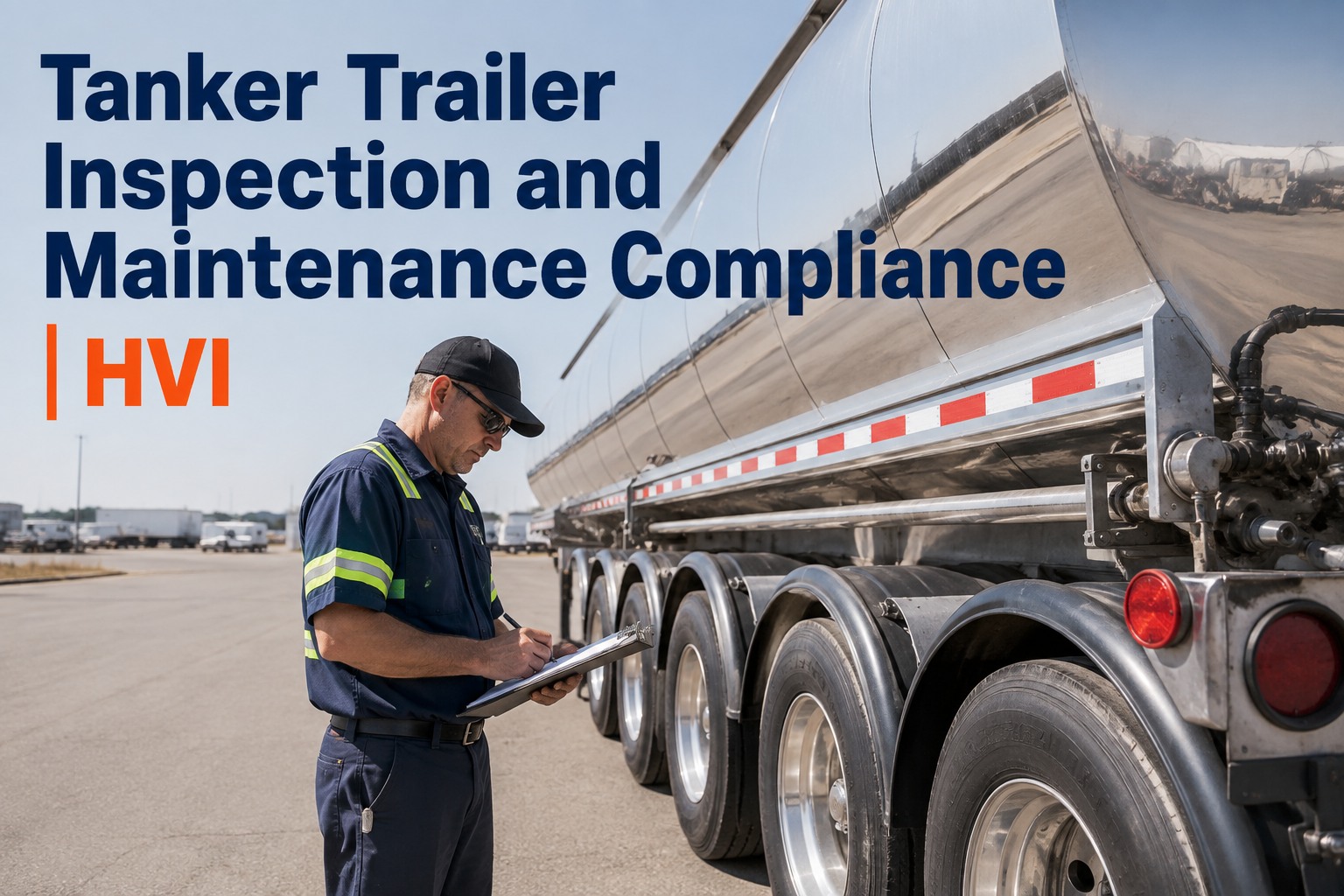
You know the feeling when a tanker trailer gets pulled at roadside and the officer asks for the last leakage test report — and the answer is a shrug, a phone call to the shop, and forty minutes of digging through a filing cabinet that may or may not have the right paper. Tanker trailer maintenance is a different discipline from flatbed or van work: a cargo tank carries its own periodic test regime on top of the annual inspection, and if any one of those tests lapses, the trailer is out of service until it passes. Miss the date and you do not get a warning — you get a grounded unit, a scrambled dispatch board, and a customer asking why the load is late. This page walks through the full cargo tank compliance picture — the tests and their intervals, the registered facility rule, the valve and vapour system checks, the rollover risk profile, and the record trail that keeps auditors happy — and shows how fleets track every due date per unit instead of per spreadsheet. If you want to see how that tracking works on your own tank numbers, book a 30-minute walkthrough and bring your messiest trailer file.
One expired tank test can ground the trailer. Are you tracking every due date?
A cargo tank trailer carries periodic tests with different intervals, a registered facility requirement, and a record trail that must survive an audit. Most fleets track all of it in a spreadsheet — until a test lapses and the unit sits.
What a missed cargo tank test actually costs you
The test itself is not the expensive part. The expensive part is the trailer sitting idle, the load rebooked, and the audit finding that follows.
A periodic test that lapses does not come with a warning period. The unit is out of service until it passes — full stop.
Unlike a worn tyre or a soft brake, a lapsed test is not a defect you can schedule around. It is a hard stop on dispatch.
External visual, internal visual, leakage, pressure, thickness, annual inspection — each with its own interval and its own paperwork.
Registered facility slots book out. You need 90, 60 and 30-day alerts per unit, not a calendar reminder the week before.
Tanker trailer periodic tests: what is due and when
The intervals below are the general pattern for DOT 407 and DOT 412 cargo tanks in US service. Exact intervals depend on the tank specification, the material hauled, and the service history — confirm current requirements with FMCSA and PHMSA before setting your schedule.
| Test or Inspection | Typical Interval | What It Covers | What Happens If It Lapses |
|---|---|---|---|
| External visual inspection | Annual | Shell, heads, welds, supports, valves, closures, and appurtenances for corrosion, damage, or leakage | Unit out of service until completed and documented |
| Internal visual inspection | Varies by spec and service | Interior shell and heads for corrosion, pitting, cracking, or lining failure | Unit out of service; may require confined-space entry procedure |
| Leakage test | Annual (with external visual) | Tank and closures hold product without seepage at prescribed pressure | Unit out of service until it passes |
| Pressure test (hydrostatic or pneumatic) | Periodic — interval varies by spec | Structural integrity of the shell under test pressure | Unit out of service; failure may require re-rating or retirement |
| Thickness test | Periodic — interval varies by spec and corrosion history | Shell and head thickness measured against minimum allowable | Unit out of service; thin readings may trigger re-rating |
| Annual vehicle inspection | 12 months | Full DOT annual inspection — brakes, lights, tyres, suspension, coupling | Out-of-service violation at roadside; CSA hit |
Each row is a separate due date on a separate clock. A fleet running ten tankers is tracking fifty-plus obligations, each with its own interval, its own facility requirement, and its own report. If you want to see how HVI tracks all of them per unit with automatic alerts, walk through it on a live demo with your own trailer list.
Who can actually sign off a cargo tank test
Not every shop can stamp a cargo tank report. Certain inspections and tests must be performed by a facility registered with the relevant authority — and the registration has to match the test being done.
Registered cargo tank facility
Pressure tests, thickness tests, and certain internal inspections must be performed by a facility holding current registration for that test type. A general repair shop cannot sign off a hydrostatic test just because it has a bay and a compressor.
Test report retention
Every test generates a report that must be retained and available for inspection. The report identifies the tank, the test performed, the result, the facility, and the date. Losing the report is treated the same as never doing the test.
Tank marking and plate
The tank carries a specification plate and test markings that show the last test dates. An officer at roadside can read the plate and ask for the matching report in the same breath. If the plate says one thing and the paper says another, you have a problem.
The practical issue for a fleet manager is scheduling: registered facility slots are limited, and a tank that needs a pressure test next month needs a booking this month. Fleets that start tracking test dates in HVI free get 90, 60 and 30-day alerts per unit, so the booking call happens before the slot fills, not after the date passes.
Valves, closures and vapour systems: the parts that decide whether you load or sit
A tank that passes its structural tests can still be shut down at the rack if a valve weeps, a closure gasket is cracked, or the vapour recovery line is blocked. These are the components that get checked every load — and the ones that fail between periodic tests.
Valve and closure condition
- Internal and external valves operate fully and seal without weep
- Manhole and fill cover gaskets intact, no cracking or compression set
- Pressure relief valves free of corrosion and within test date
- Emergency valve actuation tested — remote closure works from the cab
Vapour recovery system
- Vapour lines and couplings free of blockage, kinks, and worn seals
- Vapour recovery adapters seal against the rack connection
- Vent system operates — no vacuum lock during unloading
- Any vapour system modification documented and within spec
What a failed valve costs you
A weeping internal valve found at the loading rack means the load is refused, the trailer goes back empty, and the repair happens on the rack's schedule, not yours. A gasket that fails during unloading is a spill, a cleanup, and a reportable incident. These are not periodic test items — they are daily inspection items, and they belong on the driver's pre-trip, not in the shop's inbox.
Why tankers roll differently — and what that means for your inspection program
A cargo tank trailer has a higher centre of gravity than a flatbed or van, and the liquid load shifts. A partially loaded tank sloshes; a fully loaded tank surges on braking. Rollover thresholds for tankers are lower than for dry freight, and the consequences of a rollover with a hazmat load are measured in road closures and cleanup contracts, not bent sheet metal.
The risk profile
Tanker rollovers are disproportionately represented in serious commercial vehicle incidents relative to their share of the fleet. The load does not have to be hazmat — a milk tanker rolling on an off-ramp closes the road just as effectively. Drivers need specific training on slosh, surge, and cornering speed, and that training needs to be documented.
The maintenance connection
Stability depends on the equipment doing its job: brakes balanced across axles, suspension holding ride height, tyres at correct pressure and matched tread depth. A tanker with a weak brake on one axle or a sagging airbag on one corner handles worse in an emergency manoeuvre. The pre-trip inspection is where those defects get caught — if the driver is actually doing one and the defects actually reach the shop.
This is where a digital DVIR pays for itself on a tanker fleet. A driver flags a soft brake pedal or a leaning trailer on their phone, the defect becomes a work order before the unit leaves the yard, and the record is timestamped and photo-backed. If your current process is a paper book and a text message, see how the defect-to-work-order flow works on a live unit.
When the load is hazardous, the paperwork doubles
A tanker hauling a regulated hazardous material carries the full cargo tank test regime plus the hazmat overlay: shipping papers, placarding, driver endorsement, security plan where required, and emergency response information. The maintenance side does not get simpler — it gets more documented.
Tank spec matches the product
The cargo tank specification must be authorised for the material being hauled. A DOT 407 is not a DOT 412. Loading the wrong spec tank is a violation before the wheels turn.
Test dates current and documented
Every periodic test must be in date, and the reports must be available. A hazmat load on a tank with a lapsed pressure test is a compound violation — the test lapse plus the hazmat movement on an unqualified tank.
Driver endorsement and training current
The driver needs the hazmat endorsement, the tanker endorsement, and current hazmat training. Training records are auditable. An expired endorsement discovered at roadside puts the load on the ground.
Placarding and shipping papers correct
Placards match the shipping papers, the emergency response guide is in the cab, and the carrier's security plan is current where required. These are the driver's responsibility to verify — and the fleet's responsibility to audit.
Stop tracking tank tests in a spreadsheet
HVI tracks every test interval per unit, alerts you at 90, 60 and 30 days, and keeps every report audit-ready with photos and timestamps. See it running on your own fleet.
Tanker trailer compliance, tracked per unit — not per spreadsheet
HVI is built for fleets that run mixed equipment and cannot afford a grounded trailer. Here is what it does for a tanker operation specifically.
Multiple interval tracking per unit
Each cargo tank carries its own set of test intervals — external visual, internal visual, leakage, pressure, thickness, annual inspection. HVI tracks every one separately per unit, with 90, 60 and 30-day alerts so the registered facility booking happens before the slot fills.
Audit-ready test records
Every test report, every inspection, every repair is timestamped, photo-backed, and attached to the unit. When an auditor or a roadside officer asks for the last leakage test, you pull it up on your phone in seconds — not in forty minutes from a filing cabinet.
Defect-to-work-order in one step
A driver flags a weeping valve or a cracked gasket on the pre-trip DVIR, and HVI converts it to a work order before the unit leaves the yard. No paper book, no text message photo, no defect that lives in a group chat until the trailer fails at the rack.
One platform across the whole fleet
Tankers, dry vans, flatbeds, tractors, and shop equipment all live in the same system. Your compliance rate, cost per asset, and overdue list are on one dashboard — not split across three spreadsheets and a whiteboard.
Fleets that move their tanker compliance into HVI typically start with the test interval tracking, then add the DVIR and work order flow once the drivers see how fast the phone inspection is. You can sign up free and load your first units today, or book a demo and bring your current spreadsheet — we will show you what the same data looks like with alerts on.
Tanker trailer maintenance compliance: what to remember
A cargo tank carries five or more separate test and inspection obligations, each with its own interval and its own due date. A lapsed test grounds the unit — there is no grace period.
Certain tests must be performed by a registered cargo tank facility, and the reports must be retained and available. Losing the report is the same as never doing the test.
Valves, closures, and vapour systems fail between periodic tests. They belong on the daily pre-trip, and defects need to reach the shop before the unit reaches the rack.
Tankers roll differently. Brakes, suspension, and tyres are stability equipment on a tanker, not just wear items. The pre-trip inspection is where stability defects get caught.
Confirm current test intervals and facility requirements with FMCSA and PHMSA — intervals vary by tank specification and service, and the rules change. Then track every date per unit, with alerts, in a system built for it.
We run fourteen tankers and I used to track test dates on a whiteboard in my office. Missed one internal visual by eleven days — the trailer sat for three weeks waiting on a facility slot. Now every unit has its own alert chain and I get the 90-day ping before the shop even knows the date is coming. I have not had a grounded tank since.
Tanker trailer inspection and compliance FAQs
What periodic tests does a cargo tank trailer need?
What happens if a cargo tank test lapses?
Who can perform a cargo tank pressure test?
How long do I need to keep cargo tank test records?
Does the annual DOT inspection cover the cargo tank tests?
Every tank test, every due date, every report — in one place
HVI tracks your cargo tank intervals per unit, alerts you before dates pass, and keeps every record audit-ready. See it on your own fleet in a 30-minute demo.
Free to start — Works on any phone — No card needed