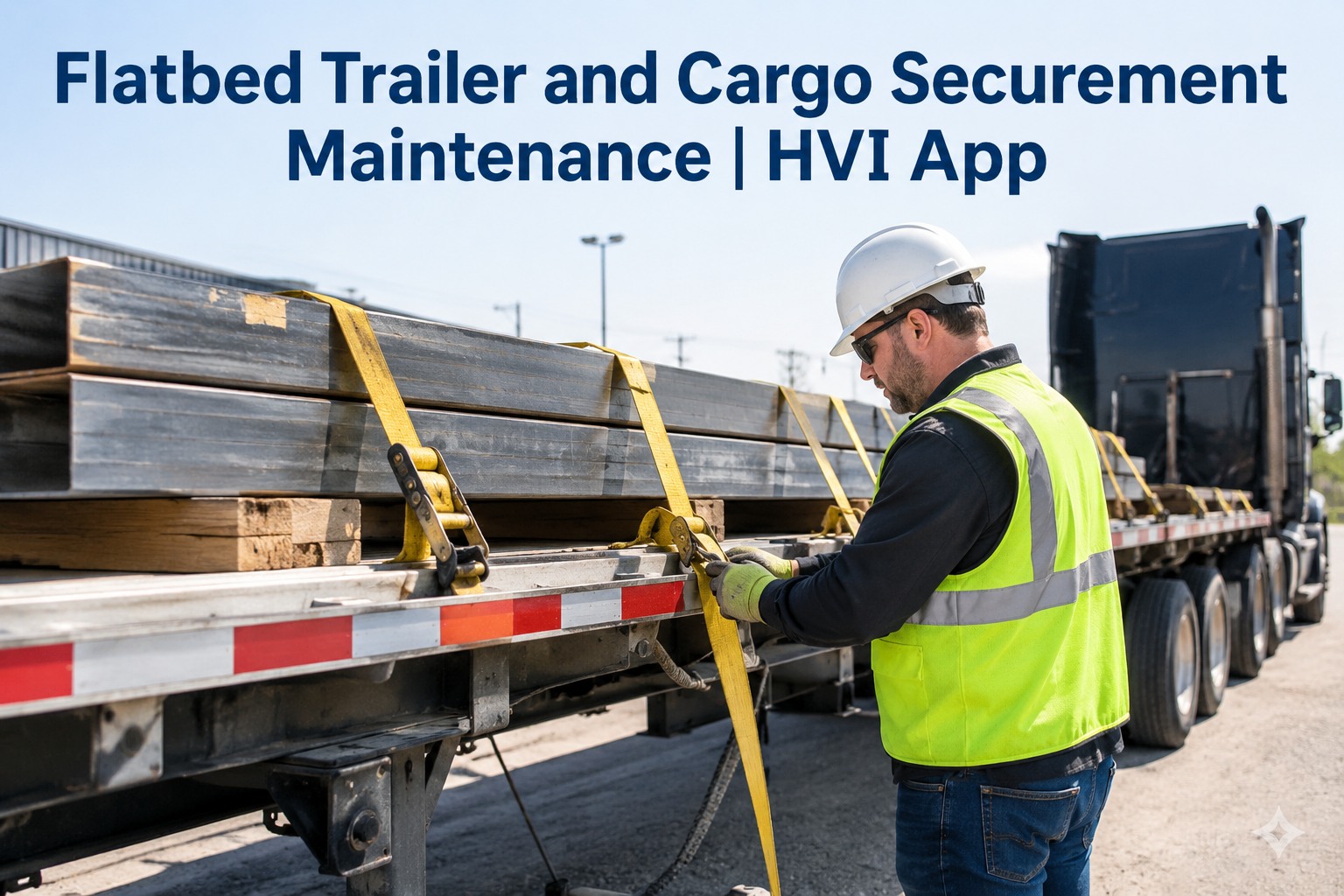
You're watching a driver throw a strap over a coil at 6 AM, and you already know that strap has a cut near the hook that nobody wrote down. That moment is where flatbed trailer maintenance either holds up or falls apart, because cargo securement is the published focus of the 2026 CVSA Roadcheck and flatbed operations will get the closest look. Tiedowns, winches, deck condition and stake pockets all get examined, and the outcome is decided by your records, not your driver's confidence. If your securement program still lives in a binder and a group chat, now is the time to walk through a digital inspection setup on your own units before an inspector does it for you.
Is your securement gear inspection-ready, or just load-ready?
CVSA has named cargo securement the emphasis area for the 2026 International Roadcheck. Every chain, strap, binder, winch and rub rail on your flatbeds is fair game. Here is what gets checked, what triggers removal from service, and how to prove condition with data instead of opinion.
What a securement failure actually costs you
Cargo securement violations sit near the top of roadside out-of-service categories every year. These are the numbers your day is measured against.
Cargo securement inspection: what pulls a tiedown from service
Inspectors do not guess. They look for specific, documented defect types on every securement device. Your drivers should be applying the same standard every morning, not learning it at a scale house.
Chains and binders
Look for stretched, twisted or bent links, gouges, weld splatter and corrosion that pits the metal. A chain binder inspection covers cracked handles, bent levers and worn pivot pins. Any deformation means the grade stamp no longer tells the truth about strength.
Synthetic straps
A strap condition inspection checks for cuts, burns, abrasion through the webbing, broken stitching and UV degradation. Knots in a strap are an automatic defect. Edge damage matters most because straps fail from the side inward under tension.
Working load limits
Every device carries a working load limit, marked or assigned by default tables. The aggregate WLL of all tiedowns must equal at least half the cargo weight. If the tag is missing or illegible, the inspector assigns the lowest default value for that size and type.
Winches and anchor points
Winch track maintenance is part of securement, not an afterthought. Cracked welds on winch mounts, corroded track sections and binders that will not release under load all count. The anchor point is only as strong as the steel it is welded to.
How many tiedowns does the load actually require?
Most drivers apply the count from habit, not calculation. That works until an inspector runs the numbers on an unusual load. The baseline rules for load securement are simple to state and easy to get wrong under pressure.
The two-tiedown floor
Every article gets at least two tiedowns regardless of size. Short and light does not mean exempt, and one strap over anything is never compliant.
Five feet and under, 1,100 lb and under
Articles up to 5 ft and 1,100 lb can ride with one tiedown in specific cases, but stacking or blocking changes the picture fast. When in doubt, add the second device.
Over 5 ft up to 10 ft: two tiedowns
Anything longer than 5 ft needs two tiedowns minimum. Weight over 1,100 lb on a short article also pushes you to two.
Over 10 ft: one more per 10 ft or fraction
A 34 ft beam needs four tiedowns minimum: two for the first 10 ft, then one for each additional 10 ft or part of it. Drivers who count by habit often stop at three.
Aggregate WLL: half the cargo weight
Count is only half the test. The combined working load limit of every tiedown on the article must reach 50% of the cargo weight. Four light straps can fail where two chains pass.
Rules vary by jurisdiction and commodity, and special cases like coils, metal products and heavy machinery carry their own requirements. Confirm current requirements with FMCSA and CVSA before you set your internal standard, then build that standard into your checklists so drivers apply the rule, not their memory. You can see how a configured checklist enforces the count in a short demo.
Flatbed deck inspection: the structure your securement depends on
A tiedown is only as good as what it hooks to. Flatbed decks take brutal point loading from coils, machinery and concentrated pallets, and the damage hides exactly where the securement gear attaches.
Structural points that fail quietly
- Stake pockets: cracked welds and elongated holes from repeated bar insertion. A stake pocket inspection catches the ones that will tear out under side load.
- Rub rails: bent sections and broken fasteners. The rub rail is where most straps and winches anchor, so a weak rail downgrades every device on that side.
- Winch tracks: corrosion between track and rail, cracked welds at the ends, and sliders that seize. Winch track maintenance keeps the anchor movable and rated.
- Main beams and crossmembers: point loads from coils and machines crack flanges and buckle crossmembers. A flatbed annual inspection should include a crawl-under look, not just a walk-around.
- Deck surface: rotted or oil-soaked wood and worn apitong reduces friction, and friction is part of the securement calculation.
Tarping equipment and the fall risk
Tarps get inspected for holes and torn D-rings, but the bigger exposure is the person throwing them. Falls from flatbed decks are a well-known injury source across the industry, and tarping stations, fall protection and three-point contact rules belong in the same program as the gear itself.
Your flatbed DVIR items should cover tarp condition, bungee and strap integrity, and the state of any ladder or platform the driver climbs. When a driver reports a torn tarp or a bent ladder rung, that report should become a tracked repair, not a text message that scrolls away. Fleets that start logging these defects digitally stop losing them in the shuffle.
What one roadside securement stop costs a 25-truck flatbed fleet
Run the arithmetic once and the case for documented condition makes itself. This is an illustrative example, but every number in it is the kind your own operation already tracks.
Now multiply by frequency. If your fleet averages one securement-related stop a quarter, you are spending several thousand dollars a year on defects that a photo and a work order would have caught in the yard. That is before insurance looks at your scores. Fleets that book a walkthrough of defect-to-work-order flow usually find the payback inside the first prevented stop.
See your securement program the way an inspector will
Book a 30-minute demo and we will load your flatbed checklist, your tiedown rules and your defect flow into HVI on the call.
Securement compliance: what to inspect and what to keep on file
A securement audit is won or lost on documentation. This mapping shows what gets examined and the record that answers it. Keep both sides current and the audit becomes a formality.
| What gets examined | Defects that trigger removal | Record that answers it |
|---|---|---|
| Chains and binders | Stretched links, cracks, bent handles, corrosion pitting | Dated condition check with photo per device set |
| Synthetic straps | Cuts, abrasion, burns, knots, broken stitching | Strap condition inspection log with defect photos |
| Working load limits | Missing or illegible WLL markings | Device register with WLL values per unit |
| Winches and tracks | Cracked welds, seized sliders, corroded track | Winch track maintenance history per trailer |
| Stake pockets and rub rails | Torn pockets, bent rails, broken fasteners | Trailer structural inspection with photo evidence |
| Deck and crossmembers | Cracked flanges, buckled members, rotted deck | Flatbed annual inspection plus interim DVIR notes |
| Tarping equipment | Torn tarps, broken D-rings, damaged ladders | Equipment condition log tied to repair work orders |
The pattern is simple: every physical item on the left needs a timestamped, photo-backed record on the right. Paper can hold this, but paper cannot produce it in thirty seconds at a scale house or during a client audit. If you want to test that difference, bring one trailer's file to a demo and compare retrieval times.
Flatbed trailer maintenance software that proves condition, not opinion
HVI is a cloud and mobile CMMS built for fleets that live on inspections. Four capabilities carry your securement program end to end.
Configurable securement checklists
Build your tiedown count rules, WLL checks and deck points into the exact checklist your drivers see. No generic form, no skipped items, on any phone in the yard or at the dock.
Photo capture on every defect
A cut strap gets photographed at the moment it is found, timestamped and pinned to the trailer. When an inspector questions condition, you show the record instead of arguing.
Defects auto-generate work orders
A failed winch or torn rub rail becomes a tracked work order the second it is reported, with parts and labour attached. Nothing waits for a text message to be noticed.
Audit-ready compliance reporting
Pull a trailer's full securement history in seconds: inspections, defects, repairs, costs. DOT, client, safety and insurance audits stop being a week of binder digging.
Flatbed trailer maintenance before the 2026 Roadcheck: the short version
Cargo securement is the 2026 CVSA Roadcheck focus. Flatbeds will be examined harder than any other configuration, so treat every week between now and then as preparation.
Device condition decides outcomes. Cuts, abrasion, deformation and corrosion all trigger removal from service, and aggregate working load limit must reach half the cargo weight.
The trailer is part of the system. Stake pockets, rub rails, winch tracks, decks and crossmembers all carry the load your tiedowns apply, and all of them belong on the inspection.
Records settle disputes. A timestamped photo beats a confident answer every time, and a defect that auto-generates a work order never becomes the strap that fails at a scale house.
Confirm current rules with FMCSA and CVSA, set your internal standard, then make that standard the easiest thing your drivers do all day. That is the whole play, and it is exactly what a free HVI account is built to run.
"I used to find out about bad straps when a driver texted me a photo from a truck stop, three states away, asking what to do. Now the strap gets flagged at the morning walk-around, photographed, and my shop has a work order before the driver finishes his coffee. The number I watch is roadside securement write-ups. Last year we had four. This year, zero, and I can show you the inspection trail for every tiedown on every trailer."
Cargo securement and flatbed maintenance FAQs
What is the cargo securement focus of the 2026 CVSA Roadcheck?
How many tiedowns does a load legally require?
What defects remove a strap or chain from service?
Does trailer condition really affect securement compliance?
How do I document securement equipment condition for an audit?
Make your securement records the strongest part of the inspection
Configurable checklists, photo-backed defects and automatic work orders, on any phone your drivers already carry. See it on your own flatbeds before Roadcheck season does.
Free to start - Works on any phone - No card needed