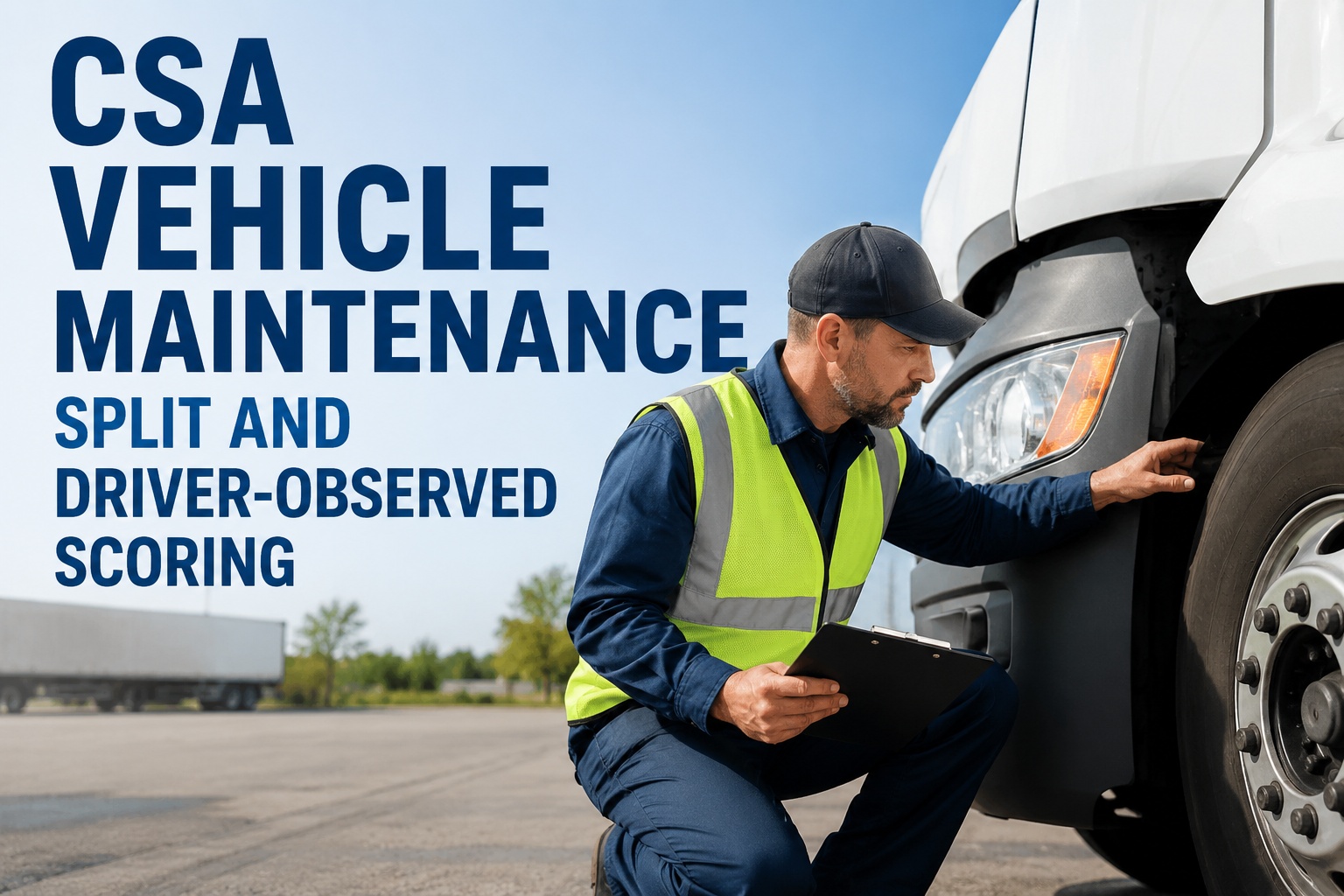
You've seen it happen. A driver walks the truck in four minutes, taps the DVIR, and rolls out. Three hours later a roadside officer writes up a chafed air line and a marker lamp that was out before sunrise. Under the 2026 CSA vehicle maintenance split, that second category now exists specifically for defects a competent pre-trip should have caught — and your DVIR quality is visible in its own public score for the first time. The Vehicle Maintenance BASIC still covers your programme broadly: brake wear trends, recurring lamp faults, inspection history. The new Vehicle Maintenance Driver Observed category isolates the violations a driver should have identified before the wheels moved. That changes a rubber-stamped pre-trip from an internal discipline problem into a scored, public metric. If you want to see what that looks like on your own units, walk through it on a 30-minute demo before the next quarterly review.
CSA Vehicle Maintenance Split
One BASIC became two scores. The second one grades your drivers' eyes.
The 2026 overhaul split Vehicle Maintenance into a broad programme score and a Driver Observed category for defects a proper pre-trip would have caught. Lighting, tyres, obvious brake issues — if your driver should have seen it, it lands in the second score.
Vehicle Maintenance
The broad programme measure. Brake systems, recurring defects, inspection and repair history, patterns across the fleet.
Driver Observed
Violations for conditions a competent pre-trip check would have caught. This is where rubber-stamped DVIRs now cost you directly.
What the split costs you
Four numbers that change how you run pre-trips
These are not abstract compliance figures. Each one maps to a budget line, a score, or a truck sitting on the shoulder.
2
Scoring categories where there used to be one — your maintenance programme and your drivers' pre-trip quality are now graded separately.
1st
Time DVIR and pre-trip quality has been visible in its own public CSA score, not buried inside a broad BASIC.
3
Defect families that dominate Driver Observed hits: lighting, tyres, and obvious brake issues a walk-around would catch.
100%
Of rubber-stamped pre-trips now feed a score directly. A pencil-whipped DVIR is no longer a private habit.
CSA maintenance score explained
What the CSA vehicle maintenance split actually measures
The split is not a rename. It is a second lens aimed at the cab, not just the shop.
Vehicle Maintenance — the programme view
This category still reflects your overall maintenance health. Brake adjustment trends, recurring lamp and wiring faults, whether defects found at inspection get repaired, and whether the same unit keeps coming back for the same problem. It answers: does your maintenance programme actually work?
Vehicle Maintenance Driver Observed — the cab view
This category captures violations for conditions a competent pre-trip would have caught before departure. A marker lamp out at dawn. A tyre with exposed cord. An audible air leak at the gladhands. It answers: did the driver look, and did the checklist make them look?
The consequence: pre-trip quality is no longer an internal coaching topic. It is a scored, percentile-ranked, public metric. A driver who taps through a DVIR in ninety seconds is now directly damaging a number your customers, insurers, and enforcement officers can see.
Driver observed violations
Which defects land in the Driver Observed category
If a driver walking the truck with a flashlight should have seen it, it belongs here. These are the defect families that feed the second score.
Lighting and conspicuity
- Marker, clearance, and tail lamps out
- Headlamp or turn signal inoperative
- Missing or damaged reflective tape
- License plate lamp out
Tyres and wheels
- Exposed cord or belt material
- Flat or visibly underinflated tyre
- Tread separation or bulge
- Missing or loose wheel fasteners
Obvious brake issues
- Audible air leak at gladhands or lines
- Chafed or bulging air hose
- Slack adjuster visibly out of stroke
- Low air warning before build-up
Visible structure and coupling
- Cracked frame rail or crossmember
- Fifth-wheel jaw visibly not closed
- Safety chain or pin missing
- Load securement visibly shifted
The common thread is detectability. None of these need a lift, a gauge, or a technician. They need a driver who actually walks the vehicle and a checklist that forces the eyes to the right places. If your current DVIR lets a driver mark "all good" without ever bending down to look at a steer tyre, the Driver Observed score will find that gap. You can start logging photo-backed inspections free and see the difference in the first week.
DVIR quality CSA impact
How a rubber-stamped pre-trip moves your score
A worked example makes the cost concrete. This is an illustrative 40-truck carrier, not a real customer.
The habit
Forty drivers, each doing a pre-trip in under four minutes. The DVIR is a tap-through. Nobody photographs anything. Nobody bends down. The checklist exists to be completed, not to find defects.
The roadside hit
Over a quarter, roadside officers write up a marker lamp, a chafed air line, and a tyre with exposed cord on three different units. Each was present before departure. Each was driver-detectable. Each lands in the Driver Observed category.
The score moves
The Driver Observed percentile climbs. Because the category isolates pre-trip quality, there is nowhere to hide it inside a broad maintenance average. The number is public, and it says your drivers are not looking.
The downstream cost
A higher percentile means more roadside attention, more inspections, more delays. Add the out-of-service risk on the tyre and the air line, plus the insurance and customer scrutiny that follows a visible score. The four-minute pre-trip just became the most expensive habit in the fleet.
The fix is not more paperwork. It is a checklist that forces detection, a photo requirement that makes rubber-stamping visible, and a per-driver defect rate you can coach against. That is exactly the workflow HVI enforces — you can see it running on your own units in a demo.
Maintenance score improvement
The improvement path: training, measurement, and a checklist that finds things
You improve the Driver Observed score the same way you improve any other scored behaviour: train it, measure it, and make the measurement hard to fake.
Train the eye, not the tap
Most drivers were never taught what a driver-detectable brake defect actually looks like. Run short, specific yard sessions: here is a chafed air line, here is cord showing, here is a slack adjuster past stroke. Ten minutes per defect family, on a real truck, beats an hour of slides.
Measure inspection quality per driver
Track defects found per pre-trip, per driver, per unit. A driver who never finds anything on a fleet that roadside keeps writing up is not careful — they are not looking. Defect analytics turn that from a suspicion into a number you can coach.
Use a checklist that forces detection
A good eDVIR makes the driver confirm each lamp, each tyre, each brake item individually — and capture a photo when something is wrong. That structure is what separates a checklist that finds defects from one that just records a signature.
Set a monitoring cadence
Review the Driver Observed category monthly, not annually. Confirm the methodology with FMCSA as the 2026 changes bed in, watch which defect families recur, and feed that back into the next training session. The score moves slowly; your review cycle should not.
See your Driver Observed risk before roadside does
HVI enforces a photo-backed eDVIR, tracks defects per driver and unit, and makes rubber-stamping visible. Book a 30-minute demo and we will walk it on your own fleet.
How HVI helps
Turn pre-trip quality into a score you control
HVI is built for exactly this problem: making driver inspections real, measurable, and audit-ready.
Enforced eDVIR with photo capture
Drivers confirm each inspection item on any phone or tablet, and capture a photo when they flag a defect. A ninety-second tap-through leaves no photos and no detail — which makes rubber-stamping visible for the first time. Outcome: pre-trips that actually find driver-detectable defects before roadside does.
Defect analytics per driver and unit
See defects found per pre-trip, broken down by driver and by unit. Spot the driver who never finds anything and the truck that keeps generating the same fault. Outcome: coaching targeted at the people and assets actually moving your Driver Observed score.
Pre-trip readiness verification
Confirm a unit has a completed, defect-cleared pre-trip before it leaves the yard. Open defects route straight to a work order, so nothing rolls with an unresolved driver-detectable fault. Outcome: fewer roadside surprises and a clean, timestamped record for any audit.
Audit-ready inspection history
Every DVIR is timestamped, photo-backed, and stored in one place across trucks, trailers, and mixed plant. When enforcement, an insurer, or a customer asks how you manage pre-trip quality, you show them in seconds. Outcome: the paperwork argument is over before it starts.
If you are still running paper DVIRs, spreadsheets, or photos scattered across group chats, the move is simpler than you think. Most fleets are live in days, and drivers need almost no training. You can book a demo and see the eDVIR workflow on a unit from your own yard.
CSA maintenance strategy
Your monitoring cadence for the new two-category score
The split rewards fleets that review often and act on specific defect families, not fleets that glance at a percentile once a year.
| Cadence | What you check | What you do with it |
|---|---|---|
| Weekly | Defects found per pre-trip, per driver | Flag drivers with zero findings on a fleet that roadside is writing up; coach immediately. |
| Monthly | Driver Observed category trend and defect families | Feed recurring families — lighting, tyres, brakes — into the next yard training session. |
| Quarterly | Both Vehicle Maintenance categories side by side | Confirm the programme score and the driver score are moving together; investigate any divergence. |
| Ongoing | FMCSA methodology updates | Confirm scoring methodology directly with FMCSA as the 2026 changes are finalised and refined. |
The point of the cadence is feedback speed. A defect family you spot in week one is a training session in week two and a avoided violation in month two. A defect family you spot at the annual review is a year of public score damage. If you want the per-driver and per-unit data without building spreadsheets, walk through the analytics on a demo and see how it looks on a mixed fleet.
Key takeaways
What the CSA vehicle maintenance split means for your fleet
The score is split, not renamed
Vehicle Maintenance still grades your programme. Vehicle Maintenance Driver Observed grades your drivers' pre-trip quality. They are separate numbers, and both are public.
DVIR quality is now a metric
For the first time, the quality of a daily inspection is visible in a CSA score. A rubber-stamped pre-trip is no longer a private habit — it directly damages a number customers and insurers can see.
The fix is detection, not paperwork
Train drivers on what driver-detectable defects look like, measure defects found per pre-trip, and use a checklist that forces the eyes to lighting, tyres, and brakes. Then review the category monthly and confirm methodology with FMCSA.
The CSA vehicle maintenance split did not add a new rule — it added a new mirror. The fleets that come out ahead are the ones that treat pre-trip quality as a measured behaviour, not a signed form. HVI gives you the enforced eDVIR, the photo capture, and the per-driver analytics to do exactly that, and you can start free and see it on your own units this week.
"I used to chase DVIRs for the signature. Now I chase the defects-found number. I have a driver, good guy, twenty years, who went six months without finding a single fault on a truck roadside wrote up twice. That told me everything. We sat him in the yard with a flashlight and a bad air line for fifteen minutes. His findings went up the same week. I track defects per pre-trip every Monday now — it is the first number I look at, before fuel."
Marcus Delaney — Maintenance Manager, regional dry-van and flatbed carrier, 60 power units
CSA vehicle maintenance split FAQ
Questions fleets are asking about the split
What is the CSA vehicle maintenance split?
What counts as a driver observed violation?
How does the split affect my DVIR process?
How do I improve my CSA maintenance score under the new categories?
Should I confirm the scoring methodology with FMCSA?
Make your pre-trip score one you are proud to show
HVI enforces photo-backed eDVIRs, tracks defects per driver and unit, and verifies pre-trip readiness before a wheel turns. See it on your own fleet in a 30-minute demo, or start free today.
Free to start — Works on any phone — No card needed