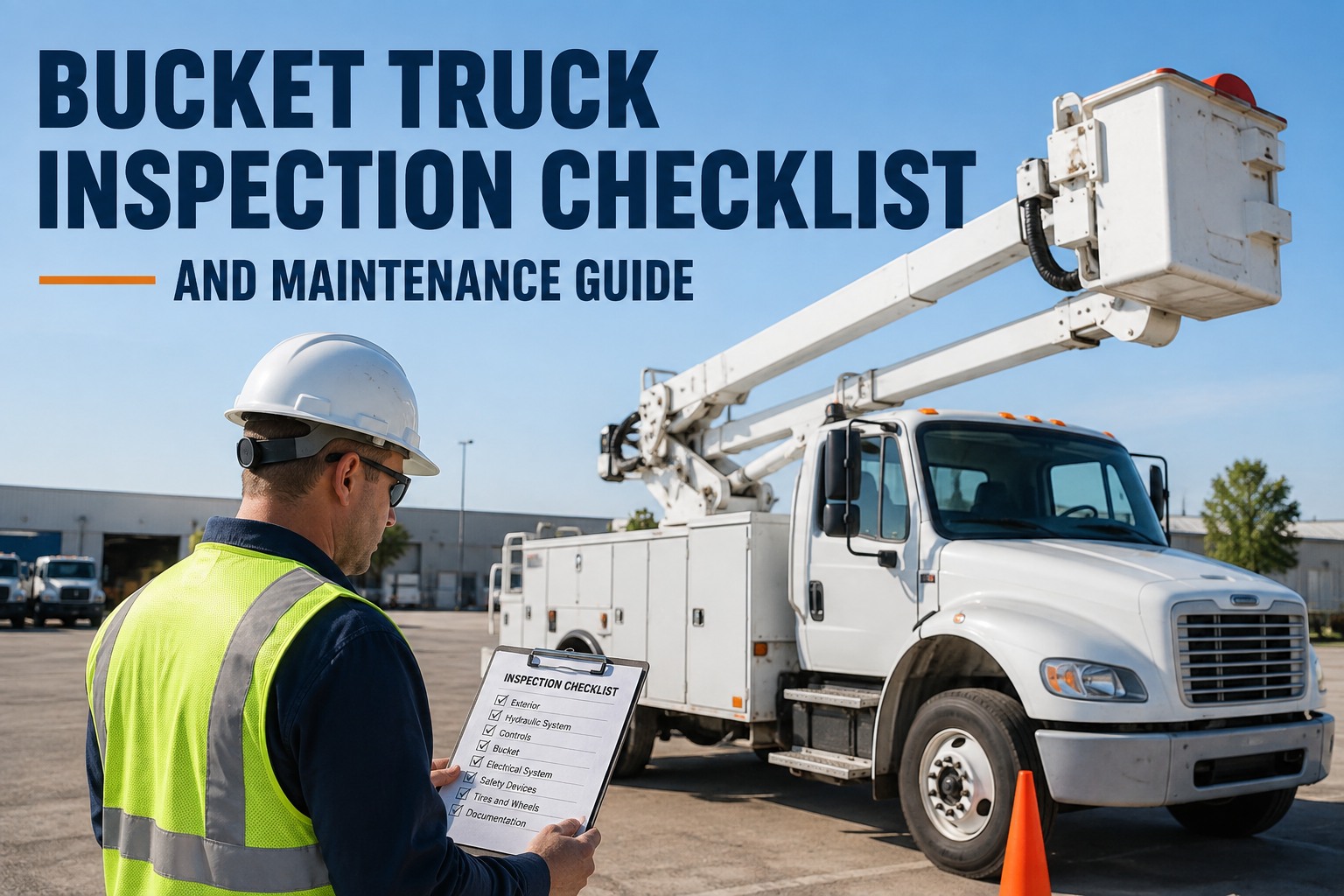
Your lineman is forty feet up in the basket when the boom drifts a few inches off level, and suddenly the morning's routine job is a near-miss report. A bucket truck inspection checklist is the daily pre-use verification of boom and control function at both stations, hydraulics, outriggers, platform attachment, emergency lowering and insulating surfaces, backed by a certificate calendar of frequent, annual and dielectric tests. Unlike a highway tractor, a missed item on an aerial device does not strand a driver at the roadside; it puts a person in the air next to live conductors. This guide walks through the daily check, the structural and hydraulic items that hide between services, the three-interval certificate calendar, and how fleets keep every record audit-ready without a filing cabinet. If you want to see the whole calendar running on your own units, you can book a 30-minute walkthrough of bucket truck inspection profiles and watch it live.
The daily bucket truck check that keeps a lapse from becoming an electrocution
Boom, platform, hydraulics, outriggers and insulating components, verified before the basket leaves the cradle. Here is the checklist and the certificate calendar, both non-negotiable.
- Two-station control function test, ground and platform
- Hydraulic leaks, hose chafing and holding valve behaviour
- Outrigger operation, pad condition and interlock check
- Insulating surfaces clean, dry and free of tracking damage
Bucket truck maintenance by the numbers
Every figure below is money, downtime or risk landing on your desk. The daily check takes minutes; the failures it prevents take weeks to recover from.
The daily bucket truck inspection checklist, zone by zone
Ten minutes before the first job catches the defects that ground the truck for days. Walk the unit in this order and record each item, not just the failures.
Boom & Both Control Stations
- Run the boom through full range from the lower controls: smooth, no drift, no jerks
- Repeat from the platform controls; verify the upper/lower selector transfers cleanly
- Test the emergency stop at both stations and the emergency lowering function
- Listen for unusual pump noise or slow response that signals low fluid or air in the system
Hydraulics & Hoses
- Walk the boom and check every visible hose for chafing, blistering, weeping fittings
- Check cylinder rods for scoring and the reservoir level with the boom stowed
- Look under the turntable and outrigger valves for fresh oil on the frame or deck
- Confirm holding valves keep the boom stationary with engine off; any creep is a red tag
Outriggers & Stability
- Extend and retract each outrigger fully; watch for bent tubes or slow cylinders
- Inspect pads and feet for cracks, missing pins and packed mud that hides damage
- Verify the interlock: boom must not operate until outriggers are set, where fitted
- Check the bubble level or indicator reads true on known-level ground
Platform & Insulation
- Check platform attachment pins, keepers and the leveling system through the range
- Inspect guardrails, gate latch, toe boards and the anchor point for lanyards
- Wipe down and visually inspect insulating boom sections for contamination, cracks or tracking
- Confirm the platform liner is undamaged and the capacity placard is legible
Aerial device inspection schedule: three intervals you cannot move
The daily check is only the first layer. Aerial device standards stack three recurring inspections on top of it, and the certificate dates are what an auditor, insurer or client asks for first.
| Interval | Trigger | What Gets Inspected | Record You Must Hold |
|---|---|---|---|
| Frequent inspection | Every 3 months or 150 operating hours, whichever first | Function tests, hydraulic system, hoses, outriggers, safety devices, platform condition, fasteners | Dated checklist signed by a qualified inspector, defects and corrective actions noted |
| Annual inspection | Every 13 months maximum | Structural: welds, pins, bearings, turntable, rotation bearing bolts, boom sections, NDT where indicated | Full inspection report by a qualified person, with repair records and certification |
| Dielectric test | Every 12 months on insulated units | Insulating boom sections and platform liner tested at rated voltage for leakage current | Test certificate showing pass/fail, test voltage, date and testing agency |
| Chassis service | Mileage or engine-hour PM alongside | Engine, brakes, PTO, driveline, tires, suspension per the truck's own PM schedule | Work orders tied to the same unit record, not a separate binder |
The trap is the 150-hour trigger. A unit working storm restoration can burn 150 hours in six weeks, long before the three-month calendar reminder anyone set in a spreadsheet. Hour-based tracking is the only way the frequent inspection stays honest, which is why fleets book a demo to see hour-meter-driven PM triggers instead of chasing dates.
The hydraulic and structural failures that hide until the annual
Most catastrophic aerial device failures are not sudden. They are slow leaks, creeping valves and fatiguing pins that a trained eye catches months early.
Holding valves and uncontrolled movement
Holding (counterbalance) valves are what stop a loaded boom from dropping if a hose bursts. They fail quietly: the boom still works, but it creeps under load or drifts overnight. The daily engine-off hold test catches this. A boom that settles two inches in ten minutes with the engine off is telling you the valve or cylinder seals are passing, and that unit should be tagged out, not worked around.
Leveling systems and the platform chain
The leveling system keeps the platform floor horizontal through the boom's full range, whether by parallelogram linkage, slave cylinder or chain. Stretched chains, worn linkage bushings and air in a slave cylinder all show up the same way: the basket tilts as the boom rises. Crews adapt by leaning, which is exactly how tools and people end up against conductors. Any tilt beyond the manufacturer's tolerance is a ground-and-repair item.
Turntable, pins and the annual strip-down
The annual structural inspection is where rotation bearing bolt torque, weld cracks at stress points and pin wear get measured, not eyeballed. Elongated pin holes at the boom pivot or pedestal mean the unit has been worked hard or overloaded, and they change the geometry of everything above them. Keep the torque records and NDT reports with the unit; they are the first documents requested after any incident.
Insulation is a surface, not a certificate
An insulated boom passes its dielectric test in a lab condition: clean and dry. In the field, hydraulic oil mist, road film and hand cream from daily use build a conductive layer across the same surface. That is why the daily wipe-down and visual check matters as much as the annual test, and why contamination found at 7 a.m. should be photographed and logged, not wiped off and forgotten. You can start logging photo-backed defect reports free and build that surface history automatically.
See your whole certificate calendar on one screen
Book a 30-minute demo and we will load one of your bucket trucks into HVI live: daily checklist, 150-hour triggers, dielectric dates and chassis PM, all on the unit's record.
Four capabilities built for aerial device fleets
Inspection profiles per vehicle class
Your bucket trucks get the aerial device checklist above; your digger derricks and service bodies get their own. One app, no generic one-size form, and crews cannot skip the two-station control test because the item will not close without an answer.
Photo capture on every defect
A weeping hose fitting or a cracked outrigger pad gets photographed in the yard, timestamped and attached to the unit. That photo converts to a work order in one tap, killing the text-message-to-the-foreman workflow that loses half of what gets reported.
Interval tracking with reminders
The 3-month/150-hour frequent inspection, the 13-month annual and the 12-month dielectric test each run as their own countdown per unit. Due-soon and overdue alerts go to the maintenance manager before the certificate lapses, not after a client audit finds it.
Mileage and hour-based PM
Chassis service runs off the odometer, the aerial device off the PTO hour meter, both feeding the same unit record. Fleets that walk through dual-trigger PM in a demo typically find at least one unit silently past its hours.
What one lapsed dielectric certificate actually costs
A municipal utility with 14 bucket trucks let one unit's dielectric test slip by five weeks during a busy season. Here is the arithmetic that followed.
The test itself costs a few hundred dollars. The lapse cost fifty times that in sidelined capacity, and the unit still had to wait for a mobile test crew's schedule. A 60-day and 30-day reminder, plus an escalation at 7 days, is the entire fix. Fleets running this through HVI set the certificate reminders the day they sign up free and never rebuild the spreadsheet again.
Bucket truck compliance, in one view
- Daily first. The pre-use check of controls at both stations, hydraulics, outriggers, platform and insulating surfaces is the layer that catches everything else early. Ten minutes, every unit, every day, recorded.
- Three intervals, no exceptions. Frequent at 3 months or 150 hours, annual structural inside 13 months, dielectric inside 12. The hour trigger is the one that ambushes high-utilisation units.
- Watch the quiet failures. Holding valve creep, leveling drift and pin wear do not announce themselves. The daily hold test and the annual strip-down exist because these failures look fine until they are not.
- Records are the product. After an incident, the inspection history is the defence. Timestamped, photo-backed records beat a binder of ticked boxes every time, and a bucket truck inspection checklist that lives on a phone gets done instead of pencil-whipped.
My gripe was never the inspections, it was the certificates. We had nine aerials and the dielectric dates lived in a spreadsheet on one laptop. A unit came back from storm duty with 40 hours over its frequent inspection and nobody knew. Now every truck shows a countdown on my dashboard, and I check the red ones with my coffee. We have not missed an interval in two years, and the last insurance audit took an afternoon instead of a week.
Daniel Mercer, Fleet & Compliance Manager, regional electrical utility contractor
Bucket truck inspection and maintenance FAQs
How often does a bucket truck need to be inspected?
What is included in a daily bucket truck inspection checklist?
What happens if a dielectric test expires on an insulated bucket truck?
Why does my bucket truck boom drift or settle overnight?
Can I track bucket truck inspections digitally instead of on paper?
Put every bucket truck on a calendar that cannot slip
Daily checklists on any phone, hour-based frequent inspections, dielectric countdowns and audit-ready records for every aerial device in your fleet.
Free to start · Works on any phone · No card needed