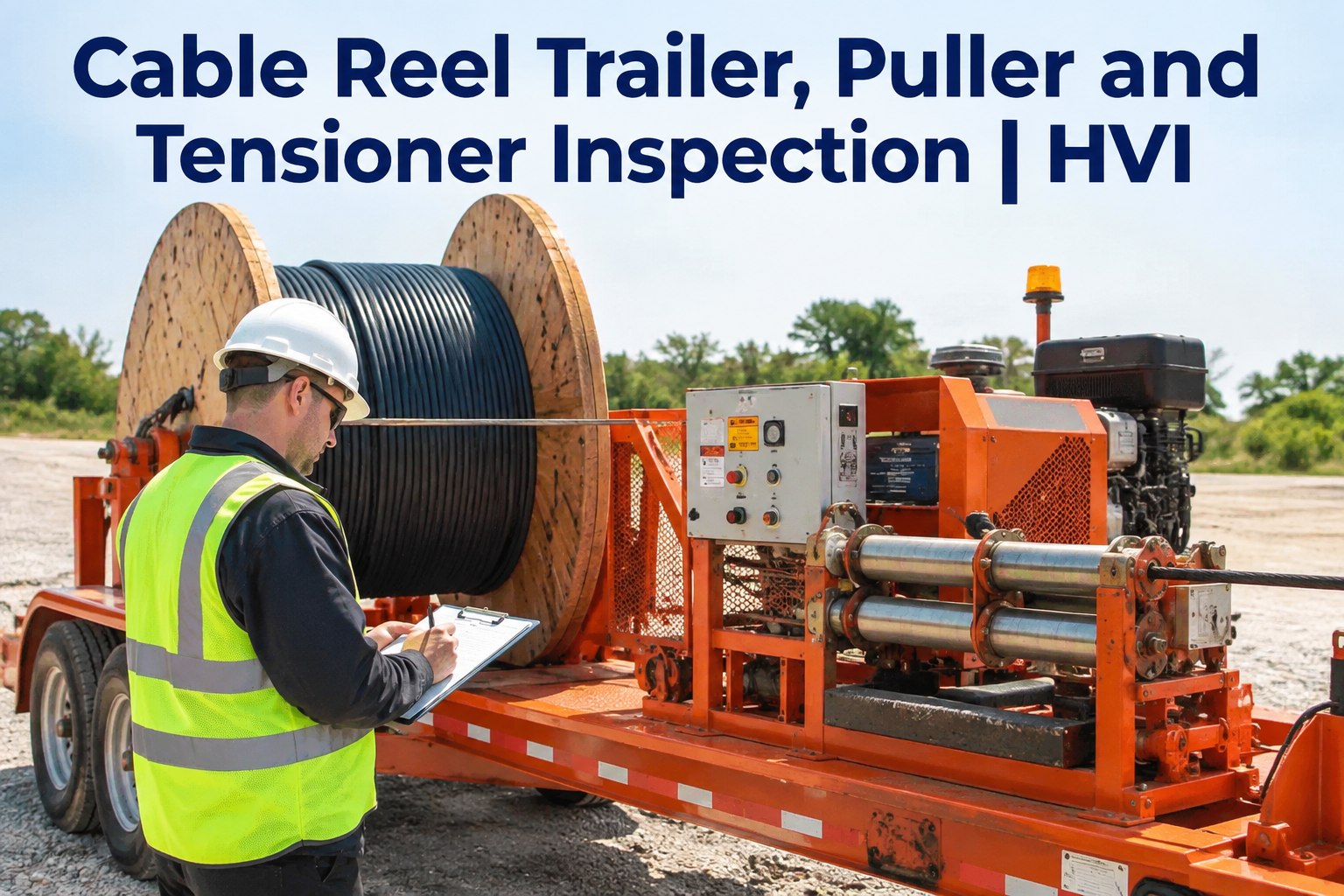
You're standing at the puller site watching the reel spin, the conductor is 600 metres out over the span, and the operator is holding 2,500 kg of tension on a hydraulic brake that hasn't had a documented inspection in months. That is the moment a cable reel trailer inspection stops being paperwork and starts being the only thing between a routine stringing job and a released-energy event that crosses the whole span. Puller and tensioner failures don't give warnings; they give results. This page covers the inspection points that matter on pullers, tensioners, reel trailers, wire rope, stringing blocks and rigging, the grounding and setup discipline that keeps crews safe near energized lines, and how to keep the records that prove it all. If you want to see how this looks digitized on your own equipment, you can walk through it on a live demo with your actual unit list.
A puller failure at full tension releases energy across the entire span. Inspection is the only control you have.
Hydraulic brakes, bullwheels, wire rope, reel trailer spindles, stringing blocks and rigging — every component holding tension is a stored-energy device. Here's what to check, when to retire it, and how to prove it was checked.
What to check on a puller and tensioner before every stringing job
The puller and tensioner are the two machines that control conductor tension across the span. A failure in either one is not a breakdown — it is an uncontrolled energy release. These are the inspection points that matter.
Hydraulic system and brake holding
Check for leaks at every fitting, hose and cylinder. The holding brake must maintain set tension without drift for the full duration of the pull. Test it under load before stringing, not after the conductor is in the air. A brake that creeps under sustained load is a brake that will fail when the reel operator needs it most.
Drum and bullwheel condition
Inspect grooves for wear, scoring and flat spots. A worn bullwheel groove changes the rope's bending radius and accelerates fatigue in the pulling line. Measure groove depth against the manufacturer's minimum — if it is below spec, the drum needs machining or replacement before the next job.
Braking and holding systems
The tensioner's brake is what keeps the conductor from running free if the puller stops. Verify brake pad thickness, disc condition and hydraulic pressure holding. Test the fail-safe: kill hydraulic pressure and confirm the brake engages automatically. If it does not, the machine is out of service until repaired.
Engine, cooling and controls
Check oil, coolant and fuel levels. Verify all gauges read correctly and that the emergency stop works from every operator position. A puller that loses power mid-pull drops tension instantly — the conductor sags, and if there is a road or energized line below, you have a serious problem.
Wire rope, pulling line and swivel inspection and retirement criteria
The pulling line is the component under the highest sustained stress on the job. It is also the one most crews inspect the least. Here is what to look for and when to retire it.
| Component | Inspection Point | Retire When |
|---|---|---|
| Steel wire rope | Broken wires, kinks, birdcaging, corrosion, diameter reduction | 6 broken wires in one lay length, or 3 in one strand, or any kink or birdcage |
| Synthetic pulling line | Abrasion, glazing, cuts, UV degradation, diameter reduction | Any cut deeper than 10% of diameter, visible core, or glazed sections that slip on the bullwheel |
| Swivels | Bearing play, corrosion, deformation, rotation under load | Any visible deformation, bearing seizure, or if it does not rotate freely by hand |
| Connectors and grips | Cracks, thread condition, jaw wear, pin retention | Any crack, worn jaw teeth, or a pin that does not seat fully |
Every wire rope and pulling line in your inventory should have a documented inspection history with dates, findings and the inspector's name. When a line fails at tension, the first question from the investigation will be "when was it last inspected?" If you cannot answer that with a timestamped record, you have a compliance problem on top of a safety problem. You can see how rigging tracking works in a live demo with your own equipment list.
Cable reel trailer brakes, spindle and towing connection — the catastrophic failure you can prevent
A loaded reel trailer carries 5,000 to 15,000 kg of conductor on a spindle. If the reel breaks free during transport or the trailer brakes fail on a grade, the result is not a fender-bender — it is a multi-tonne uncontrolled mass on a public road.
Trailer brakes and breakaway system
Test service brakes and the breakaway switch before every tow. Electric brake controllers must be calibrated to the loaded weight, not the empty trailer. Check brake drum condition, magnet wear and wiring at every connection point. A trailer brake that works at 50% capacity with an empty trailer will not stop a loaded reel on a 6% grade.
Reel mounting, spindle and bearing condition
Inspect the spindle for bending, scoring and thread damage. Check bearing play by rocking the reel — any perceptible movement means the bearings need replacement. Verify the reel locking pins are present, undamaged and fully seated. A reel that shifts on the spindle during transport changes the trailer's centre of gravity and can cause a rollover on a curve.
Towing connection and safety chains
Check the pintle hook or ball coupler for wear, cracks and proper latch function. Safety chains must be crossed under the tongue and rated for the loaded trailer weight. Verify the breakaway cable is attached to the tow vehicle, not the chain. A trailer separation at highway speed with a loaded reel is a fatal event waiting for a location.
Lights, tires and suspension
All lights must work — a reel trailer is wide and slow, and other drivers need every warning you can give them. Check tire pressure and condition against the loaded weight, not the sidewall maximum. Inspect leaf springs and hangers for cracks. A tire blowout on a loaded reel trailer at speed is a loss-of-control event.
If your reel trailers cross state or provincial lines, they fall under the same brake and lighting inspection requirements as any commercial trailer. Keeping a digital inspection record for every trailer means you can prove compliance at a roadside stop without digging through a binder in the cab.
Stringing blocks, rigging and grounding — the inspection points crews skip
Stringing blocks hang at every structure and guide the conductor during the pull. Each one is a load-rated lifting device. Rigging hardware connects them. Grounding protects the crew from induced voltage. All three need documented inspection.
Inspect and document
- Block sheave groove wear and bearing play — a worn sheave damages the conductor
- Frame cracks and deformation, especially at the attachment point
- Load rating legible and matched to the stringing tension for this job
- Shackle pins, hooks and latches — any deformation means retirement
- Grounding clamps and cables — verify continuity before stringing near energized lines
Common failures
- Using a block rated below the actual stringing tension — the frame bends or the sheave seizes
- Rigging with a shackle that has a bent pin — it holds until it does not
- Skipping grounding because "the line is de-energized" — induced voltage from parallel lines is real
- No inspection records for blocks and rigging — the first audit question you cannot answer
- Mixing rigging components from different manufacturers without verifying compatibility
Induced voltage during stringing near energized lines is not theoretical. A conductor running parallel to a live 230 kV line can carry enough induced charge to injure or kill a worker who touches it without grounding. Every stringing setup near energized infrastructure needs a documented grounding plan, and every grounding clamp and cable needs a continuity check before the pull starts. If you want to see how this looks as a digital checklist, book a walkthrough with your stringing equipment.
See HVI running on your own pullers, tensioners and reel trailers
Book a 30-minute demo and we will load your equipment list into a live inspection template — hydraulic checks, wire rope tracking, rigging intervals and all.
Setup and anchoring practice — the last check before tension goes on
The puller and tensioner are anchored to the ground. If an anchor fails, the machine moves. If the machine moves, the conductor moves. If the conductor moves at tension, people get hurt. This is the setup sequence that prevents it.
Position and level the machine
The puller or tensioner must be level within the manufacturer's tolerance. An unlevel machine changes the rope's fleet angle on the drum, which causes uneven winding and accelerates rope wear. Use the machine's built-in level indicators, not your eye.
Set anchors and verify holding capacity
Every anchor point must be rated for the maximum stringing tension plus a safety factor. Screw anchors in soil need a pull test. Deadman anchors need verification of burial depth and soil condition. If you cannot verify the anchor's holding capacity, you cannot start the pull.
Install grounding before touching the conductor
Ground the puller, the tensioner and the conductor at both ends before any crew member handles the line. Verify continuity with a meter, not a visual check. Document the grounding points and the meter reading in the job record.
Test brakes and controls at low tension
Apply tension gradually. Test the holding brake at 25%, 50% and 75% of working tension before going to full load. Verify the emergency stop from every operator position. If anything drifts, creeps or does not respond, stop and fix it before the conductor leaves the reel.
How HVI keeps stringing equipment inspection records audit-ready
Paper checklists get lost. Spreadsheet rows get overwritten. Text-message photos get buried. HVI replaces all three with one system that tracks every puller, tensioner, reel trailer, wire rope and rigging component in your fleet.
Configurable templates per equipment class
Build a different inspection template for pullers, tensioners, reel trailers, blocks and rigging. Each one captures the specific checkpoints that matter for that equipment type — hydraulic pressure, groove wear, brake holding, spindle condition — with photo capture at every step.
Rigging and wire rope tracked with inspection intervals
Every wire rope, pulling line, swivel and shackle gets its own asset record with inspection due dates. HVI alerts you when a component is approaching its interval, so nothing goes past its inspection date because someone forgot to check a spreadsheet.
Photo capture and defect routing
When an inspector finds a worn bullwheel groove or a frayed pulling line, they photograph it on their phone and the defect routes directly to a work order. No text messages, no lost notes, no "I told someone about it last week." The photo is timestamped and attached to the asset record permanently.
Audit-ready records in seconds
When a client, insurer or regulator asks for the inspection history on a specific tensioner or wire rope, you pull it up on your phone in seconds. Every record is timestamped, photo-backed and tied to the inspector's name. No digging through binders, no reconstructing history from memory.
If you are still tracking rigging inspections on paper or in a shared spreadsheet, start logging inspections free and see the difference in the first week.
Cable reel trailer, puller and tensioner inspection — what to remember
"I track one number: how many wire ropes we retired last quarter versus how many we should have retired based on usage hours. If those two numbers don't match, someone is skipping inspections. We had a swivel fail on a pull last year — nobody hurt, but the conductor dropped across a fence line and we spent two days making repairs. The swivel had never been inspected. Not once. Now every piece of rigging in my yard has a barcode and an inspection due date, and I can pull the history on my phone in ten seconds."
Cable reel trailer, puller and tensioner inspection FAQs
How often should a puller and tensioner be inspected?
When should wire rope be retired from conductor stringing?
What are the brake requirements for a cable reel trailer?
Why is grounding required during conductor stringing?
What records do I need for stringing equipment inspections?
Stop tracking stringing equipment inspections on paper
HVI gives you configurable templates, rigging and wire rope tracking, photo capture and audit-ready records — on any phone, in the yard or at the site.
Free to start — Works on any phone — No card needed