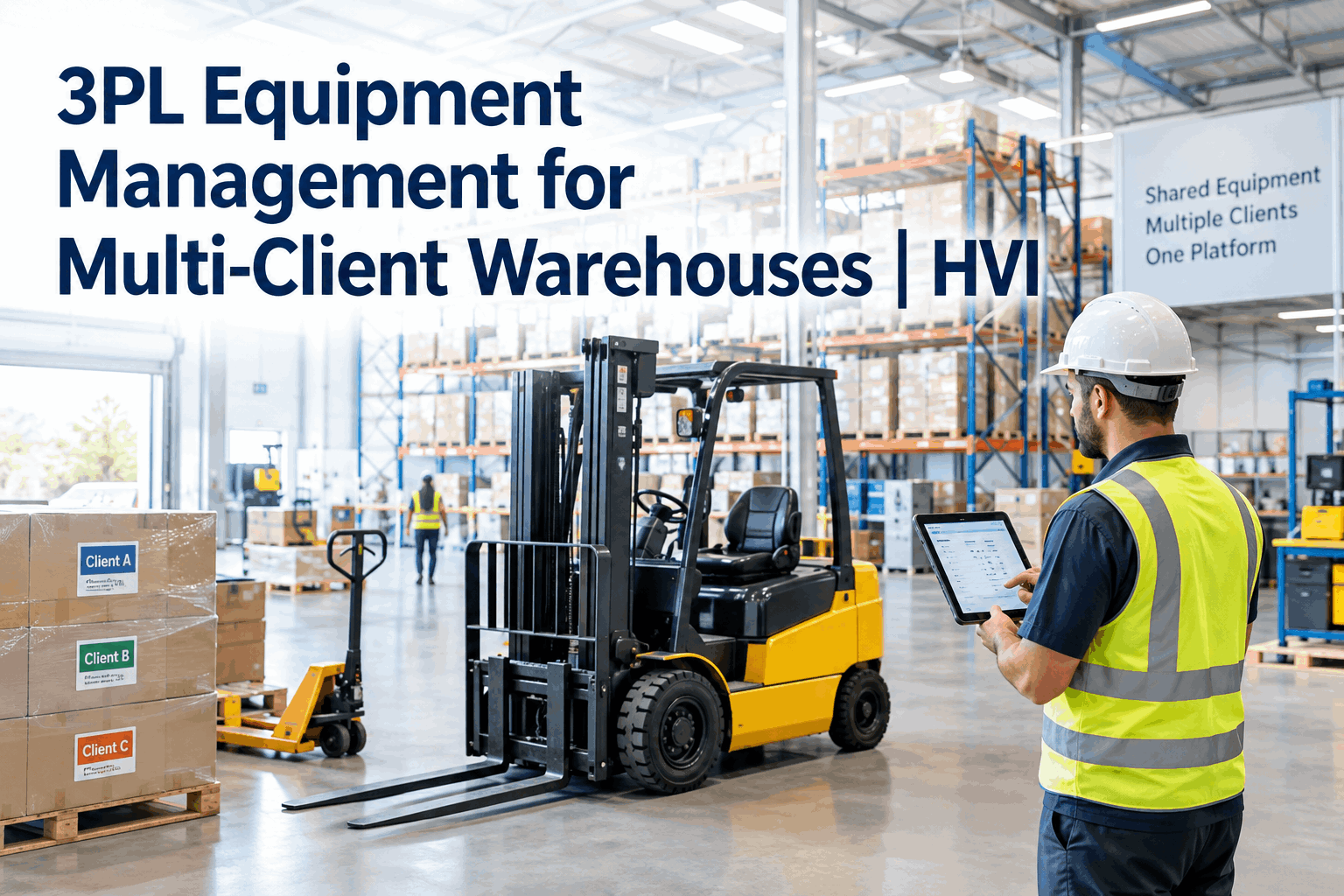
Your WMS knows every pallet and order for every client in the building. Ask it what your forklifts cost each client, or which reach truck is dragging a service level, and it goes quiet. That gap is 3PL equipment management — the asset side of a multi-client warehouse, where shared machines, client SLAs, and short-notice contracts all have to be costed and defended. This page walks through the six equipment problems every 3PL fleet manager has to answer. Book a demo to see asset-level cost and SLA data per client.
Your WMS Tracks the Inventory. What Tracks the Forklifts?
In a shared 3PL warehouse, the same fleet serves several clients at once — but the cost, the downtime, and the compliance record all have to be split back out by client. Equipment management is how you turn one shared fleet into defensible per-client numbers.
Third-party logistics runs on commercial terms a single-company fleet never faces: client-specific service commitments, cost recovery per account, shared machines, and contracts that can move with little notice. Six equipment problems fall out of that model — and a fleet manager has to have an answer for each.
Figures from material-handling and warehouse-operations industry reporting. In a shared 3PL fleet, every one of these costs has to be split back to the right client — which is impossible without asset-level data.
The Six Equipment Problems Every 3PL Has to Solve
These aren't warehouse-management problems — your WMS handles those. They're equipment problems, and each one lands on the fleet or safety manager's desk when a client asks a hard question.
Cost allocation across clients
When one forklift serves three clients, what did each client's work actually cost? Without asset-level data, you're averaging — which hides your expensive-to-serve accounts and undercharges the rest.
Contract churn & stranded capacity
A fleet sized for a client that leaves becomes stranded capacity you're still paying for. Right-sizing needs a clear read on which assets are tied to which contract and how hard each is worked.
Rental vs. owned balance
Changing contract demand makes the buy-or-rent call constantly live. You need real utilization data to know when an owned asset is idle enough to shed, or a rental cheaper than a purchase.
Service-level commitments
Equipment downtime can breach a contractual SLA. When a machine on a client's operation fails, you need reliability evidence — not just an apology — to defend performance and renegotiate terms.
Client audit exposure
Customers increasingly demand proof of inspections, maintenance, and compliance on the equipment touching their goods. "We do it" isn't enough — they want the records, on request, per asset.
Multi-site standardisation
The same client across several of your sites expects the same standard everywhere. Without one system, each location inspects and records its own way, and consistency becomes impossible to prove.
Every one of these is answerable with data you either have at the asset level or you don't. The 3PLs that defend their margins and renewals are the ones that made equipment data as granular as their WMS made inventory data. Book a demo to see all six answered from one system.
Where a WMS Stops and Equipment Management Starts
This is the confusion that sends 3PLs down the wrong path: assuming the WMS already covers equipment. It doesn't — the two systems answer different questions, and you need both.
- Inventory, SKUs, and stock by client
- Receiving, put-away, picking, packing
- Order fulfillment and shipping
- Storage and handling billing
- Client portals for stock visibility
- Cost-per-hour per forklift and reach truck
- That cost split back to each client
- Reliability KPIs for SLA evidence
- Inspection and maintenance records per asset
- Utilization for rental-vs-owned calls
A WMS optimizes the goods moving through the building; equipment management proves what the machines moving those goods cost, how reliably they run, and how it all splits by client. HVI runs beside your WMS as that equipment layer — the same platform that powers a warehouse's daily forklift inspections and PM scheduling. Book a demo to add the equipment layer to your stack.
Cost Allocation: Getting to a Defensible Per-Client Number
This is the problem that decides whether a 3PL contract is profitable or quietly bleeding. The fix is the same one 3PL cost specialists recommend: stop averaging, and allocate from actual usage.
Capture cost-per-hour per asset
Every forklift and reach truck carries a true running cost — maintenance, parts, fuel or charging, downtime. HVI builds cost-per-hour at the asset level, not the fleet average.
Split by each client's usage
Allocate that asset cost across clients by their share of the work — hours run or moves made on each account. Proportional usage is the most defensible method at invoice time.
Defend the number
When a client questions their bill or you review a contract's margin, you show the asset data behind the figure — not an estimate. The cost per client stops being an argument.
Averaging costs across all clients masks your high-cost-to-serve accounts — the ones eroding margin while the easy accounts subsidise them. Asset-level cost-per-hour is what turns that blind spot into a line you can price against. It's the same data that powers your wider cost analysis and expense tracking. Start free and build cost-per-hour per asset.
SLA Evidence: Reliability KPIs That Defend Performance
When equipment downtime threatens a service level, "it's usually fine" doesn't survive a client review. Reliability metrics turn equipment performance into evidence you can put on the table — to defend an SLA or to renegotiate one on facts.
Five numbers, tracked per asset and rolled up per client, turn a downtime dispute into a documented conversation. They also feed the buy-or-rent call — an asset with falling uptime and rising cost-per-hour is telling you to shed it before the next contract review. See how they trend on the analytics and reporting dashboard. Book a demo to see the five KPIs per client.
Rental vs. Owned: Let the Utilization Data Decide
Contract churn makes the buy-or-rent question permanently live. There's no fixed answer — there's the answer the data gives you this quarter. Here's how utilization reads on each side.
- Demand is steady baseline across long-term contracts
- Utilization stays high — the asset earns its keep
- Cost-per-hour is stable, not climbing toward retirement
- You need the machine every shift, every week
- A contract is short-notice, seasonal, or volatile
- Peak demand spikes past your owned capacity
- An owned unit sits idle enough to shed instead
- Cash protection matters more than long-run cost
The trap is guessing. A 3PL that can see real utilization per asset knows exactly when an owned forklift has gone idle enough to return, or when a demand spike is cheaper to meet with a rental than a purchase — and can defend that call to finance with numbers. Guesswork here is how stranded capacity and surprise rental bills both happen. Book a demo to see utilization drive the buy-or-rent call.
How HVI Answers the 3PL Equipment Problem
Four capabilities map directly onto the six challenges above — the reason 3PLs run HVI as the equipment layer beside their WMS.
Asset-level cost-per-hour
True running cost per forklift — maintenance, parts, charging, downtime — ready to split across clients by usage. The end of averaging.
Five reliability KPIs
Uptime, MTBF, MTTR, PM compliance, and cost-per-hour — per asset, rolled up per client — as the evidence behind every SLA conversation.
Role-based client access
Each client or site sees only their own equipment data. One system, clean separation — the same standard applied across every location.
Audit-ready records
Photo-backed inspection and maintenance history per asset, retrievable in seconds when a client's auditor asks — even captured offline at remote sites.
The same platform runs your DVIRs, preventive maintenance, work orders, and parts inventory across every asset — so equipment compliance lives inside one system, not a separate silo per site. Start free and walk your own fleet through it.
The 3PL Equipment Audit-Readiness Checklist
When a client audits the equipment handling their goods, the difference between a clean review and a scramble is whether these live in one retrievable system. This is what a 3PL should be able to produce per asset, per client, on request.
- Cost-per-hour captured at the asset level
- Usage split by client for allocation
- Utilization data to support rental-vs-owned calls
- Stranded-capacity view when a contract ends
- Uptime, MTBF, MTTR tracked per asset
- PM compliance measured against schedule
- Downtime events logged with cause and duration
- Reliability rolled up per client for SLA review
- Inspection and maintenance records per asset
- Role-based access so each client sees only their data
- One standard applied across every site
- Full history retrievable in seconds for an audit
None of this requires a new WMS or new hardware — it requires the equipment data to be as structured as the inventory data already is. When a customer asks for evidence, the answer is a record you pull up, not a promise you make. That's what an audit checklist manager and role-based access deliver together. Start free and build audit-ready equipment records.
3PL equipment management, in five lines
Your WMS manages the inventory; equipment management manages the assets moving it — you need both, and they don't overlap.
True cost per client comes from asset-level cost-per-hour split by usage — averaging hides the accounts eroding your margin.
Reliability KPIs — uptime, MTBF, MTTR, PM compliance, cost-per-hour — are your evidence when an SLA is questioned.
The rental-vs-owned call should follow live utilization data, not a fixed policy, because contract demand keeps moving.
Client audits want per-asset records on request — one system with role-based access answers in seconds, not a scramble.
From a fleet manager who defends the equipment line
The hardest conversation I have isn't with a client — it's internal, when we're deciding whether to renew a contract at the rate on the table. For years I couldn't tell you what that client's equipment actually cost us. We averaged it, and the averaging was hiding the accounts that were killing us.
Once we had cost-per-hour per truck and could split it by who was running it, the picture changed completely. Two accounts we thought were fine were underwater on equipment alone. And when a client's auditor showed up wanting maintenance history, I stopped dreading it — I pull the record while they watch. It changed how we price and how we defend a renewal.
Frequently asked questions
What is 3PL equipment management?
3PL equipment management is the tracking, costing, maintenance, and compliance of material-handling equipment — forklifts, reach trucks, order pickers — in a third-party logistics operation where that fleet is shared across multiple clients. Unlike a WMS, which manages inventory and orders, equipment management handles the asset side: what each machine costs, how reliably it runs, and how that data is split back to each client for billing, SLAs, and audits.
How do you allocate shared equipment costs across 3PL clients?
The most defensible method is proportional usage: capture each asset's true cost-per-hour — maintenance, parts, fuel or charging, downtime — then split it across clients by their share of the work, such as hours run or moves made on each account. This replaces flat averaging, which hides high-cost-to-serve clients. Documenting the method means that when a client questions their bill, you show the asset data behind the number rather than an estimate.
How does equipment management support 3PL SLAs?
Service-level agreements often hinge on equipment availability, so reliability KPIs become your evidence. Uptime, mean time between failures, mean time to repair, PM compliance, and cost-per-hour — tracked per asset and rolled up per client — let you defend performance when downtime is questioned, or renegotiate terms on facts. Instead of an apology after a failure, you bring a documented reliability record to the client review.
Should a 3PL rent or own its warehouse equipment?
It depends on contract stability, and the answer changes as demand does — which is why it needs live utilization data, not a one-time decision. Owned assets suit steady baseline demand; rentals protect cash and flex with volatile or short-notice contracts. An owned asset with falling utilization and rising cost-per-hour is a candidate to shed; a spike in demand from a new contract may be cheaper to meet with rentals than a purchase. Real usage data makes the call defensible either way.
What equipment records do 3PL clients audit?
Customers increasingly require evidence that the equipment handling their goods is inspected, maintained, and compliant — per asset, on request. That typically means inspection records, maintenance and PM history, downtime logs, and often reliability metrics, all retrievable quickly. Role-based access matters too, so each client sees only their own data. A 3PL that keeps this in one system produces it in seconds; one relying on scattered records treats every audit as a scramble.
Make Your Equipment Data as Granular as Your Inventory Data
Asset-level cost-per-hour for defensible client allocation, five reliability KPIs for SLA evidence, role-based access per client and site, and audit-ready inspection and maintenance records — on one platform beside your WMS, across every location. Live in under two weeks.
No credit card · No hardware · Works alongside your existing WMS