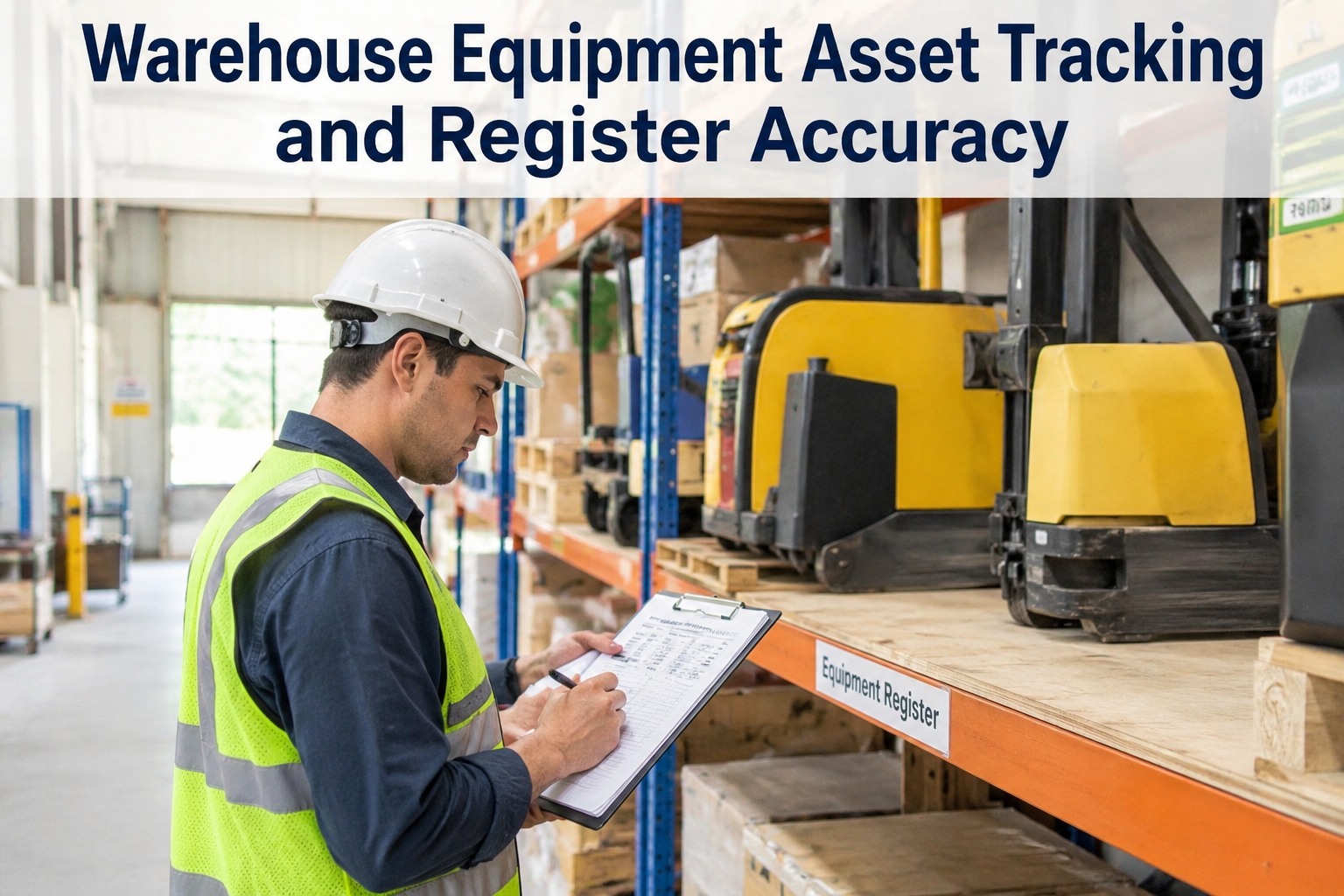
Walk into any busy warehouse yard after a two-shift day and try to find a specific reach truck by its serial number. You will likely find the unit the register says is in Bay 12 parked in a trailer three buildings away, the one marked "disposed" still pulling double duty in the cold store, and the leased forklift that went back to the dealer last month still sitting on the active list. That gap between the spreadsheet and the steel on the ground is the core problem with warehouse asset tracking, and it quietly breaks maintenance schedules, insurance valuations and audit trails at the same time. If your equipment register cannot be reconciled with the machines physically on your floor in under an hour, the register is no longer a tool — it is a liability. You can book a 30-minute walkthrough to see how HVI closes that gap on your own units before the next audit cycle rolls around.
Your Warehouse Asset Register Is Lying To You
Trucks move between sites, retire without a paper trail, and come back from lease as entirely different machines. Every downstream decision — from PM scheduling to insurance claims — inherits that error. It is time to reconcile the register with reality.
How Warehouse Asset Registers Drift From Reality
Equipment registers do not collapse in one dramatic event. They erode slowly through three quiet mechanisms that happen every week on a busy floor. If you operate a mixed fleet across multiple sites, you are likely experiencing all three right now.
Ghost Assets
These are units still listed on your register that physically no longer exist. A counterbalance truck scrapped nine months ago, a pallet jack traded in for a credit, a sweeper cannibalized for parts. Nobody updated the master list. You are still paying insurance premiums and property tax on steel that left the building long ago, and your depreciation schedule is fiction.
Unrecorded Units
The mirror image of a ghost. A leased unit arrives overnight to cover a seasonal spike, a site manager borrows a truck from another branch, or a rental gets pulled straight into production. No acquisition entry is made. The machine is working the floor, but it has no identifier, no inspection record, and no PM history. If it drops a load, you have no proof it was ever inspected.
Silent Transfers
A truck gets loaded onto a lowboy and moved to a sister site fifty miles away. The maintenance team at the origin site stops seeing it on their yard walk. The team at the destination assumes someone else is tracking it. Without a formal inter-site transfer record, the unit falls into a black hole where neither site takes ownership of the next PM interval.
Forklift Asset Tagging: The Identifier That Survives The Floor
Before you can reconcile anything, every piece of material handling equipment needs a durable identifier. A serial number on a stamped plate is a start, but plates get painted over, scratched, and warped by dock impacts. If your MHE asset management system relies on a legible plate alone, you will lose the link within the first year.
| Identifier Type | Durability in Yard | Scanning Speed | Audit Suitability |
|---|---|---|---|
| Steel Stamped Plate | High (but paint obscures) | Slow - manual entry | Weak - hard to photograph |
| Printed Barcode Label | Low - peels in cold store | Fast when readable | Moderate - fades quickly |
| Industrial QR Tag (Epoxy) | High - chemical resistant | Fast - phone camera scan | Strong - timestamped scan log |
| Active Telematics ID | Permanent | Instant - automated | Strongest - continuous data |
The goal is an identifier that links the physical machine to its digital twin instantly. When a technician scans the tag with a phone, the screen should instantly pull up the complete history for that specific asset: last DVIR, open work orders, current hour meter, and warranty status. If you want to see how HVI handles serial number tracking for forklifts and off-road plant, a 30-minute screen share will show you exactly what the technician sees on the yard.
Asset Audit MHE: Reconciling The Register To Reality
A physical equipment inventory warehouse audit is the only way to reset a drifted register. You cannot spreadsheet your way to accuracy. The process requires walking the floor, scanning every unit, and forcing the digital list to match the physical steel. This almost always finds discrepancies.
Freeze And Export
Freeze all pending transfers and export the current active register. This is your baseline. Every asset on this list must be physically located or formally marked for disposal investigation.
Walk And Scan
Teams walk every aisle, charging bay, and repair corner. Every truck gets scanned. Units found without a tag get a temporary ID and a photo. Units on the list that cannot be found get flagged immediately.
Triage The Gaps
Compare scanned reality to the exported baseline. Ghost assets are removed. Unrecorded units are entered into the system with their OEM paperwork. Silent transfers are updated to reflect their true current location.
Lock The Baseline
The reconciled list becomes the new source of truth. Moving forward, no maintenance is scheduled, no parts are issued, and no insurance is paid against an asset that is not on this verified list.
Stop Guessing Where Your Trucks Are
If your register cannot survive a surprise audit, your maintenance budget and compliance score are at risk. See how HVI makes asset reconciliation a 10-minute task instead of a two-week nightmare.
The Leased Vs Owned Distinction In MHE Asset Management
Warehouse fleets rarely consist of purely owned equipment. Leased forklifts, short-term rentals, and demo units complicate the register because they enter and exit the fleet on different terms than capital assets. Treating them the same on the spreadsheet is how you end up paying for maintenance on a truck you no longer have.
Capital Assets
These units stay on the register for their entire lifecycle. You track depreciation, warranty start dates, and full maintenance history. Disposal requires formal recording to remove them from insurance and tax rolls. The risk is keeping them on the list too long after disposal.
Temporary Assets
These units enter with a lease start date and an expected return date. They need inspection records just like owned units, but they must be removed from the active register the day they leave the yard. The risk is keeping them on the PM schedule and paying for maintenance on a unit returned to the dealer.
The Hidden Cost Of A Ghost Lease
Consider a 40-truck operation where two leased reach trucks were returned at the end of a peak season without updating the register. Over the next four months, the maintenance team schedules and attempts to perform PM checks on trucks that are not there. They order fuel filters, hydraulic oil, and tires for units sitting at a dealer lot. By the time the accounting team catches the discrepancy during a fixed asset verification, the shop has wasted roughly $1,800 in parts and 12 labor hours on ghosts. That is the cost of a broken asset transfer warehouse process. You can start logging inspections and asset transfers free with HVI to prevent that bleed immediately.
Warehouse Asset Tracking Software That Forces Discipline
HVI is built to close the gap between the register and the yard. It does not just hold a list; it forces the process discipline required at acquisition, transfer, and disposal. Here is how HVI maps directly to the problem of register accuracy.
Unique Identifiers Per Asset
Every truck, trailer, and off-road plant unit gets a permanent digital record with a scannable QR tag. The identifier links instantly to its complete history, OEM paperwork, and warranty status, eliminating manual serial number entry errors.
Complete History Per Asset
Every inspection, work order, and parts issue is timestamped and attached to the specific asset. When a leased unit goes back, you can export its entire history in seconds to prove it was maintained to the dealer's standards.
OEM & Warranty Paperwork
Upload and attach manuals, spec sheets, and warranty documents directly to the asset record. No more digging through filing cabinets to prove a hydraulic pump is still under coverage. If you want to walk through the warranty tracking feature on your own fleet, we can show you that in a demo.
Exportable Data For Reconciliation
Push the entire active register to a spreadsheet in one click for your physical audit. When the walk-through is done, import the scanned list back into HVI to instantly flag ghosts, unrecorded units, and silent transfers.
- Record every unit at acquisition, before it hits the floor.
- Force a formal transfer ticket when a truck moves between sites.
- Require a disposal entry with a reason code before removing a unit.
- Scan the QR tag to open a work order, not the truck name.
- Run a partial reconciliation every quarter, not just annually.
- Let a rented truck enter production without a record.
- Move a unit to another branch on a handshake and a text.
- Scrap a truck and just delete the row from the spreadsheet.
- Rely on the unit number painted on the door as your only ID.
- Assume the register is accurate because no one complained.
Why Warehouse Equipment Asset Tracking Determines Your Downtime
An inaccurate equipment register is not an administrative nuisance; it is the root cause of misallocated maintenance budgets, failed compliance audits, and inflated insurance premiums. When you do not know exactly what you have, where it is, and what condition it is in, you cannot schedule preventive maintenance effectively. Every ghost asset wastes money, and every unrecorded unit is a safety and compliance liability waiting to surface. The path forward requires a durable identification system, a disciplined physical verification process, and software that enforces recording at every lifecycle stage. If you are ready to see how HVI enforces that discipline across your mixed fleet, the fastest way is a live demo on your data.
"I spent three days trying to find a reach truck the spreadsheet said was in our cold store. It had been transferred to our other site eight months earlier, and nobody updated the register. We were paying insurance on it in the wrong state. Now, if a truck moves sites without a transfer ticket in HVI, it does not get unloaded off the lowboy. That simple rule fixed our register accuracy in one quarter."
Warehouse Asset Tracking And Register Accuracy
What is warehouse asset tracking for MHE?
How often should I reconcile my forklift asset register?
What is a ghost asset in warehouse equipment inventory?
How does asset tagging improve MHE asset management?
Can HVI track both leased and owned warehouse equipment?
See HVI Running On Your Own Fleet
Book a 30-minute demo and we will reconcile a sample of your actual assets live on screen. See how fast your register can match reality.
Free to start — Works on any phone — No card needed