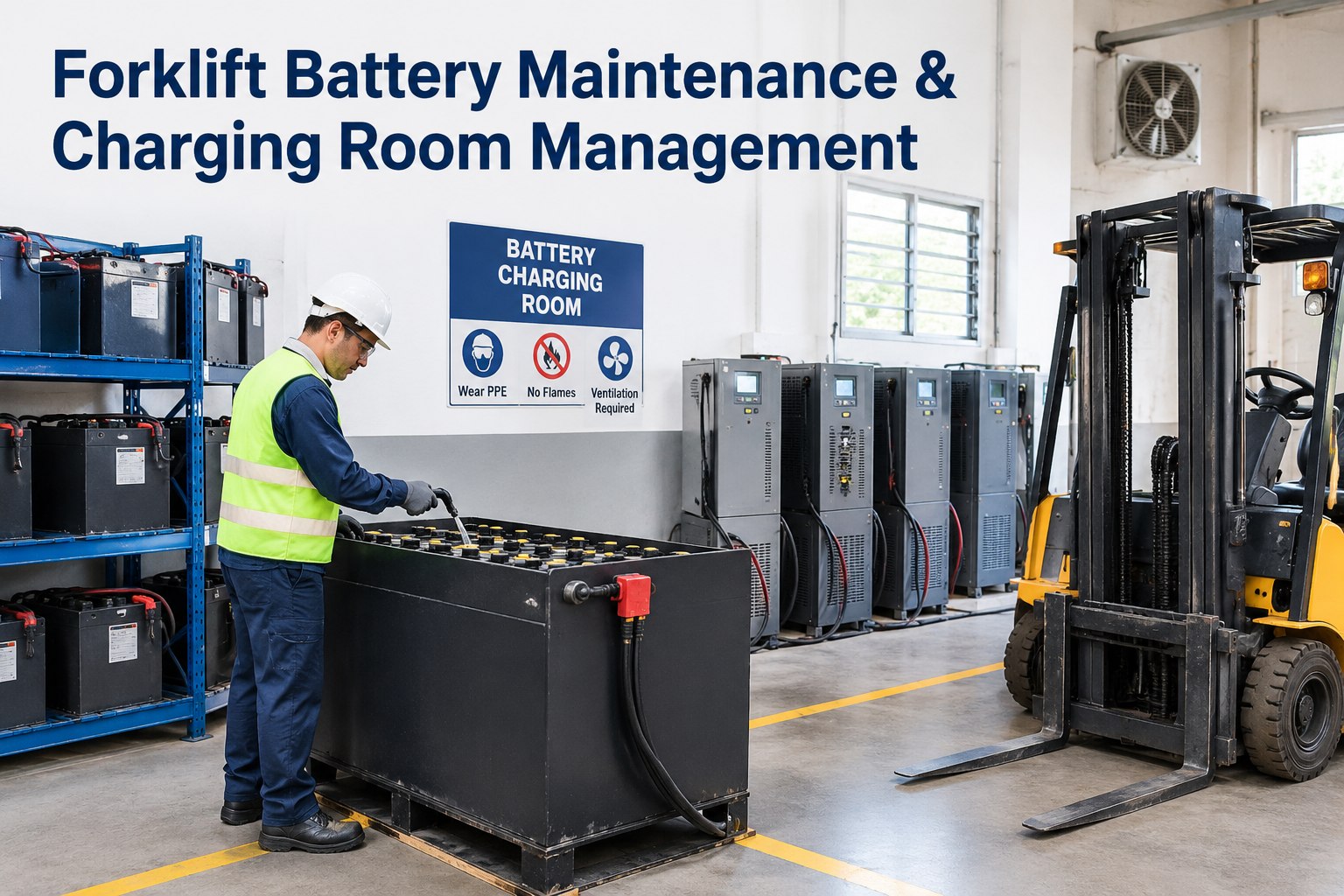
The forklift battery is the most expensive consumable in the warehouse — often five figures a unit — and the charging room is where it lives or dies early. Get forklift battery maintenance and charging room management right and a battery lasts its full five years; get the watering, ventilation, or charger routine wrong and you're buying replacements years early — or venting hydrogen into an unventilated room. It's a managed system, not a corner where batteries sit. See battery PM and charger checks tracked per unit
A Charging Room Is Four Systems, Not a Power Outlet
Most battery failures and near-misses trace back to one of these four being left unmanaged. Run all four on a schedule and the room stays safe — and the batteries last.
A lead-acid forklift battery gasses hydrogen every time it charges, needs water on a discipline, and dies fast if the charger or the room is neglected. None of that shows up until a battery is scrap or a room hits an explosive gas level. The fix is to treat the room as four scheduled systems — and here's what each one actually takes.
Hydrogen ventilation: the hazard that doesn't announce itself
This is the one that turns a battery room into a headline. Every lead-acid battery releases hydrogen gas while charging, and hydrogen is explosive at concentrations above roughly 4% in air. The industry and OSHA target is to keep the room well under that — a common design rule is holding hydrogen below 1% with active ventilation. You can't see it or smell it, so the room's airflow is your only defense.
Ventilation isn't a one-time install — fans fail, vents get blocked by stacked pallets, and a room that was compliant last year can be a hazard today. Treating the ventilation check as a recurring, logged inspection is what keeps "we have fans" from quietly becoming "the fans stopped working in March." Book a demo to see charging-room safety checks logged on a schedule.
Watering: the cheap task that decides battery lifespan
Watering is the single biggest lever on how long a lead-acid battery lasts, and it's the one most often done wrong. Let the plates dry out even once and you permanently lose capacity; overfill and acid boils over onto terminals and the floor. The rules are simple, but they have to be followed every time.
- Water after a full charge, never before
- Fill to the level indicator — about ¼" below the vent well
- Use distilled or de-ionized water only
- Check on a set cycle (commonly every 5–10 charges)
- Take specific-gravity readings to spot a weak cell
- Water a discharged battery — it overflows when charged
- Overfill — acid boils over and corrodes everything
- Use tap water — minerals wreck the plates
- Wait for a cell to run dry — that damage is permanent
- Rely on memory — skipped watering is invisible until capacity drops
The trap is that watering failures are silent. A battery watered late for months looks fine right up until its runtime falls off a cliff mid-shift. Putting the watering cycle on a per-battery schedule — with the reading logged — is how a fleet turns "someone usually tops them up" into a record that actually protects the asset. Start free and put watering on a cycle per battery.
Charger PM and battery rotation: protecting the whole fleet
Two things quietly kill batteries beyond watering: a faulty charger and no rotation. A charger with a frayed cable, a bad connector, or drifting output can overcharge or undercharge every battery it touches — so one neglected charger damages your whole rotation. And batteries need to be rotated evenly, or a few units take all the cycles and wear out while others sit.
Cables and connectors for fraying, burn marks, or heat; output against spec; cooling clear. A charger fault is a fleet-wide problem, so it's a scheduled check, not a wait-for-failure one.
Charge in sequence (oldest-charged out first) so every battery takes a fair share of cycles. Even rotation is what makes a battery pool age together instead of a few dying early.
Avoid habitual opportunity charging that skips the full cycle, and give batteries cool-down time. Chronic partial charges and heat both shorten life fast.
Run charger checks and rotation as tracked tasks and you protect every battery at once, instead of finding out one charger has been slowly cooking the fleet. Book a demo to see charger PM and rotation tracked together.
Why this is really a cost story
Everything above rolls into one number: how long each battery lasts against what it should. A forklift battery is a five-figure asset rated for a set number of cycles — and neglect doesn't fail it loudly, it just quietly shortens that life so you replace it years early.
Missed watering, an unnoticed bad charger, uneven rotation — each shaves months off, and together they turn a 5-year battery into a 3-year one. You just pay for it as "replacements," never seeing the cause.
Watering on cycle, chargers inspected, rotation even, room safe — each battery reaches its full cycle count. Tracking cost and maintenance per battery shows exactly which units are underperforming and why.
The fleets that control battery spend don't buy cheaper batteries — they make each one last its rated life by managing the room. And the only way to know which battery is dying early, and why, is to track maintenance and cost per unit. Book a demo to see cost per battery across the fleet.
The weekly charging room safety walk
This is the short walk that keeps the room compliant and the batteries healthy — the OSHA-critical safety items plus the maintenance checks that catch a silent problem early. Run it weekly and log any find with a photo. Use this charging room checklist online free, so every check is dated and any failure routes to a work order.
From a warehouse ops manager who stopped replacing batteries early
We treated the charging room like a parking spot — drive the battery in, plug it in, done. Then we had two batteries fail in the same quarter, way before their rated life, and when I actually looked, one charger had been running hot for months and half the watering was being skipped on nights.
We put the room on a real schedule — a weekly safety walk, watering logged per battery, chargers inspected monthly. The failures stopped, and now I can see which battery costs the most per hour and why. Turns out we weren't buying bad batteries; we were killing good ones.
Frequently asked questions
Why does a forklift charging room need special ventilation?
Because lead-acid batteries release hydrogen gas while charging, and hydrogen is explosive at concentrations above roughly 4% in air. A common design rule is keeping the room below 1% with active ventilation. Since hydrogen is lighter than air, exhaust fans go at the highest point and fresh-air intake near the floor so air sweeps up and out. The fans should be spark-proof, and there must be no ignition sources in the zone.
How often should forklift batteries be watered?
Follow the manufacturer's interval, but a common guide is checking every 5 to 10 charge cycles and topping up only after a full charge, never before. Fill to the level indicator — about a quarter inch below the vent well — using distilled or de-ionized water, and never overfill. Letting a cell run dry causes permanent capacity loss, so watering on a tracked cycle matters more than any single top-up.
What safety equipment does OSHA require in a charging area?
Under OSHA's powered-industrial-truck rules, a battery charging area must be a designated space with no smoking, adequate fire protection, an ample water supply for flushing and neutralizing spilled electrolyte, and an eyewash capable of a 15-minute flow. Add PPE (goggles or face shield, acid-resistant apron and gloves), warning signage, and ventilation. Confirm the exact requirements against the current regulation for your operation.
What kills a forklift battery early?
Four things, mostly silent: skipped or wrong watering (dry plates cause permanent damage), a faulty charger overcharging or undercharging, uneven rotation so a few batteries take all the cycles, and chronic heat or habitual partial charging. None fails loudly — they just shorten the battery's usable life so it's replaced years early. Managing the room and tracking maintenance per battery is what catches the cause.
Is opportunity charging bad for forklift batteries?
For traditional lead-acid batteries, habitual opportunity charging — frequent short top-ups instead of full cycles — adds heat and partial cycles that shorten life, so it's generally discouraged unless the battery and charger are designed for it. The safer default is charging after a shift or when discharged past about 30%, then allowing cool-down. Chemistry matters here, so confirm the right charging pattern for your specific batteries and chargers.
Run the charging room like the asset it protects
HVI schedules ventilation and safety checks, puts watering and charger PM on a cycle per battery, routes any failure to a work order with photo proof, and tracks cost per unit across the fleet — so the room stays OSHA-safe and every battery lasts its rated life. Stop replacing good batteries early.
No credit card · Per-battery PM & safety scheduling · Works offline in the room