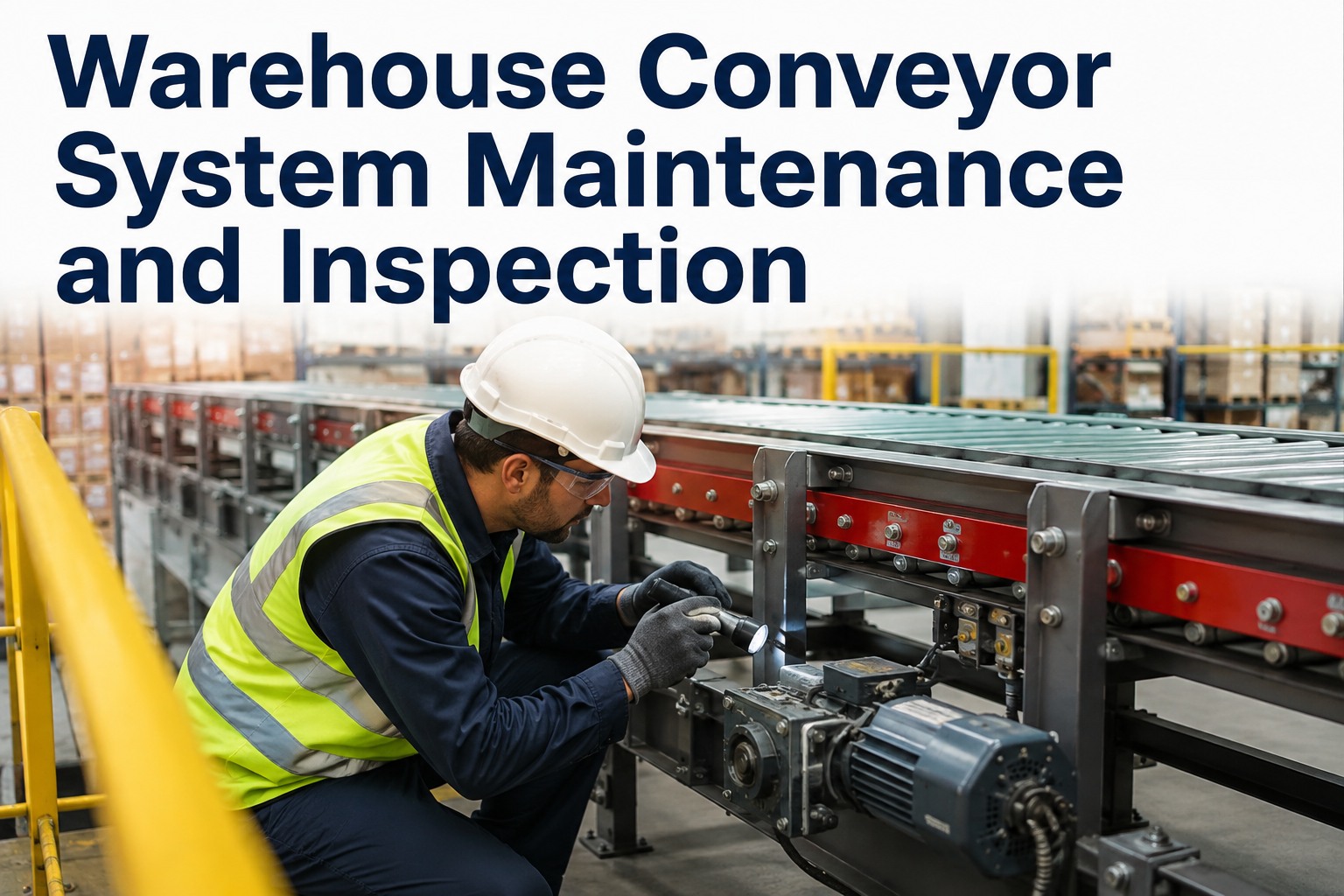
The main line stops at 9:40 on a Tuesday morning, and by 9:41 the whole building knows it. Cartons back up at the induct, pack-out runs dry, and your maintenance lead is lying on the floor trying to see whether it's a seized roller, a tracked-off belt or a tripped drive. Warehouse conveyor system maintenance and inspection is the discipline that keeps that Tuesday from happening — and keeps the guarding citations away when the system is running. Conveyors carry the flow of a modern warehouse, and they generate two distinct problems: downtime that stops everything downstream, and guarding conditions that inspectors write up. This page walks through the belt, roller, drive and emergency-stop checks that matter, the route-based schedule that fits a distributed system, and how to prove every one of them was done — and if you'd rather see it running on your own conveyor routes, that takes thirty minutes.
When the conveyor stops, what does each hour actually cost you?
A failed drive or a tracked-off belt doesn't just idle one line — it starves every station downstream. Route-based inspection catches the seized roller, the fraying splice and the defeated guard before they become a stoppage or a citation.
Four numbers worth pinning above the maintenance desk
What a conveyor inspection actually covers, zone by zone
A conveyor is not one asset — it's a chain of components with different failure modes. These are the six inspection zones a route-based warehouse conveyor maintenance schedule has to hit, and what you're looking for in each.
Guarding: nip points, drives, transfers
Guarding is the most frequently cited machine condition on conveyors — and the most commonly defeated for access. Check every guard is present, secured and undamaged at nip points, drive assemblies and transfer points. A guard held on with a zip tie "until the part comes in" is a citation and an amputation risk at the same time.
Belt: tracking, splices, edges, tension
A belt that tracks off-centre is telling you something — a seized roller, a build-up of debris, or a tension problem. Check tracking at the head and tail pulleys, inspect splices for separation and fraying, look at edge damage from rubbing structure, and confirm tension. Catching a failing splice on a route check is a planned repair; finding it when it lets go mid-shift is a re-splice under pressure with the line down.
Rollers and idlers: the silent killers
A seized roller doesn't stop the conveyor — the belt just drags across it. That flat-spots the roller, wears the belt cover, and builds friction heat. In a dusty warehouse, a hot seized roller is a genuine ignition source. Walk the route and listen: a healthy roller hums, a failing one rattles or stays silent while the belt slides over it.
Drives: motors, gearboxes, chains
Check motor temperature by hand or gun, listen for gearbox noise, look for oil weep at seals, and inspect drive chains for stretch, lubrication and guard condition. A gearbox running hotter than its neighbour on the same duty is an early warning — log it, trend it, and plan the swap before it fails under load.
Emergency stops and pull-cords
E-stops and pull-cords must be tested, not assumed. A pull-cord that's gone slack, been tied off, or has a seized switch gives you nothing when someone reaches toward a nip point. Test every device on the route, confirm it actually stops the section it's meant to stop, and record the result with a timestamp.
Isolation before any access
No inspection item that requires reaching into a guarded zone happens until the conveyor is isolated, locked and tried. The discipline is the same every time: isolate, lock, tag, try the start, then work. A route checklist that carries the isolation steps in writing protects the technician and proves the procedure was followed.
Why conveyor maintenance works as a route, not a work order pile
A warehouse conveyor system is distributed — hundreds of rollers, dozens of drives, guards and e-stops spread across the building. Issuing a separate work order per component drowns the team in paper. A route groups every checkpoint on one walk, in physical order, so one technician with a phone covers the system in a single pass.
Build the route once, in walking order
List every checkpoint — guards, belt condition, rollers, drives, e-stops — in the order the technician physically walks the line. In HVI this is a reusable conveyor route template: build it once, assign it forever.
Set the calendar PM frequency
Conveyors run on calendar time, not mileage. Weekly guarding and e-stop checks, monthly belt and drive inspections, quarterly gearbox oil — set the interval per route and let the schedule generate the work. If you want to see how the calendar PM maps to your own lines, book a walkthrough on your actual conveyor layout.
Capture condition with photos, not ticks
A tick next to "guard OK" proves nothing in an audit. A photo of the guard, timestamped and tied to the route item, proves the condition on that date. Guarding items in HVI carry photo evidence by default — the record is the defence.
Defects become work orders with isolation steps
A fraying splice or a seized roller found on the route becomes a work order on the spot — carrying the isolation steps in writing, so the repair starts with lockout, not with someone reaching in. You can start building your first conveyor route free and have it on a technician's phone this week.
A worked example: what one seized drive actually costs
Take a mid-size distribution centre running one main line feeding four pack-out stations. A drive gearbox fails at 9:40 on a Tuesday. Here's the honest maths on an unplanned stop versus a planned swap.
- Line down 4 hours waiting on the part and a re-fit under pressure
- 4 pack-out stations idle — roughly 4 hours of lost throughput across the building
- Overtime to clear the backlog, plus expedited freight on the missed cut-off
- Total: a full shift of disruption from one gearbox
- Gearbox flagged running hot on the monthly drive inspection
- Part ordered at standard freight, swap planned for a scheduled stop
- 30 minutes of planned downtime, isolation steps on the work order
- Total: one line item in the PM log, zero lost throughput
The gearbox costs the same either way. Everything else — the idle stations, the overtime, the missed cut-off, the safety risk of a rushed repair — is the price of finding it late. That's the entire case for route-based conveyor inspection, and it's why teams that walk through a live demo with their own downtime numbers usually don't go back to paper.
Four HVI capabilities built for conveyor routes
HVI is cloud + mobile inspection and maintenance work order software. For conveyor systems, four capabilities do the heavy lifting.
Conveyor route templates
Build each line as a reusable route — guards, belt, rollers, drives, e-stops in walking order. Assign it on a calendar PM and the schedule generates the work automatically, with due and overdue alerts so nothing slips.
Guarding items with photo evidence
Every guarding checkpoint carries a timestamped photo. When an inspector or insurer asks about a nip-point guard, you pull the dated record in seconds instead of digging through a binder — audit-ready by default.
Calendar PM that fits conveyors
Conveyors don't have odometers. HVI schedules preventive maintenance by date — weekly e-stop tests, monthly belt checks, quarterly gearbox service — so the interval drives the work, not a breakdown.
Work orders carrying isolation steps
A defect found on the route becomes a work order instantly, with the lockout steps written into the job. The technician starts with isolation, the record shows the procedure was followed, and the repair history stays on the asset.
See your conveyor routes running in HVI
Book a 30-minute demo and we'll build one of your actual conveyor lines as a route — guarding checks, photo evidence, calendar PM and all.
Warehouse conveyor maintenance, in five lines
Conveyors fail two ways: downtime that stops everything downstream, and guarding conditions that generate citations. Inspect for both.
Guarding at nip points, drives and transfer points is among the most-cited machine conditions — and the most commonly defeated. Photo-proof every guard.
A seized roller is a belt wear point and a potential ignition source. A failed splice found on a route is a planned repair; found mid-shift, it's a stoppage.
Emergency stops and pull-cords must be tested, not assumed — and every access starts with isolation, lock and try.
A route-based schedule fits a distributed system: one walk, every checkpoint, defects straight to work orders. That's warehouse conveyor system maintenance and inspection done properly.
The thing that used to keep me up wasn't the breakdowns — it was the e-stops. We had forty-odd pull-cords across the building and I couldn't have told you which ones actually worked, because nobody wrote it down. Now every cord gets tested on the weekly route and there's a photo and a timestamp on each one. I track one number: overdue route items. When it's zero, I sleep fine.
Questions maintenance and safety managers actually ask
How often should warehouse conveyors be inspected?
What guarding does a conveyor actually need?
Why is a seized conveyor roller dangerous?
Do conveyor emergency stops need to be tested, or just present?
Can conveyor inspections run on the same system as our fleet DVIRs?
Stop finding conveyor problems when the line stops
Put your guards, belts, rollers, drives and e-stops on a route-based schedule with photo proof and isolation steps on every work order. See it on your own lines before you commit to anything.