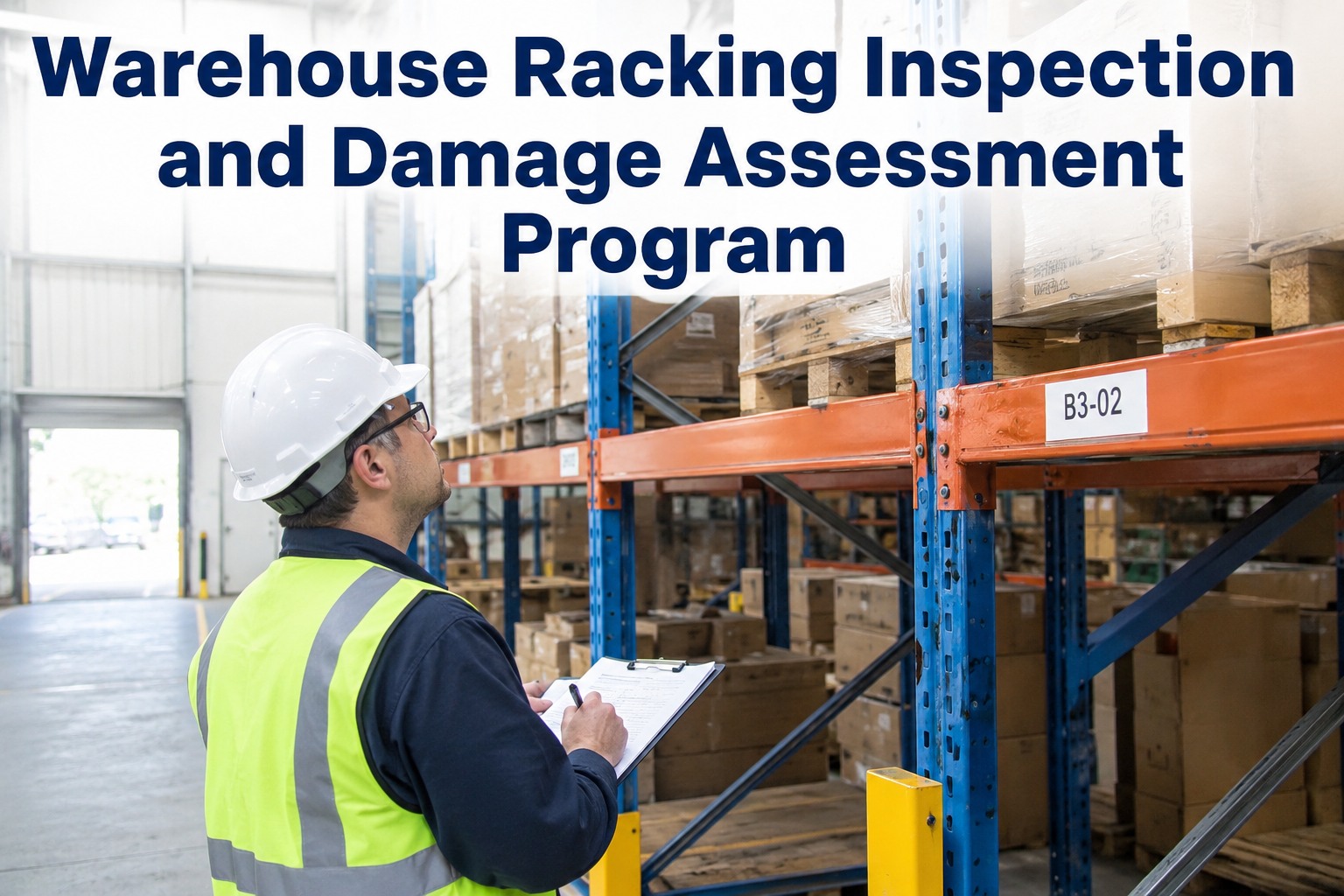
Walk through any rack aisle after the afternoon shift and you will see the evidence — a fresh gouge on an upright at knee height, a beam that no longer sits flush in its connector, a base plate with a visible gap between the steel and the concrete. None of it is urgent enough to stop the forklift, so it gets noted on a whiteboard or mentioned in a toolbox talk and then nothing happens. Forklift impact damage accumulates invisibly until a beam or upright fails catastrophically, which is why structured warehouse racking inspection is the cheapest collapse prevention available. If you are the person who has to defend a racking inspection program to management, the case is not about compliance for its own sake — it is about preventing a sudden, serious failure that shuts down the aisle, the dock door and possibly the whole warehouse. You can book a walkthrough of HVI's inspection setup on your own racks before the next impact goes unreported.
The damage is already in the steel. The question is whether you find it before it finds you.
A warehouse racking inspection program catches impact, deflection and connector damage early, when a repair ticket costs a few hours instead of a collapse that costs the aisle, the load and the downtime. Run it alongside your vehicle DVIRs so nothing slips through the cracks.
What warehouse racking inspection actually looks for
Four damage mechanisms account for nearly every rack failure in service. Each is easy to miss on a casual walk-by because the rack still stands and still holds load — until it does not.
Upright impact damage
Forklift contact at the aisle end is the single biggest cause of rack damage. A dent or bow in an upright column, brace or footplate looks cosmetic, but the upright is the load path — deform it and the whole bay's capacity drops. Impacts below 50mm of deflection may be repairable in place; anything more usually needs a replacement upright and an immediate offload of that bay.
Beam deflection & overload
A pallet beam is designed to flex under load, but permanent deflection past roughly L/180 of the span means the beam has yielded and will not spring back. Causes are overload, wrong beam height for the pallet type, or a heavy point load sitting mid-span. Any visible permanent sag is an immediate offload and replacement — not a "keep an eye on it."
Missing safety pins & connectors
The spring clip or bolt that locks a beam into its upright is small, cheap and easy to knock out or forget after a beam-height change. A beam without its safety pin can be dislodged upward by a forklift mast, dropping the load. Every beam-to-upright connection should have its pin present and seated — a gap here is a zero-tolerance defect.
Base plate & anchor damage
The base plate and its floor anchors are what stop the upright kicking out at the bottom. A cracked weld, a bent plate or a missing or loose anchor bolt is serious because it weakens the column at the point of highest shear. Salt, forklift wheel impact and floor joint movement all accelerate base plate damage, especially in cold-store and yard canopies.
Racking inspection frequency: three tiers that catch damage at the right time
No single inspection catches every defect. A defensible program layers three tiers so low-cost, high-frequency checks feed into periodic expert assessments. If you are building this from scratch you can see how HVI handles all three tiers in a 30-minute demo rather than reinventing the workflow.
Operator impact reporting
Every impact, immediately — no exception
The forklift driver who felt the bump is your fastest sensor. Any contact between the truck and the rack, however minor, must be reported before the truck moves to the next task. This is where culture matters most: if reporting an impact triggers blame, drivers stop reporting and the damage stays hidden. The report can be a quick mobile form — location, bay number, photo — and it should auto-create a defect for the supervisor to triage. You want a free digital log that drivers will actually use rather than a clipboard nobody touches.
Routine visual inspection
Weekly or per shift, aisle by aisle
A trained supervisor or lead operator walks the aisles on a rotating schedule looking for the visible signs: dents, bows, missing pins, beam sag, dislodged braces, damaged base plates and anchors. The checklist should be short and specific — upright, beam, connector, base, load sign, barrier — and tied to a location so the same bay is not checked twice while another is skipped. This tier catches the damage that was never reported and the damage that has grown since the last walk.
Periodic expert assessment
Annually, by a competent person
At least once a year, a competent person — internal or external — carries out a full racking assessment against RMI rack standards (or the local equivalent), classifies every defect and issues a written report with repair-versus-replace recommendations. This is the tier that holds up in an audit, an insurance claim or a post-incident investigation. The periodic assessment also validates that the first two tiers are actually happening.
Rack repair criteria: the repair-versus-replace decision
Once a defect is found, it has to be classified so the action is proportionate. The table below is the working standard most competent-person reports follow, aligned to RMI guidance on damage levels and offload triggers.
| Damage level | Typical defect | Action | Timeline |
|---|---|---|---|
| Green — OK | Minor scuffs, paint loss, no structural deformation | Log and monitor on next routine walk | Next routine inspection |
| Amber — Repair | Upright deflection up to ~10mm, bent brace, missing safety pin, beam deflection within elastic limit | Repair in place — replace pin, straighten or patch brace, monitor upright | Within 4 weeks |
| Red — Offload & replace | Upright deflection over ~10mm, permanent beam sag past L/180, cracked weld, damaged base plate or anchor, any column bow | Offload bay immediately, barricade, replace damaged component before reuse | Immediately — offload within 24 hours |
The exact thresholds vary by manufacturer and rack type, so the rack supplier's load charts and the competent person's judgement govern. The point is that every defect gets a colour and a deadline — not a "we'll get to it." If you want to map these categories straight into a digital defect workflow, HVI lets you set each level as an auto-work-order trigger.
Storage rack compliance: signage, barriers and the reporting culture
Two compliance essentials are missed more often than any other, and neither is expensive. Get these right and the rest of the program follows.
Load capacity signage
Every rack bay must display its maximum load capacity — typically the maximum permissible unit load and the maximum average unit load per bay, based on the original design. Without the sign, operators have no way to know whether a 1,200kg pallet is safe or overloading the beam. Signs must match the as-built configuration, so if beam heights have been moved the sign is wrong and the capacity is wrong. This is a top-five finding in almost every racking assessment.
Rack protection barriers
End-of-aisle uprights are the most-struck steel in the building. Bolted steel or upright protectors and end-of-row barriers absorb and deflect forklift impact before it reaches the column. Floor lines, aisle markings and column striping all help the driver judge clearance. Protection does not replace inspection — a barrier that has taken a hit has transferred load, so the upright behind it still needs checking.
Reporting culture without blame
If a driver reports a bump and gets pulled into a disciplinary meeting, the next bump goes unreported and the damage stays in the steel. The program only works when reporting an impact is treated as a professional action, not a failure. Pair that culture with a fast, low-friction reporting tool — a mobile form that takes 20 seconds — and drivers will flag damage because it is easier than ignoring it. You can see the driver-side reporting flow in a short demo to judge whether it is simple enough for your crew.
Stop tracking rack damage on clipboards and group chats.
Book a demo and see HVI run a full racking inspection, defect-to-work-order flow and audit trail on your own aisles — in 30 minutes.
One platform for racks, trucks and shop equipment
HVI runs your warehouse racking inspection program alongside your vehicle DVIRs, PM schedules and work orders — so rack defects live in the same system as every other asset, not on a separate spreadsheet that nobody opens.
Configurable racking templates
Build a racking inspection template with the exact checks you need — upright, beam, connector, base plate, load sign, barrier — and run it on any phone or tablet in the aisle. No paper, no re-keying.
Photo evidence, location-linked
Every defect capture includes a photo and a location tag — aisle, bay, level — so the supervisor or contractor knows exactly where to go. No more "the damage is somewhere in row C."
Defects auto-create work orders
A red-level defect raises a work order automatically — assigned, prioritised and tracked to completion. Amber defects queue for the next maintenance window. Nothing falls through the cracks.
Audit-ready records
Every inspection, photo and repair is timestamped and stored against the asset. When an auditor, insurer or client asks for proof, you export the full history in seconds — not a scramble through binders.
What a single unreported impact actually costs you
A 40,000sq ft distribution centre runs selective pallet rack along 12 aisles. A reach truck nudges an end-of-aisle upright at 2pm on a Tuesday. The driver feels it, sees no visible damage and moves on. Nobody reports it. Over the next eight weeks, that same upright takes three more minor impacts — still unreported, still invisible.
Without a reporting program
The upright deflects past 10mm. A loaded pallet sits in the bay. One Tuesday the column buckles, the beam drops, and two bays collapse. Direct cost: rack replacement, stock damage, lost product. Indirect cost: the aisle is barricaded for a week, dock door throughput drops, a forklift is rerouted, overtime climbs to clear the backlog. A conservative figure for a two-bay collapse with stock loss is five figures, before you count the downtime. The investigation finds no inspection records. Insurance and client audits follow.
With HVI in place
The first impact is reported in 20 seconds via the driver's phone — photo, aisle, bay. A defect auto-opens and the supervisor sees it before end of shift. The upright is inspected, found to be within elastic limits, and tagged for monitoring. The second impact weeks later triggers a re-inspection; the deflection has grown. The bay is offloaded, the upright is replaced in a planned window, and the rack is back in service the same day. Total cost: one upright, one hour of labour, zero downtime. The full chain — report, inspection, photo, work order, repair sign-off — is on record for any auditor.
The difference is not the steel. The difference is whether the first impact was seen, recorded and acted on. You can walk through this exact workflow on your own aisles in a demo and judge the payback for yourself.
Warehouse rack safety comes down to four moves
You do not need a 200-page manual to get racking inspection under control. You need a short, repeatable loop that catches damage early and proves you did it. Here is the summary.
Make impact reporting frictionless and blame-free. A 20-second mobile form with a photo is the cheapest collapse prevention you will ever buy. Culture eats the checklist, so protect the driver who reports.
Layer three inspection tiers. Operator report, routine visual, periodic expert — each catches what the others miss and together they form a defensible program.
Classify every defect with a colour and a deadline. Green, amber, red — with offload triggers for red. No defect sits in limbo waiting for someone to "get to it."
Keep the records in one system. Racking inspections, vehicle DVIRs, PMs and work orders in one platform means nothing slips and every audit is a 30-second export.
"I used to find out about a rack hit when someone sent me a photo on WhatsApp three days later, by which time the bay had been loaded twice. Now the driver logs it at the time, I get the defect on my phone before end of shift, and the repair is scheduled before the upright has a chance to get worse. We have not had a collapsed bay since we started, and the auditors love the paper trail."
Warehouse racking inspection: what people actually ask
How often should warehouse racking be inspected?
What is a competent person for racking inspection?
When does rack damage need to be repaired versus replaced?
Do pallet racks need load capacity signage?
Can racking inspection be done on a phone or tablet?
Get your racking inspection program live this month.
See HVI running on your own racks, trucks and shop equipment. Book a 30-minute demo or sign up free and start logging inspections today.
Free to start — Works on any phone — No card needed