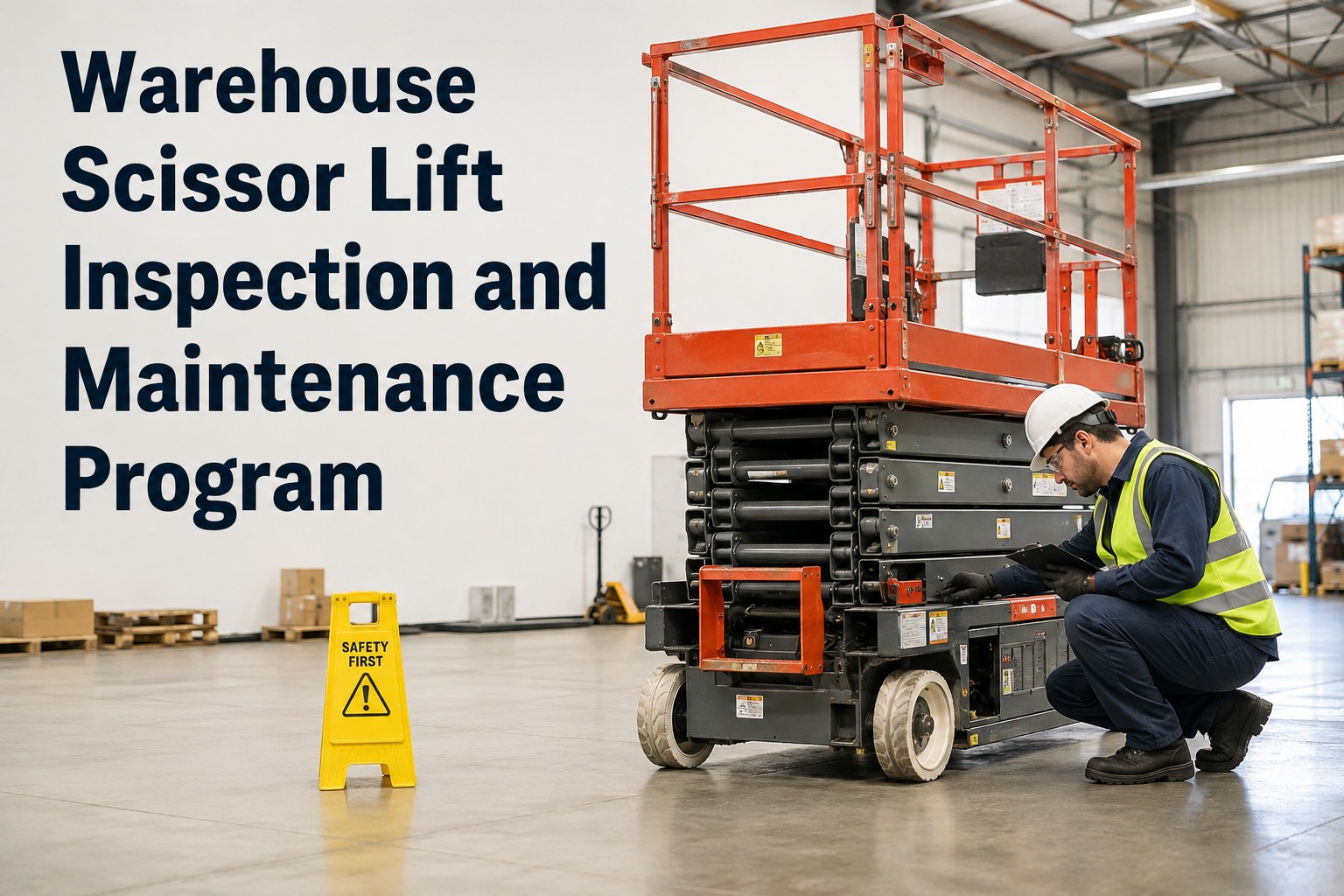
It is a familiar scene in any busy warehouse: a lighting fixture needs replacing or a racking beam needs an inspection, so someone grabs the scissor lift that has been sitting in the corner for three weeks, hops on, and assumes it is ready because it worked last time. That assumption is exactly where warehouse scissor lift inspection programs fall apart. Occasional-use equipment drifts between uses, and the gap between a visual glance and a proper function test is where incidents live. If you manage a fleet of elevated platforms and need a program you can defend to your safety director or an OSHA inspector, book a 30-minute walkthrough to see how digital inspections close that gap.
Is your scissor lift actually safe, or just lucky?
A lift that sits idle for weeks between uses is not "low hour" equipment. It is equipment with undetected drift. Pothole protection sticks, batteries sulfate, and guardrail gates get bent by forklifts. Here is how to build a warehouse scissor lift inspection and maintenance program that catches problems before the platform goes up.
Why occasional-use scissor lifts fail between inspections
Unlike a delivery truck that runs daily, a warehouse scissor lift might sit for two weeks, then get used for 20 minutes to change a ballast. That pattern creates four specific failure modes that a quick glance will never catch.
Battery sulfation
Electric scissor lifts that sit unused slowly self-discharge. Below 50% charge, lead-acid batteries begin sulfate crystal buildup. After three weeks of neglect, you have a lift that shows full bars on the gauge but dies under load at height.
Pothole protection seizure
The pothole protection system deploys steel plates under the chassis when the platform rises. If the lift sits, corrosion and dust jam the mechanism. The first time you need it is the first time you discover it is stuck.
Control drift and damage
Platform controls get bumped by forklifts, ground controls get dusty, and emergency lowering valves get sticky. A lift that "worked last month" may have a tilt alarm that no longer sounds or a deadman switch that sticks.
The "it worked last time" trap
Because the lift is used rarely, operators skip the function test to save five minutes. They drive straight to the work area, elevate, and only then discover the pothole protection did not deploy or the steering is misaligned.
Scissor lift inspection checklist: what to check and what to test
Most crews merge these into one walk-around. They are two distinct obligations. The inspection is visual and structural. The function test is operational and safety-critical. Both must happen before any worker goes up.
| Component | Visual Inspection (Look For) | Function Test (Verify It Works) | Failure Risk If Skipped |
|---|---|---|---|
| Pothole protection | Plates intact, no bent linkage, pins present | Deploys automatically when platform rises 6-8 ft | Tip-over if a wheel drops into a floor drain or dock gap |
| Guardrails & toe boards | No cracks, welds intact, gate latch present | Gate closes and latches without forcing; mid-rail secure | Worker falls through opening or gate swings open at height |
| Platform controls | No cracked housing, joystick boot intact, labels legible | All directions respond smoothly; emergency stop cuts power | Uncontrolled movement or inability to lower in an emergency |
| Ground controls | Key switch works, emergency stop accessible, manual descent valve closed | Override functions operate; alarm sounds when platform elevated | Cannot rescue a stranded worker or shut down a malfunctioning lift |
| Tilt alarm & level sensor | Sensor mounted, wires not frayed | Alarm sounds when chassis is off-level; drive cuts out | Lift operates on a slope and tips sideways |
| Battery & charging | Terminals clean, cables tight, water level correct (flooded lead-acid) | Charger cycles properly; battery holds voltage under load | Platform dies at height or battery fails mid-shift |
| Scissor stack & pins | No cracked welds, pins secured, no excessive wear in bushings | Platform rises and lowers smoothly without binding or drift | Structural collapse or sudden drop from height |
The function test is not optional. OSHA 1926.454 and ANSI A92.22 both require operators to verify that safety devices work before each use. A visual check alone does not satisfy this. If your current process is a clipboard with a single signature line, see how a digital function test works on your own units in a live demo.
How to maintain a scissor lift that sits for weeks between jobs
A warehouse scissor lift used twice a month needs a different PM schedule than a rental unit running daily. Calendar-based intervals fail because the lift degrades while parked, not while working. Here is the PM structure that actually works.
Operator inspection and function test
Every operator, every time, before the platform leaves the ground. This is the 10-minute walk-around plus the 5-minute function test. No exceptions for "just a quick job."
Battery maintenance and charge cycle
Even if the lift has not moved, check electrolyte levels, clean terminals, and run a full charge cycle. This prevents sulfation and catches a failing charger before the lift is needed.
Full function test and lubrication
Run the lift through its full range: elevate to max height, test pothole protection, cycle the steering, operate the emergency lowering. Grease the scissor stack pivot points and check for hydraulic leaks.
Structural and safety system deep check
Inspect all welds on the scissor arms, check torque on critical fasteners, test the tilt sensor with a level, verify the descent alarm, and load-test the battery bank.
Certified structural inspection
ANSI A92.22 and most insurance policies require an annual inspection by a qualified person. This is a documented, signed inspection covering structural integrity, safety systems, and wear limits. It is not the same as your monthly check.
The gap between "should" and "did" is where most programs fail. A spreadsheet reminder is easy to ignore. A CMMS that locks the lift out of service until the PM is logged is not. If you are tired of chasing paper, start tracking PMs free and see the difference in the first week.
Stop guessing whether your scissor lift is safe
See how HVI digitizes your pre-use inspections, function tests, and PM schedules in one platform your crew will actually use.
Turn your scissor lift program from paper to proof
HVI is built for fleets that run mixed equipment, including warehouse MEWPs. Here is how the platform handles the specific problems that make scissor lift compliance hard.
MEWP templates with function test steps
Pre-built scissor lift checklists that force the operator through the visual inspection and the function test as separate sections. Photo capture is required on critical items like pothole protection deployment and guardrail gate latch. No more pencil-whipping a single signature.
Outcome: Every pre-use check is documented, timestamped, and audit-ready in under 10 minutes.
Calendar and hour-based PM scheduling
Set PMs by date, by platform hours, or both. HVI sends due and overdue alerts to the maintenance manager and the operator. If a lift sits for three weeks, the weekly battery check still fires. If it suddenly gets heavy use, the hour-based PM catches up.
Outcome: No more missed PMs because the lift "wasn't being used anyway."
Certification tracking with expiry alerts
Log the annual structural inspection, operator training certificates, and insurance documents. HVI alerts you 30, 14, and 7 days before anything expires. When an auditor or insurance adjuster asks for proof, you pull it up on your phone in seconds.
Outcome: Zero lapsed certifications and instant audit response.
Instant defect-to-work-order
When an operator flags a stuck pothole protection plate or a dead tilt alarm, HVI converts that defect into a work order and assigns it to a technician. The lift is marked out of service until the repair is signed off. No more sticky notes or radio calls that get forgotten.
Outcome: Defects get fixed before the next shift, not after the next incident.
If you manage a mixed fleet and want to see how this works across your trucks, trailers, and warehouse equipment in one place, book a demo and bring your toughest compliance question.
What a missed scissor lift inspection actually costs
A 40,000 sq ft warehouse running two scissor lifts for lighting and racking work. Here is the math when one lift fails at height because the pothole protection was never function-tested.
Compare that to the cost of a 10-minute function test done right. If you are still tracking this on paper or in a spreadsheet, sign up free and run your first digital inspection today.
Building a scissor lift program you can defend
A warehouse scissor lift inspection and maintenance program is not complicated, but it does require discipline. The occasional-use pattern is the enemy, and the function test is the most-skipped step. Here is what to lock in.
Separate the inspection from the function test. One is visual, one is operational. Both are required before every use, and both must be documented.
Treat pothole protection as a life-safety system. It is not a nice-to-have. It is the difference between a stable lift and a tip-over when a wheel drops into a floor drain.
Schedule PMs by calendar and hours, not just one. A lift that sits degrades on the calendar. A lift that suddenly gets heavy use degrades by the hour. Track both.
Make the annual structural inspection non-negotiable. It is a certification, not a suggestion. Track it with expiry alerts so it never lapses.
Digitize the record. Paper checklists get lost, pencil-whipped, and ignored. A mobile CMMS with photo capture and instant defect-to-work-order closes the loop.
If you are ready to move off paper and build a program that holds up under audit, walk through it on your own units in a 30-minute demo.
"I manage a 200,000 sq ft distribution center with three scissor lifts that maybe get used twice a month. For years, we did the paper checklist thing, and I knew guys were just signing it without testing anything. The day one of our lifts died at height with a guy up there changing a light, and we found out the pothole protection had been jammed for months, that was it. Now every pre-use check is on the phone, photos required, and I get an alert if a PM is overdue. I track one number: zero lifts out of service for a missed inspection. We have held that for 14 months."
Marcus Delgado, Facilities & Safety Manager, regional logistics and warehousing operator
Scissor lift inspection and maintenance FAQs
How often should a warehouse scissor lift be inspected?
What is the difference between a scissor lift inspection and a function test?
What is pothole protection on a scissor lift and why does it matter?
How do I maintain the battery on an electric scissor lift that sits for weeks?
Can I track scissor lift inspections and PMs in the same system as my trucks and trailers?
Ready to stop guessing and start proving?
See HVI running on your own scissor lifts, trucks, and trailers. Book a 30-minute demo and bring your toughest compliance question.
Free to start - Works on any phone - No card needed