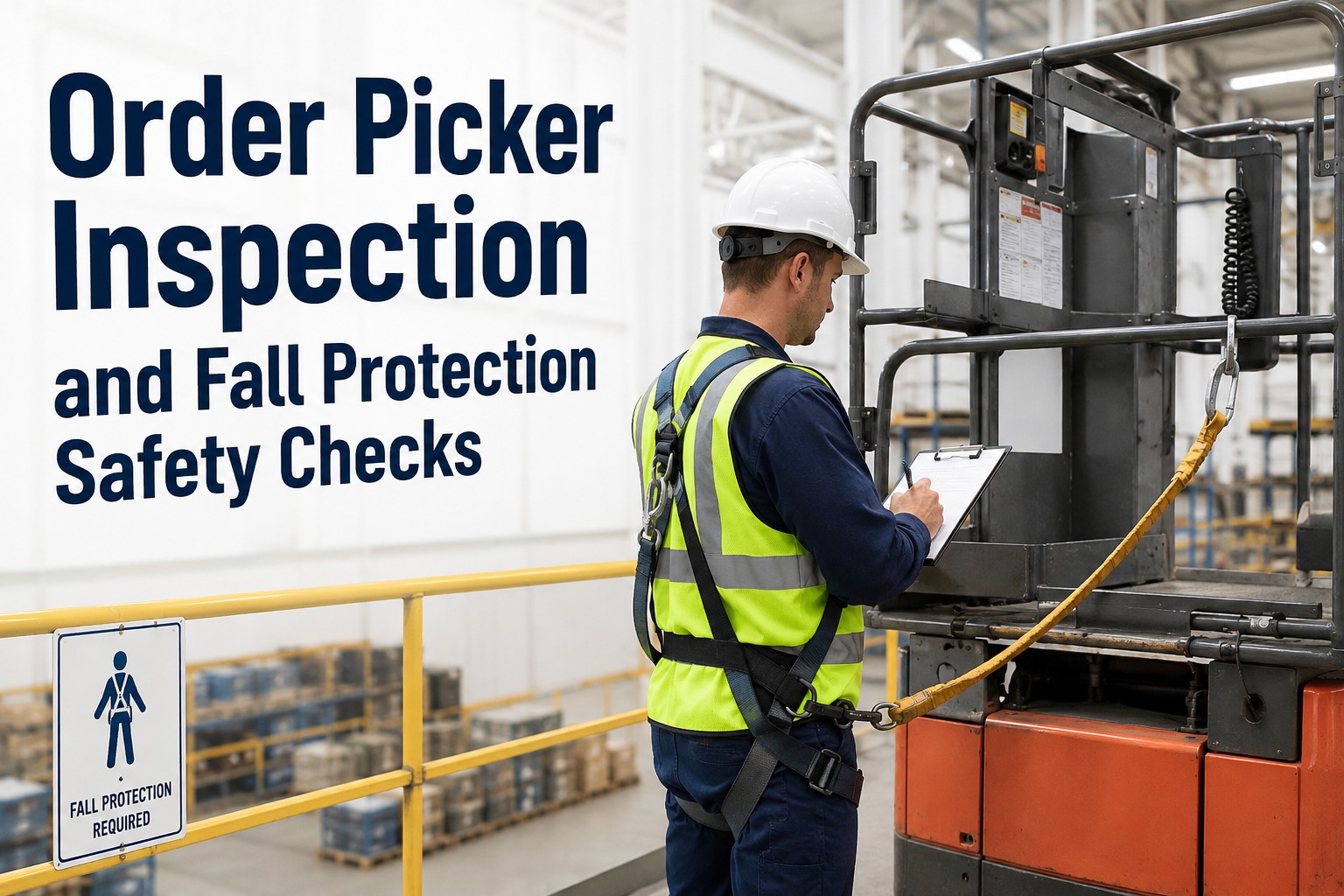
Order picker inspection is a life-safety check, not a maintenance formality: the operator rides the platform up to pick height, so a failed gate latch, a cracked anchor point or a worn lift chain is a fall event waiting for a shift to start. If you run high-level order picking, you already know the uneasy moment when a picker heads up thirty feet and you are trusting a harness clipped to an anchor nobody has looked at since last quarter. Paper checklists get pencil-whipped, defects get mentioned at the toolbox talk and forgotten, and the one record that would protect you in an OSHA or HSE investigation is a crumpled sheet in a cab drawer. This guide walks through what to check on every cycle - fall protection, platform, mast and chains, controls and stability - and how to make those checks stick. If you want to see the digital version running on your own equipment, you can book a 30-minute walkthrough and watch a defect turn into a work order live.
Elevated picking safety
When the operator rides up with the load, every missed check is a fall-risk decision
A forklift keeps the driver on the ground. An order picker lifts the person. That single difference changes the inspection from a downtime issue into a life-safety duty - and it is why these checks belong on every cycle, not every shift.
Why the stakes are different
What a missed order picker inspection actually costs you
30+ ft
Typical pick heights on high-level machines - a fall from here is rarely survivable without working fall arrest
Top 10
Fall protection and powered industrial trucks both sit permanently among OSHA's most-cited standards, year after year
Every cycle
The inspection frequency life-safety items deserve - a once-a-shift check leaves hours of exposure between looks
Seconds
How fast you should be able to pull a timestamped, photo-backed inspection record when an auditor or insurer asks
The six inspection zones
Order picker inspection checklist: what to check and why it matters at height
Each zone below fails in a different way, but they share one trait: the consequence happens in the air, not on the floor. Build all six into your order picker checklist and treat any defect as a lockout, not a note.
Fall protection system
Inspect the anchor point for cracks, deformation, corrosion and loose fasteners. Check harness webbing for cuts, glazing and chemical damage; check lanyard stitching, energy absorber condition and connector gates. Confirm the operator actually clips to the designated anchor - the most common shortcut is attaching to a guardrail or not attaching at all because the harness "slows the pick down."
Operator platform
Test gates and guardrails for positive latching, bent tubing and missing mid-rails. Check the platform floor for holes, oil film, loose anti-slip surfacing and debris. A gate that swings open under body weight at pick height is the failure mode behind a large share of elevated picking incidents.
Lift mechanism
Look for chain wear, stiff links, rust and correct tension; check mast rails and rollers for damage; check hydraulic hoses and cylinders for weeping, chafing and drift. A chain or hose that would strand a forklift at floor level drops a person on an order picker - there is no acceptable "run it until Friday" on these parts.
Controls and presence detection
Test the deadman pedal or presence sensor, lift and lower functions, travel speed cutback at elevation, emergency stop and emergency lowering. Presence detection that has been taped down or bypassed by a frustrated operator is a defect, and your inspection needs to catch it before the next shift does the same thing.
Load handling and stability
Verify capacity plate legibility, fork condition and pallet clamp function. Stability margins shrink fast at elevation: an off-centre pallet that is harmless at two feet becomes a tip risk at twenty. Confirm operators know the de-rated capacity at height and that the load is centred before the platform rises.
Travel and guidance systems
Check wire or rail guidance engagement, brakes, steering, horn and warning lights. In narrow-aisle wire-guided operation, a guidance fault at height means a machine moving between racks with a person on the platform and no steering correction - test engagement before the first run of the day.
The frequency argument
Why order picker fall protection checks belong on every cycle, not every shift
A once-per-shift inspection assumes the machine's condition at 6 a.m. predicts its condition at 2 p.m. On equipment where the operator rides to height, that assumption is where incidents live. Here is the case you can take to your own leadership.
Shift-start only
One check covers 8-10 hours of ascents. A gate latch bent by a pallet strike at 9 a.m. goes unnoticed until tomorrow - with dozens of elevated picks in between.
Every cycle
A 60-second fall-protection and platform check before each ascent. The same bent latch is caught on the very next trip up, and the machine is locked out before anyone rides it.
The pushback you will hear is pick-rate loss. The honest answer: a disciplined per-cycle check takes under a minute, while a single fall event costs you the machine, the aisle, the investigation, the claim and possibly the operator. If you want to see how fast a per-cycle digital check actually runs, watch it happen on a live demo before you argue the numbers internally.
Requirement to record
Order picker compliance: what auditors expect to see on paper - or on screen
Whether you answer to OSHA, HSE, Safe Work Australia, NHVR-aligned client audits or an insurer, the evidence pattern is the same: prove the check happened, prove the defect was actioned, prove the operator was trained.
| Safety requirement | What an auditor asks for | Record that satisfies it |
|---|---|---|
| Pre-use inspection of the machine | Dated, signed checks for each unit, each shift or cycle | Timestamped digital inspection with operator identity attached |
| Fall protection inspection | Harness, lanyard and anchor condition evidence | Mandatory photo capture on anchor and harness items |
| Defect rectification | Proof defects were repaired before the unit returned to service | Defect auto-linked to a closed work order with parts and labour logged |
| Operator training and authorisation | Only trained operators on high-level equipment | Equipment assignment tied to trained, authorised operator profiles |
| Preventive maintenance on lift systems | Chain, mast and hydraulic service at set intervals | PM schedule by date or hours with due and overdue alerts |
If your current answer to any row is "the binder in the supervisor's office," that is the gap a fleet compliance platform closes. You can start logging inspections free and have your first audit-ready record the same day.
How HVI helps
Built for equipment where a missed check hurts a person, not a schedule
HVI is cloud plus mobile inspection and maintenance work order software. For order pickers, four capabilities do the heavy lifting.
Dedicated order picker templates
Per-cycle checklists with mandatory photo capture on anchors, harnesses and gates - the inspection cannot be submitted with those items skipped, so pencil-whipping dies on day one.
Defects become work orders instantly
A failed gate latch flagged at 9:04 a.m. is a work order with photos at 9:04 a.m., routed to your shop with the unit flagged out of service until it closes. No text-message photos lost in a group chat.
Equipment tied to trained operators
Assign high-level pickers only to authorised, trained operators. When an auditor asks who rode unit 7 last Tuesday, you answer in seconds with a name, a record and a training status.
PM and analytics in one place
Chain and hydraulic service scheduled by hours with overdue alerts, plus compliance-rate reporting across every unit - the same platform that runs your trucks, trailers and shop equipment.
See a per-cycle order picker inspection run in under a minute
Book a 30-minute demo and we will load your equipment types, show the mandatory-photo checklist, and fail a gate latch live so you can watch the work order fire.
A worked example
What one caught defect is worth: the 60-second maths
Take a distribution centre running six order pickers across two shifts. At a conservative four ascents per hour per machine, that is roughly 380 elevated picks a day riding on gates, anchors and chains.
The defect
A platform gate spring fails at 10 a.m. on unit 3. Under shift-start-only checks, it was fine at 6 a.m. - so it runs broken for the rest of the day.
The exposure
That is roughly 50 more ascents with a gate that opens under body weight. Any one of them is a fall from height, a lost-time injury and a regulator investigation.
The per-cycle catch
With a 60-second per-cycle check, the next ascent catches it. Unit locked out, work order raised, spring replaced for the cost of a part and an hour of labour.
The trade
Six minutes of inspection time per machine per day against one prevented fall event. No pick-rate target survives that arithmetic - and no defence lawyer needs it explained twice.
If you want to pressure-test these numbers against your own fleet size and pick rates, bring them to a demo call and we will run the comparison with you.
Key takeaways
Order picker safety checks: the short version to take into your next meeting
Treat it as life safety
The operator rides to height, so platform, gate and anchor integrity sit in the same category as harnesses and guardrails - not in the same category as oil levels.
Check every cycle
Fall protection, gates and presence detection deserve a 60-second check before each ascent. Shift-start-only leaves hours of uninspected exposure.
Make defects lock out
A noted defect that does not stop the machine is a liability, not a control. Every failed item should flag the unit out of service until a work order closes.
Prove it in seconds
Timestamped, photo-backed records tied to named, trained operators are the difference between a two-minute audit answer and a two-week document hunt.
Order picker inspection done this way is not extra admin - it is the cheapest fall-protection programme you will ever buy. Set up your first template free and run it on one aisle this week.
My gripe was never the inspections - it was proving them. We had a gate latch fail on a Tuesday and I spent three days digging through binders to show the client we'd checked that machine. Now every check is timestamped with a photo, and I track one number: how many defects closed same-day. Last quarter it was 96 percent. That number ends arguments.
Marcus Delaney - Safety & Compliance Manager, regional third-party logistics provider
Common questions
Order picker inspection and fall protection FAQs
How often should an order picker be inspected?
Does an order picker operator need fall protection?
What are the most commonly missed items on an order picker checklist?
What records should I keep for order picker safety compliance?
Can inspection software handle order pickers alongside trucks and other fleet equipment?
Put every ascent on the record - starting this week
Move your order picker inspections off paper and onto a platform that forces the critical photos, locks out defective units and hands you audit-ready proof in seconds.
Free to start - Works on any phone or tablet - No card needed