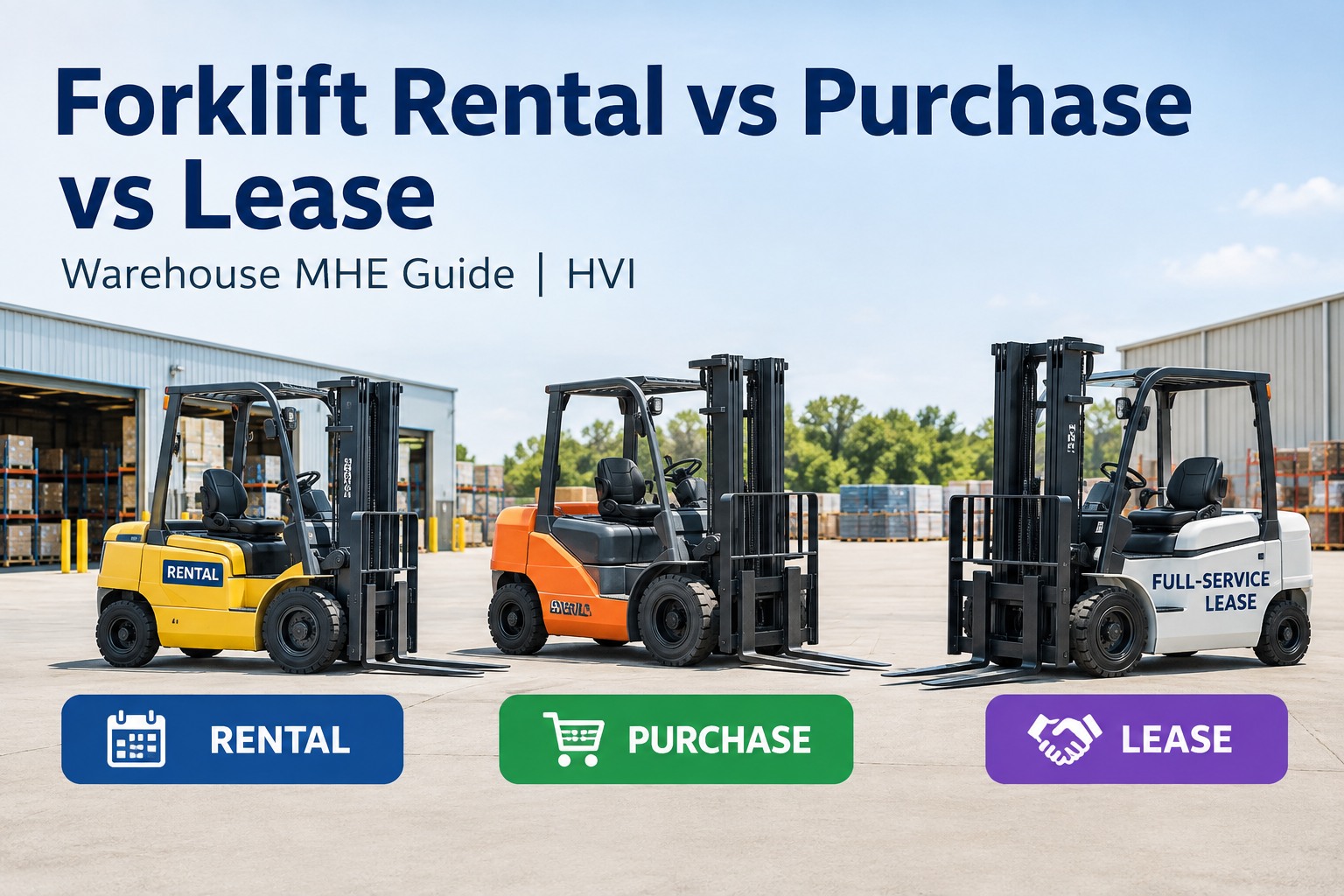
Every forklift dealer will tell you whether to rent, lease, or buy — and every one makes money on the answer. The honest version: forklift rental vs purchase vs lease isn't really a financing question; it's about where maintenance responsibility, financial risk, and flexibility should sit for your operation. Get that framing right and the numbers follow — get it wrong and you're locked into a contract that fit the salesperson, not the warehouse. See the utilisation data that actually drives this call
You're Not Choosing a Price. You're Choosing Who Carries the Risk.
Rent, full-service lease, and purchase each move maintenance responsibility, financial exposure, and flexibility to a different place. The right call depends on your operation — not a universal rule.
Below is the decision the way a fleet or safety manager has to defend it internally: the four factors that actually decide it, a side-by-side of all three options, the contract terms that quietly cost you later, and the one thing that protects you no matter which you pick — owning your own asset data.
The four factors that decide it — not a magic hour threshold
You'll see "rent under six months, buy over" everywhere. It's a rough rule, and leaning on it is how fleets end up over-renting an asset they use daily or buying one that sits idle half the year. The real decision runs on four inputs, weighed together.
Notice the thread: every one of these needs real usage data. A decision this expensive shouldn't rest on a gut feel about how busy a truck "seems." Book a demo to see utilisation and cost-per-hour per asset — the inputs this whole decision runs on.
Rent vs lease vs buy, side by side
The same operation, judged on the things that actually differ. There's no winner column — the right choice is the one whose trade-offs match your four factors above.
| Factor | Short-term rental | Full-service lease | Purchase |
|---|---|---|---|
| Best for | Peak season, projects, temporary or trial needs | Steady use, limited in-house maintenance | High-use core equipment kept long-term |
| Maintenance | Supplier's responsibility | Often bundled — check the terms | Yours entirely, scheduled + surprise |
| Upfront cost | Lowest — pay as you go | Low — minimal capital | Highest — capital or financed |
| Cost over time | Highest per hour (premium bundled) | Middle — predictable monthly | Lowest per hour at high utilisation |
| Flexibility | Highest — swap or return anytime | Set term — tech refresh at renewal | Lowest — you own the asset |
| Ownership & resale | None | None (unless lease-to-own) | Full — resale value at end of life |
Rental costs the most per hour because the price bundles the supplier's maintenance and the idle time before dispatch — you're paying for someone else to carry the risk. That's worth it for short needs and a bad deal for a truck you run every day. Book a demo to see real cost per hour on the units you already run.
The contract terms that quietly cost you later
The headline monthly rate is the part everyone reads. The parts that actually determine what you pay are buried in the terms — and on a full-service lease especially, this is where a "good deal" turns expensive. Check these before you sign.
Read all four and the "cheapest" option often changes. The last one matters most — because it's the term that decides whether you can ever leave. Book a demo to see how asset history stays with you, not the vendor.
The thing that protects you no matter what you choose
Here's the part the dealer articles never mention, because it's not in their interest: whichever way you go, you should own your asset's history. On a purchase you obviously do. On a full-service lease, you often don't — and that's the quiet risk.
The lease vendor maintains the unit and keeps the utilisation and service records. At renewal or a return dispute, you have no independent proof of condition or hours — and switching providers means starting blind.
Utilisation, inspections, and full maintenance history logged on your own system — regardless of who turns the wrench. You can prove condition at end-of-term, compare providers on real numbers, and walk away clean.
This is exactly where an inspection and maintenance platform earns its place in a rent-lease-buy decision that has nothing to do with financing: it keeps the utilisation and asset history in your hands so the decision — and every one after it — is made on your data. Start free and keep asset history on every unit, owned or leased.
The rent-lease-buy decision checklist
Run this before you sign anything — it turns "the rep said leasing is cheaper" into a decision you can defend on paper. Use this acquisition checklist online free, backed by your own utilisation and cost-per-hour data.
From a fleet manager who had to defend the call
Finance wanted everything leased because the monthly number looked lower. But when I actually pulled the hours, three of our trucks were running near double the lease's hour allowance — we'd have been eating overage charges all year. Two others barely moved and were perfect rental candidates.
I walked in with cost per hour on every unit and the picture flipped: buy the workhorses, rent the seasonal ones, lease nothing. Because I had our own utilisation data, it wasn't my opinion versus the rep's — it was numbers. That's the difference between defending a decision and hoping it holds.
Frequently asked questions
Is it cheaper to rent, lease, or buy a forklift?
It depends entirely on utilisation and how long you'll keep the unit. Rental has the lowest upfront cost but the highest cost per hour, because the price bundles the supplier's maintenance and idle time. Purchase has the highest upfront cost but the lowest cost per hour at high, steady utilisation. Leasing sits in the middle with predictable monthly payments. The only fair comparison is total cost per operating hour on your actual hours — not the headline monthly rate.
When should a warehouse rent a forklift instead of buying?
Renting makes sense for short-term, seasonal, project, or trial needs, and for covering a unit that's down — anywhere flexibility is worth more than cost efficiency. The premium buys the ability to swap or return the truck and shifts maintenance responsibility to the supplier. It's a poor fit for a forklift you run daily year-round, where that same premium is money lost every hour. Base the call on real utilisation, not a rough hour threshold.
What is a full-service forklift lease, and what's the catch?
A full-service lease bundles the forklift with scheduled maintenance and service, which suits operations with limited in-house maintenance capability. The catches are in the terms: what maintenance is actually excluded, guaranteed response times when a unit goes down, hour allowances and excess-hour charges, end-of-term condition requirements, and — the big one — who owns the utilisation and asset-history data. Review those closely; "full-service" rarely means everything, and the data-ownership term can quietly lock you in.
Does maintenance responsibility change with each option?
Yes — it's the core difference. With rental, the supplier carries maintenance. With a full-service lease, scheduled maintenance is often bundled (subject to exclusions). With purchase, you carry all of it, scheduled and surprise. That's why the decision is really about where maintenance responsibility and risk should sit for your operation, and whether you have the in-house capability to take it on. The financing structure follows from that, not the other way around.
Why does utilisation data matter for a rent-lease-buy decision?
Because every factor in the decision depends on it. Cost per hour, whether you'll exceed a lease's hour allowance, whether a unit justifies ownership or should be rented — all of it comes from actual hours run. Deciding without utilisation data means guessing, and an expensive multi-year commitment is a bad thing to guess at. Tracking real utilisation and cost per asset turns the decision from an opinion into a number you can defend to finance.
Whatever you choose, keep the numbers and the history
HVI tracks utilisation and cost per operating hour on every asset, and keeps full inspection and maintenance history in your hands — whether you own the forklift or lease it. So the rent-lease-buy call is made on your data, and you're never locked in by a vendor who holds it. Decide once, defend it easily, stay in control.
No credit card · Utilisation & cost-per-hour per asset · Your history stays yours