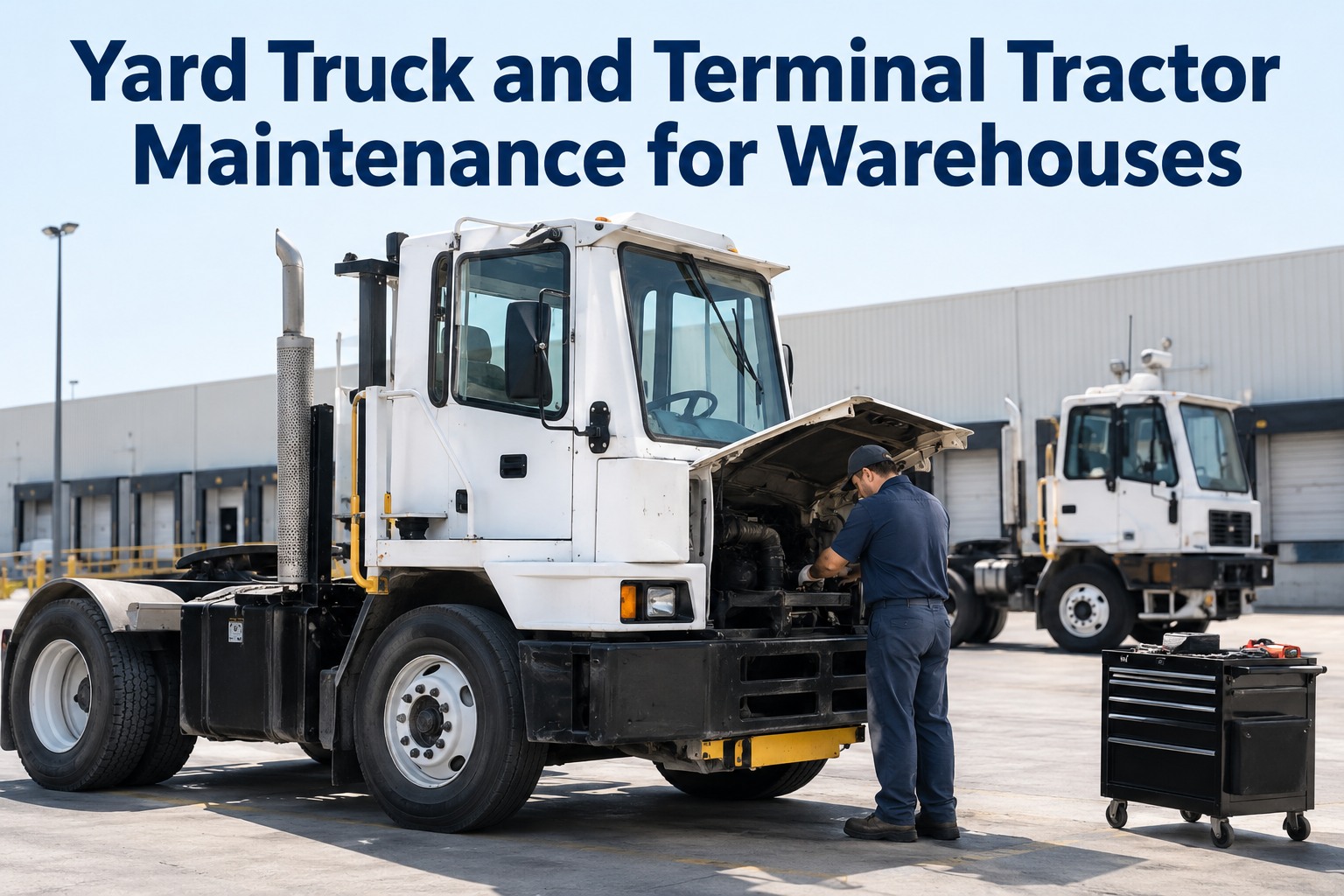
Your road tractors get a maintenance plan built around miles. Your yard trucks get fixed when they stop moving. That gap is why yard truck maintenance keeps ambushing distribution operations: a terminal tractor can run 300 to 500 coupling cycles in a single shift, dragging its lifting fifth wheel, hydraulic system, transmission and brakes through a duty cycle no highway tractor will ever see, yet most fleets still schedule it like a road unit. When one spotter goes down at 6 a.m., doors back up, trailers miss their slots, and the dock schedule unravels by lunch. This page breaks down what actually wears out on a yard jockey, how to build a PM regime around hours and coupling cycles instead of miles, and how to tie unit availability directly to dock throughput. If you want to see how this looks with your own units and your own door count, book a 30-minute walkthrough of HVI on your yard fleet and we will map it together.
Terminal Tractor & Spotter Maintenance
A yard truck lives a harder life in one shift than a road tractor does in a week. Is your PM plan built for that?
Mileage-based schedules miss almost everything that kills a spotter: hydraulic fifth-wheel wear, coupling fatigue, brake heat and transmission shock from constant direction changes. The fix is an hour- and cycle-based regime with inspections that feed straight into work orders.
What the Duty Cycle Costs You
Why terminal tractor service can't copy your road fleet schedule
Every cycle slams the fifth wheel, jaws, lift cylinders and gladhands. Road tractors see a handful of couplings a week; your spotter sees that before break.
Most DCs run lean on spotters. Lose one and door turnaround stretches immediately — trailers dwell, drivers wait, and detention charges start ticking.
A yard tractor may idle and shuttle 10–14 hours a day while racking up almost no road mileage. Mileage-based PM lets it run months past due.
Continuous stop-start spotting with heavy trailer loads cooks pads, drums and slack adjusters far faster than linehaul service ever will.
Component by Component
The six failure points every yard tractor inspection checklist must cover
Terminal tractor reliability comes down to six systems that wear in ways road units never do. Build your yard tractor checklist around these and you catch problems while they are still a planned repair instead of a mid-shift breakdown.
1. Lifting fifth wheel & hydraulics
The defining component and the number one failure point. The hydraulic lift lets the spotter raise the trailer nose and move it without dropping landing gear — hundreds of times a shift. Watch cylinder seals for weeping, hoses for chafe at the pivot points, pump strain and slow lift times, and jaw wear from constant coupling. A slow or drifting lift is your earliest warning; a failed one stops the unit dead.
2. Coupling & air line connections
Gladhands, seals and air lines connect and disconnect with every move. Worn gladhand seals leak, slow the trailer brake release and get flagged on any yard tractor inspection. Check the kingpin jaws for play, the locking mechanism for positive engagement, and air lines for rub-through where they flex at the rear of the cab.
3. Brakes under stop-start duty
Yard truck brakes live at temperature. Short runs with a loaded trailer mean constant application, heat soak and accelerated pad and drum wear. Measure lining thickness on a schedule, check slack adjuster travel, and listen for operators reporting a soft pedal — on a spotter that usually means heat fade, not air.
4. Transmission & driveline
Repeated forward-reverse shifts under load punish the transmission, U-joints and driveline. Shock loading from aggressive direction changes shows up as harsh engagement, slipping, or vibration. Fluid condition checks on engine hours — not miles — catch the breakdown before the gearbox does it for you.
5. Cab access, steps & grab handles
Spotter operators climb in and out dozens of times a shift — often backwards, often in a hurry. Loose steps, worn anti-slip surfaces and cracked grab handles are behind a disproportionate share of yard injuries. Treat ingress and egress hardware as a safety inspection item, not a cosmetic one.
6. Visibility, mirrors & camera systems
Rear-view cameras and proximity sensors are working safety equipment on a unit that reverses all day. Vibration kills connectors and mounts; dirt blinds lenses. A dead camera on a spotter is not an inconvenience — it is a blind reversing event waiting for a pedestrian or a dock plate.
Build the Regime
A yard truck PM schedule that matches how spotters actually work
The pattern that holds up in real distribution yards: daily operator checks, hour-based service intervals, and defects that become work orders the moment they are reported — not at the end of the week.
Daily operator walk-around — 5 minutes, phone in hand
Before first move: lift function test, gladhand seal check, brake pedal feel, camera and mirror check, step and handle tug test, fluid leaks under the unit. Logged as a digital DVIR with photos, so a cracked gladhand seal at 5:50 a.m. is a work order by 5:52 — not a note on a dashboard. You can start logging these inspections free with a template built for yard trucks.
250-hour service — the hydraulic and brake interval
Hydraulic fluid and filter condition, lift cylinder seal inspection, hose chafe check, fifth-wheel jaw wear measurement, brake lining measurement and slack adjuster travel. On a two-shift operation, 250 engine hours arrives in roughly a month — which is exactly why mileage triggers fail here.
500-hour service — driveline and coupling deep check
Transmission fluid and shift-quality assessment, U-joint and driveline play, kingpin jaw and locking mechanism wear limits, air line replacement where flex damage shows, camera mount and connector integrity. This is the interval that prevents the mid-shift transmission failure that takes a unit out for a week.
Weekly availability review — tie the shop to the dock
Pull unit availability next to door turnaround. If spotter uptime dips below what the door schedule needs, you see it in the numbers before the dock manager feels it in the queue. This is the meeting where maintenance defends its budget with data instead of anecdotes.
The Business Case
What one downed spotter actually costs a distribution yard
Here is the worked example to take into your budget meeting. It uses conservative, round numbers — plug in your own rates and the case usually gets stronger.
(Doors affected × trailer dwell hours × detention per hour) + (driver wait hours × wait cost) + (rental or loaner unit per day) + emergency callout repair premium
Illustrative day, 12-door DC, one spotter down
Door turnaround slips from 45 to 70 minutes across the affected doors. Four trailers dwell an extra 2 hours each at $50 detention — $400. Two drivers wait 3 hours at $60 — $360. A rental spotter runs $350/day if you can get one. Emergency hydraulic callout adds a $500 premium over a planned seal job.
Run that twice a quarter and the unplanned-repair habit costs a mid-size yard five figures a year — before you count missed shipping windows or the safety exposure of a rushed yard. Fleets that want to see this math on their own door count can walk through it on a live demo with their own numbers.
How HVI Helps
Yard truck maintenance software built for hours, cycles and dock pressure
Dedicated yard truck templates
Inspection checklists built around the lifting fifth wheel, gladhands, cab access and camera systems — not a generic truck DVIR. Operators complete them on any phone in minutes, with photos attached to every defect.
Hour-based PM scheduling
Preventive maintenance triggered by engine hours and calendar, with due and overdue alerts per unit. Your 250- and 500-hour services fire on time even when the odometer barely moves.
Defects auto-create work orders
A failed gladhand seal or slow lift reported at 5:50 a.m. becomes a prioritised work order instantly — no paper DVIR, no text-message photos, no lost notes. Parts get checked against inventory before the tech picks up a wrench.
Availability tracking tied to throughput
Uptime, cost per unit and compliance rate in one dashboard, so you can put spotter availability next to door turnaround and defend the maintenance budget with numbers the operations director already cares about.
See your own yard trucks in HVI — book a 30-minute demo
Bring your unit count, your door schedule and your worst breakdown story. We will show you the templates, the hour-based PM and the defect-to-work-order flow on your exact setup.
Paper vs Platform
Shunt truck maintenance: the binder method vs a connected CMMS
| Task | Paper binder & spreadsheets | HVI on phone or tablet |
|---|---|---|
| Daily spotter inspection | Checkbox sheet, often pencil-whipped, filed and forgotten | Guided digital DVIR with photos, timestamped and stored per unit |
| Defect to repair | Note passed to the shop, or a text with a blurry photo | Defect auto-creates a prioritised work order with photo evidence |
| PM trigger | Mileage or memory — hours-based units run months overdue | Engine-hour and calendar triggers with due/overdue alerts |
| Audit or incident review | Dig through binders, hope the sheets are legible | Pull the unit's full timestamped, photo-backed history in seconds |
| Availability vs dock plan | Shop whiteboard vs the dock office's spreadsheet | One uptime dashboard both teams read from |
If your yard still runs on the left column, the fastest way to scope the switch is to book a demo and see the right column running live on a unit profile like yours.
Key Takeaways
Yard truck maintenance, summed up for your next budget meeting
- Spotters are not road tractors. Hundreds of coupling cycles per shift destroy fifth wheels, hydraulics, brakes and transmissions on a schedule mileage-based PM will never catch.
- The lifting fifth wheel is the heartbeat. Slow lift times and weeping seals are your early warning — catch them on the daily check or pay for the emergency callout.
- Hours and cycles are the right triggers. A 250/500-engine-hour service rhythm matches how terminal tractors actually wear.
- Availability is a dock metric. One down unit costs a working DC roughly $1,600 or more per day in dwell, detention, rental and emergency repair — planned PM is a rounding error by comparison.
- Connected records win arguments. When inspections feed work orders automatically and uptime sits next to door turnaround, yard equipment PM stops being a cost centre and starts being a throughput guarantee.
The shortest path from this page to a working regime is to sign up free and load your first yard truck template — it takes minutes, not a rollout project.
The number I watch every Monday is lift-cycle complaints per unit. If an operator says the fifth wheel feels slow, that truck is in the bay that week — no exceptions. We used to find out when it stopped lifting with a trailer on it, and that phone call from the dock is one you don't forget. Since we moved the spotters onto hour-based services and phone inspections, I haven't had a mid-shift hydraulic failure in over a year. The dock manager stopped yelling, which honestly is the metric my boss cares about.
— Marcus Doyle, Maintenance Manager, regional grocery distribution centre
Questions Fleet Managers Ask
Yard truck and terminal tractor maintenance FAQ
How often should a yard truck be serviced?
What fails most often on a terminal tractor?
Why does yard truck downtime hurt more than a road truck breakdown?
What should a daily yard tractor inspection checklist include?
Can fleet maintenance software really track engine-hour PM on yard equipment?
Keep every spotter lifting — and every door turning
Put your yard trucks on hour-based PM, phone inspections and automatic work orders. See it running on your own fleet before you spend a dollar.
Free to start — Works on any phone — No card needed