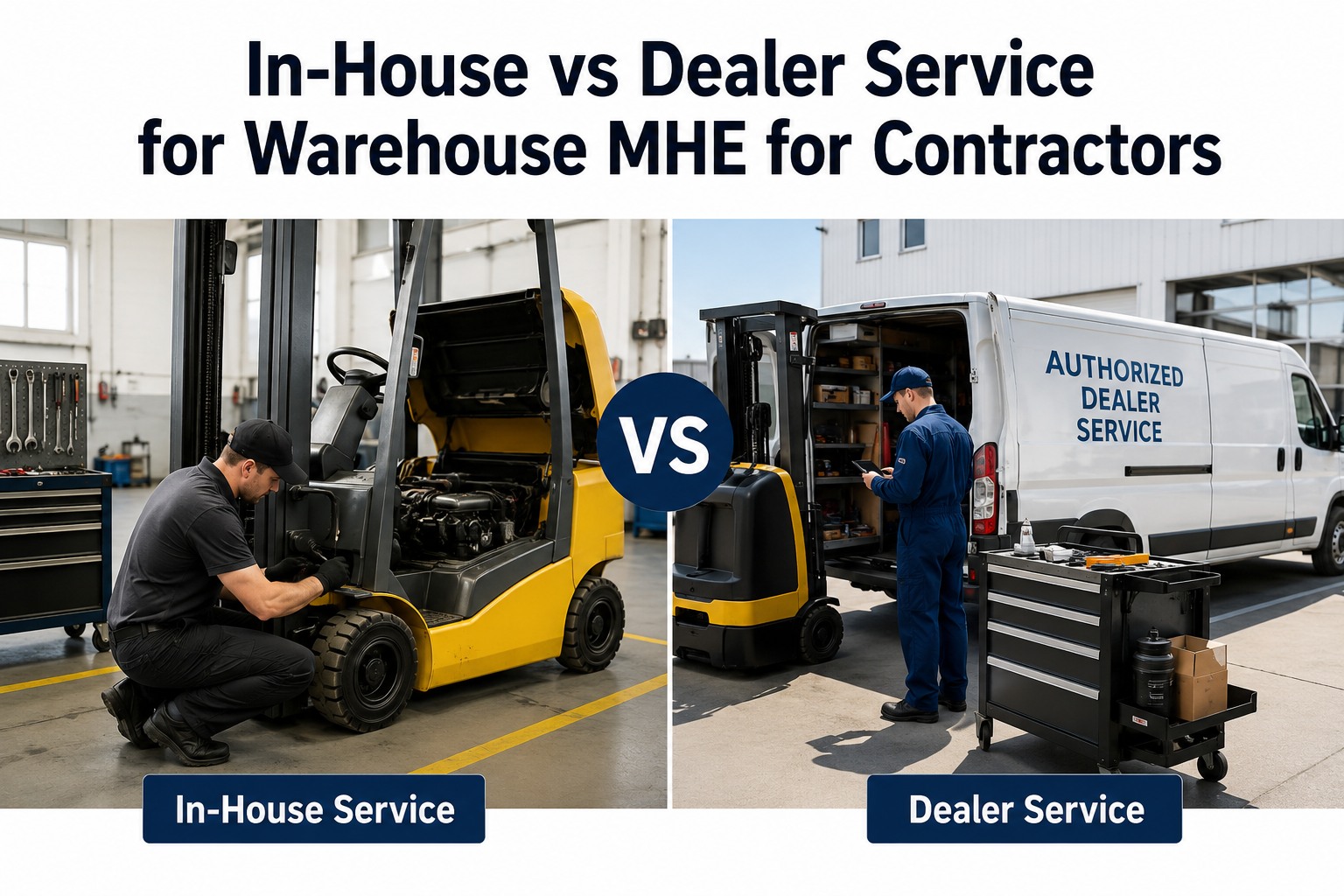
Your reach truck drops a hydraulic hose at 6:40 on a Tuesday morning, the night shift has left fourteen pallets on the dock, and the dealer's dispatcher tells you the earliest a field tech can reach you is Thursday. That phone call is where the in-house vs dealer service question stops being a procurement line item and becomes the decision that runs your warehouse. Most operations signed a full service agreement years ago and treat it as settled, yet the terms you accepted quietly determine how fast a technician shows up, what every repair actually costs you, and whether you even own the maintenance history of machines you paid for. This page breaks down what dealer contracts genuinely do well, when internal capability pays for itself, the hybrid model most warehouses converge on, and the contract clauses worth fighting over, so you can walk through the numbers on your own fleet in a 30-minute demo before your next renewal date.
Dealer Contract or Your Own Toolbox: Who Actually Owns Your Uptime?
Dealer service moves the wrench work. It does not move the accountability. Response time, cost visibility and data ownership are what actually differ between the two models, and those three decide your downtime.
What the dealer keeps
- Scheduling priority sits with their dispatch board, not your dock
- Service records live in their system, summarized on your invoice
- Chargeable extras defined by their rate card, found after the fact
What you should keep
- A response-time commitment in writing, with credits when it slips
- Every work order, photo and part number in a system you control
- Cost per truck per month you can defend at budget review
Four numbers to check before you renew any MHE service contract
These are the figures that separate a well-run agreement from an expensive habit. Pull your own versions from last year's invoices and compare.
In-house vs dealer service for MHE: what each model actually delivers
Neither model wins across the board. Dealer service is genuinely strong on OEM depth and warranty work; in-house wins on response and cost control. The table is the version your provider will not show you.
| Factor | Dealer / third-party service | In-house technician | What it means for you |
|---|---|---|---|
| Response time | Dispatch queue, often next-day or later for non-critical calls | Minutes to hours; the tech is already on site | A down reach truck at peak costs you picks per hour, not just repair dollars |
| Technical depth | OEM diagnostics, factory bulletins, specialist tooling | Strong on your units, weaker on rare faults and software | Complex controller and CAN-bus faults still justify a dealer call |
| Warranty work | Clean claims processing, genuine parts, no disputes | Risk of voided coverage if procedures are not followed | Keep warranty-period units on dealer terms regardless of model |
| Cost visibility | Fixed monthly fee plus extras defined by their rate card | Loaded labor rate plus parts at your negotiated pricing | In-house you see the true cost per truck; on contract you see an invoice total |
| Data ownership | History sits in the dealer's system; you get summaries | Every record is yours from day one | Without full history you cannot make independent replacement decisions |
| Staffing risk | Their recruitment problem, not yours | You carry hiring, training, vacation and sick cover | One resignation can strip your capability overnight below a critical size |
The service model most warehouses actually converge on
Pure in-house and pure dealer are both rare past a certain fleet size. Most well-run operations land on a split: internal hands for the fast, frequent work, dealer support for the deep and the warranted. Here is how a typical 30-unit single-site fleet divides the load.
PMs, greasing, forks and chains checks, battery watering, pre-shift inspection follow-ups. High frequency, low specialization: this is where internal labor beats a dealer's call-out rate every time.
Hoses, tires, contactors and brakes stay inside; mast, controller and telemetry faults go to the dealer. The split shifts with your tech's skill set and your tooling budget.
Anything under factory warranty, plus engine, transmission and traction motor rebuilds, stays with the OEM channel. The claims risk of doing it yourself rarely pays.
The hybrid only works if both sides log into the same record. When your technician closes a PM in one spreadsheet and the dealer emails an invoice PDF, your cost per truck per month is fiction. This is exactly the gap a shared free work order log you can start today closes: internal and external work land in one history, whoever turned the wrench.
Five clauses to negotiate before you sign a full service agreement
The monthly rate is the least important number in a dealer contract. These five clauses decide what the agreement actually costs and how much leverage you keep.
Response time, in writing, with teeth
"Best efforts" means their dispatch board decides your uptime. Push for a committed on-site window by fault severity, for example four working hours for a truck-down call, with service credits when it slips. If they will not put it in the contract, they will not staff for it.
The included-versus-chargeable list
Full service agreements routinely exclude tires, forks, chains, batteries, attachments, damage and "abuse," which is where the 15 to 25 percent extras come from. Get the exclusion list attached as a schedule and price the top five items against your last two years of invoices before you compare quotes.
Data access and portability
Insist that every work order, defect, photo and part number is exported to you monthly in a usable format, and that the full history transfers at contract end at no charge. A fleet without its own maintenance history cannot defend a replacement decision or switch providers cleanly. You can see how a portable record works in a short demo before your next negotiation.
Loaner and downtime provisions
If a unit is down beyond an agreed window, who supplies the replacement truck and at what rate? Without this clause, a three-day parts delay becomes your rental bill on top of the monthly fee you already paid.
Exit terms and rate escalation
Cap annual increases, keep the term to what your lease or ownership cycle justifies, and strike any clause that makes your own service data conditional on renewal. The best time to negotiate the exit is before you sign.
See every work order, whoever turns the wrench
HVI logs internal and dealer work in one equipment history you own. Book a 30-minute demo and we will map it to your service contract.
When does an internal MHE technician pay for itself?
The break-even is simpler than providers suggest. Work it for your own fleet with three numbers: your annual dealer spend on chargeable work, a loaded technician salary, and the downtime hours you would recover.
Dealer chargeable extras last year: $58,000 + recovered downtime (approx. 90 truck-hours at $65/hr of lost throughput): $5,850 = $63,850 of value an internal tech captures.
Loaded technician cost (salary, benefits, training, tooling amortized): $78,000. On repair dollars alone the hire is underwater; add the PM work pulled off the contract rate and the faster response at peak, and the same fleet crosses break-even at roughly 25 to 30 units. Below that, stay hybrid. Above 40, in-house usually wins outright.
The costs people forget
- Diagnostic laptops and OEM software subscriptions, often several thousand per brand per year
- Coverage for vacation, sickness and training days, or your response time collapses one week in four
- Recruitment lead time: skilled MHE techs are scarce in every market from Texas to the UAE
- Parts inventory carrying cost once you stock your own filters, hoses and contactors
One maintenance record, whichever service model you run
HVI's work order management works identically for your own technicians and external providers, so the history stays with you even when the labor does not.
Work orders for internal and external techs
Your technician and the dealer's field tech close jobs in the same system, with photos, parts and labor captured either way. Outcome: one cost per truck per month you can finally trust.
Preventive maintenance scheduling
PMs trigger by date, hours or mileage with due and overdue alerts, whoever performs them. Outcome: no more missed intervals hiding inside a dealer's dispatch backlog.
Digital inspections with defect capture
Operator pre-shift checks on any phone feed defects straight into work orders with photos. Outcome: small faults get fixed in-house for parts money instead of returning as dealer call-outs.
Analytics you can take to renewal
Uptime, cost per asset and response performance by unit and by provider. Outcome: you negotiate your next contract from your own data, not their summary. Book a demo to see the reports.
The in-house vs dealer service decision, in four lines
Dealer service is a tool, not a strategy
It is genuinely strong on OEM diagnostics, warranty claims and specialist work. It is structurally weak on response time and cost transparency, because both are set by their priorities, not yours.
In-house pays once you have the density
Around 25 to 40 units on one site, a technician's loaded cost is usually beaten by recovered response time plus work pulled off the contract rate. Below that, the recruitment and coverage risk outweighs the gain.
The contract terms matter more than the rate
Response commitments, the chargeable-extras schedule, loaner provisions and data portability decide what a full service agreement really costs. Negotiate them before signature, not at renewal.
Own the data whichever way you go
A fleet without its own maintenance history cannot make independent repair-versus-replace decisions or switch providers cleanly. Keep every work order in a system you control and the in-house vs dealer service question stays reversible.
"We ran a full service agreement for six years and I could never tell you what a truck actually cost us. The dealer's report said everything was fine; my dock said otherwise. Now every job, theirs and ours, closes in one log and I walk into renewal with my own numbers. Last year that conversation alone took eleven percent off the quote. My one gripe is I did not demand the data clause in year one."
Daniel Reeves, Maintenance Manager, regional 3PL distribution group, 46 MHE units across two sites
In-house vs dealer service for MHE: your questions answered
Is in-house forklift maintenance cheaper than a dealer contract?
What should a full service agreement for forklifts include?
Who owns the maintenance records when a dealer services my fleet?
What is a hybrid MHE service model?
How do I measure whether my dealer is performing?
Own your maintenance history, whoever does the work
Start free, log your first work orders this week, and walk into your next contract negotiation with your own data. Or book a demo and we will build the comparison on your fleet's real numbers.
Free to start - Works on any phone - No card needed