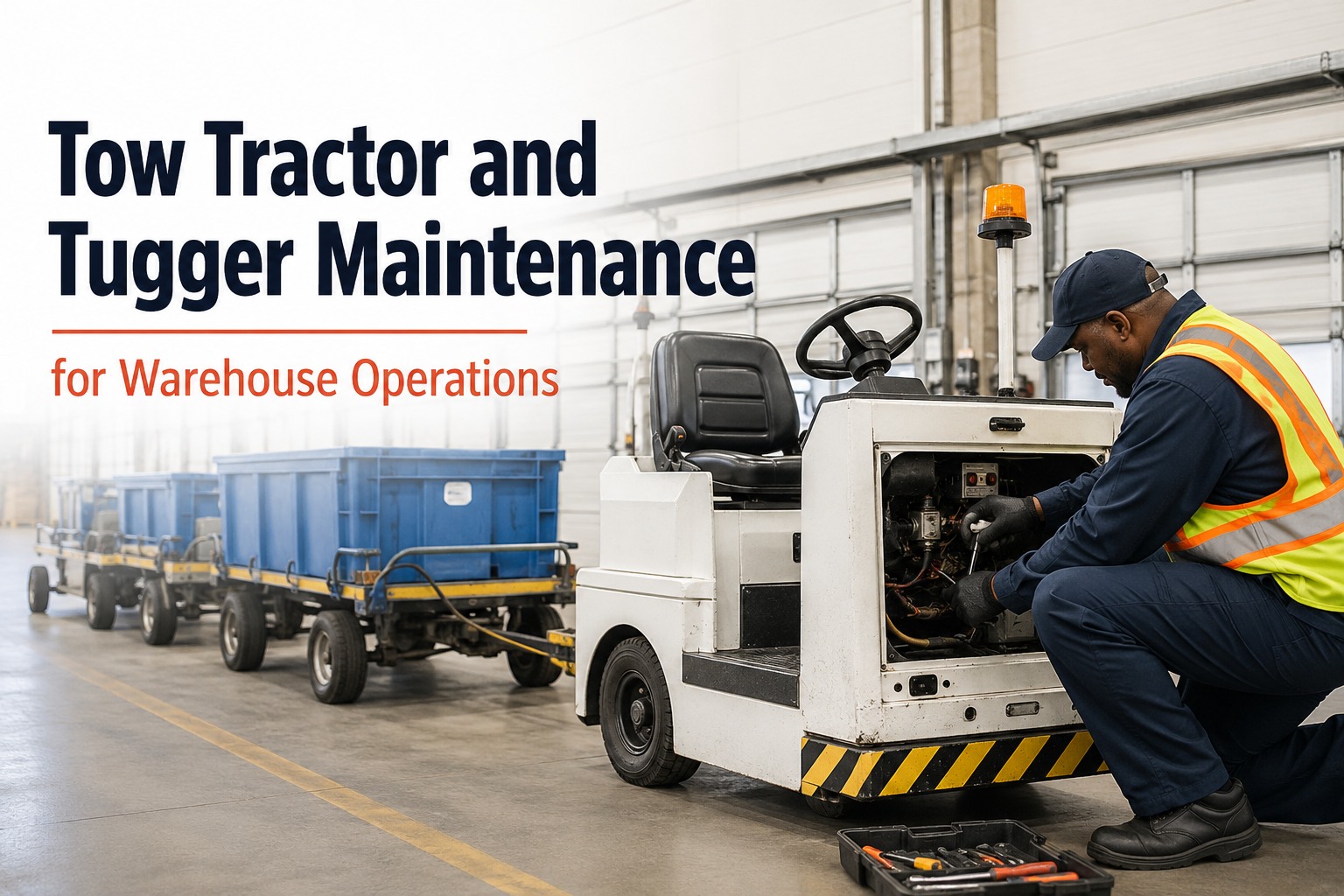
It's 6:40 on a Tuesday morning and your tugger driver radios in: the train won't stop straight, and the third cart is tracking sideways into the racking. That's the moment tow tractor maintenance stops being a line item and becomes the only thing that matters. Tuggers pulling cart trains cover more distance per shift than any forklift in your building, which means brakes, hitches, tyres and batteries wear faster and fail harder than on any other warehouse vehicle. This page breaks down the six systems that decide whether your milk run equipment makes it through the week, what a defensible tow tractor inspection looks like, and how fleets run this without paper checklists disappearing into a cab. If you'd rather see it working than read about it, you can book a 30-minute walkthrough on your own units any time.
Your tugger covers more ground than any forklift. Is your PM program built for that?
A loaded cart train carries serious momentum. Brakes, hitch couplings, battery capacity and cart condition decide whether your warehouse train system is an asset or a liability waiting for a pedestrian crossing.
The numbers behind tow tractor maintenance
Tuggers don't fail like forklifts. They fail like small locomotives — under load, at speed, in pedestrian aisles.
The six systems that decide tugger reliability
Ranked by what hurts most when it fails at 7am with a full train behind you.
Brakes — momentum is the enemy
A tugger pulling five loaded carts can weigh several tonnes in motion. Service brakes, parking brake hold and regenerative braking (on electrics) all need testing with a train attached, not solo. A tractor that stops fine empty can push through a pedestrian crossing loaded. Log brake pedal feel, hold test results and any pulling to one side on every tow tractor inspection — and if a driver flags fade mid-shift, that's a work order, not a note on a whiteboard. Fleets that see defect-to-work-order automation in a demo usually recognise this exact gap in their own process.
Hitch and coupling — the most-damaged, least-inspected part
Tow pins wear oval, latches lose spring tension, and cart-side tow eyes crack from thousands of connect-disconnect cycles a week. Worn coupling creates slack; slack creates surge; surge destroys brakes and jackknifes carts on corners. Check pin diameter against spec, latch positive engagement, safety clip presence, and the cart-side attachments — which are frequently bent or cracked and almost never on anyone's checklist. Cart coupling safety lives or dies on the cart end, not the tractor end.
Battery and charging — distance drives capacity
Tugger battery management is a range problem, not just a charge problem. A unit covering 30+ km per shift needs capacity headroom, and opportunity charging habits make or break battery life: short random top-ups on lead-acid accelerate sulfation, while lithium tolerates them well. Track runtime against route distance, flag units that can't finish a second shift, and log charger faults the day they appear — a dead charger at shift change cascades into two down tuggers by morning.
Tyres and drive wheels — mileage you can't see
Warehouse tow vehicle tyres wear on the inside edge and chunk at the tread face long before they look bald from the side. Drive wheels on electrics take constant torque; steer tyres take every dock-plate hit. Measure tread depth, check for flat spots from emergency stops, and inspect cart casters too — a seized caster drags the whole train and overheats the tractor's drive motor.
Visibility, horn and warning systems
Tuggers operate nose-first into pedestrian aisles, often with the driver's sightline blocked by the first cart on tight turns. Blue spot lights, reverse beepers, horn function and mirror condition aren't cosmetic — they're your primary defence in a struck-by incident. Any failed warning device should ground the unit. No exceptions, no "finish your route first."
The carts — nobody's responsibility, everybody's problem
Ask three people who maintains the carts and you'll get three different answers. Bent decks, broken caster welds, missing tow-bar pins and cracked shelves sit in service for months because carts don't have an owner, an ID number or a checklist. Give every cart an asset record and its own inspection template — this is exactly where fleets that start tracking carts as assets free find their hidden failure pile.
What a defensible tow tractor PM schedule looks like
Calendar-based PM misses the point — tuggers wear by hours and distance. Here's the structure that holds up internally and in an audit.
| Interval | Trigger | Key checks | Why it matters |
|---|---|---|---|
| Pre-shift | Every operator, every shift | Brake hold test, horn and lights, hitch latch engagement, visible pin wear, battery charge state | Catches the overnight damage and the "it felt funny yesterday" items before the train rolls |
| 250 hours | Hour meter | Brake adjustment and pad/shoe wear, tyre depth and chunking, coupling pin measurement, caster swivel check | Wear items on a high-mileage tugger hit service limits between monthly calendar services |
| 500 hours | Hour meter | Battery capacity test, contactor inspection, drive motor brush wear, steering linkage play, full cart-train brake test | Capacity fade shows up here first — before a unit starts dying mid-route |
| Annual | Date | Full structural inspection of tractor frame and cart fleet, weld crack check, charger output verification, brake system overhaul as needed | The documented deep check that satisfies insurers, auditors and your own safety case |
The worked example that sells this internally: one distribution centre running 8 tuggers found that switching from monthly calendar PM to hour-based triggers caught brake wear 3–4 weeks earlier on their two highest-mileage units — the exact two that had generated every brake-related near-miss report the previous year. If you want to map this schedule onto your own fleet, a short demo with your actual unit count is the fastest way to pressure-test it.
Stop guessing which tugger is due. See every unit's status in one screen.
HVI tracks hours, triggers PM automatically and turns driver defect reports into work orders before the morning route starts.
Tractors and carts are not the same asset — stop inspecting them like they are
A tow tractor checklist asks about brakes and batteries. A cart checklist asks about decks, casters and tow eyes. One template can't do both jobs.
Tow tractor template
- Service brake and parking brake hold test
- Hitch pin diameter and latch spring tension
- Battery charge state, cables and connector heat
- Tyre tread depth, chunking and flat spots
- Horn, blue spot, beeper, mirrors and lights
- Steering play and hour-meter reading
Towed cart template
- Tow eye cracks and tow-bar pin condition
- Caster swivel, bearing noise and wheel wear
- Deck straightness and weld cracks at corners
- Shelf and restraint integrity for load type
- Coupling alignment — does it track true?
- Cart ID legible and matched to asset record
This split is where most tugger fleet management falls down: the tractor gets a number and a checklist, the 40 carts behind it get nothing. Fleets that walk through cart-population tracking in a demo typically find 15–20% of their carts have a defect nobody has ever recorded.
Built for fleets where the towed equipment matters as much as the tractor
Separate templates for tractors and carts
Distinct digital checklists for each asset type, with photo capture on every defect. A cracked tow eye gets documented with a picture, not a shrug — and the record is timestamped for any safety audit.
Hour-based PM with due and overdue alerts
Preventive maintenance triggers off the hour meter, not the calendar. Your high-mileage tuggers get serviced when they actually need it, and nothing quietly slips past its interval.
Defects become work orders automatically
A driver flags brake fade on the pre-shift check and a work order exists before they've parked. No paper DVIR travelling to a desk, no text-message photo lost in a group chat.
Asset tracking across whole cart populations
Every cart gets an ID, a history and an inspection record. You finally know which carts are scrappers, which are repairable, and what the fleet actually costs — data you can start building free on your first units.
Tow tractor maintenance in five lines
Tuggers out-distance forklifts 3–5x per shift — calendar PM under-services them. Trigger by hours.
Test brakes with a loaded train attached. An empty hold test proves almost nothing.
Hitch slack doubles stopping distance. Measure pins, check latches, inspect the cart-side eyes.
Battery capacity is a range issue. Trend runtime against route distance, not just charge state.
Carts need their own IDs, templates and records — or they'll stay nobody's responsibility forever.
Tow tractor maintenance doesn't need a bigger budget — it needs triggers that match how tuggers actually wear, and records that prove it. That's a process decision, and it's one you can defend in any budget meeting with the numbers on this page. If you want help building the business case, bring your unit count to a demo and we'll run the math with you.
"The thing that used to drive me mad was the carts. Tractors had numbers, had files, had service stickers. The carts? Nothing. We had one with a cracked tow eye in circulation for months — I know because when we finally tagged and inspected the whole population, the crack had paint worn off the edges. Now every cart gets looked at weekly and I track one number: defects open longer than five days. It's usually zero."
Marc Delaney — Maintenance Manager, regional 3PL distribution centre
Tow tractor and tugger maintenance FAQs
How often should a warehouse tugger be inspected?
What should a tow tractor pre-shift checklist include?
Why do cart couplings fail so often?
How do I get the carts included in our maintenance program?
Can software actually track PM by hours across a mixed tugger fleet?
Your tuggers run more miles than anything else in the building. Maintain them like it.
Digital inspections for tractors and carts, hour-based PM, and defects that become work orders automatically — on any phone your team already carries.
Free to start — Works on any phone — No card needed