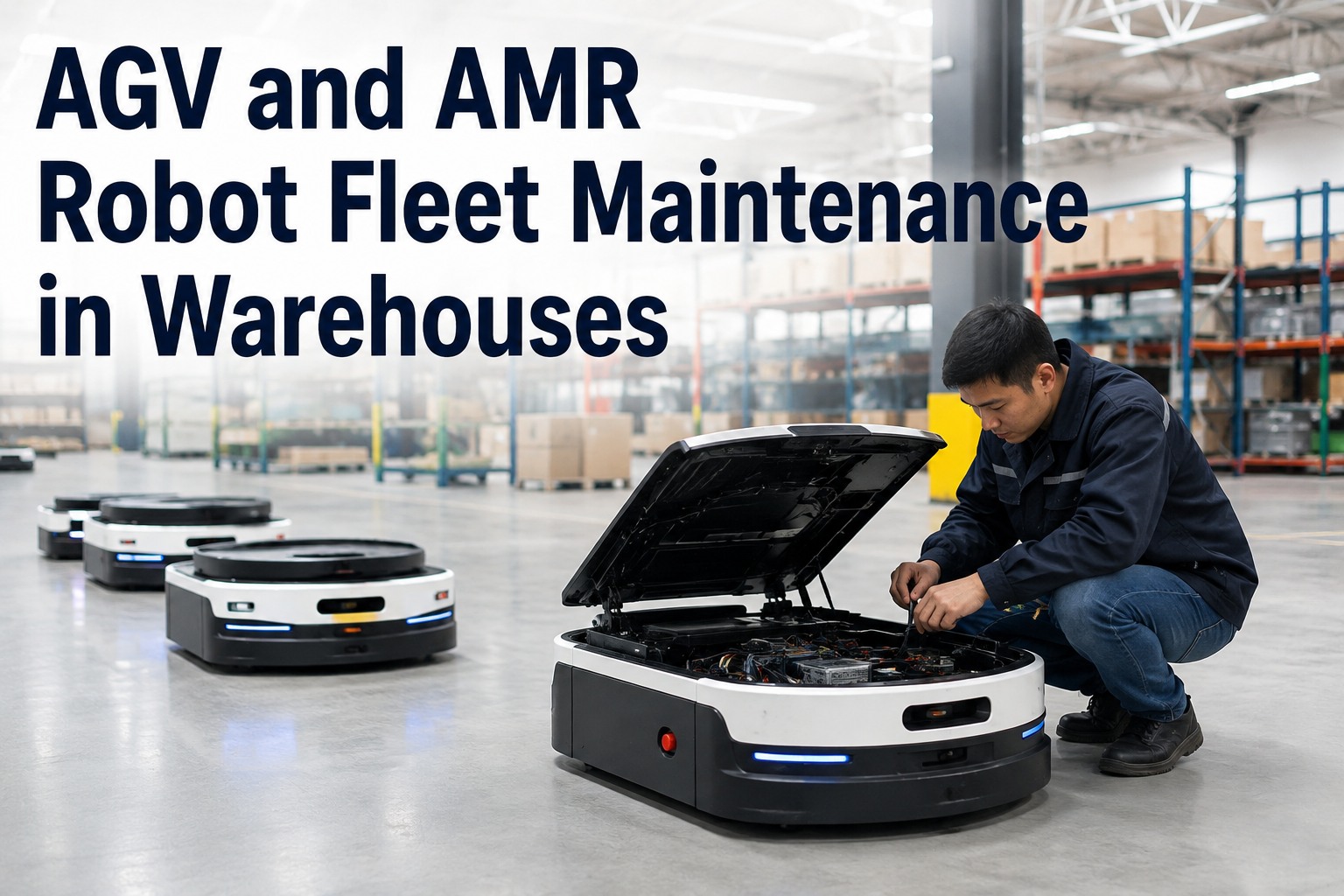
Your AGV fleet just stopped mid-shift because a safety scanner picked up dust on its lens, and now three pick stations are idle while someone hunts for the cleaning procedure in a spreadsheet. This is the reality of AGV maintenance and AMR fleet management in modern warehouses: mobile robots are mobile equipment with batteries, drive motors, wheels and safety systems that degrade exactly like forklifts and trucks, yet most operations treat them as IT assets that only need attention when they stop moving. The result is unplanned downtime, missed delivery windows and safety systems that get assumed rather than tested. If you are running automated guided vehicles or autonomous mobile robots alongside conventional material handling equipment, you need a maintenance system that treats robot fleet PM with the same rigor as your diesel fleet. HVI gives you custom inspection templates, PM scheduling by hours or cycles, and instant defect-to-work-order conversion so your mobile robot maintenance becomes proactive instead of reactive. You can walk through robot fleet templates on a demo call and see exactly how it works on your units.
Are Your Robots Getting the Same PM Discipline as Your Forklifts?
AGVs and AMRs have drive motors, batteries, navigation sensors and safety scanners that wear out and fail just like any mobile equipment. The difference is that most warehouses have no structured preventive maintenance program for their robot fleet, and sensor cleanliness is the most commonly neglected item. A dirty LiDAR or obscured safety scanner degrades navigation performance and protective stop function at the same time.
The Real Price of Treating AGVs Like IT Assets
When a robot stops, the cost is not just the service call. It is the idle pick stations, the manual workarounds, the delayed shipments and the safety risk of a degraded protective stop system. Here is what the numbers look like in a typical distribution center running 15 to 30 mobile robots.
What Actually Wears Out on an AGV or AMR
Mobile robots are not sealed black boxes. They have mechanical, electrical and optical systems that degrade with hours, cycles and environmental exposure. Treating them as maintenance-free until they fault is the fastest route to chronic downtime and safety exposure.
Drive Motors and Wheels
Brushless drive motors, gearboxes and polyurethane wheels wear with load, floor condition and duty cycle. Wheel tread degradation causes navigation drift and increased current draw. Bearing noise and vibration are early warnings that get missed without a structured inspection. Catching a worn wheel at 2mm tread depth instead of letting it run to failure saves the motor and gearbox from overload damage.
Battery and Charging Systems
Lithium-ion packs degrade with charge cycles, temperature and depth of discharge. Charging contacts corrode, cables fray and battery management systems throw fault codes that get cleared without investigation. A robot that charges to 85% instead of 100% is telling you the pack is aging. Tracking charge acceptance and cycle count lets you plan battery replacement before a robot dies mid-aisle during peak shift.
Navigation Sensors and LiDAR
LiDAR units, cameras and encoders accumulate dust, condensation and physical damage. A dirty navigation sensor causes localization errors, path deviation and increased stop-start behavior that kills throughput. Sensor cleanliness is the most neglected PM item because the robot still moves, just slower and less accurately. Daily lens cleaning and weekly encoder checks prevent the gradual performance decay that most teams attribute to software.
Safety Scanners and Protective Stop
Safety-rated laser scanners and emergency stop circuits are the systems that protect pedestrians and prevent collisions. These must be tested, not assumed. A scanner with a contaminated lens or a misaligned protective field will either nuisance-stop constantly or fail to stop when it should. Weekly functional tests and monthly field verification are non-negotiable, and every test must be logged with timestamp and result for audit and incident investigation.
Robots Share Space with Forklifts and People
Your AGVs do not operate in a sterile lab. They share aisles with forklifts, pallet jacks, order pickers and pedestrians. That mixed-traffic environment is where safety system verification stops being a checkbox and becomes a legal and moral obligation.
What Goes Wrong in Mixed Traffic
- Protective stop failures: A robot's safety scanner fails to detect a person stepping into its path because the lens is dirty or the protective field has drifted out of calibration.
- Navigation conflicts: A degraded LiDAR causes the robot to hesitate or deviate, forcing forklift operators to swerve or stop, creating new collision risks.
- Assumed compliance: The vendor commissioned the robots and tested the safety systems at install, but no one has verified the protective stop function in eight months.
- Incident investigation gaps: A near-miss occurs, and you have no timestamped inspection or test records to show the safety systems were maintained and functional.
What Structured PM Looks Like
- Daily operator checks: Robot operators or shift leads run a 3-minute pre-shift inspection covering sensor cleanliness, visible damage, E-stop function and charge status, logged on a phone with photos.
- Weekly safety tests: A technician physically tests the protective stop by walking into the scanner field and verifying the robot halts, then logs the result with a timestamp.
- Monthly deep inspections: Drive motors, wheels, battery contacts, charging cables and navigation sensors get a full inspection with measurements and photos, creating a trend history.
- Audit-ready records: Every inspection, test and defect is timestamped, photo-backed and searchable, so you can prove compliance during a client audit, insurance review or incident investigation in seconds.
The difference between assumed safety and verified safety is a logged test. If you cannot show when the protective stop was last verified and what the result was, you are exposed. See how safety test logging works in a live demo and how it integrates with your existing robot fleet management interface.
Stop Guessing. Start Logging.
HVI gives you custom inspection templates for AGVs and AMRs, PM scheduling by hours or cycles, and instant defect-to-work-order conversion. Your robots get the same maintenance discipline as your trucks and forklifts, all in one dashboard.
The Parts and Service Model That Actually Works
Most robot vendors offer a service contract, but response times are measured in days, not hours. The warehouses that keep robot uptime above 95% are the ones that stock critical spares in-house and train their own technicians to handle first-line maintenance and troubleshooting.
| Component | Typical Lead Time | Stock Recommendation | Failure Impact |
|---|---|---|---|
| Drive wheel assembly | 5-10 days | 2 per 10 robots | Robot out of service until replaced |
| Safety scanner | 7-14 days | 1 per site | Robot cannot operate legally without it |
| Battery pack | 10-21 days | 1 per 15 robots | Reduced runtime, eventually full stop |
| Charging contact set | 3-7 days | 2 sets per site | Robot cannot charge, out of service |
| LiDAR unit | 7-14 days | 1 per site | Navigation failure, robot stopped |
The 80/20 Rule for Robot Spares
Eighty percent of robot downtime comes from twenty percent of the components: wheels, batteries, charging contacts and sensors. Stocking those four items on-site cuts your average repair time from 10 days to 4 hours. HVI's parts and inventory module tracks stock levels across multiple sites, flags low inventory and links parts usage to specific robots so you can see which units are consuming spares at abnormal rates. Start tracking robot parts free and see which components are driving your downtime.
One Platform for Robots, Forklifts and Trucks
HVI is not a robot-specific tool that forces you to run a separate system for your AGVs and AMRs. It is a full CMMS built for mixed fleets, so your mobile robots sit in the same dashboard as your forklifts, yard trucks and delivery vehicles.
Custom Robot Inspection Templates
Build inspection checklists specific to your AGV and AMR models, covering sensor cleanliness, drive wear, battery health and safety system tests. Technicians complete inspections on any phone or tablet with photo capture and instant defect logging. No more paper checklists or text-message photos that disappear.
PM Scheduling by Hours or Cycles
Set preventive maintenance intervals based on operating hours, charge cycles or calendar days, whatever matches your robot duty cycle. HVI sends due and overdue alerts so nothing slips. Track PM compliance rate across your robot fleet and prove adherence during audits.
Defects Auto-Create Work Orders
When an inspection flags a worn wheel or a dirty safety scanner, HVI instantly creates a work order, assigns it to a technician and tracks it to completion. No more defects sitting in a notebook or email thread. Every repair is logged with parts used, labor time and photos, building a full service history per robot.
One Dashboard for All Assets
See uptime, PM compliance, cost per asset and open work orders for your entire fleet in one view, whether that is 20 AGVs, 15 forklifts and 8 yard trucks or any other mix. Filter by asset type, location or status. Export audit-ready reports in seconds. Book a demo to see the mixed-fleet dashboard running on real data.
What You Need to Remember About Robot Fleet Maintenance
AGVs and AMRs are mobile equipment, not IT assets. They have drive motors, wheels, batteries and safety systems that wear out and fail exactly like forklifts and trucks. Treating them as maintenance-free until they fault is the fastest route to chronic downtime.
Sensor cleanliness is the most neglected PM item. A dirty LiDAR or obscured safety scanner degrades navigation performance and protective stop function simultaneously. Daily lens cleaning and weekly functional tests are non-negotiable.
Safety systems must be tested, not assumed. The protective stop function needs weekly verification with a logged result. If you cannot show when it was last tested and what happened, you are exposed during an incident investigation or audit.
Stock critical spares on-site. Wheels, batteries, charging contacts and sensors drive 80% of robot downtime. Having them on the shelf cuts repair time from days to hours and keeps your fleet moving.
One system for robots and conventional MHE. Running separate maintenance tracking for AGVs, forklifts and trucks creates gaps and duplicate work. HVI puts your entire fleet in one dashboard with the same PM discipline across all asset types. Sign up free and consolidate your fleet maintenance this week.
"We run 22 AMRs and 12 forklifts in the same building, and for the first year the robots were basically black boxes. When one stopped, we called the vendor and waited. I started tracking sensor cleaning and battery health in HVI, and within three months our unplanned robot stops dropped by half. The number I watch now is PM compliance rate. If we are above 95%, uptime stays above 96%. If it slips, I know we will pay for it in downtime the following week."
AGV and AMR Maintenance FAQs
How often should AGV safety scanners be tested?
Safety scanners and protective stop functions should be tested weekly at minimum, with a full field verification monthly. The test involves physically entering the scanner's protective field and confirming the robot halts, then logging the result with a timestamp. HVI lets you build this test into a recurring PM task with photo proof and automatic work order creation if the test fails. See how safety test logging works in a demo.
What is the most common cause of AGV downtime?
Battery and charging system issues are the most common cause, followed closely by drive wheel wear and navigation sensor contamination. Most of these failures are preventable with structured PM: tracking charge cycles and battery health, inspecting wheels for tread wear and cleaning sensors daily. The warehouses with the highest robot uptime are the ones that treat these as scheduled maintenance items, not surprises.
Can I track AGV maintenance in the same system as my forklifts and trucks?
Yes, and you should. HVI is built for mixed fleets, so your AGVs, AMRs, forklifts, yard trucks and delivery vehicles all sit in one dashboard with the same PM scheduling, work order tracking and compliance reporting. You can build custom inspection templates for each asset type and see uptime, cost and PM compliance across your entire operation in one view. Start consolidating your fleet maintenance free.
What spare parts should I stock for a robot fleet?
Focus on the components that drive 80% of downtime: drive wheel assemblies, battery packs, charging contact sets and at least one safety scanner and LiDAR unit per site. These items typically have lead times of 5 to 21 days, so having them on the shelf cuts your repair time from over a week to a few hours. HVI's parts and inventory module tracks stock levels, flags low inventory and links parts usage to specific robots so you can spot abnormal consumption patterns.
How do I prove safety system compliance during an audit?
You need timestamped, photo-backed records showing when each safety system was tested, what the result was and who performed the test. HVI logs every inspection and test with a timestamp, technician name, photos and any defects found, creating an audit trail you can export in seconds. This is critical during client audits, insurance reviews and incident investigations where you need to prove the protective stop function was maintained and operational.
Give Your Robots the Same PM Discipline as Your Trucks
HVI puts your AGVs, AMRs, forklifts and trucks in one maintenance platform with custom inspection templates, PM scheduling by hours or cycles, instant defect-to-work-order conversion and audit-ready records. See it running on your own fleet.
Free to start - Works on any phone - No card needed