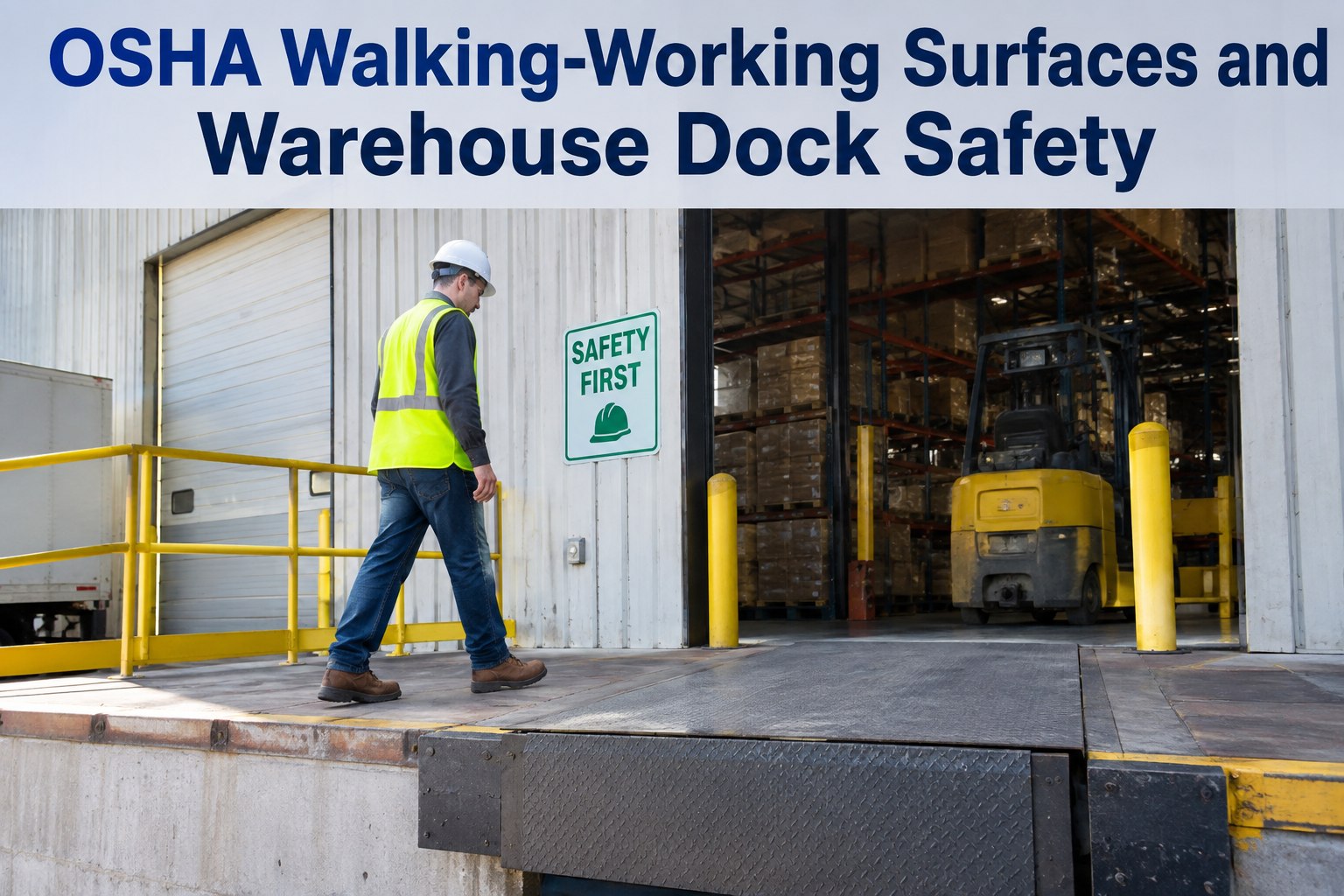
The 4-foot drop from an open dock edge to the apron below is one of the fastest ways a warehouse operation turns a routine shift into a recordable injury and a lost-time workers' compensation claim. Under OSHA 1910 Subpart D, walking-working surfaces in the warehouse — dock edges, mezzanines, elevated platforms, fixed ladders, pit covers and floor openings — are regulated physical assets, meaning their guarding, condition and inspection status determine whether you can defend your safety program after an incident. You can write the best housekeeping policy in the world, but if a mezzanine pallet drop gate is bent and latched open, or a dock leveller plate is worn past its lip-keep clearance, the physical hazard overrides the paperwork. If you want to see exactly how facility and equipment inspections tie together, book a 30-minute walkthrough of the HVI platform and we will map it to your site.
An open dock door with no trailer is a fall to grade. What is guarding it right now?
Walking-working surface failures rarely come from missing paperwork. They happen when physical barriers — dock gates, mezzanine rails, pit covers and ladder rungs — drift out of spec and nobody logs the defect. See how digital facility inspections close that gap before an auditor or an injury exposes it.
Dock edge protection: where the exposure actually lives
The dock face is the highest-traffic fall hazard in a warehouse. When a trailer pulls away and the overhead door is still open, the dock edge is an unguarded 4-foot drop. The barrier between your forklift operator and that drop is a physical control — and physical controls bend, break and get chained open.
The Open Dock Face
An overhead door raised with no trailer seated creates an immediate fall hazard. Dock gates, chained barriers or vehicle-restraint integrated interlocks are the primary controls. If the chain is dangling at mid-height or the gate track is jammed with dock debris, you have no protection. These barriers must be checked as part of the dock area inspection — not assumed to be intact because they were installed three years ago.
Dock Leveller Lip & Deck
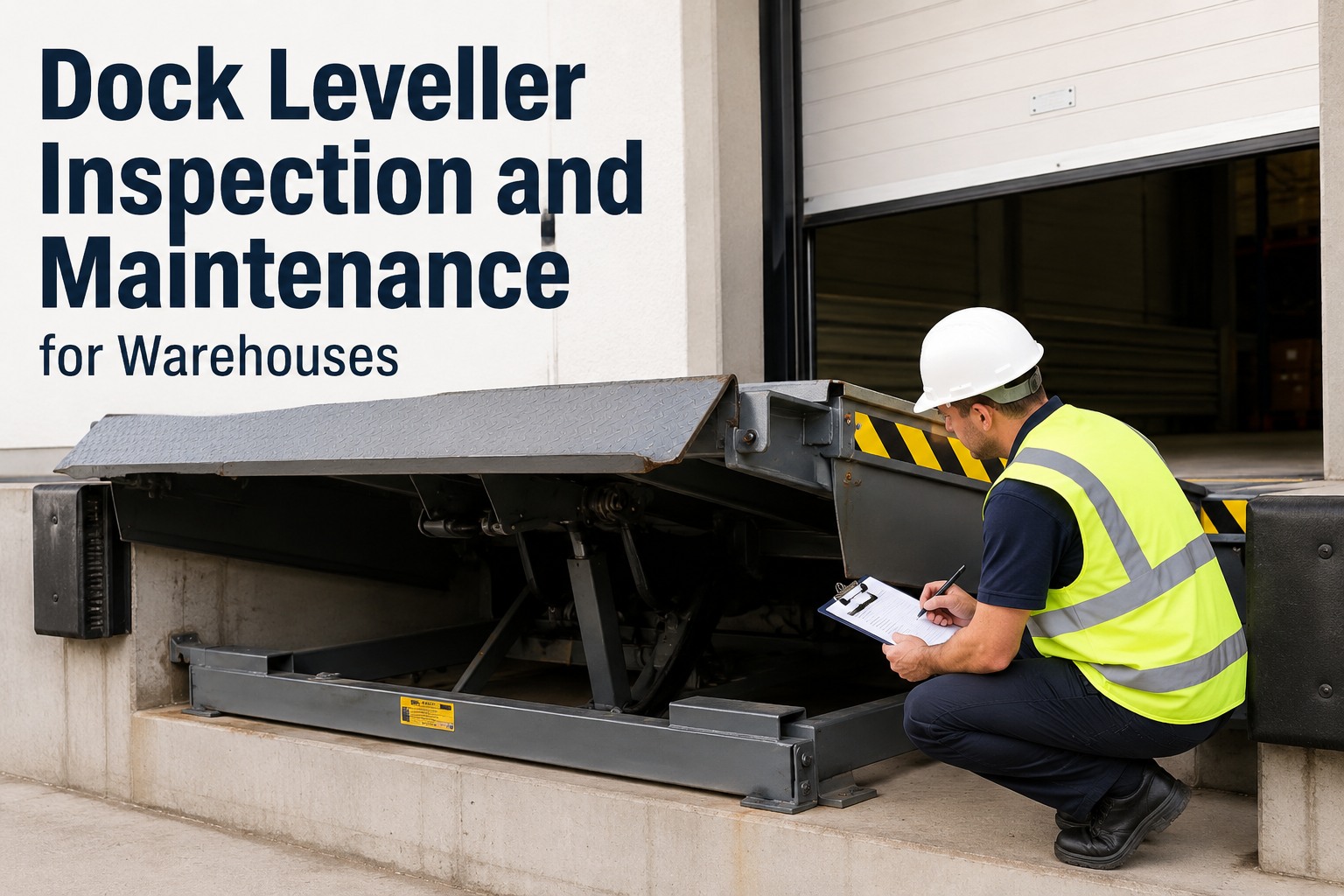
A worn leveller lip that cannot maintain full bearing on the trailer bed, or a torn deck plate that creates a trip edge, turns a loading operation into a fall and equipment-drop hazard. Lip-keep clearance, hold-down ratchet condition and deck plate integrity are physical inspection items. When a technician spots a cracked weld on the lip hinge, that needs to become a corrective work order immediately, not a note on a clipboard that gets lost.
Warning Lines & Visual Cues
Yellow floor striping and warning signage are secondary controls — they only work if they are visible and respected. Faded paint, pallets stacked in the walkway and blocked sightlines defeat the warning entirely. Housekeeping is not a separate issue from fall prevention; surface condition directly drives slip and trip incidents at the dock edge, which is why OSHA treats walking-working surface condition and obstruction as part of the same standard.
Mezzanine safety and the pallet-drop gate problem
Mezzanines and elevated work platforms are force multipliers for warehouse capacity, but they introduce a fall hazard that is frequently defeated by the very operation they support. The pallet drop gate — a dual-gate system designed so the mezzanine edge is never open while a load is being transferred — is the classic failure point.
Operators bungee-cord or chain the drop gate open to speed up pallet flow. The mezzanine edge is now a permanently unguarded fall hazard. The top rail of the adjacent guardrail is used as a crane beam for hoisting. Mid-rails are removed to pass wide loads. Nobody logs the modification because the clipboard inspection form does not have a line item for "gate latched open during non-transfer."
The dual-gate interlock is tested during the area inspection — floor gate closed, edge gate open, and vice versa — and the photo evidence is timestamped and stored. Guardrails are checked for the 42-inch top-rail height and 200-pound outward force capacity. Any defect — a bent gate track, a missing pin, a cracked weld — is pushed as a corrective work order to the facilities team before the shift ends.
Edge Gate Interlock
Verify the mezzanine-side gate and the floor-side gate cannot be open simultaneously. Test the mechanical interlock, not just the visual position.
Guardrail Height & Force
Confirm 42-inch top-rail height, mid-rail at 21 inches, and the ability to withstand 200 pounds of outward force. Check for modified or removed rails.
Toeboard Integrity
Ensure 3.5-inch toeboards are present and secured along all open-sided mezzanine edges to stop objects from rolling off onto workers below.
Platform Load Rating
Check that the posted load rating plate is legible and matches the current use. Overloaded mezzanines compromise the structure and the deck surface.
Warehouse floor openings, pit covers and fixed ladder condition
Conveyor pits, scale pits and floor-level access openings are less obvious than a dock edge but equally regulated. A missing or inadequately rated pit cover is an immediate fall hazard. Fixed ladders and stairways — the access routes to roof units, mezzanines and elevated conveyors — are often the most neglected walking-working surfaces because they are out of the daily flow.
| Surface / Asset | Primary Fall Hazard | Required Physical Control | Inspection Trigger |
|---|---|---|---|
| Conveyor / Scale Pits | Fall into pit; trapped below machinery | Secured covers or guardrails with toeboards | Cover condition, fastening, load rating |
| Floor Openings | Step into unguarded hole or chute | Standard railings on all open sides | Rails removed for maintenance not replaced |
| Fixed Ladders | Fall from height during climb | Ladder safety system or cages above 24 ft | Rung integrity, side rail condition, cage secure |
| Warehouse Stairways | Trip and fall down stairs | Handrails, uniform tread depth, nosing contrast | Loose handrail, worn tread, lighting failure |
| Elevated Platforms | Fall over edge during maintenance | Guardrails and self-closing gates | Gate spring failed, rail modified for access |
The problem with assuming these assets remain sound is that warehouse environments are hostile to fixed steel. Forklifts hit stair stringers, pallets knock ladder cages, and maintenance crews remove guardrail sections to pass a motor and never reinstall them. If your inspection routine only covers trucks and forklifts, you are leaving the walking-working surface standard entirely unverified. You can start logging facility inspections free alongside your equipment DVIRs to close that gap, or walk through the setup on a call to see how the templates map to your floor plan.
Working surface inspection: proving the barrier was sound
OSHA does not simply require that you install a guardrail or a dock gate; the standard functions on the premise that you know the condition of your walking-working surfaces. If an incident occurs at an open dock edge, the first question an inspector asks is not "did you have a policy?" but "when was the barrier last verified, by whom, and what was its condition?"
Assign the facility template
Build a digital template for dock areas, mezzanines, pits and ladder routes. Every item — gate operation, rail height, cover fastening, rung condition — is a discrete pass/fail line with a photo requirement.
Capture defects in the yard
A supervisor or technician runs the inspection on their phone. A bent pallet-drop gate track is flagged as failed, photographed, and annotated with a note. The timestamp and GPS location are locked to the record.
Convert the defect to a work order
The failed item auto-generates a corrective work order assigned to the facilities team. No clipboard transcription, no missed emails. The work order sits in "open" status until the repair is verified and signed off.
Prove the cycle during an audit
If OSHA, a client or an insurer asks for proof of your fall-prevention inspection regime, you export a timestamped, photo-backed history of every dock, mezzanine and ladder check — and the work orders that closed the defects — in seconds.
From paper assumption to photo-backed proof
Photo-Backed Facility Inspections
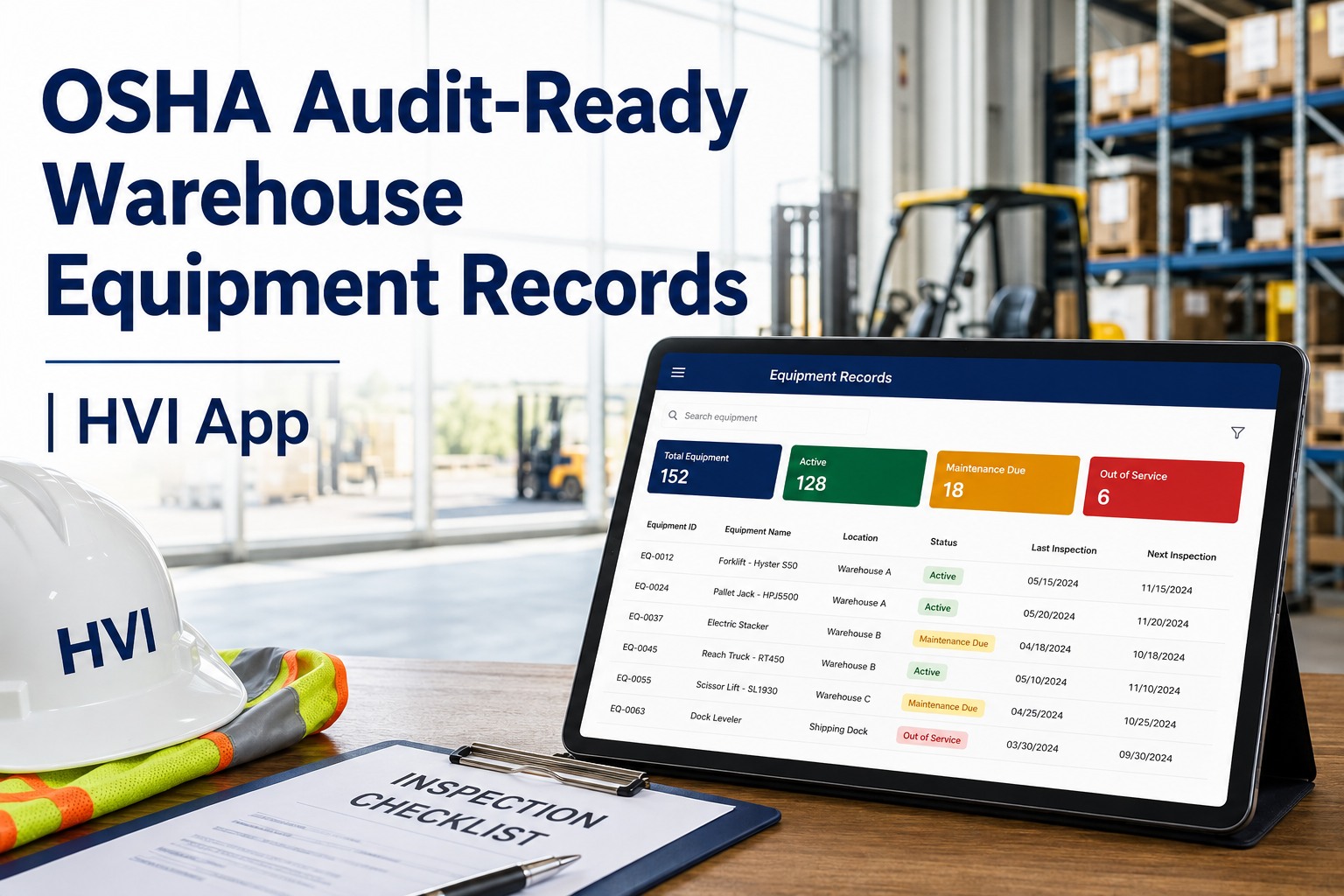
Run OSHA 1910 Subpart D-aligned templates on dock edges, mezzanines and ladders from any phone or tablet. Every pass/fail item carries a timestamped photo, killing the clipboard-and-clipboard-tape routine and giving you irrefutable evidence that the barrier was checked.
Instant Defect-to-Work-Order
A failed dock gate or missing pit cover does not wait for a weekly meeting. The defect converts to a tracked work order instantly, assigned to the right technician, with parts pulled from inventory if needed. You track unplanned downtime and closure time by asset.
Audit-Ready Compliance Records
When an OSHA inspector, insurance auditor or client safety lead asks for proof of your fall-prevention inspections, export the full timestamped, photo-backed history in seconds. No more hunting through binders or chasing text-message photos.
One Platform for Assets & Facility
Track trucks, trailers, forklifts, shop equipment and facility walking-working surfaces in the same system. If you want to see HVI running on your own site layout, book a demo and we will map your dock and mezzanine zones live.
Walking-working surface compliance is a physical-asset problem
Guards beat policies
Dock fall prevention, mezzanine safety and edge protection are physical controls. If the gate, rail or cover is damaged or defeated, the paperwork does not save you. Inspect the hardware, not just the procedure.
Status is time-bound
A guardrail verified last year is not verified today. Warehouse traffic bends steel and breaks welds. The inspection obligation means proving the barrier was sound at a specific, recent timestamp.
Close the loop
A logged defect that is not repaired is a documented known hazard. Convert walking-working surface findings to tracked work orders and prove the closure — that is what stops the OSHA citation after an injury.
"We had a dock gate that was chained open for three months because the track was bent. Nobody logged it because the paper form did not ask. Now the gate track is an inspection line item with a photo, and if it fails, the facilities team gets a work order before I even leave the floor. That is the difference between hoping a barrier is sound and knowing it is."