Cargo Securement Inspection Checklist Guide for Heavy Vehicle Fleets

By Bruno Talley on June 18, 2026

cargo-securement-inspection-checklist-for-heavy-vehicle-fleets

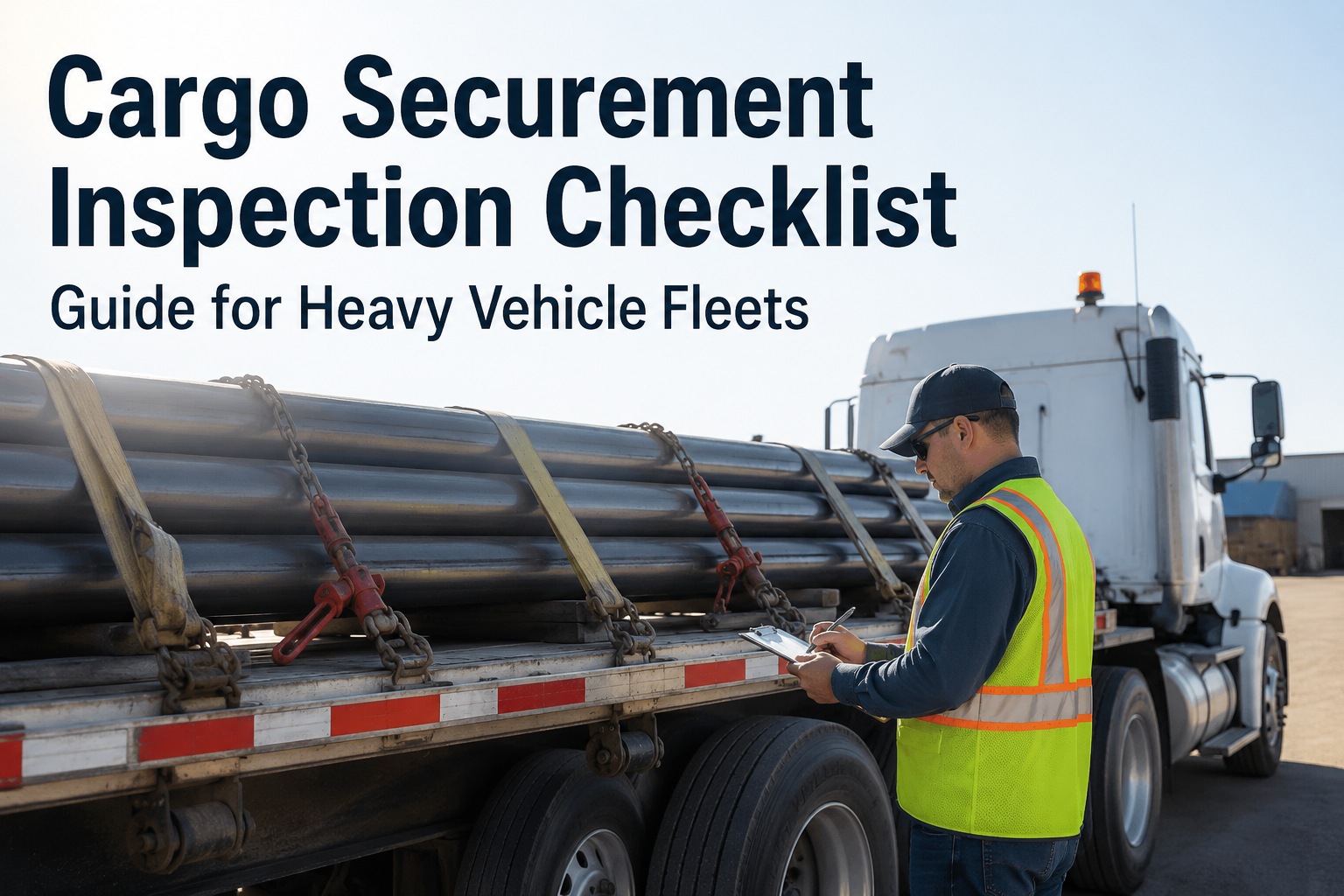
Cargo securement is one of the most-checked items at a roadside inspection and one of the most cited — and unlike a worn brake or a burned-out lamp, a securement failure can put a load on the highway. The rules in 49 CFR Part 393, Subpart I are precise: cargo must be contained, immobilized, or secured so it can't shift, spill, blow off, or fall, and the securement system has to withstand real physics — 0.8g of force forward, 0.5g rearward, and 0.5g laterally, simulating hard braking and sharp turns. The number every fleet has to know is the aggregate working load limit rule: the combined WLL of all tiedowns must equal at least 50% of the cargo's weight. Get the tiedown count wrong, use a chain a grade too low, or roll on a strap with an unreadable tag, and you've built a non-compliant load even if it "looks tight." Worse, a single securement violation hits your CSA score and, after a cargo-loss event, becomes the first thing FMCSA, OSHA, and your insurer all ask about. The defense is a disciplined, documented pre-departure inspection. A digital cargo securement inspection turns the rules into a guided checklist that captures every check with a photo and proves it happened. This guide walks the full checklist, the WLL math, the tiedown counts, and the en-route rule.

A Securement Failure Doesn't Mean Downtime. It Means a Load on the Highway.
HVI turns the FMCSA cargo securement rules into a guided pre-departure inspection — tiedown count, aggregate WLL, device condition, edge protection, and en-route re-checks — with photo evidence, defect-to-repair routing, and GPS-stamped records ready the minute a roadside inspector or a cargo-event investigator asks.

The Two Numbers That Govern Every Load

Before any checklist, two FMCSA rules decide whether a load is legal. You have to satisfy both — not pick one. Miss either and it's a citation regardless of how secure the load looks.

≥ 50%

Aggregate Working Load Limit

Under 393.104, the combined WLL of every tiedown in the system must equal at least half the weight of the cargo for forward and rearward restraint. Add up each device's rated WLL; the total must hit 50% of the load weight.

30,000 lb load → tiedowns must total ≥ 15,000 lb WLL
0.8 / 0.5 / 0.5

Performance Criteria (in G's)

Under 393.102, the system must hold the load against 0.8g of force forward, 0.5g rearward, and 0.5g lateral — the forces of hard braking, acceleration, and sharp turns. This is the physics the 50% rule and tiedown counts are built to satisfy.

Forward 0.8g · Rearward 0.5g · Lateral 0.5g

Minimum Tiedown Count by Length & Weight

Separate from the WLL math, FMCSA 393.106/393.110 sets a hard minimum number of tiedowns based on the article's length and weight. Inspectors carry a tape measure — this is one of the most common citations.

Article Length
Weight
Minimum Tiedowns
≤ 5 ft
≤ 1,100 lb
1 tiedown
≤ 5 ft
> 1,100 lb
2 tiedowns
5–10 ft
Any weight
2 tiedowns
> 10 ft
Any weight
2 + 1 per extra 10 ft
Example: a 31-ft article needs at least 4 tiedowns — 2 for the first 10 ft, plus 1 for each additional 10 ft (or fraction) — even if it's light. Heavy vehicles and equipment over 5,000 lb need a minimum of 4 tiedowns, one at each corner, with wheels chocked and tiedowns attached to the frame or designated points, not removable components.
The tiedown count and the WLL total are two separate tests, and a load has to pass both — the math is exactly what a guided digital checklist computes for you before departure, so nothing ships short. sign up for a free HVI trial and never roll on an under-secured load.

The Pre-Departure Inspection Checklist

Walk the load before it leaves. These are the checks that catch a securement violation in the yard — grouped into the system, the devices, and the special cases — before it becomes a roadside citation or a lost load.

THE SECUREMENT SYSTEM
1

Confirm the tiedown count

Count tiedowns against the article's length and weight per the table above. Measure — don't eyeball. A long light load still needs the length-based minimum.

2

Calculate aggregate WLL ≥ 50%

Add the rated WLL of every device; confirm the total is at least half the cargo weight. Document the calculation with each tiedown's rating listed.

3

Verify restraint in all directions

Cargo must be immobilized forward, rearward, and laterally. Confirm blocking, bracing, and tiedown angles actually prevent movement, not just hold it down.

4

Check anchor points & rails

Inspect trailer anchor points, rub rails, and winches for cracks, wear, or deformation. A tiedown is only as strong as what it's attached to.

THE DEVICES
5

Read & record every WLL tag

Each strap, chain, or cable must have a legible WLL tag. A missing, illegible, or damaged tag means the device counts as WLL of zero — pull it.

6

Confirm the correct chain grade

Grade 70 (gold/yellow zinc, stamped "7"/"70") is the FMCSA minimum for securement. Grade 43 underrates WLL ~25–30% — verify by the stamp, not by sight.

7

Inspect straps, chains & binders

Look for cuts, frays, burns, knots, stretched links, cracked hooks, and damaged ratchets or binders. Any compromised device drops to zero WLL — replace it.

8

Add edge protection & secure loose ends

Protect webbing where it crosses sharp edges, and confirm excess strap tails are secured so they can't flap loose in the wind.

SPECIAL CASES
9

Apply commodity-specific rules

Logs, metal coils, paper rolls, concrete pipe, intermodal containers, and heavy equipment each have their own rules (393.116–393.136). Confirm the right one is applied.

10

Heavy equipment: 4 corners + chocks

Machinery over 5,000 lb needs four tiedowns minimum, one per corner, to the frame or designated points, with wheels/tracks chocked against movement.

Every one of these ten checks is a line an inspector can cite — and a step a driver can complete in minutes with a guided app that flags a zero-WLL strap or a short tiedown count before the truck moves. schedule a live demo to see the cargo securement checklist in HVI.

The En-Route Rule: Securement Isn't Done at Departure

A common citation surprise: even a perfectly secured load can earn a violation if the driver can't show they re-inspected en route. FMCSA 393.100(b) requires re-checks at set points — tension relaxes as cargo settles and webbing stretches.

First 50 Miles

Stop and re-tension after the first 50 miles — cargo settling and strap relaxation loosen the system early. Log the location and time.

Every 3 hrs / 150 mi

Re-examine and re-adjust as needed every 3 hours of driving or 150 miles, whichever comes first — throughout the trip.

Every Duty-Status Change

Re-check at each change of the driver's duty status. An inspector will ask when and where you last inspected — the record is your defense.

The en-route inspection is a regulatory requirement, not a suggestion: a carrier whose driver can't demonstrate compliance can be cited even when the cargo is perfectly secure at the moment of inspection. Logging each re-check with time and location is how you prove it.

Make Every Load Inspection Audit-Ready

Guided cargo securement inspections built for FMCSA Part 393 — tiedown-count and aggregate-WLL checks, device condition with photo capture, edge protection, commodity-specific rules, and en-route re-check logging with time and location. Defects route to repair, every inspection is timestamped, and records are ready the minute an inspector or investigator asks. Trusted by 25,000+ users worldwide.


Frequently Asked Questions

What is the FMCSA aggregate working load limit rule?
Under 49 CFR 393.104, the aggregate working load limit of all the tiedowns in a securement system must equal at least 50% of the weight of the cargo for forward and rearward restraint. You calculate it by adding up the rated WLL of every device in the system — each strap, chain, or cable — and confirming the total reaches half the cargo weight. For a 30,000-lb load, that means tiedowns totaling at least 15,000 lb of WLL. Importantly, any tiedown with a missing, illegible, or damaged WLL tag counts as zero, so it contributes nothing to the total. Sign up for a free HVI trial to calculate it automatically.
How many tiedowns does FMCSA require?
The minimum is based on the article's length and weight, and it's separate from the WLL calculation — you must satisfy both. For an article 5 feet or shorter and 1,100 lb or less, one tiedown; 5 feet or shorter but over 1,100 lb, two; between 5 and 10 feet, two regardless of weight; and over 10 feet, two for the first 10 feet plus one more for each additional 10 feet or fraction. So a 31-foot article needs at least four tiedowns even if it's light. Heavy vehicles and equipment over 5,000 lb require a minimum of four tiedowns, one at each corner. Schedule a demo to see the count verified for you.
How often must a driver re-inspect cargo securement?
FMCSA 393.100(b) requires re-examining and re-adjusting the securement at three points: after the first 50 miles of travel, at every change of the driver's duty status, and after every 3 hours of driving or every 150 miles, whichever comes first. This is required because tiedown tension relaxes as cargo settles into the trailer floor, webbing stretches under sustained load, and temperature changes affect both the cargo and the securement materials. The en-route inspection is a regulatory requirement, not optional — a driver who can't demonstrate compliance can be cited even if the cargo is perfectly secure when inspected. Sign up for a free HVI trial to log en-route checks.
What chain grade is required for cargo securement?
Grade 70 transport chain is the FMCSA minimum for load securement tiedowns. It typically has a gold or yellow zinc finish and is embossed with "7" or "70" on each link. Grade 43 high-test chain — usually a yellow chromate finish, stamped "4" or "43" — is acceptable for general towing but underrates the working load limit by roughly 25–30% compared to Grade 70 for the same link size, so using it for securement builds a non-compliant system. The key is to verify the grade by reading the stamp on the link, not by judging the chain by sight, since finishes can look similar. Schedule a demo to track device specs.
What happens if a tiedown has no working load limit tag?
A tiedown with a missing, illegible, or damaged WLL tag must be assumed to have a working load limit of zero for the aggregate calculation — meaning it contributes nothing toward the required 50% of cargo weight, even if the strap or chain is physically sound. The same zero-WLL principle applies to devices manufacturer-unmarked: unmarked steel strapping and wire rope are treated as having a WLL equal to just one-fourth of their breaking strength. This is why reading and recording every device's tag before assembling the securement system is a core checklist step — a single untagged strap can quietly drop you below compliance. Sign up for a free HVI trial to record every WLL tag.

Share This Story, Choose Your Platform!

Start Free Trial Book a Demo