Your fleet's daily pre-trip inspection takes 45 minutes per truck. Your drivers are checking 37 components with a clipboard and a flashlight. And still — 1 in 5 trucks gets flagged at a CVSA roadside check. The problem isn't effort. It's the method. In 2026, AI-powered condition assessment is rewriting the rules for heavy fleet maintenance — but is it actually better than the manual process fleets have relied on for decades? We tested both. Here's what the data says — or if you're ready to see AI inspection in action, sign up for a free trial at HVI and test it on your own fleet.
The Big Question Every Fleet Manager Is Asking
Can AI really outperform experienced human inspectors?
M
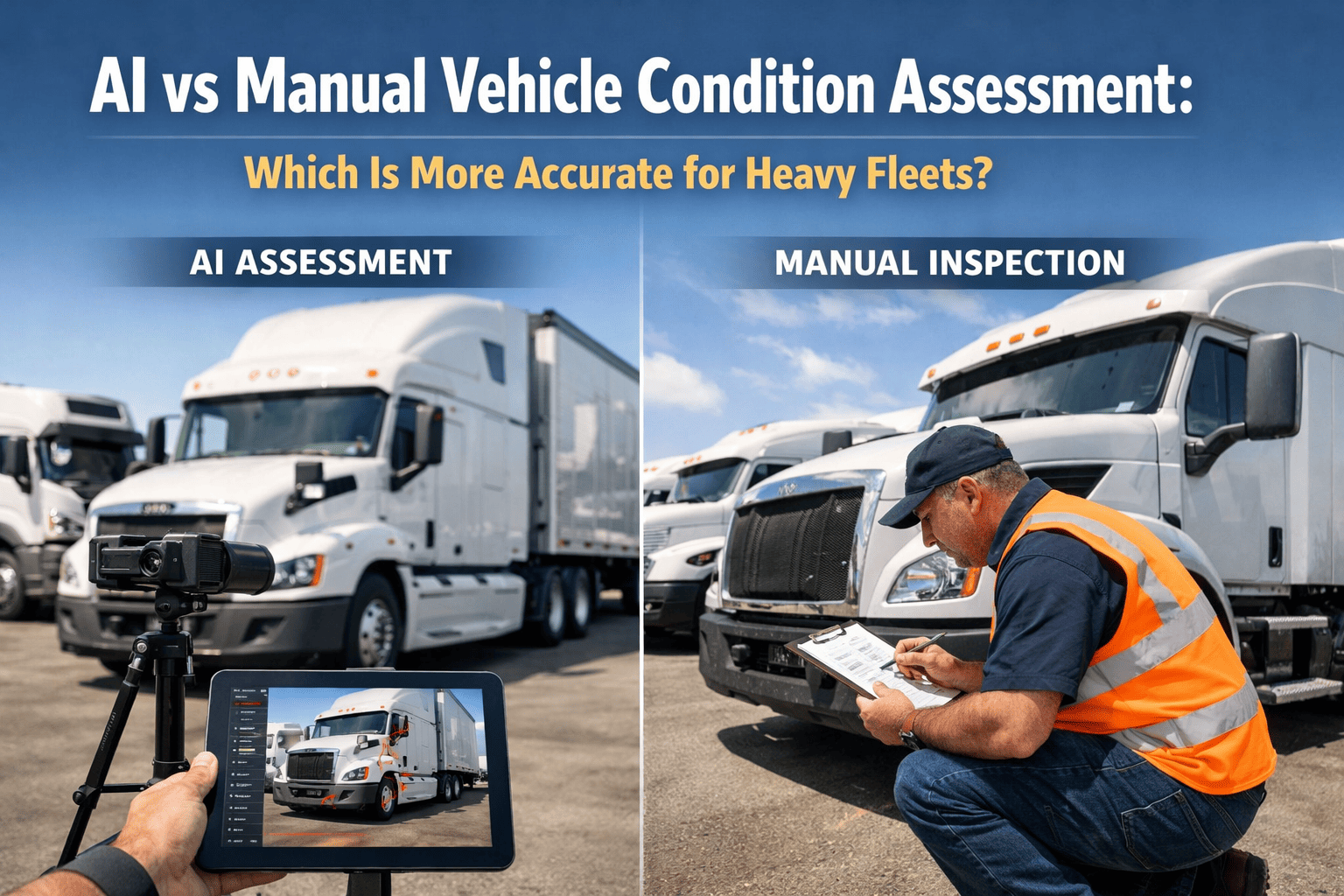
Manual Inspection
Clipboard, flashlight, trained eyes — the method fleets have used for 100+ years
~75-80%
Average Defect Detection
VS
AI
AI-Powered Assessment
Computer vision, photo analysis, pattern recognition — trained on 30M+ vehicle images
95-99%
Average Defect Detection
01
Why Manual Inspections Are Falling Behind
Manual vehicle condition assessment has been the backbone of fleet safety since the first commercial truck hit the road. But here's the uncomfortable truth: human inspectors miss 20-30% of vehicle defects during routine checks. Not because they're careless — because they're human. If you're wondering how many defects your fleet is currently missing, schedule a free demo with HVI and run a side-by-side comparison on your own vehicles.
1
Fatigue & Blind Spots
After inspecting the same truck types daily for months, inspectors develop routine blindness. Anomalies stop registering.
2
Inconsistency Between Inspectors
Defect identification varies up to 50% between different inspectors examining the same vehicle. No two humans see the same thing.
3
No Verification Layer
Paper DVIRs provide zero proof the driver actually looked at the equipment. "Pencil whipping" remains the industry's open secret.
4
Time-Intensive Process
A thorough manual walk-around takes 30-45 minutes per vehicle. Multiply that across a 50-truck fleet — and you're burning driver hours daily.
18.1%
Vehicle out-of-service rate at CVSA International Roadcheck 2025 — nearly 1 in 5 trucks had critical safety violations that passed daily manual inspections.
02
How AI Vehicle Condition Assessment Actually Works
AI-powered assessment isn't science fiction. It's a smartphone, a trained algorithm, and a systematic workflow that removes human inconsistency from the equation. HVI's platform follows this exact pipeline — you can create a free HVI account in under 2 minutes and see each step working on your fleet today.
A
Photo Capture
Driver follows guided prompts showing exactly what to photograph and from which angle. The app prevents submission without required photos.
B
AI Analysis
Deep learning algorithms trained on 30M+ real-world vehicle images analyze each photo in real-time — detecting 21+ damage types across 163+ components.
C
Severity Classification
Each detected defect is classified by type, location, and urgency — critical vs. monitor vs. cosmetic — with photo evidence attached.
D
Auto Work Order
Critical defects instantly generate prioritized work orders with repair details, assigned technician, and estimated timeline. Zero manual data entry.
Want to see AI condition assessment catch what your manual process misses?
03
Head-to-Head: AI vs. Manual Assessment
We compared both methods across the metrics that matter most to fleet managers — accuracy, speed, cost, compliance, and scalability.
| Metric |
Manual Inspection |
AI Assessment |
Winner |
| Defect Detection Accuracy |
75-80% |
95-99% |
AI |
| Time Per Vehicle |
30-45 min |
5-8 min |
AI |
| Consistency Across Inspectors |
50% variance |
<2% variance |
AI |
| Documentation Quality |
Handwritten, often incomplete |
Photo-verified, GPS-stamped |
AI |
| Anti-Fraud Protection |
None (pencil whipping) |
Duplicate/altered photo detection |
AI |
| Contextual Judgment |
Excellent (human intuition) |
Limited (pattern-based) |
Manual |
| Unusual Condition Assessment |
Strong (experienced eyes) |
Improving (requires training data) |
Manual |
| Upfront Cost |
Low (pen + paper) |
Moderate (software subscription) |
Manual |
| Long-Term ROI (12 months) |
Stagnant |
300-500% ROI |
AI |
| DOT Audit Readiness |
93% fail rate |
96% pass rate |
AI |
The Verdict
AI dominates in accuracy, speed, and compliance. Manual inspection still holds value for contextual judgment — which is exactly why the best approach combines both.
04
The Real-World Dollar Impact
The 22-percentage-point gap between manual (75%) and AI (97%) defect detection isn't just an academic number. Here's what it costs your fleet. Want to calculate the exact savings for your fleet size? Book a personalized ROI walkthrough with our team — we'll run the numbers with your real data.
$8,500
Annual repair savings per truck through early AI detection
40%
Reduction in inspection time — saving $3,650 per driver annually
15%
Insurance premium reduction from improved CSA scores
89%
Fewer preventable breakdowns with AI-powered monitoring
05
2026 Compliance: The Regulatory Landscape Has Changed
If you're still debating AI vs. manual, the federal government just made the decision easier.
NEW RULE
FMCSA eDVIR Final Rule — Effective March 23, 2026
FMCSA published final rule FMCSA-2025-0115 explicitly authorizing electronic Driver Vehicle Inspection Reports under 49 CFR 396.11 and 396.13. Digital signatures now fully replace wet ink requirements. AI-generated DVIRs with photo verification exceed the minimum FMCSA standard.
Supported by: American Trucking Associations, OOIDA, National Tank Truck Carriers
Increasingly disadvantaged during audits
No proof of actual inspection completion
Cannot feed CSA Driver Observed category
93% of carriers fail audit with paper systems
GPS-stamped, timestamped, photo-verified
Tamper-evident audit trails
Auto-maps to new CSA scoring categories
96% audit pass rate with digital documentation
The new CSA methodology splits Vehicle Maintenance into "Driver Observed" and "Inspector Detected" categories — meaning the quality of your driver inspections now directly impacts a visible compliance score. See the complete 2026 DOT audit checklist here.
Ready to see what AI catches that your manual process misses? Get a live fleet demo.
06
The Smart Answer: AI + Human = Best Results
Here's what top-performing fleets have figured out: AI doesn't replace your inspectors — it makes them dramatically better. The most effective model puts AI on pattern recognition and humans on contextual judgment.
AI Handles
Repetitive visual scanning across 163+ components
Pattern recognition across fleet-wide data
Micro-damage detection invisible to naked eye
Documentation, compliance, and audit trails
Predictive degradation trend analysis
+
Humans Handle
Unusual condition assessment
Environmental context (weather, terrain impact)
Safety judgment calls
Operator experience and "feel" for the machine
Final go/no-go decisions
Combined Result
When AI assists human inspection, combined detection rate exceeds either method alone — approaching 99.5% accuracy with contextual judgment preserved.
This is exactly how HVI's AI-powered inspection platform works — AI flags the risk areas, your team focuses attention where it matters most.
07
How HVI Delivers AI Condition Assessment for Your Fleet
HVI isn't just another inspection app. It's the bridge between manual expertise and AI precision — built specifically for heavy vehicle fleets.
01
AI-Guided Walk-Around
Step-by-step prompts ensure every component is captured. No skipped steps. No guesswork.
02
Computer Vision Defect Detection
Real-time analysis of every photo — catching tire wear, brake damage, fluid leaks, and structural issues humans miss.
03
Auto-Generated eDVIRs
FMCSA-compliant reports with GPS, timestamps, digital signatures, and complete component checklists — automatically.
04
Predictive Maintenance Intelligence
AI spots degradation trends 2-4 weeks before failure. "This alternator shows early wear — recommend replacement within 14 days."
05
Closed-Loop Work Orders
Defect detected — work order created — technician assigned — repair scheduled. Zero manual data entry required.
06
Anti-Fraud Detection
Catches duplicate photos, altered images, "photo of a photo" tricks, and suspicious submission patterns automatically.
Already using manual inspections? See how HVI compares to your current process — read our adoption guide for switching from paper to digital.
Frequently Asked Questions
Is AI vehicle condition assessment DOT-compliant?
Yes. FMCSA's eDVIR final rule (effective March 23, 2026) explicitly authorizes electronic DVIRs. AI-generated inspection reports with timestamped photos, GPS verification, and digital signatures exceed the minimum standard. The ATA, OOIDA, and NTTC all supported this rulemaking.
How fast can I deploy AI assessment across my fleet?
Most fleets go live within 1-2 weeks. No special hardware — it works with the smartphones your drivers already carry. Driver training takes 25-30 minutes. Pilot with 3-5 vehicles first, then scale to the full fleet.
Will AI replace my inspectors and technicians?
No — AI augments your team. AI handles repetitive visual scanning and pattern analysis; humans handle contextual judgment and safety decisions. The combination outperforms either method alone. Your team becomes more effective, not redundant.
What's the typical ROI timeline?
Most fleets see positive ROI within 60 days. The first prevented breakdown often pays for the entire system. Documented returns include $8,500/truck annual repair savings and 40% reduction in inspection time.
Start your free trial today — no credit card required, and most fleets go live the same week.
Stop Guessing. Start Seeing.
Every day your fleet runs on manual-only inspections, you're missing 20-30% of defects that AI catches instantly. The question isn't whether AI assessment is more accurate — it's how much longer you can afford to wait.
No credit card required · Setup in under 15 minutes · Works with your existing smartphones