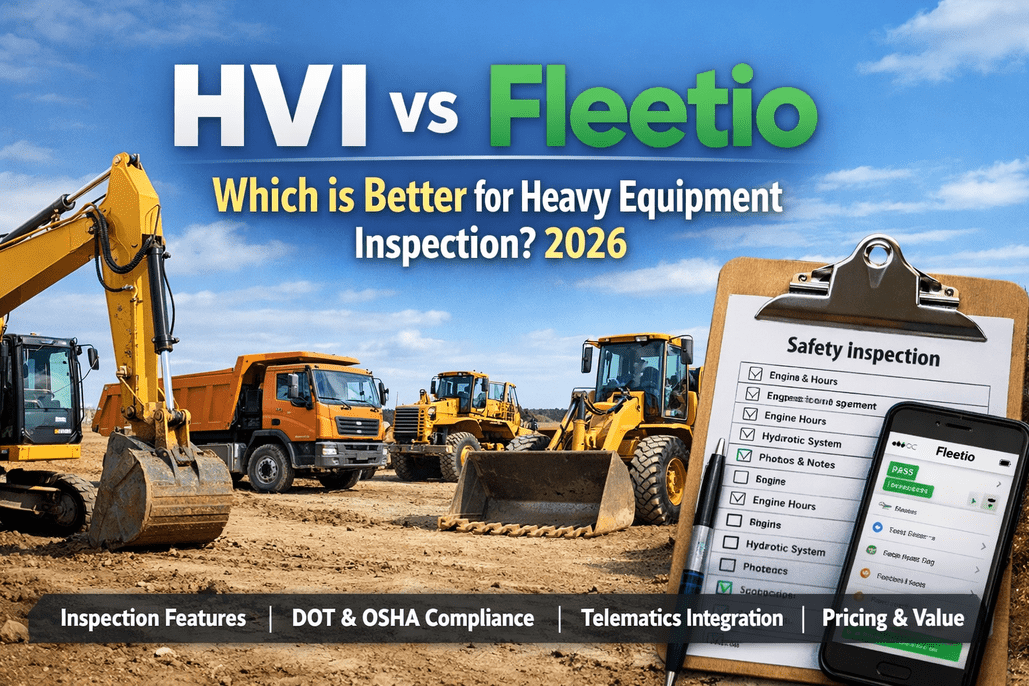
HVI and Fleetio are both fleet management platforms — but they were built to solve different problems for different fleets. Fleetio started as a general-purpose fleet management tool for light and medium-duty vehicles, expanding into maintenance scheduling, fuel tracking, and inspections across industries from delivery vans to service trucks. HVI was built from the ground up for heavy vehicle and heavy equipment operations — Class 8 trucks, excavators, cranes, bulldozers, forklifts, and specialty construction equipment — where inspection depth, multi-regulation compliance, and equipment-specific maintenance templates are the primary operational requirements. The question isn't which platform is "better" in the abstract — it's which platform matches what your fleet actually needs. If you run a mixed fleet of light-duty vehicles with basic PM needs, Fleetio may serve you well. If your fleet includes heavy equipment with OSHA, FMCSA, and ASME compliance requirements, equipment-specific inspection checklists, and the inspection-to-work-order chain that heavy operations demand, HVI was purpose-built for that. This comparison evaluates both platforms across six categories that matter most for heavy equipment fleets — with honest assessments of where each platform excels and where it falls short. Book a demo to see HVI with your actual equipment types, or start free.
See How HVI Handles Your Heavy Equipment
Purpose-built inspection templates for excavators, cranes, dozers, loaders, forklifts, and Class 8 trucks — with the compliance rules and PM schedules each type requires.
Head-to-Head: Six Categories That Matter
Each category below is evaluated specifically for heavy equipment fleet operations — not general fleet management. A platform that excels for a 50-van delivery fleet may fall short for a 30-machine construction fleet with excavators, cranes, and Class 8 haul trucks.
HVI
Purpose-Built
Vehicle-type-specific inspection templates: Class 8 tractors (37+ items), trailers (28+ items), excavators (40+ items covering hydraulics, undercarriage, boom/stick/bucket, swing system), cranes (70 items across 7 systems per ASME B30.5), forklifts (62 items with battery-chemistry-specific checks), bulldozers, wheel loaders, and specialty equipment. Each template includes the exact items, frequencies, and regulatory references for that equipment type.
Fleetio
Customizable but General
Offers customizable inspection templates that can be adapted for different vehicle types. Strong for standard truck/trailer DVIRs and light-duty inspections. However, heavy equipment templates (excavators, cranes, construction machinery) are not pre-built with the depth that specialized operations require — you'll need to build them from scratch. Reviewers note inspection templates work well for trucks but need manual customization for heavy equipment types.
HVI
Multi-Regulation
Handles multiple regulatory frameworks on one platform: FMCSA DVIRs (49 CFR 396.11 with 3-signature chain enforcement), DOT annual inspections (396.17 with all 15 Appendix A categories), OSHA equipment inspections (1926.1412 for cranes, 1910.178 for forklifts), ASME B30.5 crane certifications, and CSA 2026 score tracking. Each regulation has its own template, retention rules, and compliance calendar.
Fleetio
DOT-Focused
Strong FMCSA DVIR compliance — the Fleetio Go app handles pre/post-trip inspections well for CDL vehicles. DOT annual inspection tracking is available. However, OSHA construction equipment compliance (crane certifications, forklift inspections) and ASME B30.5 requirements are not natively built into the platform. Construction-specific compliance requires manual configuration or third-party tools.
HVI
Automatic
Every inspection defect auto-generates a work order with: asset ID, defect description, severity classification, photo evidence with GPS/timestamp, and reporter identity. Work orders route by severity — safety-critical items push immediately to maintenance. Repair certification flows back to the original DVIR, completing the FMCSA 3-signature chain. Zero manual re-entry. Gap from defect discovery to maintenance awareness: under 60 seconds.
Fleetio
Workflow-Based
Fleetio can create issues from failed inspection items and route them to maintenance through configurable workflows. The inspection-to-issue workflow is available but requires setup — creating automation rules through the Workflow tab. Some reviewers note the workflow sections could communicate better between each other. The process works well once configured, but is not as immediately automatic out-of-the-box as a purpose-built inspection platform.
HVI
Multi-Trigger
PM-A through PM-D tiers with triggers by engine hours, mileage, calendar, or whichever-comes-first — different triggers for different equipment types. Hours-based for excavators and cranes. Mileage for trucks. Calendar for seasonal equipment. 90/60/30-day lookahead alerts. Auto-generated work orders with equipment-specific PM checklists when service comes due.
Fleetio
Strong
Solid PM scheduling with time, mileage, and engine-hour triggers. Service reminders are praised by users as reliable and intuitive. Integrates with telematics for automatic meter readings. Works well for standard PM schedules. Note: some reviewers mention difficulty with meter value discrepancies when GPS systems import erroneous readings, requiring manual correction.
HVI
Offline-First
Full functionality on iOS and Android with complete offline capability — critical for construction sites, underground garages, remote locations, and rural routes. Complete inspections, update work orders, capture photos without cellular signal. Auto-sync when connectivity returns. No specialized hardware required. 25,000+ users worldwide.
Fleetio
Strong
Fleetio Go mobile app is well-regarded — praised for ease of use and driver adoption. Supports offline inspections. Available on iOS and Android. Includes Spanish language support. Some G2 reviewers note the mobile app lacks some desktop features and reporting sync could improve. Overall, a strong mobile experience for standard fleet operations.
HVI
Heavy-Equipment-First
Built for the heavy equipment ecosystem: construction, mining, municipal, energy, rental fleets. Supports diesel, hybrid, and electric equipment with powertrain-specific templates. Battery health monitoring for electric equipment. Component wear tracking (undercarriage measurements, wire rope diameter). Mixed-fleet management during electrification transitions.
Fleetio
Fleet-Wide
Broad fleet management ecosystem: fuel tracking, 100,000+ outsourced maintenance shop partners, parts inventory, vendor management, and telematics integrations (Geotab, Samsara, GPS Trackit). Excellent for fleets that need fuel management and outsourced repair alongside maintenance. Less depth in construction-specific workflows like undercarriage tracking, crane certifications, or equipment utilization by job site.
HVI was built for heavy equipment fleets — with the inspection depth, compliance coverage, and equipment-specific templates that construction, mining, and industrial operations require.
Book a demo to see HVI with your equipment types. Or
start free.
Where Each Platform Wins
No platform does everything equally well. This section identifies the specific use cases where each platform delivers the most value — so you can match the platform to your actual operation.
Choose HVI When
Your fleet includes excavators, cranes, bulldozers, forklifts, or other heavy equipment requiring deep, equipment-specific inspection checklists
You need multi-regulation compliance: FMCSA DVIRs + DOT annual + OSHA equipment inspections + ASME B30.5 crane certifications on one platform
The inspection-to-work-order chain is critical — defects must auto-generate work orders with photos, severity, and routing within seconds
Your equipment operates on construction sites, mines, or remote locations requiring full offline mobile capability
You're transitioning to electric/hybrid equipment and need powertrain-specific inspection templates and battery health monitoring
Component wear tracking (undercarriage measurements, wire rope, hydraulic efficiency) is part of your maintenance decision-making
Choose Fleetio When
Your fleet is primarily light and medium-duty vehicles (delivery vans, service trucks, passenger vehicles) with standard PM needs
Fuel tracking and fuel card integration are primary requirements alongside maintenance management
You outsource most maintenance and need access to a 100,000+ shop partner network for vendor-managed repairs
You want a broad all-in-one fleet platform covering maintenance, fuel, inspections, and vendor management in a single subscription
Your team values intuitive UI and quick setup — Fleetio is consistently praised for ease of adoption and minimal training requirements
Your inspection requirements are standard truck/trailer DVIRs without the need for heavy-equipment-specific depth
The Honest Gaps: What Each Platform Doesn't Do Well
Every platform has limitations. Understanding them before you commit prevents the expensive discovery that your chosen tool can't handle a requirement you assumed it could.
HVI Limitations
Not a fuel management platform: HVI doesn't offer fuel card integration or fuel cost tracking as a core feature. If fuel management is a primary requirement, you'll need a separate tool or a platform like Fleetio that includes it natively.
No outsourced shop network: HVI is built for fleets with in-house maintenance capability. If you outsource most repairs, Fleetio's 100,000+ shop partner network provides vendor management that HVI doesn't offer.
Heavy-vehicle focus may be more than needed: If your fleet is entirely light-duty vehicles with basic PM needs, HVI's deep equipment-specific templates and multi-regulation compliance may be more capability than you require.
Fleetio Limitations for Heavy Equipment
Heavy equipment inspection templates require manual creation: Pre-built templates are oriented toward trucks and vehicles. Excavator, crane, dozer, and forklift inspection checklists must be built from scratch — requiring knowledge of what to inspect and at what depth.
No native OSHA/ASME compliance: Construction equipment regulations (OSHA 1926.1412 crane inspections, 1910.178 forklift requirements, ASME B30.5 annual certifications) are not built into the platform. Compliance tracking for these regulations requires manual workarounds.
Customization limitations at scale: Multiple reviewers note that workflows feel locked in and customization options become limited when scaling. Some features require premium plan add-ons. Reporting customization requires an additional paid analytics add-on.
No component wear tracking: Undercarriage measurement trending, wire rope diameter tracking, hydraulic pump efficiency monitoring — the component-level condition tracking that heavy equipment maintenance requires — isn't part of Fleetio's architecture.
Side-by-Side Quick Reference
The Bottom Line
Fleetio is a well-built, well-reviewed fleet management platform that serves light and medium-duty fleets effectively. It earned its reputation through intuitive design, broad feature coverage, and reliable PM scheduling. For standard truck and van fleets, it's a strong choice. But heavy equipment fleets operate in a different world — where an excavator inspection has 40+ items including undercarriage measurements and hydraulic pressure tests, where a crane annual certification requires 70 items across 7 systems with ASME B30.5 compliance, where OSHA and FMCSA requirements apply to different equipment types simultaneously, and where the inspection-to-work-order chain must close within seconds to prevent a $40,000 hydraulic failure that a paper DVIR would have caught too late. HVI was built for that world. The question isn't which platform is better — it's which world your fleet operates in.
eDVIR Authorization Makes Digital Inspection Non-Negotiable
FMCSA's February 2026 final rule (effective March 23, 2026) explicitly authorizes electronic DVIRs. Both platforms support eDVIRs — but the depth of inspection matters more than ever as CSA's "Driver Observed" category makes DVIR quality visible in safety scores.
Construction Fleet Digitization Accelerating
78% of construction fleets still manage maintenance with spreadsheets or paper. The platforms winning this market are the ones with construction-specific workflows — equipment-type templates, hour-based PM triggers, undercarriage tracking, and offline mobile for job sites.
Book a demo.
Mixed Diesel/Electric Fleets Need Powertrain-Specific Tools
As fleets add electric and hybrid equipment, the inspection and PM requirements change by powertrain. Platforms must provide different templates for diesel, hybrid, and electric equipment — including battery health monitoring for electric assets. This is where purpose-built platforms have a structural advantage.
Platform Consolidation: One System for All Equipment Types
Fleets are consolidating from separate tools for trucks, equipment, and compliance into unified platforms. The platform that handles your Class 8 trucks AND your excavators AND your cranes AND your forklifts — with the correct templates for each — eliminates data silos and reduces management complexity.
Purpose-Built for Heavy Equipment Operations
HVI provides equipment-specific inspection templates, multi-regulation compliance, automatic defect-to-work-order routing, and component wear tracking — for excavators, cranes, dozers, loaders, forklifts, and Class 8 trucks on one platform.
Frequently Asked Questions
Q: Can Fleetio handle excavator and crane inspections?
Fleetio's inspection templates can be customized, but pre-built heavy equipment templates (excavators, cranes, bulldozers, forklifts) are not included. You'll need to create them manually — requiring knowledge of what items to include, at what depth, and under which regulatory framework. HVI provides these pre-built with 37-70+ items per equipment type, including OSHA and ASME references.
Q: Does Fleetio track OSHA or ASME compliance?
Fleetio focuses on FMCSA/DOT compliance for commercial vehicles. OSHA construction equipment requirements (1926.1412 for cranes, 1910.178 for forklifts) and ASME B30.5 annual crane certifications are not natively built into the platform. HVI handles FMCSA, DOT, OSHA, and ASME compliance on one platform with the correct templates and retention rules for each regulation.
Q: Which platform is better for a mixed fleet (trucks + heavy equipment)?
If your fleet is primarily trucks with some equipment, either platform can work — Fleetio for the truck-centric view, HVI for the equipment-centric view. If heavy equipment is a significant portion of your fleet (construction, mining, municipal), HVI's equipment-specific templates and multi-regulation compliance provide depth that Fleetio doesn't offer for those asset types.
Try HVI free.
Q: Does HVI offer fuel tracking like Fleetio?
HVI focuses on inspection, maintenance, and compliance — not fuel management. If fuel card integration and fuel cost tracking are primary requirements, Fleetio includes these natively. Some fleets use both: HVI for inspection and maintenance depth on heavy equipment, Fleetio for fuel management on road vehicles. The platforms serve different operational needs.
Q: What about Fleetio's outsourced shop network?
Fleetio's 100,000+ shop partner network is a genuine advantage for fleets that outsource maintenance — particularly light-duty fleets without in-house shops. HVI is designed for fleets with in-house maintenance capability where the inspection-to-work-order-to-repair chain is managed internally. If you rely heavily on outsourced maintenance, Fleetio's vendor network adds value HVI doesn't provide.
Q: Can I switch from Fleetio to HVI?
Yes — HVI supports data import from existing platforms. Asset records, maintenance history, and PM schedules can be migrated. Most fleets complete the transition in 2-4 weeks. The most common migration path is construction fleets that started on Fleetio for trucks and found it insufficient as they added heavy equipment requiring deeper inspection templates and OSHA/ASME compliance.