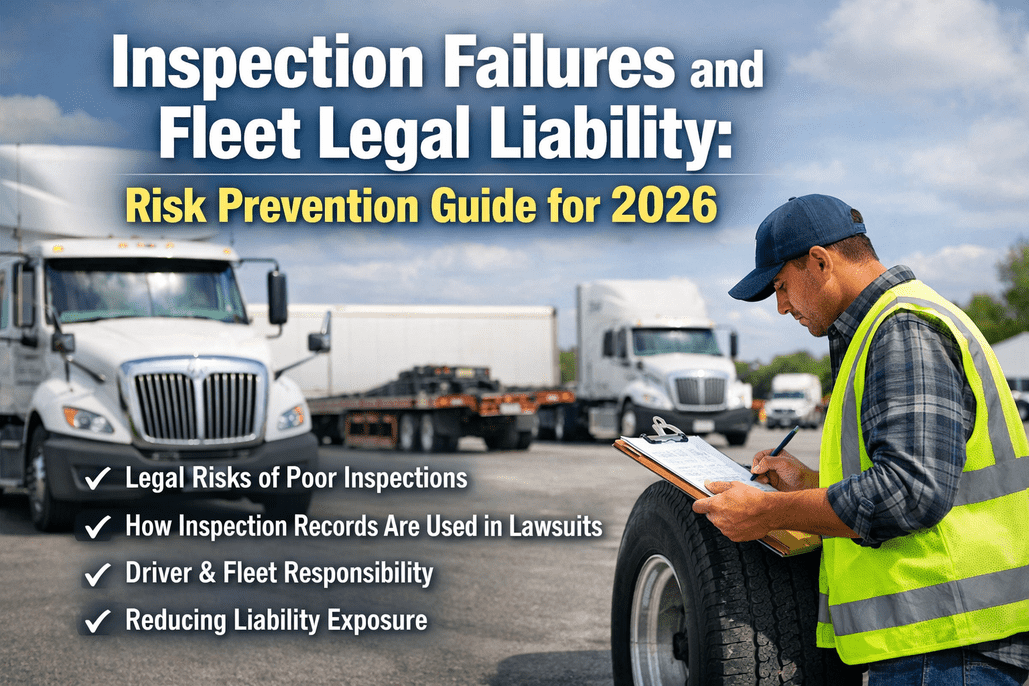
A single missed brake defect on a pre-trip inspection can cost a fleet $50,000 in DOT fines. A pattern of missed inspections can cost millions in a courtroom. Between 2020 and 2023, the average trucking verdict reached $27.5 million. In 2024 alone, the trucking and automotive sectors faced 15 verdicts totaling over $4.1 billion. The legal term for these outcomes is "nuclear verdict" — a jury award exceeding $10 million — and they're becoming more frequent, not less. What drives these catastrophic judgments isn't the accident itself. It's what the plaintiff's attorney finds in the carrier's records afterward: incomplete DVIRs, delayed defect repairs, missing inspection documentation, and patterns of safety shortcuts that a jury interprets as systemic negligence. In 2026, with FMCSA shifting to data-driven continuous safety ratings, new CSA scoring categories tracking driver-observed defects, and Amazon enforcing violation rate metrics for carrier access, your inspection records are your legal armor — or your biggest vulnerability.
How Inspection Records Become Courtroom Evidence
When a truck accident results in injuries or fatalities, plaintiff attorneys follow a predictable playbook. They don't just investigate the accident — they investigate the carrier. The first records subpoenaed are almost always inspection and maintenance files. Here's exactly what they look for and how they use it against you.
DVIRs for 90+ Days Pre-Accident
Missing DVIRs on any day = "The carrier didn't even require daily inspections." Incomplete DVIRs with no defects for weeks = "The driver was rubber-stamping, and the carrier didn't notice or didn't care." Short completion times = "These inspections were fabricated from the cab."
Maintenance Records & Work Orders
Defect reported but repair delayed 5+ days = "The carrier knowingly operated an unsafe vehicle." No work order generated from defect report = "The carrier's safety system is broken." Recurring same defect = "The carrier was aware of a chronic issue and failed to resolve it permanently."
CSA Scores & Roadside Inspection History
Prior OOS violations on similar defects = "The carrier had a documented pattern of this exact safety failure." High CSA percentiles = "Federal data shows this carrier is among the most dangerous in the industry." Multiple roadside violations = "The carrier's internal inspections failed to catch what roadside inspectors found repeatedly."
Driver Training & Qualification Files
No documented inspection training = "The carrier never taught its drivers how to perform proper inspections." Expired medical certificates = "The carrier was operating with unqualified drivers." Missing Clearinghouse queries = "The carrier failed basic driver qualification requirements."
Safety Meeting Records & Policies
No documented safety meetings = "The carrier had no active safety program." Policy exists but no evidence of enforcement = "The carrier wrote policies to appear compliant but never actually enforced them." No corrective action for known safety gaps = "The carrier prioritized operations over safety."
Your inspection records are your first line of legal defense. Start your free HVI trial — timestamped, GPS-verified, photo-documented inspections that create an auditable compliance record. Or book a demo to see how digital records protect you in litigation.
The Nuclear Verdict Threat: Why Inspection Failures Cost Millions
Nuclear verdicts — jury awards exceeding $10 million — have transformed the legal risk landscape for trucking. These aren't reserved for catastrophic negligence by rogue operators. They hit mid-size carriers, established fleets, and companies that thought they were "good enough" on safety. The plaintiff attorney's strategy is consistent: put the carrier's entire safety culture on trial, not just the accident.
Incomplete inspection records, delayed repairs, and missing DVIRs prove the carrier knew — or should have known — about mechanical defects.
ELD data showing hours violations, combined with no evidence of fatigue management programs, demonstrates willful disregard for safety regulations.
No documented inspection training, no safety meeting records, no corrective action for known deficiencies = negligent supervision.
Missing Clearinghouse queries, expired medical certificates, or retaining drivers with known safety violations opens the door to punitive damages.
Destroying records, failing to preserve evidence, or inadequate accident response protocols suggest the carrier is hiding evidence of systemic problems.
Driver vs. Carrier Liability: Who's Responsible?
In trucking litigation, both the driver and the carrier face liability — but they face it differently. Understanding the legal distinction is critical for structuring your inspection program, training documentation, and defect response workflow to protect both parties.
Driver must review the last DVIR and sign it before operating the vehicle. If a defect was reported, the driver must confirm the repair was completed.
Driver must prepare a DVIR at the end of each day's work on each vehicle operated. Report must cover specific inspection items including brakes, steering, tires, and lighting.
Driver must be satisfied the vehicle is in safe operating condition before driving. This creates personal liability for operating a known-defective vehicle.
Carrier must maintain a systematic inspection, repair, and maintenance program for all vehicles. This is the foundation of maintenance negligence claims.
Carrier must repair any defects reported by the driver that affect safe operation AND certify the repair in writing before the vehicle is dispatched.
Carrier is vicariously liable for driver's negligence while operating within the scope of employment — including negligent inspection.
Protect your drivers AND your company. Start free with HVI — every inspection creates a timestamped, GPS-verified record that documents both driver diligence and carrier response. Or schedule a demo to see the compliance chain in action.
The 7 Inspection Failures That Create Maximum Legal Exposure
Not all inspection failures carry the same legal risk. The seven failures below are ranked by their litigation impact — how effectively a plaintiff attorney can use them to prove negligence, gross negligence, or willful disregard for safety.
Known Defect, No Repair, Vehicle Dispatched
Driver reports a brake defect. No work order generated. Vehicle dispatched the next day. If that vehicle is involved in an accident, this is the textbook definition of gross negligence — the carrier knew about the danger and chose to ignore it. This single failure has produced nuclear verdicts exceeding $100 million.
Systematic Missing DVIRs
Multiple days without inspection reports. Not a one-time oversight — a pattern. Plaintiff attorneys use this to argue the carrier had no functioning safety program. "If they can't even verify their trucks are inspected daily, what else are they ignoring?"
Fabricated Inspection Records
Inspections completed in under 2 minutes, completed remotely (GPS shows driver wasn't at the vehicle), or completed for vehicles not in the yard. Digital platforms with GPS, timestamps, and photo evidence make fabrication nearly impossible — and provable when it occurs. Paper records offer no verification.
No Driver Inspection Training Documentation
The carrier can't produce records showing drivers were trained on inspection procedures. Without training documentation, a plaintiff argues the carrier "never equipped its drivers to identify the defects that caused this accident." Training records are your evidence of due diligence.
Recurring Defect Without Permanent Fix
The same brake issue reported 3 times in 60 days. Repaired each time, but never root-cause analyzed or permanently resolved. Plaintiff's argument: "The carrier was aware of a chronic, life-threatening defect and chose band-aid repairs over real solutions to keep the truck earning revenue."
Incomplete Inspection — Missing Critical Items
DVIRs exist but don't cover brakes, steering, or tires. A partial inspection is sometimes worse than no inspection in court — it shows the carrier had a process but executed it carelessly, suggesting a culture of corner-cutting.
Records Retention Failure
DVIRs must be retained for 3 months, maintenance records for 1 year + 6 months, annual inspections for 14 months. If records requested by subpoena don't exist because they weren't retained, courts may instruct the jury to assume the missing records would have been unfavorable to the carrier.
Digital Inspection Records as Legal Protection
Paper inspection records are a liability in litigation. They can be lost, fabricated, backdated, and lack any verification of when, where, or how the inspection was performed. Digital inspection platforms create an entirely different evidentiary standard — one that protects carriers who do the right thing and exposes carriers who don't.
GPS-Verified Location
Timestamped Completion
Photo Evidence at Each Checkpoint
Automatic Defect-to-Work-Order Chain
Immutable Audit Trail
Driver Quality Scoring
Turn your inspections into legal armor. Start your free HVI trial — GPS verification, timestamped completion, mandatory photo evidence, and immutable cloud storage that creates courtroom-ready records. Or book a demo to see the legal protection features.
Building a Liability-Proof Inspection Program
Legal protection isn't about perfection — it's about documented, consistent, good-faith effort. A carrier that can demonstrate a systematic, enforced, data-driven inspection program has a fundamentally different legal posture than one operating on paper checklists and hope. Here's the framework.
Document Everything, Digitally
Every inspection, every defect, every repair, every training session — captured digitally with timestamps, GPS, and photo evidence. If it isn't documented, it didn't happen. Courts operate on this principle. Digital platforms create documentation automatically as part of the workflow, not as an afterthought.
Close Every Defect Loop
Every defect report must generate a work order within 24 hours. Every safety-critical defect must ground the vehicle until repaired. Every repair must be documented and the driver notified. This chain — report, work order, repair, confirmation — is the single most important legal protection a carrier can build.
Monitor Inspection Quality Continuously
Track completion rates, inspection duration, photo compliance, defect reporting rates, and zero-defect streaks. When metrics indicate a driver is rubber-stamping inspections (under 5 minutes, no photos, zero defects for 30+ days), intervene with coaching — and document the intervention.
Train and Document Training
Initial inspection training for every new driver. Annual refresher training. Targeted coaching when metrics decline. Every session documented with date, content, attendees, and acknowledgment signatures. Training records are your evidence that you equipped drivers to perform their safety duties competently.
Retain Records Beyond Minimums
Federal retention minimums: DVIRs 3 months, annual inspections 14 months, maintenance records 1 year + 6 months. Legal best practice: retain everything for 3-5 years minimum. Digital storage makes extended retention virtually free. Paper storage makes it expensive and unreliable. Lawsuits are often filed 1-2 years after an accident — your records need to survive that long.
Your Records Tell a Story. Make Sure It's the Right One.
In every trucking lawsuit, the carrier's inspection records tell one of two stories. Either they show a systematic, documented, responsive safety program where inspections were performed genuinely, defects were repaired promptly, and quality was monitored actively — or they show gaps, shortcuts, and a culture where safety was secondary to operations. In 2026, with nuclear verdicts averaging $27.5 million, FMCSA enforcing continuous data-driven ratings, and plaintiff attorneys specializing in trucking litigation, the story your records tell determines whether an incident costs you a deductible or costs you the company. Build the program. Document the effort. Close the loops. The legal protection follows.
Build Legal Protection Into Every Inspection
HVI creates courtroom-ready inspection records automatically: GPS verification, timestamped completion, mandatory photo evidence, defect-to-repair chains, quality scoring, and immutable cloud storage. Every inspection your drivers complete builds your legal defense.