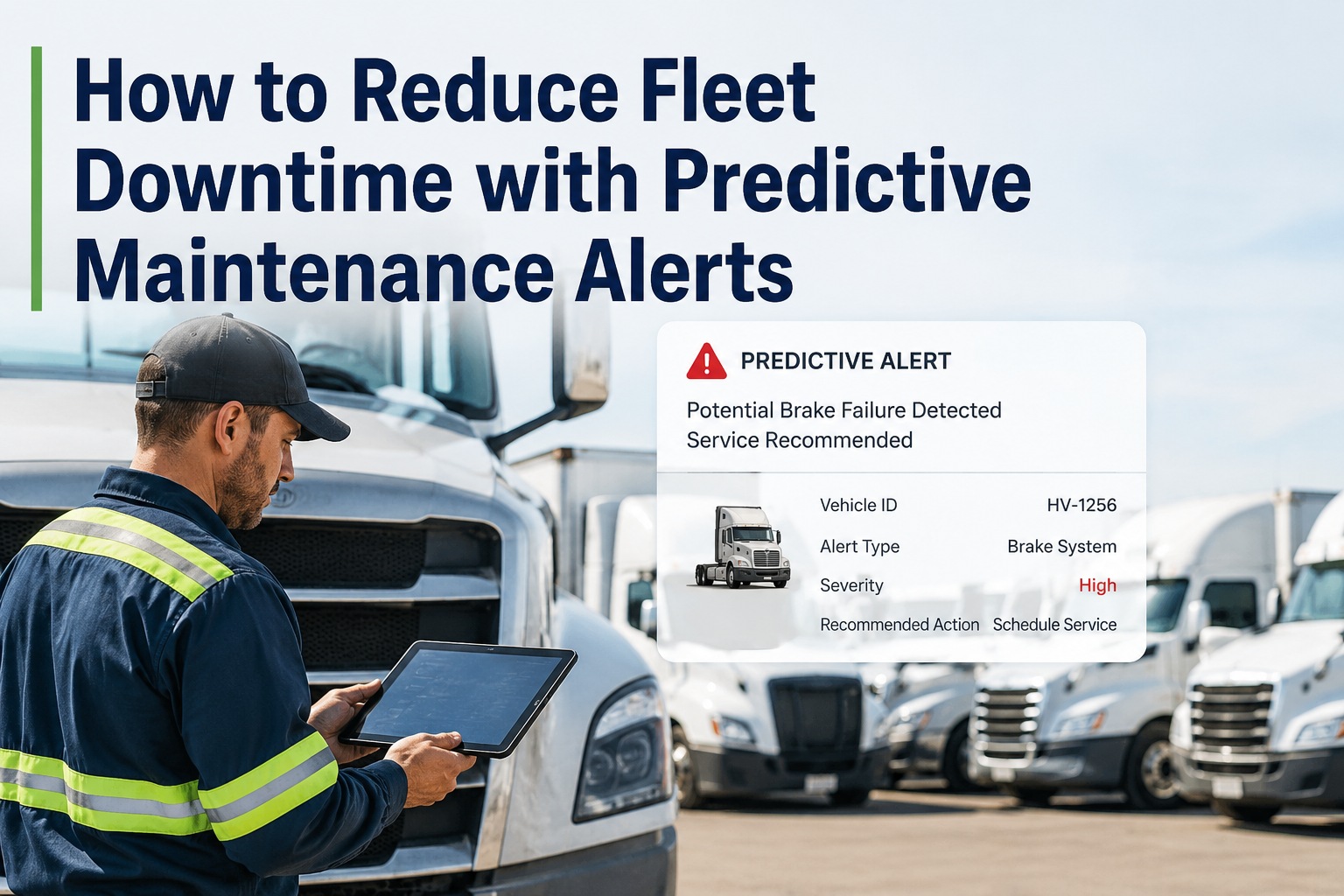
Every hour a truck sits unplanned costs $500–$2,000 in lost revenue. The average unplanned breakdown produces 1–3 days of downtime — and across a 100-vehicle fleet, unplanned maintenance consumes 11% of annual operating hours. That is 40,000+ hours per year where trucks should be earning revenue but are not. Predictive maintenance alerts change this equation by telling you which vehicle will fail, which component will fail on it, and when — 2–4 weeks before it happens. The repair shifts from a $1,900 roadside emergency to a $400 scheduled shop job. The downtime shifts from 1–3 unplanned days to a 2–4 hour planned window. And the cascading supply chain disruption — missed deliveries, idle warehouse labour, contract penalties — never happens at all. HVI's predictive maintenance alert system delivers this foresight by combining telematics sensor data with daily inspection intelligence across 163+ heavy vehicle components — the dual-layer approach that catches failures sensor-only platforms miss.
Predict Downtime Before It Costs You
HVI's predictive alerts forecast 75–85% of failures 2–4 weeks ahead — giving your maintenance team time to schedule repairs instead of reacting to breakdowns.
What Is Predictive Maintenance in Fleet Management?
Predictive maintenance uses AI to analyse real-time vehicle data — engine parameters, component condition, historical repair patterns — and forecast when a specific part will fail. It answers: "what will break, on which vehicle, and when?" before any warning light fires.
Reactive
Fix after it breaks
3–5x cost, 1–3 days downtime
→
Preventive
Fix on fixed schedule
Planned cost, but over-services 30–40%
→
Predictive
Fix when data says it will fail
Lowest cost, zero surprise downtime
How Do Predictive Alerts Actually Reduce Downtime?
Predictive alerts reduce downtime through four specific mechanisms — each compounding the others.
01
Early Warning = Scheduled Repair
AI detects a failure trajectory 2–4 weeks before breakdown. Maintenance schedules the repair during a planned window — overnight, on a low-demand day, or during a scheduled PM. The truck never experiences unplanned downtime because the repair happens before the failure.
Downtime impact: 1–3 days unplanned → 2–4 hours planned. Same repair. 90% less downtime.
02
Parts Pre-Staged Before Repair Starts
When a failure is predicted weeks ahead, parts are ordered through normal channels at planned prices and staged at the shop before the vehicle arrives. No mid-repair parts discovery. No $150–$400 rush shipping. No technician idle time waiting for delivery.
Downtime impact: Eliminates the 20–40% of jobs stalled by parts unavailability — the single biggest cause of extended repair time.
03
Cascade Prevention
A failed alternator does not just stop one truck — it strands the driver, delays the load, misses the dock appointment, idles the warehouse, and delays the outbound shipment. Predictive alerts prevent the initial failure that triggers the entire downstream cascade.
Downtime impact: $1,900 direct repair cost prevented + $15,000–$75,000 in supply chain disruption eliminated.
04
Maintenance Queue Optimisation
When the shop knows what is coming 2–4 weeks out, they can batch similar repairs, optimise technician scheduling, and balance workload across shifts. Reactive maintenance creates unpredictable spikes that overwhelm shop capacity and extend every other repair in the queue.
Downtime impact: Shop throughput increases 20–30%. Work order backlog decreases 40%. Every vehicle moves through maintenance faster.
HVI's predictive alerts automate all four mechanisms — from early warning through parts staging to work order generation and queue optimisation.
Schedule a demo and see predictive alerts on sample fleet data. Or
start free — alerts begin building from day one.
What Types of Alerts Does HVI Generate?
Not all alerts are equal. HVI uses a tiered alert system that matches urgency to response — preventing alert fatigue while ensuring nothing critical is missed.
Critical
80%+ failure probability within 7 days
Immediate dispatch restriction. Auto-generated emergency work order. Fleet manager notified instantly. Vehicle pulled from service until inspected.
Warning
45–79% failure probability within 14–30 days
Scheduled work order auto-created. Parts availability verified. Repair window recommended during next planned downtime. Supervisor notified.
Monitor
15–44% failure probability, trend accelerating
Component flagged for heightened inspection. Added to next PM service checklist. Trend tracked over subsequent inspections for escalation or de-escalation.
The Downtime Reduction Numbers
Documented results from fleets that deployed predictive maintenance alerts. Start free with HVI and begin building toward these outcomes today.
45%
Fewer Unplanned Breakdowns
AI surfaces failure risks 20–45 days before traditional diagnostics
95%+
Vehicle Availability
Up from 87.6% average — 27 extra operating days per vehicle per year
85%
Faster Defect Resolution
From 18–30 hours (reactive) to 2–4 hours (predicted + scheduled)
40%
Work Order Backlog Reduction
Predictable workload eliminates the reactive spikes that overwhelm shop capacity
$8,500
Annual Savings Per Vehicle
Prevented breakdowns + right parts + scheduled rates + extended component life
44 days
Average ROI Payback
First prevented breakdown covers the system cost for months
Why HVI's Alerts Are More Accurate Than Sensor-Only Platforms
Most predictive platforms analyse only telematics sensor data. HVI adds the daily inspection layer that makes predictions complete. Schedule a demo to see the accuracy difference on your vehicles.
Sensor-Only Alerts
Engine temperature, oil pressure, fuel trim
Transmission shift data, fault codes
Cannot see: tyre wear approaching DOT minimum, coolant hose bulging, brake pads at 3mm, fluid seepage at connections, fifth-wheel cracks. Physical defects that precede sensor alerts by 2–3 weeks.
+
HVI: Sensor + Inspection Alerts
All telematics data via API (Samsara, Geotab, Motive, 40+)
Daily DVIR photos analysed by AI across 163+ components
Physical condition tracking between PM intervals
Result: 95–99% accuracy. Earlier warnings. Fewer false positives. Catches every failure type — sensor-detectable and physical.
Downtime Is Not Inevitable — It Is Predictable
Every breakdown your fleet experiences in 2026 was preceded by signals — sensor anomalies, physical wear, component degradation — that AI could have detected and acted on 2–4 weeks before the failure occurred. The 45% reduction in unplanned breakdowns, the shift from 87.6% to 95%+ availability, and the $8,500 per vehicle in annual savings are not theoretical — they are documented outcomes from fleets that replaced reactive maintenance with predictive alerts. HVI delivers these alerts through the only dual-layer prediction model built for heavy vehicles — combining telematics sensor data with daily physical inspection intelligence across 163+ components. The result: earlier warnings, fewer false positives, and the most accurate failure predictions available for heavy vehicle fleets. Start free today — or schedule a demo and see predictive alerts working on your fleet data.
Predict Downtime. Prevent It. Every Day.
Tiered alerts. Dual-layer accuracy. Auto-generated work orders. Parts pre-staging. 44-day ROI. Trusted by 25,000+ users.
Frequently Asked Questions
Q: What is predictive maintenance in fleet management?
Predictive maintenance uses AI to analyse real-time vehicle data — engine sensors, component condition from inspections, and historical repair patterns — to forecast when specific parts will fail. Unlike preventive maintenance (fixed-schedule service) or reactive maintenance (fix after failure), predictive maintenance tells you which vehicle, which component, and when — giving maintenance teams 2–4 weeks to schedule the repair before the breakdown occurs.
Q: How do predictive alerts reduce fleet downtime?
Four ways: (1) early warnings convert unplanned breakdowns into scheduled repairs — 1–3 days downtime becomes 2–4 hours, (2) parts are pre-staged before repairs start — eliminating the 20–40% of jobs stalled by unavailable parts, (3) supply chain cascades are prevented before the initial failure occurs, (4) predictable maintenance workload allows optimised shop scheduling. Combined result: 45% fewer breakdowns, 95%+ vehicle availability.
Start free.
Q: How far in advance can AI predict vehicle failures?
Modern AI models predict major component failures 20–45 days before traditional diagnostics — and 2–3 weeks before fault codes fire. Accuracy improves over time as the AI trains on your fleet-specific patterns. HVI generates initial predictions within 72 hours of data connection, with meaningful accuracy by 60 days.
Schedule a demo to see prediction timelines on your vehicle types.
Q: Will predictive alerts create alert fatigue?
Not with a properly tiered system. HVI uses three alert levels: Critical (80%+ probability, immediate action), Warning (45–79%, scheduled repair), and Monitor (15–44%, heightened inspection). Only Critical alerts demand same-day response. Warning alerts generate scheduled work orders with recommended repair windows. Monitor alerts add items to the next inspection. This prevents the "every alert is urgent" fatigue that undermines adoption.
Q: What ROI can I expect from predictive maintenance alerts?
Industry average: 44-day payback. The first prevented breakdown — typically within 30 days — covers the platform cost for months. Documented annual results: 45% fewer breakdowns, $8,500 per vehicle saved, 30% lower total maintenance costs, 95%+ vehicle availability. ROI compounds year over year as AI accuracy improves with more data.
Start free today.