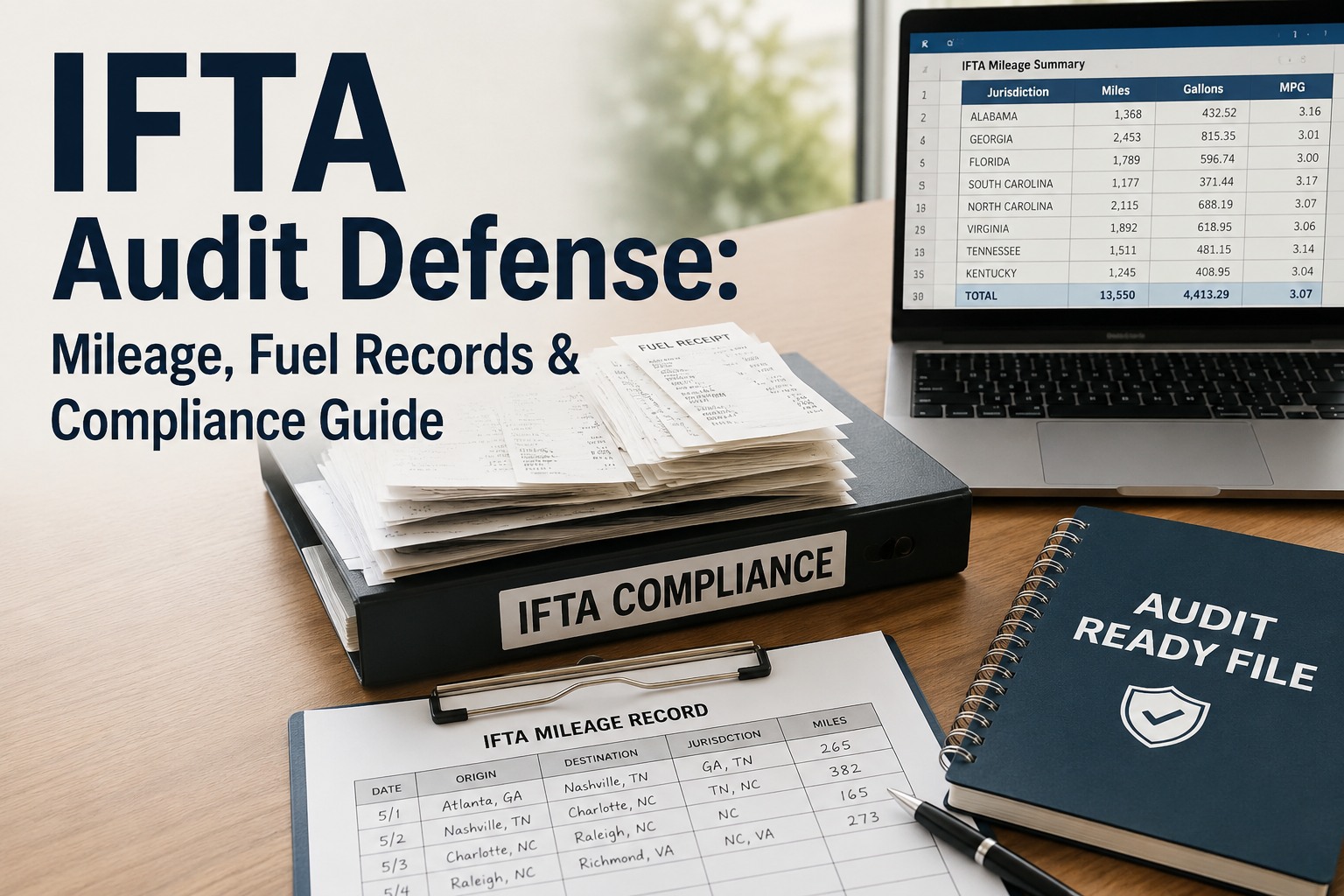
IFTA audit defense rests on three evidence pillars: mileage records with 10-minute GPS granularity, fuel receipts with all required data elements, and quarterly filings reconciled to source data. Missing any pillar means disallowed tax-paid credits, assessments typically $3,000-$25,000 for small fleets on sloppy-but-not-fraudulent records, and license-revocation risk after two missed quarters. All three pillars must be audit-ready before the notice arrives — book a demo to see audit-ready IFTA records in HVI.
The 3 Evidence Pillars That Determine IFTA Audit Outcomes
Base jurisdictions must audit roughly 3% of carriers each year. When the notice arrives, all three pillars either exist or they don't. There is no middle ground.
Mileage evidence
- VIN or vehicle unit number
- Date + time of each reading
- Lat/lon to 4 decimals (0.0001)
- ECM odometer or dash/hub
- Reading every 10 minutes engine-on
Fuel evidence
- Date of purchase
- Location (name + full address)
- Gallons purchased + fuel type
- Vehicle receiving fuel identified
- Tax-paid vs non-taxable separated
Filing evidence
- Quarterly return filed on time (4x/year)
- Amended returns if corrections made
- Supporting worksheets + calculations
- Reconciled to Pillar 1 & 2 data
- MPG within industry-plausible range
All three pillars must be retained 4 years from the return due date (6 years in suspected-fraud cases). Small-fleet assessment for sloppy-but-not-fraudulent records typically runs $3,000-$25,000; fraud findings hit six figures and can trigger federal involvement.
The rest of this page walks the exact auditor request sequence (what they ask for, in what order, and what happens when a pillar has gaps), the 10-minute GPS granularity standard that took effect January 2024, the fuel receipt requirements that make credit-card statements insufficient on their own, and the quarterly reconciliation discipline that turns audits into a search instead of a scramble. Book a 30-minute demo to see per-vehicle GPS mileage and fuel record archives in HVI.
The auditor's request sequence — what they ask for, in what order
IFTA audits follow a predictable escalation pattern. Understanding the sequence helps you audit-proof each stage before it starts. Every base jurisdiction runs the process slightly differently, but the underlying request sequence is consistent across US and Canadian jurisdictions bound by the International Fuel Tax Agreement.
| Stage | What auditor requests | Preparation window |
|---|---|---|
| 1. Audit notice | Notice by mail identifying quarters under review (typically 4-8 quarters), scope of audit, and initial document list | Typically 30-60 days to prepare, depending on jurisdiction |
| 2. Fleet inventory verification | Vehicle list matching quarterly returns; VINs, unit numbers, fuel types, base jurisdiction registration | Should be same-day from digital records |
| 3. Sample trip review | Complete trip records for selected units and dates: origin, destination, route, jurisdiction miles, GPS data | Sample size typically 10-30% of trips in review period |
| 4. Fuel receipt reconciliation | All tax-paid fuel receipts for the review period, cross-referenced to purchase location and vehicle | Missing receipts = disallowed credits, not requests for clarification |
| 5. MPG reasonableness check | Computed MPG per unit compared to industry norms (typically 5-9 MPG for Class 8 diesel) | Outliers trigger extended sample or full audit expansion |
| 6. Findings + assessment | Written findings, tax adjustments, penalties, interest; appeal window 30 days from final notice | Assessment collected by base jurisdiction for all member jurisdictions |
The critical insight most fleets miss: the auditor does not build the case against your filings from scratch. They start from your quarterly returns and work backward, verifying that source data supports the reported numbers. When source data (GPS, receipts, trip records) reconciles to the return, the audit closes clean regardless of size. When it does not reconcile, adjustments follow whether the gaps are honest errors or intentional understatement — the auditor's job is not to assess intent, only to verify support. Book a demo to see automated quarterly reconciliation between GPS mileage and IFTA returns in HVI.
4 audit-failure modes that catch fleets by surprise
IFTA audit failures rarely come from carriers deliberately understating tax owed. They come from four structural gaps in ongoing record discipline that produce defensible-looking quarterly returns but fall apart under the source-data reconciliation the auditor performs. Each has a specific structural cause and a specific fix.
Summary data without source
Fleet retains monthly mileage summaries but not the underlying GPS raw data. Auditor demands raw source data; only summaries exist. Summary numbers immediately treated as unverified and best-information-available audit begins — typically producing higher assessments than the fleet's own numbers.
Credit card statements as receipts
Fleet uses fuel cards; retains monthly statements; loses or never captures individual receipts. Auditor accepts card statements as secondary proof with reduced credibility, then disallows tax-paid credits where the statement lacks gallons or vehicle-specific data. Assessment follows.
MPG anomalies flagged
Fleet-computed MPG on quarterly return falls outside 4-9 MPG plausibility range for Class 8 diesel due to underreported miles or overreported fuel. Auditor's pattern-matching algorithm flags for extended sample and often expands the audit to more quarters.
Late/amended filings
Fleet late-files or repeatedly amends quarterly returns. Base jurisdiction pattern-matching flags for higher audit selection probability. Two consecutive missed quarters can trigger license revocation, halting interstate operations until the license is restored.
The pattern connecting all four failures: reactive quarterly filing without ongoing reconciliation between telematics data and reported numbers. Fleets that reconcile GPS mileage to IFTA returns within 10 days of each quarter close catch discrepancies while the data is fresh and correctable. Fleets that file first and reconcile only when the auditor arrives find themselves defending numbers they cannot verify from source data 12-30 months later. Start a free HVI trial to see per-vehicle mileage-to-return reconciliation reports.
The 10-day quarterly close discipline that turns audits into a search
Every serious IFTA audit-defense playbook centers on the same discipline: close the quarter within 10 days of the quarter end, reconcile every number to source data, flag every variance while data is fresh, and file only when the return matches what the GPS and receipts actually show. Four steps make this repeatable across every quarter.
Pull GPS mileage by jurisdiction
- Per-unit mileage totals by state/province
- Reconcile to ELD or telematics source
- Flag units with missing GPS coverage days
- Export raw data for 4-year archive
Reconcile fuel receipts to card statement
- Every card transaction to matched receipt
- Flag statements without matching receipt
- Photograph any cash-purchase receipts same day
- Separate tax-paid vs non-taxable purchases
Verify computed MPG
- Fleet MPG within 4-9 range for Class 8 diesel
- Per-unit MPG within 20% of fleet baseline
- Investigate outliers before filing
- Document variances with explanations
File within deadline
- Quarterly return due end-of-month following
- Save filed copy + supporting worksheets
- Archive all source data linked to return
- Zero-return still required if no tax owed
Fleets running this 10-day close discipline consistently pass IFTA audits with minor or no adjustments. Fleets running quarterly filings from summary data with no source reconciliation routinely face assessments in the $3,000-$25,000 range even when actual operations were fully compliant — because the auditor cannot verify what the fleet cannot produce. The discipline separates audit-proof programs from audit-exposed ones, regardless of fleet size or complexity. Book a demo to see the automated quarterly close workflow in HVI.
A fuel tax manager on defending an IFTA audit across 87 tractors and 4 jurisdictions
We're an 87-tractor regional carrier, base jurisdiction Illinois, running lanes across IL, IN, WI, MI. Random-selection audit hit in Q2 2025 covering the prior 6 quarters. Auditor requested full trip records on 22 sample units across the review window, all fuel receipts, and computed MPG per unit for reconciliation.
Before the audit we were on a hybrid system: GPS from our telematics vendor, fuel receipts scanned by drivers via mobile app to the AP system, quarterly returns prepared by our controller from summary reports. The audit exposed the seam: we had raw GPS data available from the telematics platform, but the format the auditor needed (per-jurisdiction breakdown at 10-minute intervals with ECM odometer readings) required data exports the platform could do but our team had never run for archival purposes. Two weeks of scrambling to export and format 24 months of raw GPS data at 4-decimal-place lat/lon precision.
The audit closed with roughly $8,400 in adjustments — not fraud, just fuel receipts we could not produce for cash purchases on a few units and one unit with a GPS coverage gap during a 5-day window when the telematics unit had been swapped. Manageable but avoidable. We restructured after: 10-day quarterly close where telematics data is pulled and archived in the required format, fuel receipts locked-in via mobile capture the same day as purchase (cash prohibited unless receipt photographed within 24 hours), MPG per unit reviewed before filing. Since then two additional targeted follow-up reviews have both closed with zero adjustments. The recordkeeping discipline is the audit defense — not the operational compliance, which was fine all along.
Frequently asked questions
How long must IFTA records be kept?
IFTA regulations require carriers to retain all supporting mileage and fuel records for a minimum of 4 years from the date the quarterly IFTA tax return was due or the date it was filed, whichever is later. This retention rule is uniform across all US and Canadian jurisdictions bound by the International Fuel Tax Agreement. Records covered include GPS or ELD raw mileage data (not just monthly summaries), individual fuel receipts (credit card statements alone are insufficient), trip records with origin/destination/route/jurisdiction miles, copies of every filed quarterly return with supporting worksheets, and any amended returns. In cases of suspected fraud, some jurisdictions extend the lookback window to 6 years; fleets handling overall federal tax records commonly retain everything for 7 years for that reason. The critical structural requirement introduced January 1, 2024: when using vehicle tracking systems for mileage records, the system must retain data at 10-minute minimum intervals when the engine is on, capturing VIN or unit number, date and time, latitude and longitude to at least 4 decimal places (0.0001), and ECM odometer readings (dashboard or hubometer acceptable if no ECM available). If your telematics platform does not retain data in this format for 4 years, download and archive the raw data quarterly as backup — the auditor will accept your archived copy even if the platform vendor no longer has it.
What triggers an IFTA audit?
Five factors drive IFTA audit selection. First, random selection: each base jurisdiction is required under IFTA to audit approximately 3% of its licensees annually, so any active IFTA carrier has a baseline probability of selection every year regardless of filing quality. Second, filing inconsistencies: quarter-over-quarter variance in miles, fuel gallons, or MPG outside typical ranges triggers pattern-matching flags. Large swings in reported jurisdiction miles without corresponding operational changes are particularly noticeable. Third, MPG outside plausibility bands: Class 8 diesel fleets typically report 5-9 MPG (with weighted average around 6-7). MPG substantially outside that range (either implausibly high suggesting underreported fuel, or implausibly low suggesting overreported miles) invites extended review. Fourth, late or amended filings: repeatedly missing quarterly deadlines or amending previously filed returns increases audit selection probability. Two consecutive missed quarters can trigger license revocation independent of audit. Fifth, cross-jurisdiction data mismatches: base jurisdictions share data with member jurisdictions, and reported miles in one jurisdiction that do not match fuel purchase patterns or roadside inspection records from that same jurisdiction can flag discrepancies visible only through the shared database. Compliance-focused fleets treat all five triggers as things to manage year-round, not just when returns are due.
Are credit card statements enough to support IFTA fuel claims?
Almost never. IFTA requires actual fuel receipts containing all required data elements: date of purchase, location (name and full address), gallons purchased, fuel type, and vehicle receiving the fuel identified either by unit number or through fuel card tracking that ties the transaction to a specific vehicle. Standard credit card statements provide only the merchant name, date, and dollar amount — they lack the gallons, fuel type, and vehicle-specific information the audit requires. Auditors will accept detailed fuel card reports (from carriers like Comdata, WEX, Fleet One, T-Chek, and similar programs) as adequate substitutes for individual receipts because these reports capture the full required data set electronically at the point of transaction. Generic credit card statements alone will result in disallowed tax-paid credits, meaning higher tax owed for those fuel purchases even if the fuel was legitimately purchased. The practical fix for most fleets is a fleet fuel card program that produces the detailed transaction data automatically, combined with a mobile receipt capture app for the rare cash purchases (with a company policy requiring same-day photograph and upload of any cash-purchase receipt). Modern IFTA-focused platforms integrate directly with major fuel card providers and pull transaction data on a daily basis, eliminating the receipt-collection burden entirely.
Can GPS or ELD data alone satisfy IFTA mileage requirements?
Yes, GPS and ELD data can satisfy IFTA mileage requirements and is increasingly the audit-preferred format, provided the data meets specific standards effective January 1, 2024. The tracking system must record and retain data at minimum 10-minute intervals when the engine is on, with each record containing five data elements: the vehicle identification number or unit number, the date and time of the reading, the latitude and longitude to at least 4 decimal places (0.0001), the odometer reading from the engine control module (ECM — or a beginning and ending dashboard/hubometer reading for the trip if no ECM is available), and adequate detail to reconstruct per-jurisdiction miles for the trip. Two important cautions. First, there is no official "IFTA-certified" ELD; vendor claims of IFTA certification are marketing, not regulatory approval. Verify the specific data elements yourself. Second, FMCSA ELD rules and IFTA data requirements are separate regulatory frameworks — an ELD compliant with FMCSA hours-of-service requirements may not meet IFTA data-retention standards for mileage. Confirm your platform captures and retains all five IFTA data elements for the required 4-year retention window. If your platform only retains raw GPS data for a shorter period, you must download and archive the raw data quarterly to maintain the full 4-year audit-ready record. Monthly, quarterly, or annual mileage summaries generated by the platform are not acceptable at face value during an audit — they must be supported by the underlying raw source data.
What happens if I fail an IFTA audit?
Consequences scale with the nature and severity of the audit findings. For small fleets (5-50 trucks) with sloppy but non-fraudulent record-keeping, assessments typically range from $3,000 to $25,000, covering additional tax owed plus penalties (typically 10% of unpaid tax) and interest (approximately 1% per month on unpaid tax from the original due date). Missing receipts and inability to produce raw GPS data are the most common contributors to assessments in this range. For more serious findings involving apparent fraud — deliberately understated miles in high-tax jurisdictions or fabricated fuel receipts — assessments can reach six figures and may trigger federal involvement including IRS coordination and potential criminal referral. Beyond direct assessment costs, the base jurisdiction can revoke the IFTA license after two consecutive missed quarters or after audit findings indicating pattern non-compliance. License revocation stops interstate operations until the license is restored, which requires paying the assessment in full plus reinstatement fees and often demonstrating corrective action. Fleets have 30 days from final audit notice to appeal in writing to their base jurisdiction, which coordinates the appeal with any other member jurisdictions where tax may be owed. The most reliable audit-defense strategy is quarterly reconciliation between telematics data and reported returns, which catches gaps within 10 days of each quarter close while data is fresh and correctable rather than 12-30 months later when the auditor arrives.
Turn IFTA audits from a scramble into a search.
HVI captures per-vehicle GPS mileage at the required 10-minute granularity, logs fuel receipts with all IFTA data elements at source, reconciles quarterly returns to raw telematics data with MPG anomaly detection, and retains the audit-ready archive for the mandated 4 years. When the audit notice arrives, you already have the answers. Live in under two weeks. No hardware. No credit card.
Trusted by IFTA-registered carriers across the USA & Canada · Ready on day one