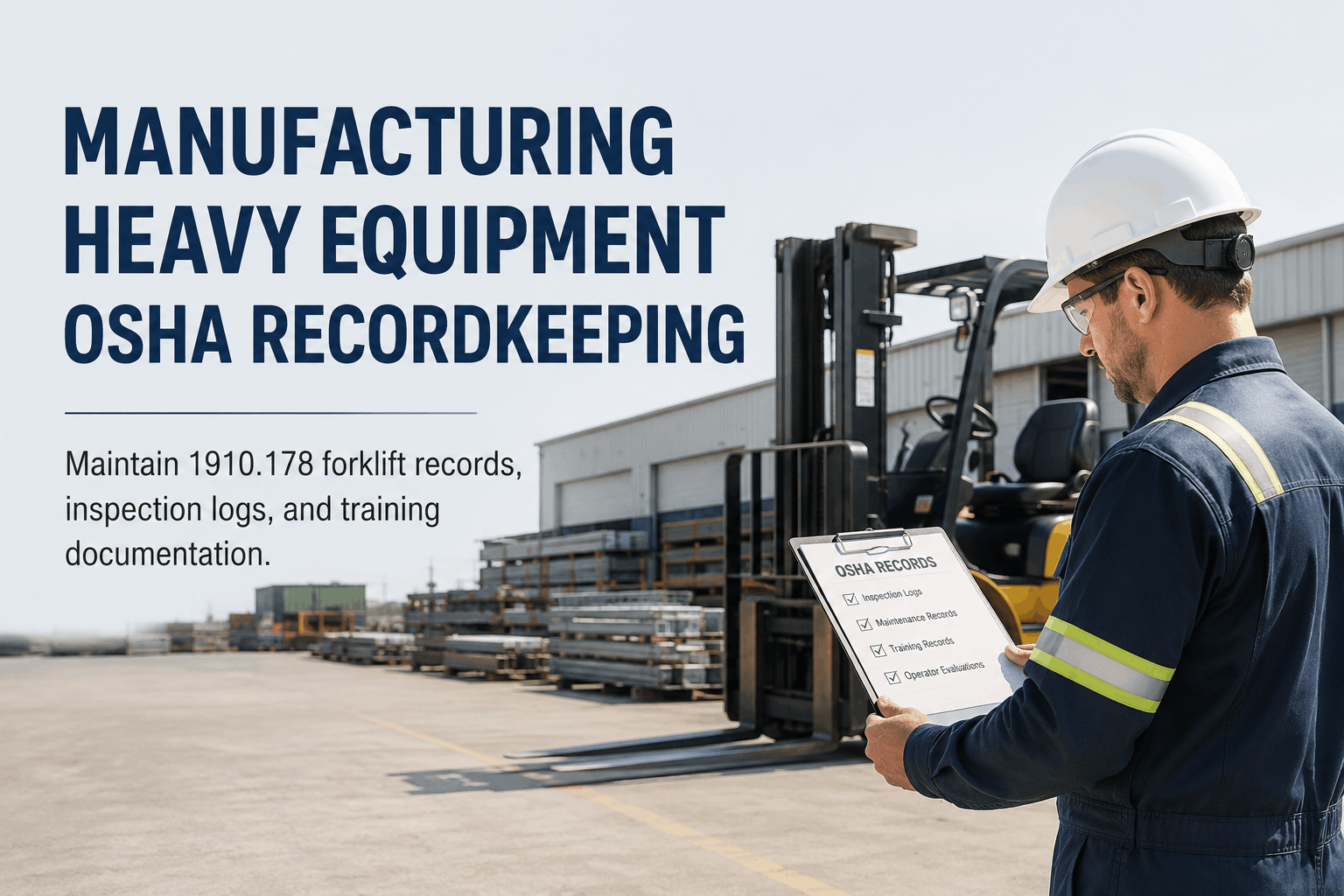
In an OSHA inspection of a manufacturing plant, there's one rule that governs everything: if you can't document it, OSHA treats it as if it never happened. A perfectly trained forklift operator, a machine inspected every shift, a defect fixed the day it was found — none of it counts without the paperwork to prove it. That's why recordkeeping, not safety practice itself, is where most plants get cited. Powered industrial trucks are regulated under 29 CFR 1910.178, and three of the five most common forklift violations are pure documentation failures — missing training records, missing refresher records, missing certifications — while the other two are daily-inspection failures. Both live in the same recordkeeping system. The stakes are not small: serious violations run up to $16,550 each, willful or repeat violations reach $165,514, and one Texas facility drew $288,299 in proposed penalties after a fatal forklift incident exposed training-record failures. The good news is that 1910.178 recordkeeping comes down to four record types with clear required fields and retention periods — and once they're tracked systematically, an audit becomes a non-event. Digital OSHA recordkeeping keeps all four complete, current, and instantly retrievable. This guide covers the four record types, what each must contain, how long to keep them, and how to stay audit-ready.
If You Can't Document It, OSHA Says It Never Happened
HVI keeps every 1910.178 record audit-ready — daily forklift inspections, operator training and certification, three-year evaluations, and defect logs — with required fields enforced, renewal alerts before they lapse, and instant retrieval when the inspector arrives.
The Four Records OSHA Checks
1910.178 recordkeeping comes down to four document types. Three are training-related and one is inspection — and an OSHA inspector can ask for any of them. Know what each is and which subsection governs it.
1910.178(q)(7)
Daily Inspection Records
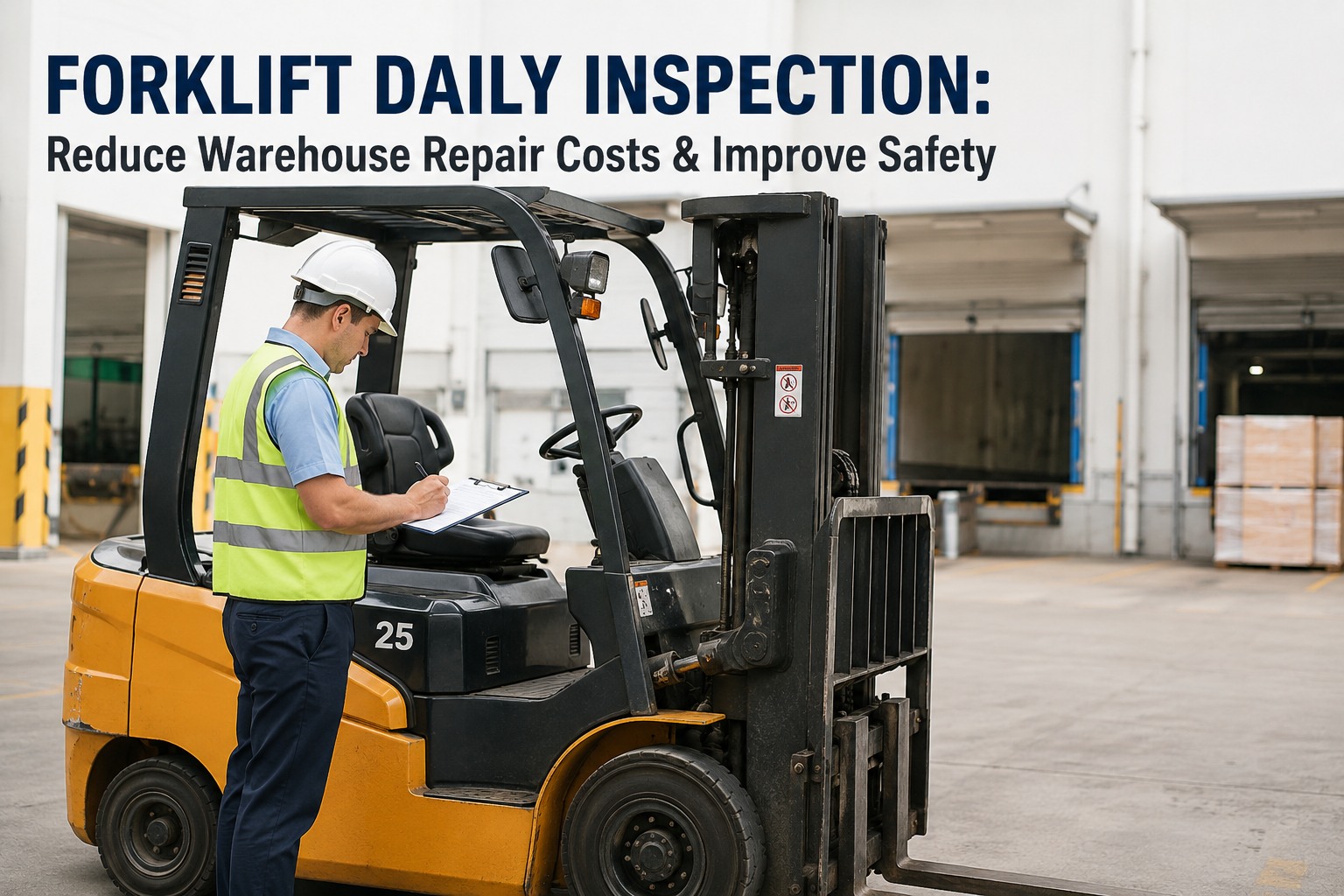
A powered industrial truck must be examined before being placed in service — every shift. The log proves the inspection happened: who inspected, when, and what was found. Three of the top-five violations involve inspection or its documentation.
1910.178(l)(6)
Operator Certification
The employer must certify each operator has been trained and evaluated. This is the single most-cited record — and it has four mandatory fields (below). No government license exists; OSHA puts the entire burden on the employer.
1910.178(l)(4)(iii)
Three-Year Evaluation
Each operator's performance must be re-evaluated at least once every three years. That's the maximum interval, not a target — and the evaluation date is a required field on the certification record. Miss it and a compliant operator becomes a citation.
1910.178(p)(1)
Defect & Maintenance Logs
A truck with a defect affecting safe operation must be taken out of service. While 1910.178 doesn't explicitly mandate maintenance logs, documenting defects found, repairs done, and return-to-service is essential to prove compliance and defend against citations.
The Certification Record: Four Mandatory Fields
The operator certification is the most-cited record, and it fails most often for a missing field. OSHA 1910.178(l)(6) spells out exactly what it must contain — leave one out and the record is non-compliant even if the operator is fully trained.
Operator Name
The identity of the operator being certified — tying the record to a specific person.
Date of Training
When the operator completed the required training program.
Date of Evaluation
When the operator's performance was evaluated — and the clock for the next 3-year re-evaluation.
Trainer / Evaluator Identity
The name of the person(s) who performed the training and the evaluation.
Retention: How Long to Keep Each Record
Different records have different clocks, and OSHA expects you to produce any of them on request. Keep them at least this long — longer is better for accident defense.
Record Type
Minimum Retention
Notes
Forklift training / certification
3 years
The current certification stays valid 3 years until the next evaluation; retain past records for defense
Daily inspection checklists
Not mandated*
OSHA doesn't require retention, but keeping them proves inspections occurred — best practice to retain
Defect & repair logs
3+ years
Supports compliance defense; track defects found, repairs done, and return-to-service authorization
OSHA 300 injury/illness logs
5 years
Separate requirement; 100+ employee high-risk establishments now submit electronically via ITA
*Daily checklists aren't required to be retained, but the burden of proof is on the employer — without them you can't show the mandated inspections happened. Best practice is to keep them, and digital storage makes extended retention effectively free.
What a Missing Record Costs
Recordkeeping gaps aren't paperwork nits — they carry the same penalties as the underlying safety failures, because to OSHA an undocumented control doesn't exist.
$16,550
per serious violation
The standard penalty for a serious 1910.178 violation, including documentation failures.
$165,514
willful / repeat
For willful or repeated violations — the cost of a known, uncorrected recordkeeping gap.
$288,299
one real case
Proposed penalties at one Texas facility after a fatal forklift incident exposed training-record failures.
3 of 5
top violations
Of the five most common forklift citations are pure recordkeeping — training, refresher, certification.
Staying Audit-Ready: The System
The difference between passing an audit and scrambling through a file cabinet is whether the records manage themselves. Four habits keep a plant inspection-ready.
1
Enforce Every Field
Required fields on every certification and inspection so no record is ever filed incomplete — the #1 audit failure, eliminated at entry.
2
Alert Before Lapse
Automatic reminders before a 3-year evaluation or refresher comes due — so a compliant operator never silently expires into a citation.
3
Retrieve Instantly
Pull any operator's certification or any truck's inspection history in seconds when the inspector asks — no frantic file search.
Make Your Next OSHA Audit a Non-Event
Digital 1910.178 recordkeeping — daily forklift inspections, operator training and certification with all four required fields, three-year evaluation tracking, and defect logs — with required-field enforcement, renewal alerts before records lapse, and instant retrieval. Three of five forklift violations are recordkeeping; close them all in one system. Trusted by 25,000+ users worldwide.
Frequently Asked Questions
What records does OSHA 1910.178 require for forklifts?
Four core record types. Daily pre-shift inspection records under 1910.178(q)(7), proving each truck was examined before being placed in service; operator training and certification under 1910.178(l)(6), certifying each operator was trained and evaluated; three-year performance evaluation records under 1910.178(l)(4)(iii); and defect and maintenance logs supporting 1910.178(p)(1), which requires removing a defective truck from service. Three of the five most common forklift violations are documentation failures across these records, so keeping all four complete and current is the single highest-leverage compliance step.
Sign up for a free HVI trial to track all four.
What must a forklift operator certification record contain?
OSHA 1910.178(l)(6) requires four specific fields: the name of the operator, the date of the training, the date of the evaluation, and the identity of the person(s) who performed the training and evaluation. A certification missing any one of these is a citable violation even if the operator was fully and properly trained — and the missing field is usually discovered at audit time, too late to correct. That's why a system that enforces every required field at the moment the record is created is so valuable: it makes an incomplete certification impossible.
Schedule a demo to see enforced fields.
How long must forklift records be kept?
Forklift operator training and certification records should be retained at least three years — the current certification stays valid for three years until the next required evaluation, and keeping prior records supports accident defense. Daily inspection checklists aren't explicitly required to be retained, but because the burden of proof is on the employer, best practice is to keep them to prove inspections occurred. Defect and repair logs should be held three or more years for compliance defense, and OSHA 300 injury/illness logs have a separate five-year requirement. Digital storage makes extended retention effectively free.
Sign up for a free HVI trial for effortless retention.
How often do forklift operators need re-evaluation?
At least once every three years under 1910.178(l)(4)(iii) — and that's the maximum interval, not a recommendation. Refresher training and re-evaluation are required much sooner whenever an operator is observed operating unsafely, is involved in an accident or near-miss, is assigned a different type of truck, or when workplace conditions change. The three-year evaluation date is a required field on the certification record, so missing it turns a compliant operator into a citation overnight. Timely recertification also cuts accident rates by up to 30%.
Schedule a demo to automate evaluation reminders.
What are the penalties for OSHA forklift recordkeeping violations?
Serious violations run up to $16,550 each, and willful or repeat violations reach $165,514 — and recordkeeping gaps carry these same penalties because, to OSHA, an undocumented control doesn't exist. The exposure is real: one Texas distribution center drew $288,299 in proposed penalties after a fatal forklift incident exposed training-record failures. Since three of the five most common forklift citations are pure documentation failures — training, refresher, and certification records — and the other two are daily-inspection failures, systematic recordkeeping closes most of a plant's citation risk on its own.
Sign up for a free HVI trial to avoid the penalties.