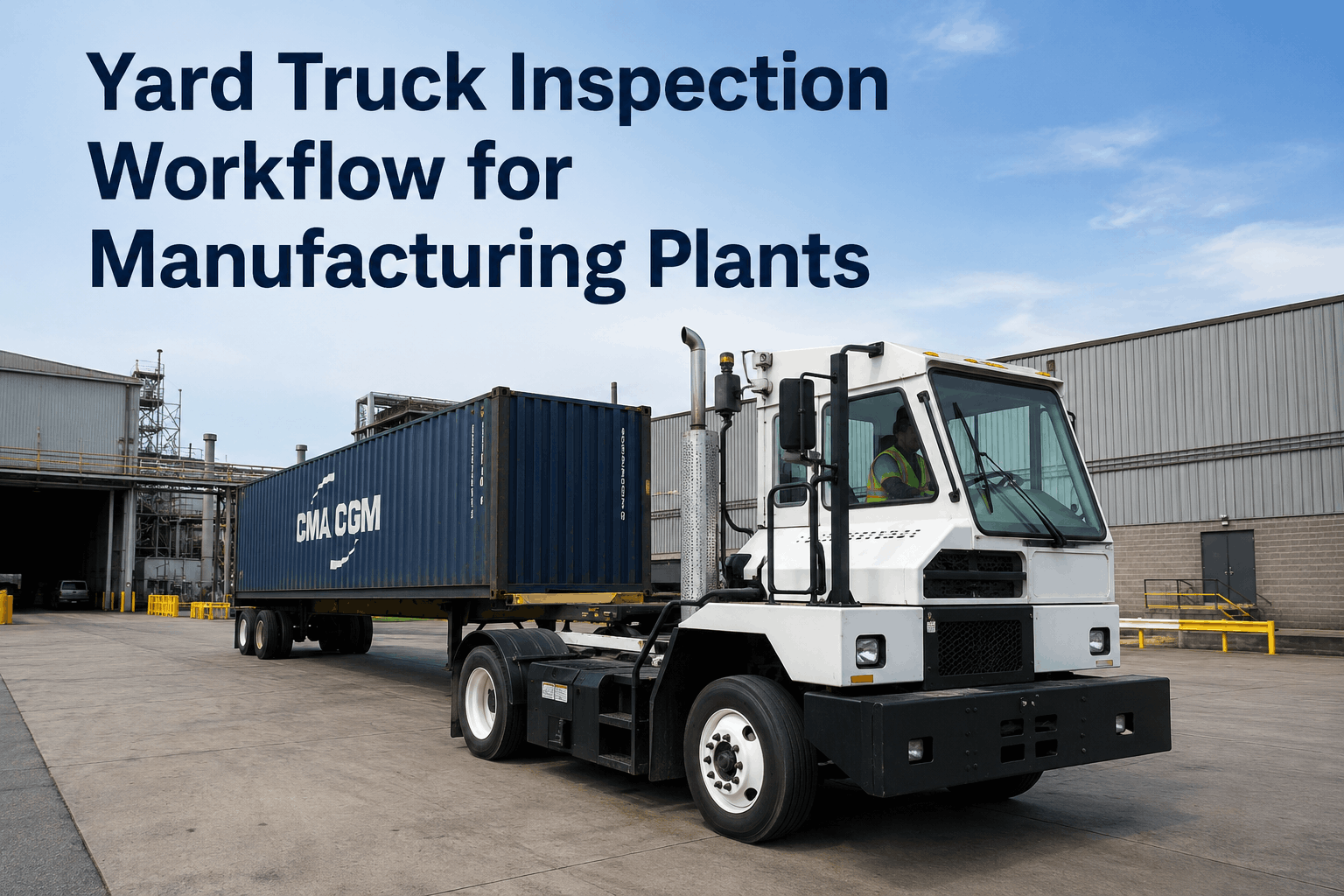
The yard truck has more names than any machine in the building — yard dog, hostler, spotter, terminal tractor, yard goat — and a job description that sounds simple until you watch one work. A single hostler can connect and drop a hundred trailers in a shift, raising and lowering a hydraulic fifth-wheel boom under each one, slamming air-line connections, and shuttling loaded trailers across a busy yard where trucks, pedestrians, and dock doors all share the same space. The fifth-wheel boom is the part that makes a yard truck a yard truck — and the part a generic truck inspection completely ignores. That hydraulic boom, fed from a shared reservoir that also runs the cab tilt and power steering, lifts trailers thousands of times a week; when it fails, a trailer drops, a connection lets go, or the unit simply stops earning in the middle of a yard that depends on it to keep product moving. A purpose-built yard truck inspection workflow covers what matters on a hostler specifically — the fifth-wheel boom, the hydraulics behind it, the air-line and trailer connection, and the brakes that stop a loaded rig in a crowded yard. This page lays out that workflow stage by stage and shows how a structured per-shift check keeps spotters safe, running, and out of the repair bay.
The Hostler Inspection Workflow: Five Stages
A yard truck check follows the natural flow of how the machine works — walk it, test the boom, check the connections, confirm the brakes, then log it. Run the stages in order and nothing gets skipped under shift-start pressure.
Walk-Around
Tires, wheels, lights, leaks, frame, and cab. Circle the unit before start-up; note any fluid on the ground — often the first sign of a hydraulic problem.
Fifth-Wheel Boom
Raise and lower the boom through full travel. Check for smooth lift, no drift, secure locking jaws, and an undamaged plate. This is the heart of the unit.
Hydraulics
Reservoir level and sight gauge, hoses, and filter. One pump feeds boom, cab tilt, and steering — a weak system shows up across all three.
Air & Connection
Glad-hand seals, air-line condition, and trailer-brake charge. The sliding rear door lets the hostler connect lines fast — check the seals stay tight.
Brakes & Log
Service and parking brake test under load, then document pass/fail per item with a timestamp. The record is what survives the audit.
The Fifth-Wheel Boom: What a Generic Check Misses
Every yard truck inspection lives or dies on the boom. It's the one system that separates a hostler from an ordinary tractor, and the one most likely to cause a dropped-trailer incident if it's not watched. Here's what to check and why it matters.
Lift & Travel
Boom raises and lowers smoothly through full range with no hesitation, jerk, or drift-down under load. Slow or jerky lift points to hydraulic wear before it becomes a failure.
Locking Jaws
Coupling jaws engage fully and lock secure on the kingpin; no excessive wear or play. A worn lock is the direct path to a trailer separating in motion.
Plate & Mount
Fifth-wheel plate undamaged, properly greased, and securely mounted to its bracket. Cracks or loose mounting bolts are immediate tag-out conditions.
Boom Cylinder
Lift cylinder and rod free of leaks, scoring, or bent rods. The cylinder carries the full trailer weight on every hook — a slow leak ends in a drop.
One Pump, Three Jobs: The Shared Hydraulic System
A defining quirk of the yard truck: a single hydraulic system runs three critical functions. A problem in the reservoir or pump doesn't show up in one place — it degrades all three at once, which is why hydraulics deserve their own inspection stage.
Lifts and lowers the trailer — the highest-load function, thousands of cycles a week.
Raises the cab for engine access — failure here blocks maintenance itself.
Steers the unit in tight yard maneuvers — weak steering is a safety issue in shared aisles.
The PM Schedule for Plant Yard Trucks
Per-shift inspection catches the immediate hazard; scheduled PM keeps the boom and hydraulics from getting there. Manufacturers like Kalmar Ottawa publish hour-based intervals — here's the typical structure for a plant spotter.
From Workflow to Work Order
The value of a structured workflow is that it doesn't end at "inspected." A defect found becomes a work order, a repair, and a record — all in one loop, no paper slip to lose.
Run the Workflow
Hostler completes the guided five-stage check on a phone, photographing any boom, hydraulic, or brake defect.
Flag & Route
A critical fail tags the spotter out; the defect becomes a work order routed straight to the yard maintenance team.
Track & Document
Inspection, repair, and PM log against the unit by engine hours — full history ready for any audit.
Keep Every Spotter Hooking, Hauling, and Documented
A guided per-shift workflow for the fifth-wheel boom, hydraulics, air connection, and brakes; hour-based PM scheduling; instant defect-to-work-order routing; and timestamped records — built for manufacturing plant yard fleets. Trusted by 25,000+ users worldwide.