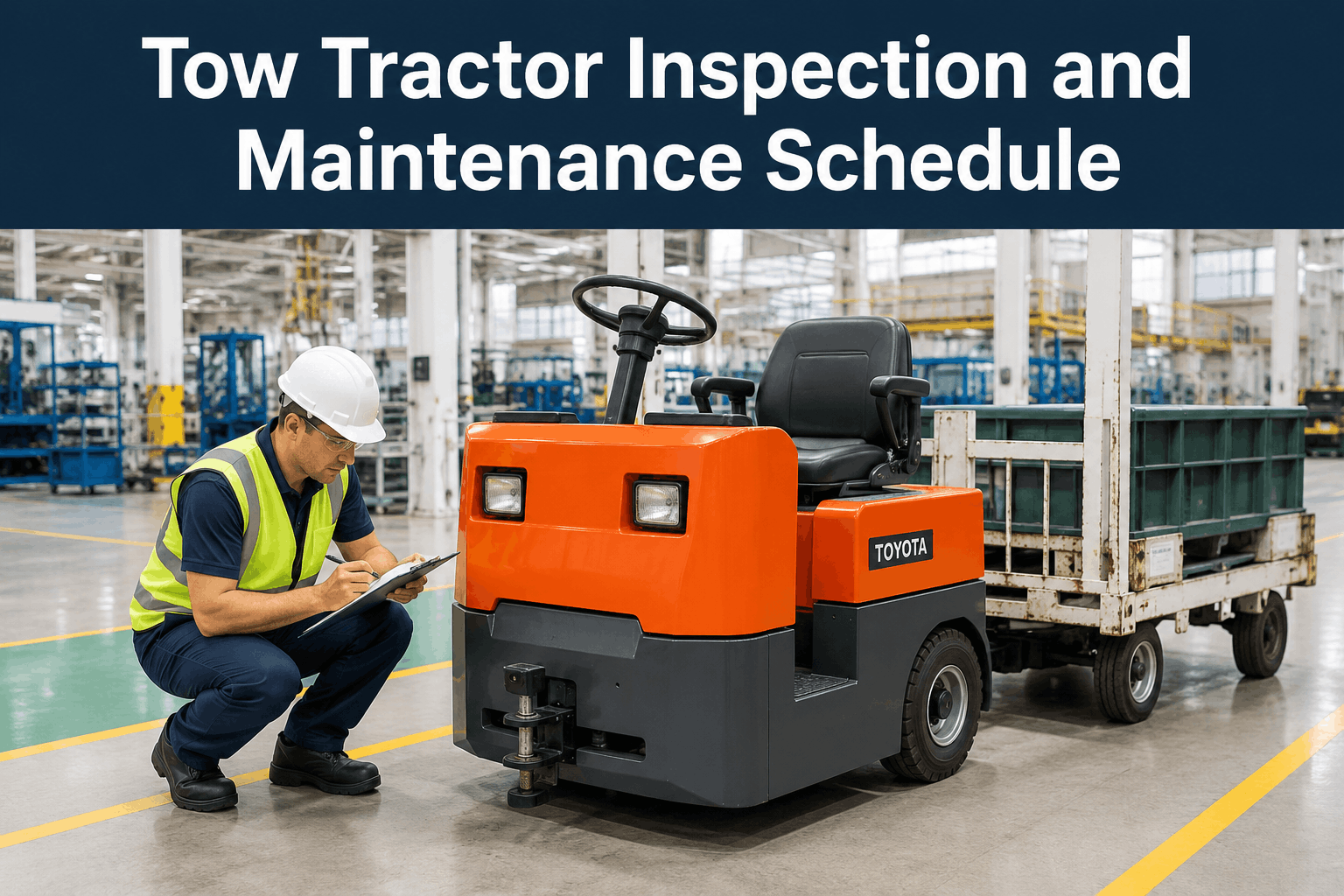
The tow tractor is the quiet workhorse of plant logistics. It never lifts a load, so it rarely gets the scrutiny a forklift does — yet it pulls trains of carts weighing several tonnes through aisles full of people, all day, every shift. That combination, heavy towed loads plus constant pedestrian traffic, is exactly why a tugger with a worn hitch or a soft brake pedal is one of the more dangerous machines on the floor. OSHA treats it accordingly: a tow tractor is a Powered Industrial Truck under 29 CFR 1910.178, which means it must be inspected before each shift it's used — not daily, but every shift in round-the-clock plants — with defects documented before the unit enters service, and preventive maintenance performed on the manufacturer's schedule. Miss the inspection and you're not just risking a runaway cart train; you're risking citations that start at $16,550 per serious violation, and the most common audit finding isn't a broken part — it's missing inspection paperwork. This page lays out the per-shift inspection points that matter most for tuggers, the preventive maintenance schedule by interval, and the difference between hitting all of it and merely hoping you did.
A Tugger Doesn't Lift — But It Still Has to Stop
HVI guides operators through the per-shift tow tractor inspection in minutes, flags a failed hitch or brake instantly with a photo, auto-creates the work order, and keeps the timestamped records that turn an OSHA audit from a scramble into a search. Hitches, brakes, electric drive — covered.
The Per-Shift Inspection: Four Zones That Decide Safety
OSHA requires a pre-shift check, but it doesn't hand you a tugger-specific list. These are the four zones that matter most on a tow tractor — the hitch and brakes especially, because they're what stands between a loaded cart train and the people around it.
CRITICAL
Hitch & Towing Mechanism
The defining tugger component. Confirm the hitch pin, coupling, and latch are secure, undamaged, and rated for the load. A failed hitch releases a multi-tonne cart train into a populated aisle — tag out immediately if worn or cracked.
CRITICAL
Brakes & Steering
Service brake must stop the loaded unit promptly and straight; parking brake must hold on a grade without creep. Steering smooth, no excessive play. Brake failure is the leading cause of pedestrian fatalities in powered-truck incidents.
MONITOR
Drive System & Power Source
Electric: battery charge, connectors, cable condition, no exposed wiring. Propane: tank mounting, hose condition, leak check. These lists differ entirely — use the right one for the unit's power type.
MONITOR
Tires, Lights & Controls
Tires free of damage and properly inflated; horn, lights, and warning devices functional; throttle and emergency stop responsive. Essential in shared aisles where the tugger relies on signals to warn pedestrians.
C Critical — fails, tag out of service immediately, no exceptions per OSHA 1910.178(p)(1)
M Monitor — document with photo, create work order, repair within SLA; may run if safe
S Service — note and schedule at next PM; does not affect safe operation
The Preventive Maintenance Schedule by Interval
Per-shift inspection catches the immediate hazard; preventive maintenance keeps the unit from getting there. OSHA 1910.178(q)(1) requires PM on the manufacturer's schedule — here's how the intervals typically stack for a plant tow tractor.
Every Shift
Operator inspection
Hitch, brakes, steering, drive, tires, lights, horn, e-stop — documented pass/fail
~250 hrs
Light service
Lubricate hitch and linkages, inspect brakes, check battery water/connections or LP system
~500 hrs
Drive & brake service
Brake adjustment, drive motor/controller check, steering components, hydraulic fluid if equipped
~1,000 hrs
Major service
Full brake overhaul check, drive system, battery capacity test or engine service, hitch load-rating verification
Annual
Comprehensive
Complete safety and structural inspection, all systems certified, records archived for audit
Intervals follow manufacturer hours (Toyota, Raymond, and others publish their own); usage-based scheduling beats fixed calendar dates for tuggers that run hard across multiple shifts.
Electric vs. Propane: The Drive Check Splits Here
One inspection zone changes completely depending on the power source. Running the wrong checklist means missing the failure mode that actually applies to the unit in front of you.
ELECTRIC TUGGER
Battery charge level and state of health
Connectors and cables — no fraying or exposure
Electrolyte level (lead-acid) or BMS status (lithium)
Drive motor and controller response
Charge-cycle tracking for battery life
PROPANE TUGGER
Tank securely mounted, free of corrosion
Hoses and fuel lines sound, properly connected
Leak check of engine compartment and lines
Engine fluids, belts, and exhaust condition
Ventilation adequate for indoor operation
Why Paper Inspections Fail the Audit
The inspection isn't the hard part — proving you did it is. When OSHA arrives, they don't just watch a walk-around; they ask for the records. This is where the method decides the outcome.
73%
paper audit pass rate
Lost sheets, illegible entries, missing signatures, and no defect trail — paper records pass OSHA audits far less often.
96%
digital audit pass rate
Timestamped, photo-backed, instantly searchable records with automatic defect routing — exactly what an auditor wants to see.
OSHA fines start at $16,550 per serious violation and climb to $165,514 for willful or repeated offenses — and the most common finding is inadequate inspection documentation, not a broken machine. The records are the defense.
From Walk-Around to Work Order in One Flow
The payoff of digital is the closed loop: the inspection that finds the defect is the same system that fixes and documents it. No re-keying, no lost slip, no gap.
1
Inspect
Operator runs the guided per-shift tugger check on a phone — hitch, brakes, drive — in minutes, photo on any defect.
2
Flag & Route
A critical fail tags the unit out; the defect becomes a work order routed to maintenance automatically.
3
Document
Inspection, repair, and PM all log against the unit on the right interval — audit package ready on demand.
Keep Every Tugger Safe, Running, and Audit-Ready
Guided per-shift inspections for hitch, brakes, and electric or propane drive; manufacturer-interval PM scheduling; instant defect-to-work-order routing; and timestamped OSHA records. Built for manufacturing plant logistics. Trusted by 25,000+ users worldwide.
Frequently Asked Questions
How often must a tow tractor be inspected?
A tow tractor is a Powered Industrial Truck under OSHA 29 CFR 1910.178, and section (q)(7) requires inspection before it's placed in service each day — or before each shift in round-the-clock operations. Defects must be documented before the unit enters service, and any critical failure means tagging it out per 1910.178(p)(1). Preventive maintenance is separately required on the manufacturer's schedule under (q)(1).
Sign up for a free HVI trial to run per-shift tugger inspections.
What's the most important thing to check on a tugger?
The hitch and the brakes. The hitch is the component unique to tow tractors — a worn or cracked coupling can release a multi-tonne cart train into a populated aisle, so it must be secure, undamaged, and rated for the load. Brakes matter just as much because brake failure is the leading cause of pedestrian fatalities in powered-truck incidents: the service brake must stop the loaded unit promptly and the parking brake must hold on a grade. Both are tag-out-immediately items if they fail.
How does the inspection differ for electric vs. propane tow tractors?
The drive-system zone changes completely. An electric tugger needs battery charge and health, connector and cable condition, electrolyte or BMS status, and drive-motor/controller checks. A propane unit needs tank mounting and corrosion, fuel-line and hose integrity, a leak check, engine fluids, and adequate indoor ventilation. Running a generic list means missing the failure mode that actually applies — HVI serves the correct power-type checklist per unit automatically.
Schedule a demo to see it.
What preventive maintenance schedule should a plant tow tractor follow?
Layer the intervals: a documented operator inspection every shift; light service around 250 hours (lubricate hitch and linkages, inspect brakes, check the power system); drive and brake service near 500 hours; major service around 1,000 hours including a brake overhaul check and hitch load-rating verification; and a comprehensive annual safety and structural inspection. Follow the manufacturer's published hours (Toyota, Raymond, and others differ), and use usage-based scheduling for hard-working multi-shift units.
Sign up for a free HVI trial to schedule PM by hours.
Are digital inspection records really better for OSHA compliance?
Measurably. Paper inspection records pass OSHA audits about 73% of the time versus 96% for digital, because digital records are timestamped, photo-backed, instantly searchable, and include an automatic defect trail — exactly what an auditor asks for. Since the most common audit finding is inadequate documentation rather than a broken part, and fines start at $16,550 per serious violation, the recordkeeping method is often what decides the outcome.
Sign up for a free HVI trial to digitize your records.
.png)