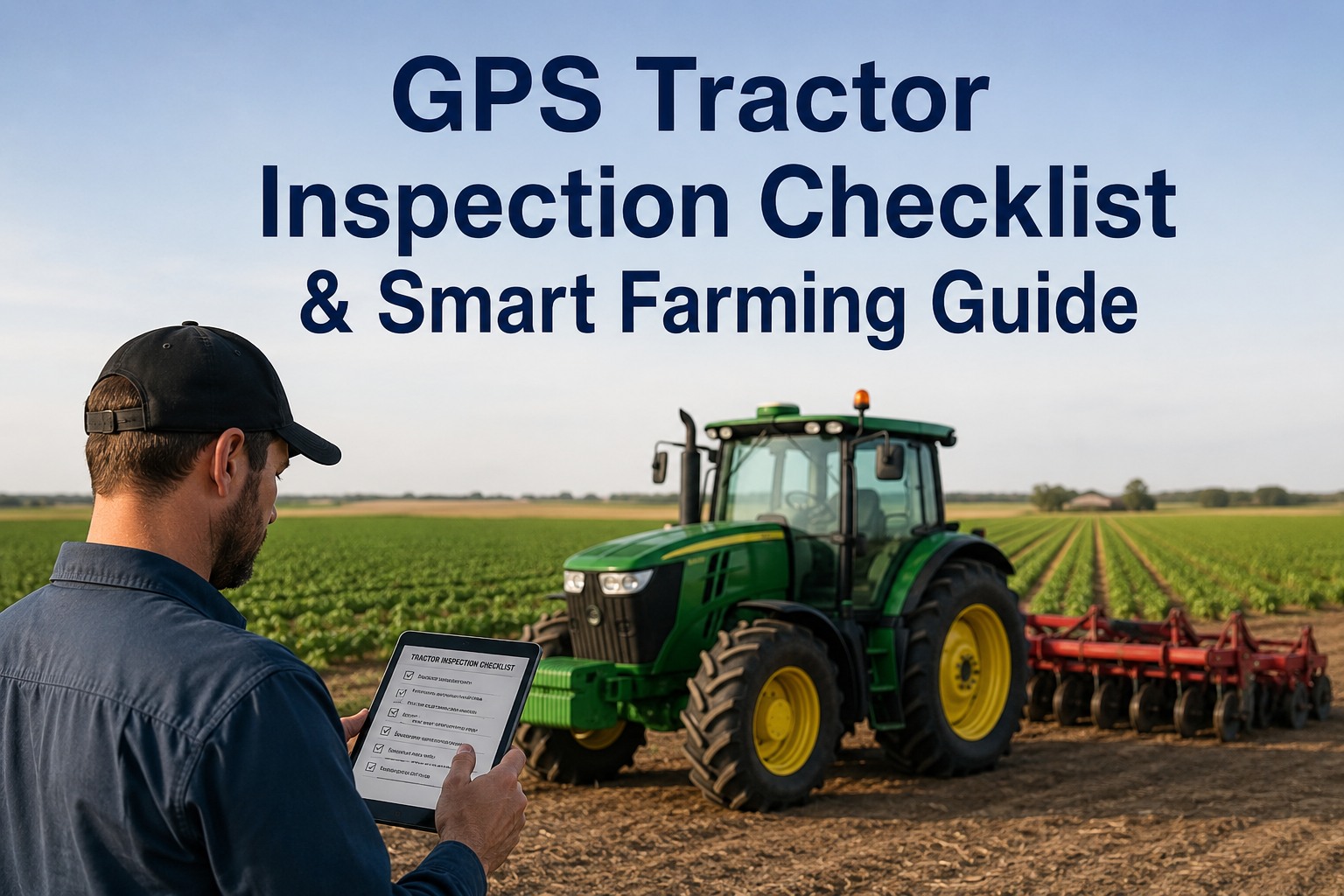
A GPS-guided tractor is really two machines in one. Underneath is the conventional tractor — engine, hydraulics, tyres, the mechanical systems any pre-season check covers. On top sits a precision-guidance stack — GNSS antenna, RTK correction link, steering actuator, and control console — that most inspection routines completely ignore. That gap matters, because the value of precision ag lives in that second layer: RTK-corrected auto-steer holds a tractor to roughly ±2.5 cm, and studies have measured around 6% fuel and machine-time savings plus up to 15% less input overlap on guided farms. When a loose antenna mount, a drifting calibration, or a stale firmware build quietly degrades that accuracy, the tractor still runs — it just stops paying for itself, and no one notices until the rows don't line up. This 2026 guide covers both layers: the conventional tractor walkaround and the GPS-specific checks that keep guidance accurate, plus how digital inspection ties it all together. Pair it with HVI inspection and maintenance software to run both layers on a phone, schedule calibration and firmware checks, and keep a history per machine. Always follow your guidance system and tractor manuals for model-specific steps.
The Two Inspection Layers
Every GPS tractor needs both layers checked. The mechanical layer keeps it running; the precision layer keeps it earning. Skip the second and a perfectly healthy tractor slowly drifts off the money-saving lines it was bought for.
The Conventional Tractor
Engine, fluids, hydraulics, tyres, brakes, belts, lights, and PTO — the mechanical walkaround any tractor needs before work. If the machine can't run reliably, the smartest guidance in the world is useless.
The Precision-Guidance Stack
GNSS antenna and receiver, RTK correction link, steering actuator, IMU/terrain compensation, and the control console. The layer that delivers ±2.5 cm accuracy — and the one almost no paper checklist covers.
Layer 1: The Conventional Walkaround
Before guidance ever matters, the base machine has to be field-ready. The core pre-use checks, fast and familiar.
Engine & Fluids
Check oil, coolant, hydraulic, and fuel levels and condition; service or confirm filters. Scan for leaks and listen for rough idle before heading out.
Tyres, Brakes & Steering
Inspect tyre pressure and wear, brake response, and steering play — the mechanical steering must be sound before auto-steer can sit on top of it.
Belts, Hydraulics & PTO
Check belts for wear, hydraulic lines for leaks, and PTO shields and operation. Hydraulic health matters doubly on hydraulic-actuated steering systems.
Lights, Guards & Hours
Test lights and safety guards, and log the engine-hour reading — the trigger for usage-based preventive maintenance on the base machine.
Layer 2: The Precision-Guidance Checklist
This is the layer that pays for itself — and the one that needs its own dedicated inspection. Each component below directly affects whether the tractor holds its line.
GNSS Antenna & Receiver
Inspect the antenna monthly for damage, obstruction, or dirt, and confirm it's mounted securely on centerline — a loose or shifted antenna corrupts every position. Watch for multipath or signal dropout near buildings, which signals an antenna placement or EMI problem. This is the single highest-impact precision check.
RTK Correction Link
Verify the correction source — base station, CORS/NTRIP, or radio — connects and holds a fix. Check correction age and that the link doesn't drop to float when working far from base.
Steering Actuator & Feedback
Check the wheel motor or hydraulic actuator for free movement to full lock without hitting stops, secure bracket mounts, and tight mechanicals — backlash and loose mounts cause line weaving.
Console, IMU & Firmware
Confirm the control console reads clearly, terrain-compensation/IMU is functioning, and firmware and software are current — updates maintain accuracy, compatibility, and security.
Cabling & Connectors
Inspect cable strain relief, harnesses, and connectors for chafing or corrosion, and reseal enclosures. Vibration and moisture are the quiet killers of guidance reliability.
Calibration & Implement Offsets
Recalibrate steering and re-check implement offsets seasonally or after any repair. A correct offset is what keeps the implement — not just the tractor — on the line.
The Calibration & Field-Verification Loop
Calibration isn't a one-time setup — it's a loop run seasonally and after repairs to confirm the system still holds its line. Four quick stages.
Zero & Configure
Set straight-ahead zero, confirm GNSS receiver config and vehicle/implement measurements, and change one parameter at a time, documenting each.
Straight-Line Test
At low speed, engage auto-steer and verify it holds the line without weaving. Persistent oscillation usually means loose mechanicals or gains set too high.
Step Response
Introduce a small offset and watch the tractor correct smoothly back to line — no snap, no delayed swing. Tune aggressiveness until the response is clean.
Headland & Safety
Confirm disengage is immediate and predictable at the headland. Never rely on auto-steer near people or obstacles — keep hands near the e-stop.
Why the Precision Layer Pays Back
Keeping the guidance stack inspected isn't busywork — it protects the exact returns precision ag was bought to deliver.
Less Fuel & Time
Guided farms have measured around 6% fuel and machine-time savings — but only while the system steers accurately. Drift erodes the saving silently.
Less Overlap & Waste
Precise lines cut input overlap by up to 15%, saving seed, fertilizer, and chemical. A degraded antenna or calibration puts that overlap right back.
Consistent Repeatability
RTK's real value is returning to the same line season after season for controlled-traffic farming — which depends entirely on stable, calibrated hardware.
Less Operator Fatigue
Reliable auto-steer lets operators work longer with less error, even in fog or dusk — but only when disengage and safety behavior are verified.
Paper Walkaround vs. HVI
Two layers, two schedules, calibration loops, and firmware tracking across a guided fleet — exactly the work a digital inspection system was built to carry.
PAPER OR MEMORY
HVI INSPECTION SOFTWARE
Inspect the Whole Smart Tractor — Both Layers
HVI gives precision-ag farms one guided inspection covering the conventional tractor and the GPS-guidance stack — engine, hydraulics, and tyres alongside antenna, RTK link, actuator, console, and calibration — with photo-flagged defects, hour-based PM, seasonal calibration scheduling, and a full history per machine. Keep the tractor running and the guidance earning. Trusted by 25,000+ users worldwide.
.png)