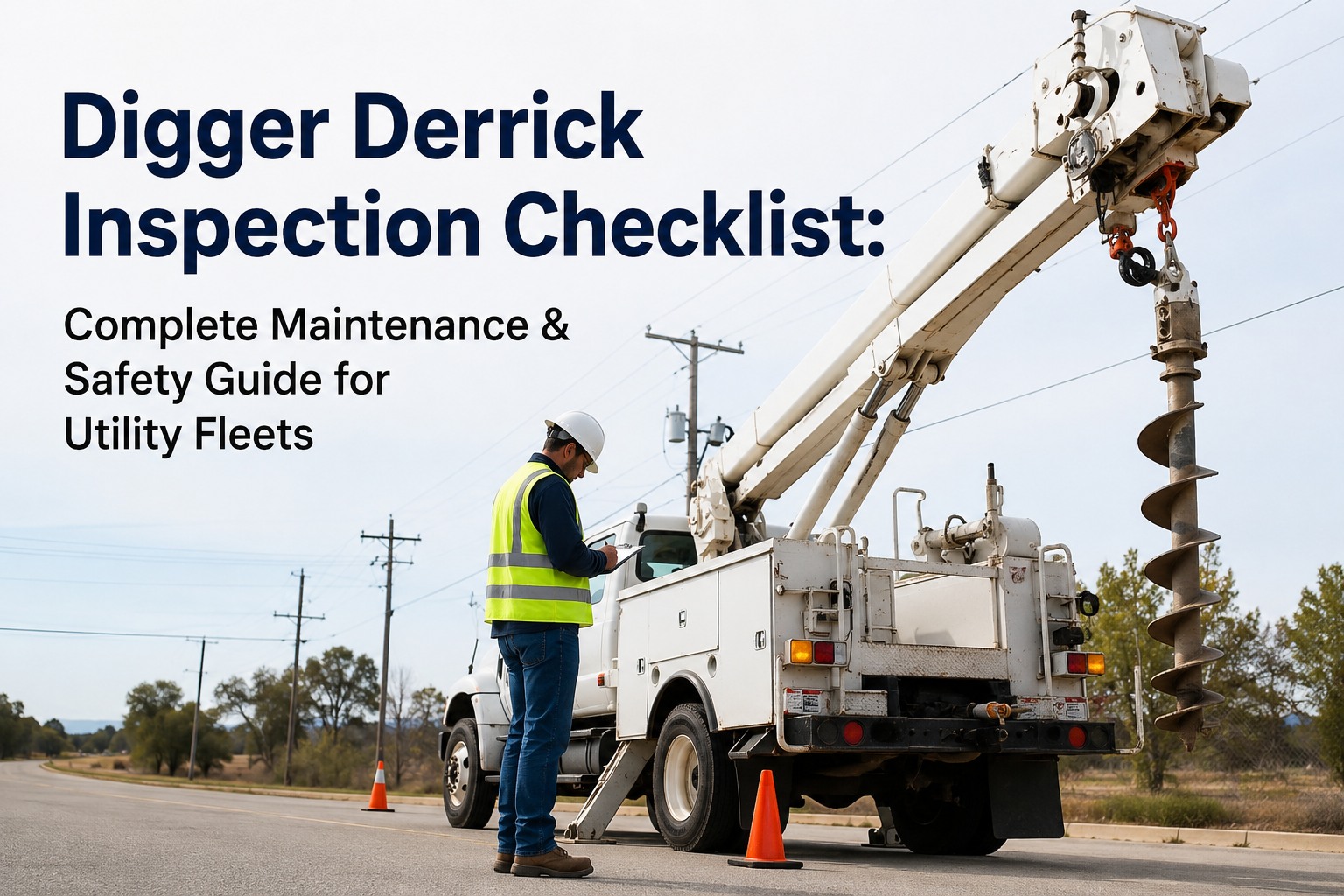
A digger derrick is one of the most demanding machines in a utility fleet — it digs pole holes, hoists poles into place, lifts loads on a winch, and on insulated units puts a worker near energized conductors. That combination means an inspection lapse isn't just a breakdown risk; it's an electrocution and structural-failure risk. The governing standard, ANSI/ASSP A10.31, makes the owner and user responsible for inspections by a qualified person, with records retained for five years and a daily pre-shift check before every use. Insulated units add a hard rule: at minimum a daily inspection and an annual dielectric test of all fiberglass components are necessary to maintain insulation integrity. This guide walks the complete inspection — component by component, daily through annual — so every digger derrick stays reliable, compliant, and safe. Pair it with HVI inspection and maintenance software to run the checklist on a phone, track every interval, and keep the five-year record audits demand. Always follow your manufacturer's manual for model-specific items.
Three Tiers of Inspection
A digger derrick is inspected on three cadences under ANSI A10.31 and manufacturer guidance. Each tier goes deeper than the last — and each carries its own documentation rule.
Daily Pre-Shift
A visual walkaround before every use: fluids, controls, load line, rigging, tires, and outriggers. Need not be documented unless a hazard is found — then the issue and its correction must be kept for five years.
Periodic / Frequent
Deeper checks at intervals set by the manufacturer's manual — wear points, hydraulics, fasteners, and safety devices. Records must be documented and retained for five years.
Annual + Dielectric
A full inspection by a qualified person (typically 3-6 hours), with annual dielectric testing of all fiberglass on insulated units. A placard showing the test date must be displayed on the equipment.
The Component-by-Component Checklist
This is the heart of the inspection — the systems a qualified inspector works through on every digger derrick. Use it as your build template, then tailor to your manufacturer's manual.
Boom & Structure
Inspect boom sections, pins, and the chassis for cracks, gouges, dents, or deformation. Pay special attention to high-stress wear points and the boom-tip, which must always be treated as conductive.
Winch & Load Line
Inspect the load line daily for damage; keep it clean and dry. During the annual, unspool the full winch rope and check hand-over-hand for cuts, frays, flat spots, or lumps from shock loading. Keep at least 4 wraps on the drum.
Outriggers & Stability
Check outrigger operation, pads, and the interlock that prevents boom motion until outriggers are deployed. Confirm slope/level indicators are present and the stability system is intact.
Hydraulic System
Check hoses, fittings, and cylinders for leaks and wear, and verify fluid level and filter condition. Check level with outriggers stowed to avoid overfilling — a neglected low level can mean a $2,000 pump repair.
Auger / Digger
Inspect the auger, teeth, and digger drive for wear and damage; confirm it stores at its shortest length and stows fully when personnel are in the platform. Check the digger shake and auger release functions.
Dielectric / Fiberglass
On insulated units, inspect all fiberglass for contamination, moisture, cracks, or damage daily, and dielectrically test annually. Dirty or damaged fiberglass becomes conductive — this is the line crew's life-safety barrier.
Controls & Safety Devices
Test upper and lower controls, anti-two-block, load moment limiter, motion alarm, and the outrigger/boom interlock. Confirm load charts, hand-signal chart, and all placards are present and legible.
Fasteners & Vehicle
Torque-check critical fasteners, inspect tires and brakes, and confirm the DOT chassis is road-ready. Grease all pivot points per the manufacturer's lubrication schedule.
The Dielectric Rule You Can't Skip
For insulated digger derricks, the fiberglass boom is secondary insulation — the last barrier if primary protection (gloves, hot sticks) fails. That makes a handful of rules non-negotiable.
Test Annually, Minimum
Dielectric testing of all fiberglass components at least every 12 months — best scheduled alongside the annual inspection — with a placard showing the test date displayed on the unit.
Keep It Clean & Dry
Contamination, moisture, or dirt makes fiberglass conductive. Inspect daily and never operate near energized conductors with damaged or dirty insulating components.
The Boom-Tip Is Conductive
Boom-tips contain metal and can track current, so they must always be treated as conductive — insulation protects below the tip, never at it.
Document & Retain
The dielectric test record must be provided to and retained by the owner — and a documented program is also your evidence of due care if a contact incident is ever investigated.
Paper Checklist vs. HVI
Three inspection tiers, eight component areas, a five-year retention rule, and a dielectric placard to track per unit — this is precisely the workload digital inspections were built for.
PAPER OR CLIPBOARD
HVI INSPECTION SOFTWARE
Run Every Digger Derrick Inspection in One System
HVI gives utility fleets guided daily, periodic, and annual checklists for digger derricks, automated tracking for dielectric and ANSI A10.31 intervals, defect-to-work-order routing, and a five-year record retained per asset and retrievable on demand. Keep every unit safe, compliant, and field-ready. Trusted by 25,000+ users worldwide.


.png)