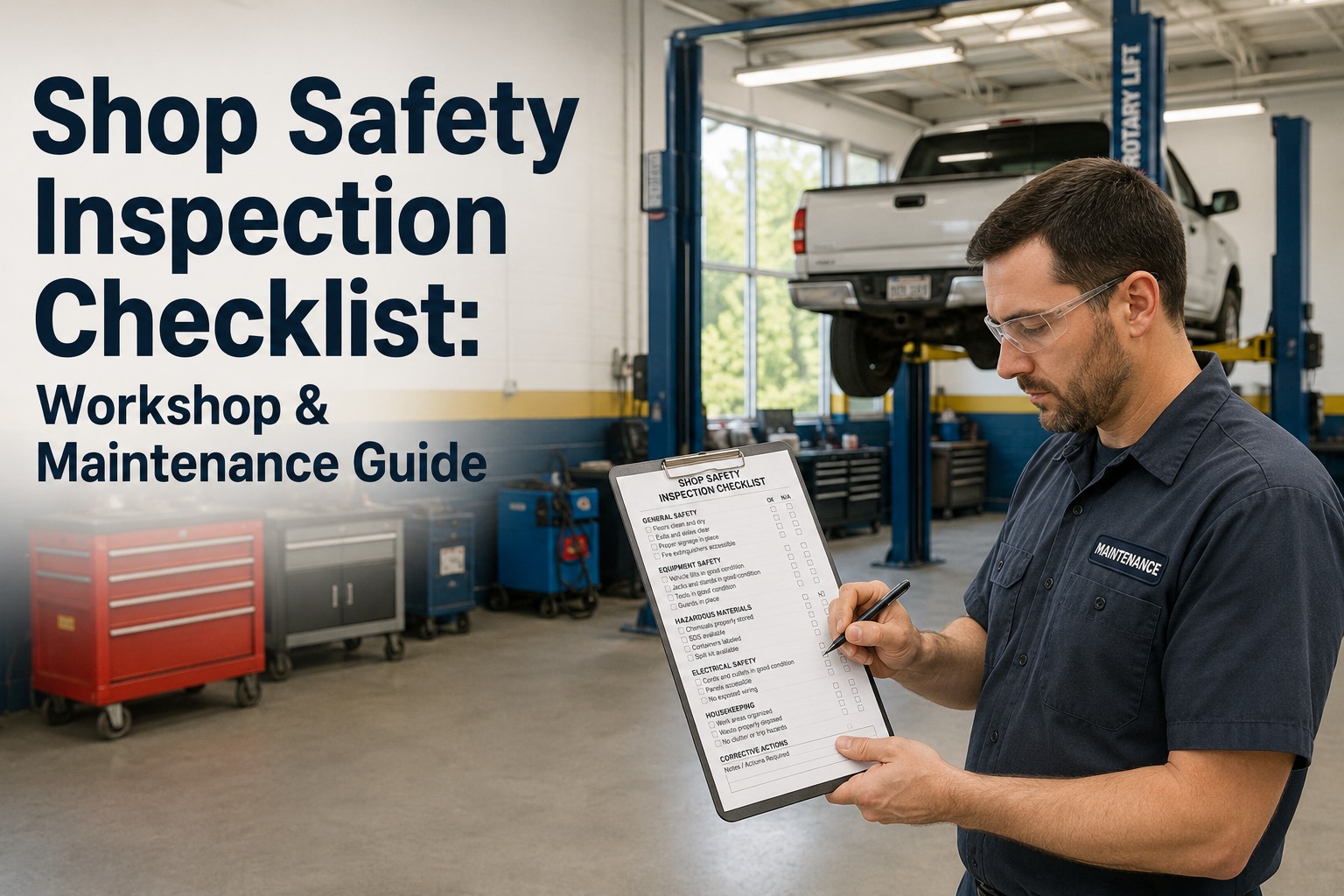
A shop safety inspection checklist that treats a workshop as one general walkaround misses the point. The floor has 7 distinct hazard zones — vehicle lifts, jacks & stands, welding/hot work, chemicals, electrical, housekeeping, and emergency equipment — each with its own inspection focus, its own frequency, and its own corrective-action path. Combined into one checklist, one zone always ends up under-inspected. This shop safety inspection checklist walks each zone with the right cadence and corrective flow — book a demo to digitize workshop safety inspections in HVI.
Workshop Safety Isn't One Walkaround. It's Seven.
Each hazard zone has its own inspection focus and corrective actions. A single generic checklist collapses them into one place where one always drifts.
7 zones · live status per zone · 13 open corrective actions with due dates · one dashboard. That's what a workshop safety programme looks like when it's actually running.
The rest of this page walks each of the 7 zones with the specific inspection points, applicable standards, and the corrective-action flow that turns findings from observations into closed work. Book a 30-minute demo to see per-zone workshop safety templates in HVI.
Zone 1 & 2 — Vehicle lifts, hoists, jacks and stands
Vehicle lifts are the most consequence-heavy asset in most workshops — a lift failure with a vehicle overhead is life-changing. In North America, ANSI/ALI ALOIM:2020 is the governing standard; OSHA enforces via the General Duty Clause and NTTAA 1996 rather than direct regulation. In the UK, PUWER 1998 Regulation 6 applies. Three cadences apply to every vehicle lift regardless of jurisdiction: daily pre-use, monthly checks, and annual qualified-inspector certification.
Pre-use lift check
- Mechanical safety lock function test (raise / drop / catch)
- Visual for hydraulic leaks under cylinders, hoses, fittings
- Controls respond correctly, no sticking
- No visible structural damage since last use
- Capacity label legible and matches vehicle
Structural check
- Anchor bolt torque verified per manufacturer spec
- Concrete around anchors: no cracks or spalling
- Columns straight, no bending, welds intact
- Arms, adapters, pads: no cracks, wear at contact points
- Equalizer cables/chains: no broken strands, correct tension
Qualified inspector
- ALI-certified lift inspector (North America) or PUWER-competent (UK)
- Full ANSI/ALI ALOIM 30+ point inspection
- Written certification report retained
- Gold Label maintenance where applicable
- Any structural defect = permanent out-of-service
Jacks & stands rule
- Jacks raise. Stands support. Never reverse.
- Jack capacity rating stamped and legible
- Stand capacity per jack (2-stand minimum on axle)
- Stands placed on frame or manufacturer lift points only
- Never work under a vehicle on a jack alone — ever
The rule that comes up most often in fatal-incident investigations: technicians working under a vehicle supported only by a floor jack, not on stands. A hydraulic jack is a lifting device, not a support device. Every workshop safety checklist must reinforce this distinction, and every technician must be trained on it. Book a demo to see per-lift inspection schedules with photo evidence in HVI.
Zone 3 & 4 — Welding, hot work, chemicals and hazardous substances
Welding, cutting, grinding, and other hot work create ignition sources that in a workshop full of hydrocarbons, oxygen cylinders, and combustible waste can escalate into serious fires within seconds. Chemical storage failures don't produce the same immediate consequence but produce the largest volume of long-term reportable incidents (spills, exposures, environmental non-compliance).
| Hazard | Standard reference | Key inspection points |
|---|---|---|
| Hot work permit | OSHA 29 CFR 1910.252 / NFPA 51B | Written permit issued per job; fire watch designated; extinguisher within reach |
| Welding screens | ANSI Z49.1 / OSHA 1910.252 | Screens or curtains prevent arc-flash exposure to others; positioned per work area |
| Ventilation | OSHA 1910.252(c) / HSE COSHH | LEV (local exhaust) operational; general ventilation adequate for confined space work |
| Cylinder storage | OSHA 1910.253 / BCGA CP44 (UK) | Upright, chained, capped when not in use; oxygen separated from fuel gas >20ft or 30-min firewall |
| Fire extinguisher | NFPA 10 / BS EN 3 | Monthly visual, annual professional service; correct class for hazard (ABC / CO2 / D) |
| Chemical SDS access | OSHA HazCom / UK CLP | Current SDS on file for every hazardous substance; accessible to workers on shift |
| Container labelling | OSHA HazCom / UK CLP | Original labels intact or GHS-compliant replacements; secondary containers labelled |
| Spill containment | EPA SPCC / UK EA | Secondary containment for >55gal drums; spill kit accessible; absorbents in date |
| Eyewash / safety shower | ANSI Z358.1 | Within 10 seconds of chemical hazard; 15-min flow rate; weekly activation test |
Two operational rules that reduce hot-work incidents by the largest margin. First, the permit is not paperwork — it forces the pre-work risk assessment (nearby combustibles, ventilation adequate, fire watch designated, cylinders positioned correctly) that stops most incidents before they start. Second, the fire watch continues for **30 minutes after** hot work completes, because smouldering ignition sources routinely take that long to flare. A worker walking away at the moment the torch shuts off is where welding fires escalate most often. Book a demo to see hot-work permit and chemical-storage inspections in HVI.
Zone 5, 6 & 7 — Electrical, housekeeping, and emergency equipment
The three remaining zones share a common characteristic: each generates a large volume of small findings that individually seem trivial, and collectively cause more workshop injuries than lifts and welding combined. A trailing extension lead trips a technician carrying a battery. A blocked emergency exit costs seconds in an evacuation. An extinguisher three years out of service fails to discharge when needed. Frequency, not severity, is the story in these zones.
Electrical safety
Portable tools inspected before use; extension leads not chained or overloaded; plugs and cables not damaged; PAT testing current (UK); GFCI protection in wet areas (US); electrical panels clear 36" access; isolation locks used for maintenance.
Housekeeping
Oil and coolant spills cleaned immediately; compressed air hoses stowed; trailing cables covered or elevated; waste bins not overflowing; walkways and bay access clear; drip trays under vehicles; parts and tools returned to stores.
Fire & extinguishers
Extinguishers monthly visual (pin, seal, pressure gauge, no damage); annual professional service per NFPA 10 / BS 5306; correct class for zone hazard; unobstructed access; signage current.
Emergency equipment
Emergency exits unlocked and unblocked; emergency lighting tested monthly; first-aid kit stocked and in-date; eyewash weekly activation; assembly point signposted; evacuation plan posted.
The distinguishing feature of a well-run workshop safety programme in these three zones is that findings become corrective actions with names and due dates, not observations on a clipboard. A finding without an assigned responsible person and a due date is not a corrective action — it's a note. Workshop safety software exists to enforce the transition from observation to closed action. Start a free HVI trial to convert your workshop findings into tracked corrective actions.
From observation to closed corrective action — the four-step flow that separates a real programme from a compliance theatre
A finding without a name, date, and photo is not a corrective action
The single largest failure mode in workshop safety inspections is the confusion between recording an observation and creating a corrective action. A weekly walkaround that produces "cracked extinguisher tag, missing eyewash test log, broken cover on socket outlet by Bay 3" as notes on a clipboard is not a safety programme — it's a paper record that things were seen. What matters is what happens after the observation, and the discipline that separates a real programme from compliance theatre runs on four stages. First, classification: every finding is classified by severity (critical / major / minor) and by hazard zone. Critical findings (unsafe lift, missing extinguisher in a hot-work area, blocked emergency exit) require immediate action; major findings require repair within a defined timescale; minor findings enter the normal workshop maintenance queue. Second, assignment: every finding is assigned to a named responsible person by role — not "the shop manager" as an abstraction, but a specific person accountable for closing it. Second-tier findings can be assigned to a technician, a shift lead, a maintenance contractor, or the site's H&S coordinator, but the assignment has to be one person with authority to close the finding. Third, due date and evidence requirement: every finding has a specific due date (not "ASAP") tied to its severity, and the closure requires photo or documentary evidence — a repaired extinguisher photo with new tag date, a functional eyewash test log, a replaced socket cover. Fourth, verification and closure: the responsible person's evidence is verified by someone other than themselves (H&S coordinator, supervisor, or site manager depending on severity), and only then does the finding move to closed status. A closed finding without evidence is an open finding pretending to be closed, and this is exactly what an OSHA CSHO or HSE inspector uncovers within the first hour of a serious audit. The whole reason digital workshop safety systems exist is to enforce the transition from observation to verified-closed corrective action, and to make the whole life-cycle auditable per finding.
A workshop manager on the shift from paper walkarounds to zone-based digital inspections
We run a mixed workshop — heavy fleet maintenance, some welding fabrication, chemical stores for cleaning solvents and coolant. About 22 technicians across two shifts. Paper walkarounds every week for years, filed in the office. When our insurer conducted a workshop audit in early 2024, they pulled findings from the last 18 months of walkarounds against actual repair records — and the gap was ugly. Roughly 40% of findings from paper walkarounds had no closure record. Not because the work wasn't done, but because the paper trail collapsed between the finding and the fix.
Digital zone-based inspections changed the culture more than I expected. Every finding now has a name, a photo, a due date, and closure evidence. The 7-zone dashboard shows me open counts per zone at any moment. Insurance renewal in April 2026 came in 14% lower than the prior year, largely on the strength of the audit trail. Corrective action close rate is now above 95% inside due date. The visible pass-rate scorecard by zone drives friendly competition between shifts to keep the numbers up.
Frequently asked questions
How often should a workshop safety inspection be performed?
Frequency depends on the hazard zone, not on the workshop as a whole. Different zones require different cadences based on hazard severity and consequence. Vehicle lifts and hoists: daily pre-use check (mechanical lock function test, visual for hydraulic leaks), monthly structural check (anchor bolt torque, column condition, cables), annual qualified-inspector certification per ANSI/ALI ALOIM:2020 (North America) or PUWER 1998 Regulation 6 (UK). Jacks and jack stands: pre-use check before every use. Welding and hot work: per-permit inspection, plus 30-minute fire watch after work completes. Chemical storage: weekly walkthrough covering SDS access, container condition, labelling, spill containment, eyewash function. Electrical safety: monthly visual on portable tools and extension leads, annual detailed test (PAT in UK, GFCI check in US). Housekeeping: daily walkthrough covering spills, walkways, waste, trailing cables. Fire extinguishers: monthly visual (NFPA 10 / BS 5306), annual professional service. Emergency equipment: monthly (emergency lighting, exit clearance, first-aid kit stock), weekly eyewash activation. Treating the workshop as one weekly walkaround guarantees one zone drifts.
What are OSHA's requirements for vehicle lifts and hoists?
OSHA has no direct regulations specifically for vehicle lifts, but enforces safety through the General Duty Clause and by referencing ANSI/ALI ALOIM under the National Technology Transfer and Advancement Act 1996. The current governing standard is ANSI/ALI ALOIM:2020 (Safety Requirements for Operation, Inspection and Maintenance), effective January 1, 2021, applying to all vehicle lifts regardless of type, age, or manufacturer. ALOIM requires: daily pre-use inspection by the operator (mechanical lock function test, hydraulic leak visual, controls); periodic in-house maintenance per manufacturer schedule (typically monthly structural check including anchor bolt torque, column condition, cables, arms); annual inspection by a qualified lift inspector, ideally ALI-certified, with written certification report retained. OSHA also requires electrical compliance under UL 201 for garage equipment. In the UK, PUWER 1998 Regulation 6 applies to vehicle lifts as work equipment, with inspection intervals set by risk assessment and typically an annual thorough examination by a competent person. Structural damage (cracks in columns, broken welds, bent arms) cannot be repaired safely and requires the lift to be taken out of service permanently. OSHA penalties can reach $13,653 per serious violation in 2026.
What is the difference between a jack and a jack stand?
A jack is a lifting device; a jack stand is a support device. This is the single most consequential distinction in workshop safety and gets confused most often. A hydraulic jack (bottle jack, floor jack, trolley jack) is designed and rated to raise a vehicle to working height. It is not designed to support the vehicle for any duration — hydraulic seals fail, valves leak down, and a vehicle supported on a jack alone can drop without warning. A jack stand (axle stand) is designed and rated specifically to support the vehicle at a set height once it has been raised. Stands are placed on the vehicle's frame or on manufacturer-designated lift points, sized to the load, and typically used in pairs (two stands minimum per axle). The workshop safety rule that follows: raise the vehicle with a jack, place stands, lower the vehicle onto the stands, remove or slacken the jack. Never, under any circumstances, work under a vehicle supported only by a jack. Technicians killed by falling vehicles almost always died working under a vehicle on a jack alone rather than on stands. The rule is absolute: jacks raise, stands support, never reverse.
What should be on a hot-work permit for a workshop?
A hot-work permit under OSHA 29 CFR 1910.252, NFPA 51B, or equivalent UK/AU requirements documents the pre-work risk assessment and controls that prevent welding, cutting, grinding, or other hot-work operations from causing fires. Every permit should identify: the specific job and hot-work method (arc welding, oxy-fuel cutting, grinding, torch soldering); exact location within the workshop; date and time window covered; person responsible (welder/operator); designated fire watch (separate person, with extinguisher, present throughout); pre-work checks completed (combustibles removed within 35ft or protected by fire-resistant covers, floor swept clear, cylinder storage checked, ventilation adequate, extinguisher class and location, first-aid access); PPE required (welding helmet, gloves, apron, respirator if needed); permit expiry (typically single shift maximum); post-work fire watch duration (minimum 30 minutes, longer for confined spaces). The permit must be closed after the fire watch confirms no smouldering ignition source remains. The most common cause of workshop welding fires is not the welding itself but a fire watch ending too early after the work completes. Cylinders must be stored upright, chained, capped when not in use, with oxygen separated from fuel gas by 20ft or a 30-minute firewall.
How do I turn workshop safety findings into corrective actions?
Four stages separate a real corrective action from a note on a clipboard. First, classification: every finding is classified by severity (critical, major, minor) and by hazard zone. Critical findings (unsafe lift, missing extinguisher in a hot-work area, blocked emergency exit) require immediate action; major findings require repair within a defined timescale (typically 7-30 days depending on severity); minor findings enter the normal workshop maintenance queue. Second, assignment: every finding is assigned to a named responsible person with authority to close it — not "the shop" as an abstraction, but a specific technician, shift lead, contractor, or H&S coordinator. Third, due date and evidence requirement: every finding has a specific due date tied to its severity (not "ASAP"), and closure requires photo or documentary evidence — a repaired extinguisher photo with new tag date, functional eyewash test log, replaced socket cover. Fourth, verification and closure: the responsible person's evidence is verified by someone other than themselves (H&S coordinator, supervisor, or manager depending on severity), and only then does the finding move to closed status. A closed finding without evidence is an open finding pretending to be closed — and this is exactly what an OSHA CSHO or HSE inspector uncovers within the first hour of a serious audit.
Every workshop zone. Every finding closed. Every audit clean.
HVI holds workshop safety inspections per hazard zone with the right cadence, converts every finding to a corrective action with responsible person, due date, and photo evidence, tracks vehicle lift inspection schedules per asset, and produces the audit trail your safety manager, insurer, OSHA CSHO, or HSE inspector actually asks for. Live scorecard shows pass rate and open actions per zone at any moment. Live in under two weeks. No hardware. No credit card.
Trusted by fleet, industrial, and mechanical workshops across USA, Canada, UK & Australia · Ready on day one