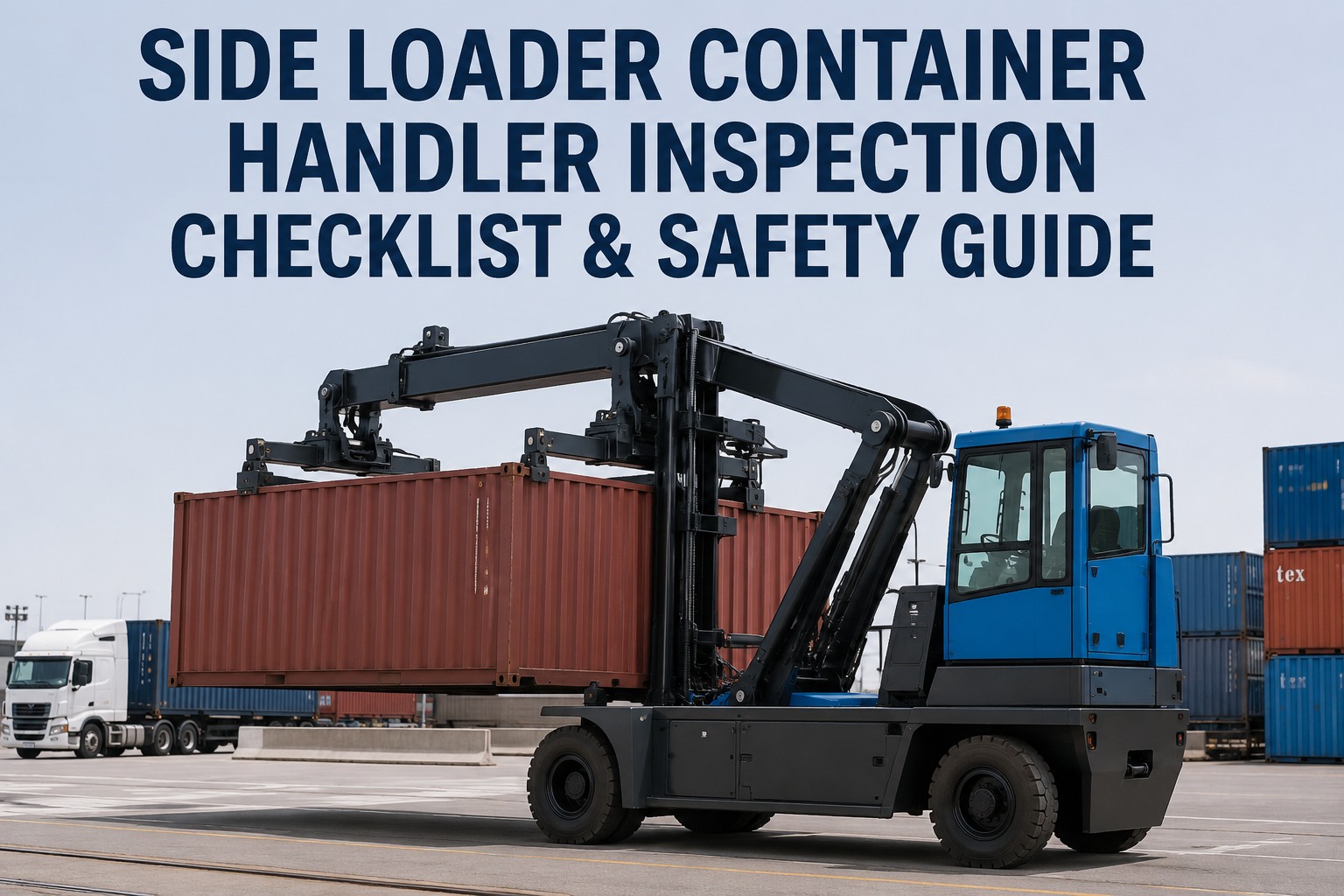
A side loader — a Hammar, Steelbro, Boxloader, or TITAN sidelifter — is a self-loading trailer that lifts and places a fully loaded shipping container weighing up to 72,000 lbs using two hydraulic cranes, four chains, and four ground contact points, with no external crane needed. That capability is also its risk: the entire load hangs from lifting chains, twist-lock connections, and hydraulic rams, and a single failed link, a cracked weld on a stabilizer, or a slow-creeping ram under load can drop a 30-tonne box in a busy yard. Under lifting-equipment regulations like LOLER, a competent person must thoroughly examine lifting equipment at set intervals — but the daily pre-operation check done by the operator is what keeps the machine safe between those formal exams. This checklist covers every system on a side loader container handler — lifting cranes, chains and twist locks, stabilizer legs, hydraulics, chassis, brakes, tires, and emergency safety devices — organized as a pre-shift walkaround you can actually follow. HVI's inspection & maintenance software runs that whole walkaround on a phone or tablet, turns every failed check into a maintenance work order, and tracks examination intervals per asset so nothing lapses. Book a 30-minute walkthrough to see it set up for your side loader fleet.
The whole load hangs from four chains and four twist locks. Inspect them before every lift — not after one drops.
HVI inspection & maintenance software puts the full side loader checklist on every operator's phone — lifting crane, chains, twist locks, stabilizers, hydraulics, chassis, brakes, tires, and safety devices. Defects trigger maintenance work orders automatically, examination intervals are tracked per asset, and the whole thing runs fully offline in the yard with a complete compliance audit trail.
Why a side loader needs its own checklist
A side loader is two machines in one: a road-going trailer and a mobile lifting crane. A generic vehicle inspection covers the trailer half and completely misses the lifting half — which is exactly the half that drops loads and hurts people. The checklist below is built around the lift.
The load is suspended
Up to 72,000 lbs hangs from chains and twist locks during every lift. A worn link or a cracked corner casting is a dropped container — there is no margin to inspect it later.
Hydraulics drive everything
Cranes, stabilizers, and slew all run on hydraulic rams. A leaking seal, a chafed hose, or a ram that creeps under load turns a controlled lift into a sudden drop.
Stability is everything
Outriggers must be fully extended, level, and on firm ground before any lift. Soft ground or a container loaded outside the stabilizer footprint is how side loaders tip over.
Safety devices are mandatory
Dual emergency stops, overload protection, and load-moment limiters must be tested for function, not just looked at. A device that fails silently isn't protecting anyone.
Regulations like LOLER require a thorough examination by a competent person every 6 to 12 months — but that's the legal backstop, not the daily safeguard. The pre-operation check below is what catches a fault before it ever reaches the formal exam, and it's the operator's responsibility on every shift.
The pre-operation inspection checklist
Work the machine in zones, ground-up and front-to-back, so nothing gets skipped. Each section below is a stage of the walkaround — tick every line before the first lift of the shift.
Lifting cranes & booms
The two hydraulic arms that carry the entire load.
- Boom structure free of cracks, dents, bends, or weld failures
- Telescopic sections slide smoothly with no binding or scoring
- Slew/rotation mechanism operates without grinding or play
- Crane rails and rollers clean, greased, and undamaged
- Cranes slide freely along chassis to set lift position
- All pivot pins and retaining clips present and secure
- Grease points serviced; no dry or seized joints
Lifting chains & twist locks
The single most safety-critical zone — the load attaches here.
- Chain links free of stretch, wear, nicks, gouges, or corrosion
- No elongated or distorted links (measure against original pitch)
- Twist locks engage and lock fully into container corner castings
- Corner-casting fit checked — no cracks or wallowing
- Hooks and connectors undamaged with working safety latches
- Chain shorteners (if fitted) functioning and secured
- SWL markings legible; current examination certificate valid
Stabilizer legs & outriggers
What stops a loaded lift from tipping the trailer.
- Outrigger legs extend and retract fully without sticking
- Stabilizer feet/pads present, undamaged, and seated flat
- No hydraulic leaks at outrigger cylinders or hoses
- Support plates available for soft or yielding ground
- Legs hold position under load — no drift or settling
- Ground surface firm, level, and within grade limits
Hydraulic system
The power behind every crane, slew, and outrigger movement.
- Oil level correct; no contamination or milky appearance
- Hoses free of chafing, cracking, bulging, or heat damage
- No leaks at cylinders, fittings, valve block, or pump
- Ram seals hold — no creep or slow descent under load
- PTO or standalone engine drives pump at correct pressure
- Filters within service life; no warning indicators showing
Chassis, brakes & tires
The road-going half — still load-bearing during the lift.
- Chassis frame, crossmembers, and welds free of cracks
- Suspension and axles sound; no leaks or broken components
- Brakes test firm; air system holds with no audible leaks
- Tires within tread limits; no cuts, bulges, or low pressure
- Wheel nuts torqued; no missing studs or indicator movement
- Lights, reflectors, and electrical connectors all working
Safety & control devices
Functionally tested, not just glanced at.
- Both emergency stops (panel + remote) cut all movement
- Overload and load-moment limiters trigger correctly
- Side-mounted and remote controls respond accurately
- Warning labels, decals, and signage present and legible
- Operator has clear sightline to the full lifting zone
- Remote-control battery charged; power isolation works
Six zones, around forty checkpoints, done on every shift across a whole fleet — paper forms get rushed, skipped, or filed and forgotten the moment a yard gets busy. sign up free and run this checklist in HVI's inspection & maintenance software, or book a demo to see defect photos auto-raise maintenance work orders.
Inspection & examination intervals
A side loader sits under two layers of checks: the operator's pre-use inspection on every shift, and the competent-person thorough examination on a fixed legal cycle. Both are required — one keeps it safe day to day, the other is the backstop.
Pre-operation check
The full walkaround above, done by the operator before the first lift. Visual and functional — catches the obvious faults that cause same-day incidents.
Lifting accessories exam
Chains, twist locks, hooks, and shackles are lifting accessories — they require thorough examination at least every 6 months, regardless of the trailer's cycle.
Thorough examination
The crane, structure, hydraulics, and safety devices get a full competent-person thorough examination at least every 12 months, with a written report.
Exceptional re-exam
Any major repair, modification, overload, or contact with power lines triggers an immediate re-examination before the machine returns to service.
A defect that poses a risk means the machine comes out of service until it's repaired and re-examined — no exceptions. Missing or expired examination paperwork is itself a defect, even if the machine looks perfect. HVI inspection & maintenance software tracks every interval per asset, schedules the recurring exams, and flags an expiring certificate before it lapses.
Paper checklist vs. HVI inspection & maintenance software
Both record the same checks. Only one makes them impossible to skip, photographs every defect, raises a maintenance work order on the spot, and keeps an audit trail a regulator will accept.
Paper / clipboard
- Checks rushed or pencil-whipped on busy shifts
- No proof a chain or twist lock was actually inspected
- Defects noted on paper, then lost before repair
- Examination certificate dates tracked in a spreadsheet
- No photo evidence when something is flagged
- Audit trail is a binder no one can find
With HVI software
- Every checkpoint must be answered before sign-off
- Mandatory photo capture on any defect found
- Failed items auto-raise a maintenance work order
- PM and examination intervals scheduled per asset
- Timestamped digital records ready for any audit
- Works fully offline in the yard, syncs when back online
Stop inspecting a 72,000 lb lift on a clipboard.
HVI inspection & maintenance software puts the full checklist on every operator's phone — mandatory photos, instant maintenance work orders, scheduled PM, and an examination-interval tracker that never lets a certificate lapse.
Frequently asked questions
What should a side loader pre-operation inspection cover?
A complete side loader (sidelifter) pre-operation inspection works in zones, ground-up and front-to-back: the lifting cranes and booms (cracks, telescopic action, slew, rails); the lifting chains and twist locks (link wear, elongation, twist-lock engagement into corner castings, hook latches, SWL markings); the stabilizer legs and outriggers (full extension, pad condition, firm and level ground); the hydraulic system (oil level, hose condition, leaks, ram creep under load, pump pressure); the chassis, brakes, and tires; and the safety and control devices (dual emergency stops, overload/load-moment limiters, remote controls). The chains and twist locks are the most safety-critical zone because the entire suspended load attaches there. HVI delivers all six zones as a phone checklist where every line must be answered before the lift is signed off.
How often must a side loader's lifting equipment be inspected?
Two layers apply. The operator's pre-operation check happens before the first lift of every shift — visual and functional. On top of that, under lifting-equipment regulations such as LOLER, a competent person must carry out a thorough examination: lifting accessories like chains, twist locks, and hooks at least every 6 months, and the crane, structure, and safety devices at least every 12 months, each with a written report. Any major repair, modification, overload event, or contact with power lines triggers an immediate re-examination before the machine goes back to work. Equipment with a risk-bearing defect must be withdrawn from service until repaired and re-examined — and missing or expired examination paperwork counts as a defect in itself. HVI tracks every interval per asset and warns before a certificate expires.
What are the most common side loader failures to watch for?
The failures that drop loads or tip machines cluster in a few places. On the lifting side: stretched or worn chain links, twist locks that don't fully engage the corner castings, cracked corner castings, and worn hook latches. On the hydraulic side: chafed or heat-aged hoses, leaking ram seals, and rams that creep or descend slowly under load — a classic warning sign. On stability: outriggers that aren't fully extended, damaged or missing stabilizer pads, and lifting on soft or sloped ground where the trailer can tip. And on safety devices: emergency stops or overload limiters that have failed silently and only show up when functionally tested. Most of these are catchable in a careful pre-use check long before a formal examination — which is the entire point of running the checklist every shift.
Why test safety devices instead of just looking at them?
Because a safety device that fails is usually invisible to the eye. An emergency stop can look perfect and still not cut power; an overload or load-moment limiter can sit unblinking and not trigger when the load exceeds the limit. The only way to know they work is to test the function — press both emergency stops and confirm all movement halts, simulate the conditions that should trigger the limiters, and verify the correct response. A visual glance proves the device is present, not that it's working. This is exactly why a thorough examination by a competent person functionally tests these systems rather than just inspecting them, and why your shift check should confirm the emergency stops actually stop the machine.
How does HVI's inspection & maintenance software help with side loaders?
HVI runs the whole inspection and maintenance program for a side loader fleet in one platform. The full six-zone checklist lives on a phone or tablet so it can't be rushed or skipped — every checkpoint must be answered before sign-off, with mandatory photo capture the moment a defect is flagged. A failed chain link or leaking ram instantly becomes a maintenance work order routed to the right person, so nothing gets noted and forgotten. Beyond the pre-shift check, the software schedules recurring preventive maintenance and tracks the 6-month and 12-month examination intervals per asset, flagging an expiring certificate before it lapses. Everything works fully offline in the yard and syncs when back in range, and every inspection and repair is a timestamped digital record, exportable as the audit trail a regulator or insurer will accept. book a demo and we'll set it up around your specific side loader fleet on the call.
Make every side loader inspection provable, photographed, and impossible to skip.
HVI inspection & maintenance software turns this entire checklist into a digital pre-operation inspection — mandatory defect photos, auto-generated maintenance work orders, scheduled PM, examination-interval tracking, and a full audit trail, all working offline in the yard. Protect your operators, your loads, and your compliance record on every lift.
No credit card required · Live in under two weeks · Digital checklists + defect photos + maintenance work orders + PM & examination tracking, fully offline
.png)