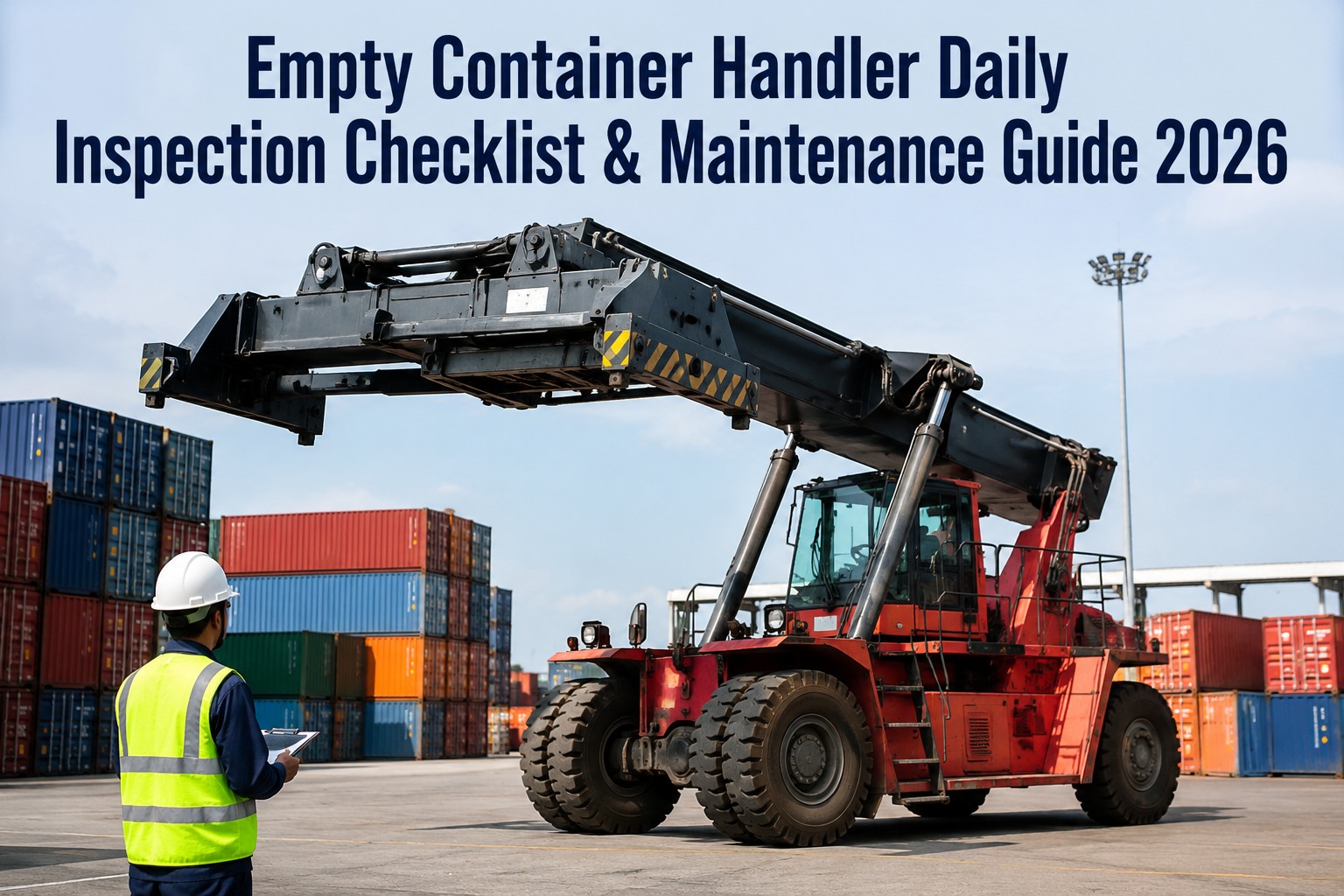
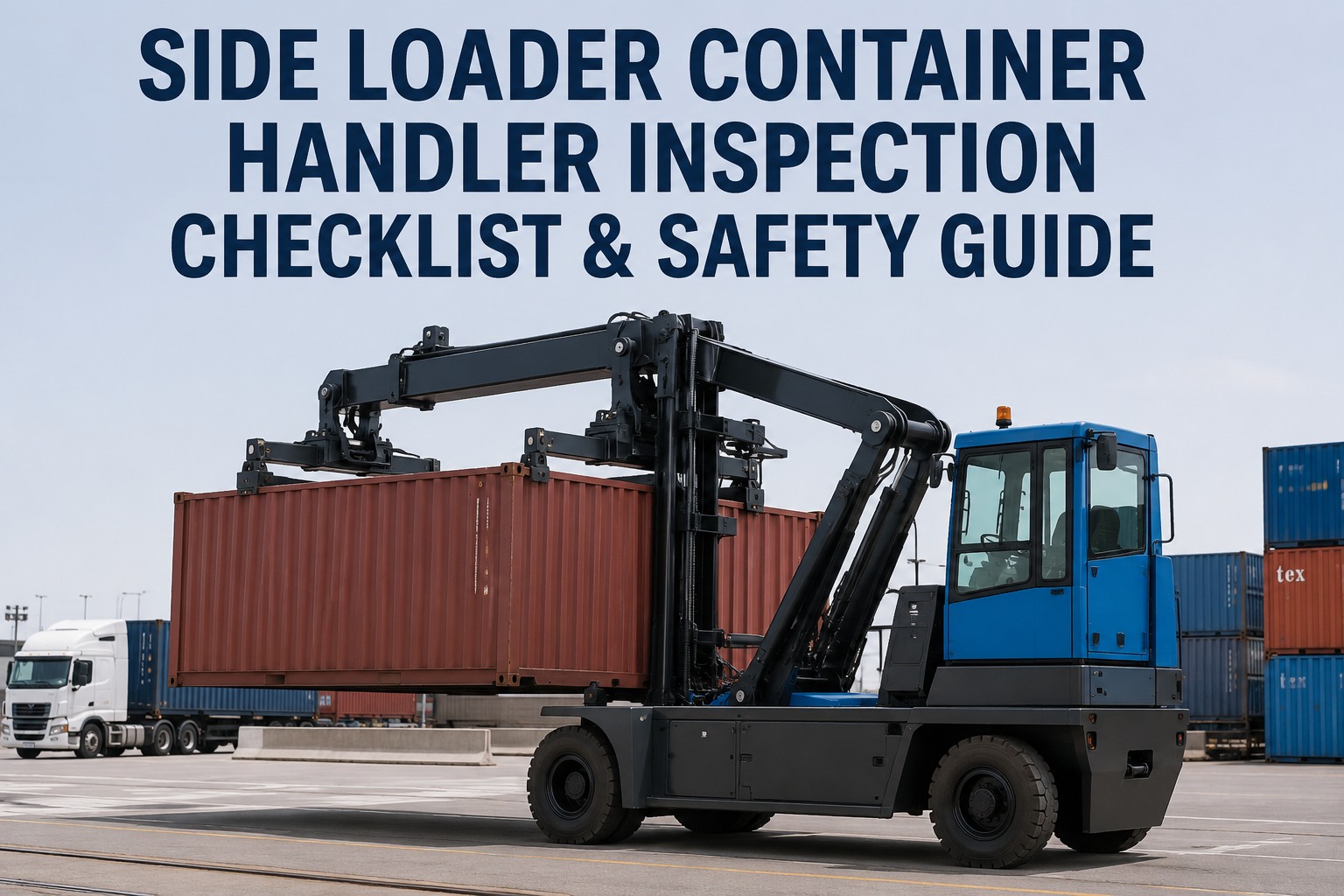
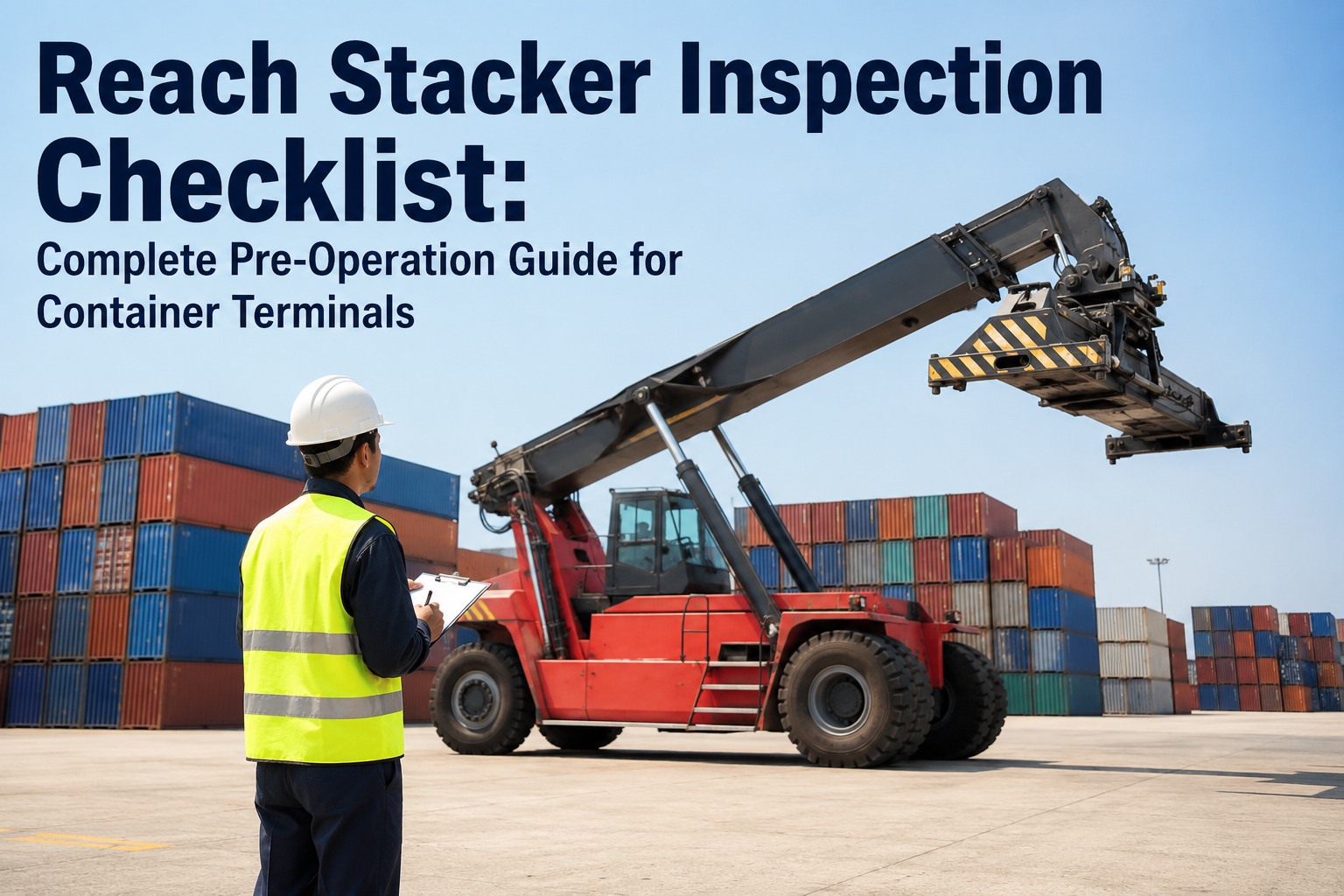
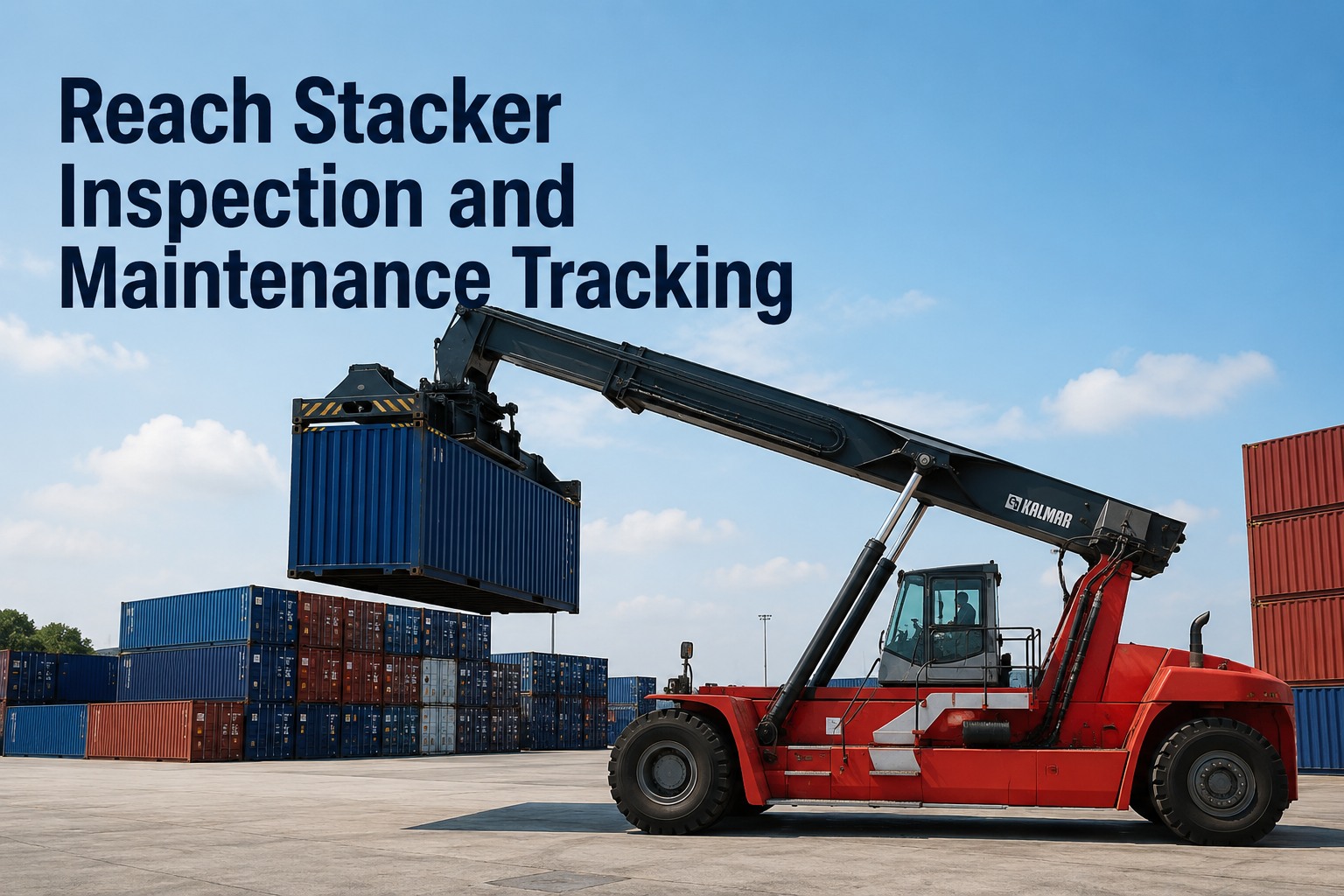
An empty container handler doesn't look like a forklift — but at a terminal, that's exactly what it is under the rules: a powered industrial truck under OSHA 29 CFR 1910.178, governed by ANSI/ITSDF B56.1-2020, operating inside a marine terminal under 29 CFR 1917. The difference is the load. A 9-ton machine stacking 8'6" empty boxes seven-high in a 12-row yard with reefer-correction sideshift and a hydraulic twistlock spreader has consequences a 5,000 lb counterbalance forklift doesn't. A twistlock that lights amber instead of green at six-high means a container with no lock holding it to the spreader. A hydraulic seep at the lift cylinder, a worn lift chain, a soft brake pedal, a missed pile-slope sensor — every one of those is a stacked-empty about to drop into a yard with workers, trucks, and adjacent stacks. OSHA estimates roughly 85 forklift-class fatalities per year in the US, and ASME B56.1 specifies that maintenance and inspection "shall be performed" before the truck is placed in service. The daily pre-shift inspection is the line of defense — but only when every required item is captured, photographed if it's a defect, and logged to that specific ECH unit. A digital empty container handler inspection & maintenance app runs that check on the operator's phone, enforces every field, routes defects to maintenance instantly, and stores the signed record for the audit. This guide is the full daily checklist for terminal ECH fleets.
OSHA 1910.178 + ASME B56.1 + 1917 MARINE TERMINALS
The Empty Container Handler Daily Inspection
A two-phase pre-shift check — visual walkaround plus functional test — covering hydraulics, spreader twistlocks, mast, tires, brakes, steering, and safety devices, all signed off in HVI before the first pick.
~85
forklift-class fatalities per year (US)
7-High
typical empty stack height in a terminal
9 Ton
typical ECH lift capacity at the spreader
1910.178
OSHA rule the ECH inspection follows
Why an ECH Daily Check Is Different
An empty container handler is a powered industrial truck — but with a hydraulic spreader, a six-story stack, and yard traffic underneath. Four risks shape the daily inspection.
Twistlock Failure
A twistlock not fully engaged means a container hanging by friction alone — at six-high the drop is unsurvivable for anyone below.
Hydraulic Loss
A burst lift hose or spreader hose with a load up high means immediate loss of control. Daily hose inspection is OSHA-required, not optional.
Stack-Stability
Pile slope, sideshift, and reefer-correction must work precisely — an offset pick into a seven-high row can topple the adjacent stack.
Yard Traffic
Drayage trucks, longshoremen, lashers, fellow handlers — the warning systems (horn, alarm, lights) are pedestrian survival, not paperwork.
The Two-Phase Daily Inspection
ANSI/ITSDF B56.1 and OSHA 1910.178 split the pre-shift check into a cold visual walkaround and a key-on functional test. Both close in HVI before the operator can sign the ECH operational for the shift.
PHASE 1 — KEY OFF
Visual Walkaround
A 360° physical inspection with the engine cold. Operator looks for leaks under the machine, hose damage, structural cracks, tire condition, spreader integrity, mast chains, and any damage from the previous shift.
~5–7 minutes
PHASE 2 — KEY ON
Functional Test
Engine running, machine in a controlled area. Operator tests every safety-critical system — brakes, steering, hydraulics, spreader twistlocks (amber/green/red), backup alarm, horn, indicator lights, e-stop.
~5–7 minutes
The Complete System-by-System Checklist
Every item below is what an HVI ECH template prompts in sequence. Required fields, photo evidence on defects, and a signed timestamp on submission — exactly what a 1910.178 audit demands.
Walkaround for new damage, leaks under the machine, debris
Frame welds, lifting eyes, no cracks or deformation
Capacity plate present, legible, matches attachment
Glass clean, mirrors aligned, wide-angle mirrors intact
Decals, warnings, and DOT/terminal ID legible
Reservoir level at sight glass; fluid clear, not milky/foamy
All hoses — lift, tilt, sideshift, spreader — no cracks, bulges, abrasion
Cylinder rods — no scoring, pitting, or active seep
Mast drift < 1 in/min under rated load (per B56.1)
No leaks at main valve, manifolds, fittings, or quick-disconnects
03
Spreader & Lifting Attachment
Twistlocks rotate fully — both 90° lock and unlock positions
Twistlock indicator lights — amber (unlock) and green (lock) both functional
Hook & clamp wear within spec; safety wedges (45–53') seat fully
Sideshift to full travel both directions, alignment pins functional
Pile slope & reefer-correction respond smoothly to controls
Container-presence and lowering-interrupt sensors test OK
Lift chains — no elongation >3%, no rust, no deformed/pitted links
Chain anchors and tension equal between left and right chains
Mast rails — no cracks, no deformation, no worn rollers
Mast extends/retracts smoothly through full stroke
Carriage rollers, bearings, and stops within wear tolerance
05
Tires, Wheels & Undercarriage
Drive tires — no cord-penetrating cuts, chunking, or flat-spotting
Steer tires — pressure to spec (bias-ply pneumatic 14.00 × 24 typical)
Wheel lugs visibly tight; no rust streaks indicating loosening
Axles, hubs — no oil seeping past seals
No yard debris (steel banding, dunnage) caught around tires
Service brake — firm pedal, full stop within yard standard distance
Parking brake holds on grade; no creep when drive engages
Steering — no excessive play, smooth power assist to full lock
Steer axle stud protectors intact; tie-rod ends not worn
No air or hydraulic brake warning lights at startup
07
Safety Devices & Lights
Backup alarm audible over yard ambient (10+ ft range)
Horn — functional, audible above terminal noise
Headlights, work lights, strobe/beacon all functional
Twistlock signal lights at cab + spreader synchronized
Operator restraint (seatbelt) — latch, retraction, webbing intact
Fire extinguisher — charged, in date, secured
3-point contact mounting surfaces — handrails, steps clean & secure
Overhead guard — no cracks or missing fasteners
Operator display panel — twistlock indicators, warnings clear
Joysticks/levers respond, no sticking, neutral returns correct
Cab doors latch securely; door hold-back trip handles functional
Spreader & Twistlock Deep-Dive
The spreader is what makes the ECH unique among industrial trucks — and the single most consequential system to inspect every shift. Three checks rule everything else.
Each twistlock must rotate the full 90° in both directions and seat fully into the corner casting. A partial engagement looks identical to a full one from the cab if indicators aren't working.
Test: Cycle each twistlock at ground level, observe full rotation, photo the engaged position.
B
Indicator Lights & Sensors
Amber = unlocked / unsafe to lift. Green = fully engaged / safe to lift. Red = fault. Both the cab display and the spreader-mounted lights must match — a mismatch is an out-of-service condition.
Test: Cycle the spreader and confirm cab + attachment lights agree on every state.
C
Sideshift, Pile Slope, Sensors
Sideshift (±600 mm typical), pile slope, alignment pins, and lowering-interrupt sensors must all respond on command. Misaligned picks are how a six-high stack ends up on a seven-high.
Test: Run sideshift to both ends; confirm pile-slope returns to neutral; verify alignment pin engagement.
Out-of-Service Criteria — The Stop-Now List
OSHA 1910.178(q)(7) says a powered industrial truck "shall not be placed in service" if any examination shows a condition affecting its safety. For an ECH, that means these defects trigger an immediate tag-out in HVI — no exceptions.
CRITICAL
Twistlock fails to fully engage or cab/spreader lights disagree
Service brake spongy or stopping distance exceeds yard standard
Parking brake fails to hold on grade
Steering excessive play or power assist failure
Hydraulic leak under pressure at lift cylinder or spreader hose
Lift chain elongation >3%, broken link, or pitting
Backup alarm or horn inoperable
Seatbelt missing, damaged, or non-functional
Mast drift exceeds 1 inch/minute under load
Frame, mast, or spreader weld crack visible
An ECH on the out-of-service list does not move until repaired and re-inspected. HVI captures the defect, opens the work order, locks the asset, and notifies the supervisor — all in one operator-flagged action on the phone.
book a demo to see HVI's auto-lockout in action.
Paper vs. HVI for ECH Fleets
Terminals run multiple ECHs across multiple shifts on multiple operators. Paper clipboards lose the trail; HVI keeps every asset's inspection, defect, and work order on one searchable record.
PAPER CLIPBOARD
Operators skip fields; dates back-filled
Twistlock light failure noted but never reaches maintenance
No photo evidence of hose damage or chain wear
Trends invisible — same defect recurs unnoticed
Audit prep takes days; records often missing
HVI MOBILE APP
Required fields enforced; timestamps locked
Critical defects auto-route to maintenance + lockout the asset
Photo evidence required on every defect
Trend reports by asset, defect type, operator, shift
Full audit package exported in under 5 minutes
Run Every ECH Daily Check on HVI
HVI gives terminals and intermodal yards a digital, OSHA 1910.178 + ASME B56.1-aligned daily inspection — pre-built ECH templates covering hydraulics, spreader twistlocks, mast, tires, brakes, steering, safety devices, and operator cab. Photo-verified defects, auto-routed work orders, hour-meter capture, and a 5-minute audit export. Trusted by 25,000+ users worldwide.
Frequently Asked Questions
What standard governs empty container handler inspections?
An empty container handler is a powered industrial truck, so the primary federal rule is OSHA 29 CFR 1910.178 — which requires the truck to be examined before being placed in service each shift and prohibits operation if the examination reveals any condition affecting safety. The detailed technical criteria come from ANSI/ITSDF B56.1-2020 (Safety Standard for Low Lift and High Lift Trucks), which OSHA references as the industry standard. Container handlers operating inside a marine terminal also fall under 29 CFR 1917 (Marine Terminals), and longshoring operations under 29 CFR 1918. The manufacturer's operator manual layers ECH-specific items on top — spreader twistlocks, indicator lights, pile slope, reefer-correction sideshift — that the daily inspection must cover. HVI's ECH template encodes all four sources into one workflow.
Start a free HVI trial to run the full ECH check.
What's the most critical check on an empty container handler?
The spreader twistlock engagement test, followed immediately by the indicator-light verification. Every twistlock must rotate the full 90° in both directions and seat fully into the container's corner casting — a partial engagement looks identical to a full one from the cab if the lights aren't working. Amber means unlocked, green means engaged, red means fault; cab and spreader-mounted lights must always agree. If they disagree on any state, the ECH is out-of-service until repaired. Hydraulic integrity (no burst-prone hoses on the lift or spreader circuits), brake performance (service and parking), and lift chain wear are the other shift-stoppers. None of these can be eyeballed from the cab — they require a ground-level walkaround with the operator physically at the spreader, which is exactly what HVI's required-field workflow enforces.
Book a demo to see the twistlock test in HVI.
How long should an ECH daily inspection take?
A trained operator running HVI's two-phase template completes the full eight-system check in roughly 10–14 minutes — about 5–7 minutes for the cold visual walkaround (frame, hydraulics, spreader, mast, tires) and another 5–7 for the key-on functional test (brakes, steering, twistlocks, indicator lights, safety devices). The time is well-spent: pre-shift inspections catch problems while they're still relatively minor adjustments, and a 20% increase in inspection frequency has been shown to drop incidents 4–6%. HVI's mobile workflow keeps the inspection short by prompting the operator through the sections in the right sequence, auto-capturing hour meter and asset ID via QR, and only requiring photos when something's flagged. The defect that takes 15 minutes to log on paper takes 30 seconds on HVI.
Sign up for a free HVI trial to time it yourself.
What defects automatically take an ECH out of service?
Under OSHA 1910.178(q)(7), any condition adversely affecting safety means the truck must not be placed in service. For an empty container handler, that critical list includes: a twistlock that fails to fully engage or where cab and spreader indicator lights disagree; a spongy or non-functional service brake; a parking brake that doesn't hold on grade; excessive steering play or loss of power assist; a hydraulic leak under pressure at the lift cylinder or spreader hoses; lift chain elongation over 3% or a broken/pitted link; an inoperable backup alarm or horn; a missing or damaged seatbelt; mast drift exceeding 1 inch per minute under load; or any visible weld crack on the frame, mast, or spreader. HVI flags these as critical-severity defects, locks the asset in the app, auto-generates a work order, and notifies the supervisor — the ECH can't be marked operational again until the repair is logged and verified.
Schedule a demo to see HVI's auto-lockout.
Does HVI work for a multi-ECH terminal with multiple shifts?
Yes — that's exactly the operating model HVI is built for. Each ECH gets its own asset record with a QR code on the cab; whoever climbs in scans it and the right ECH template loads on their phone, pre-populated with the asset's hour meter and any open defects from previous shifts. The incoming operator must acknowledge open defects before signing the inspection. Defects route to the same maintenance work-order queue across the fleet, so a recurring twistlock issue on Unit 7 is visible alongside a hydraulic seep on Unit 12. Supervisors get a fleet-wide dashboard showing every ECH's status, last inspection time, open defects, and PM-due alerts. Hours roll up across operators and shifts into accurate usage-based PM scheduling — so a hard-worked stacker never slips past its 250-hour or 500-hour service interval.
Sign up for a free HVI trial for your terminal fleet.
What documentation does HVI capture for an OSHA audit?
HVI captures the records OSHA expects for a 1910.178 audit automatically: the ECH's asset ID and hour meter (QR-scanned), the operator's identity and digital signature (logged-in user), the locked server-side timestamp, every item inspected (required fields enforced), findings with mandatory photo evidence on defects, and the corrective action tied to an auto-generated work order with disposition (repaired, removed from service, or deferred with written justification). Operator certification under 1910.178(l) is tracked alongside the inspection records, with refresher alerts before the 3-year recertification lapses. When an OSHA inspector or insurance auditor asks for proof, the full audit package — inspection history, defect resolution, operator certifications, work orders, hour meters — exports in under five minutes for any ECH, operator, or date range. Audit pass rates on digital systems run roughly 96% versus 73% on paper.
Book a demo to see HVI's audit export.