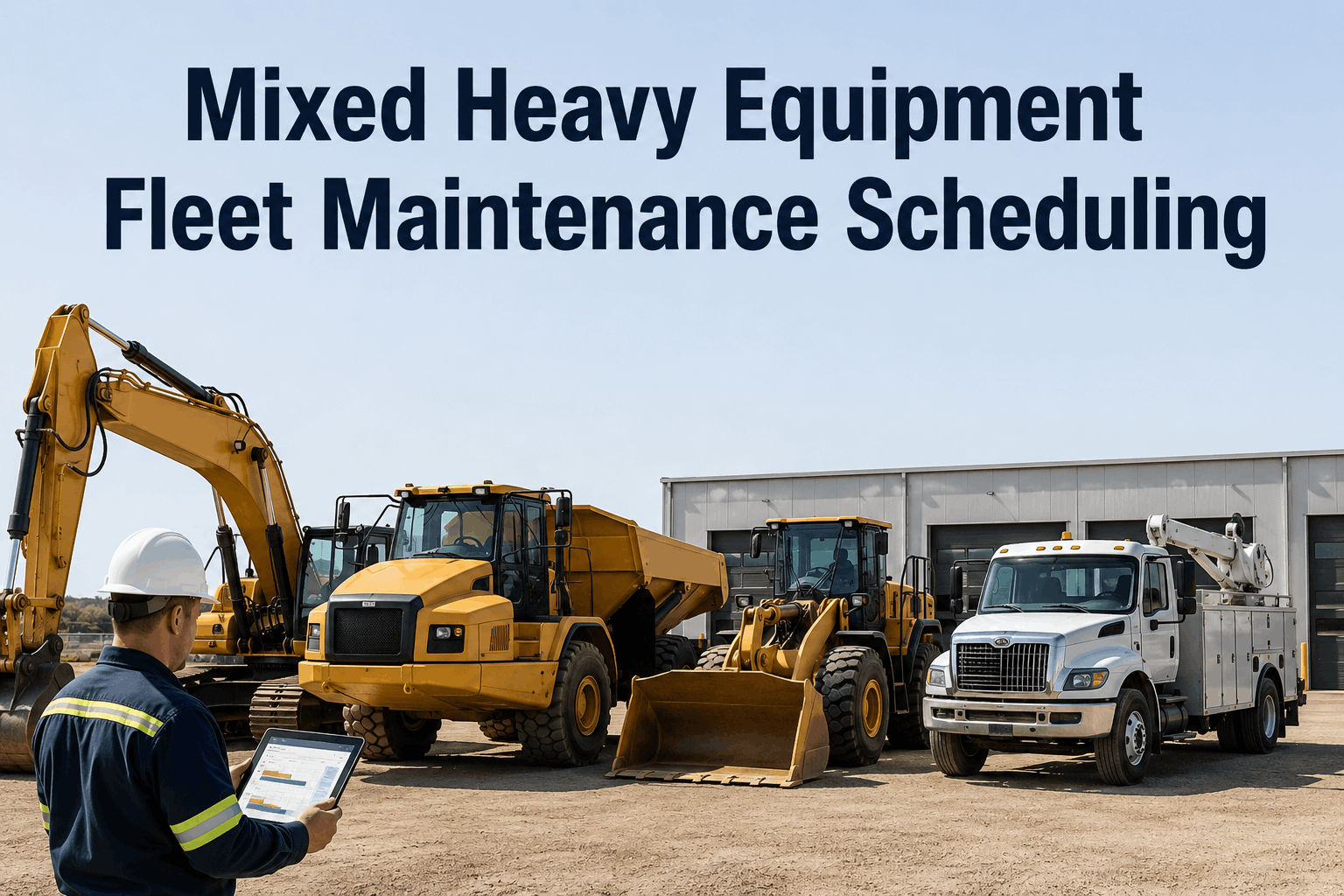
A loader operator in a quarry spots a hydraulic leak during the morning walk-around. He scribbles it on a paper inspection sheet, drops it in the cab, and keeps working because the machine still runs. The sheet rides back to the yard at shift end, sits in a tray overnight, gets keyed into a spreadsheet two days later, and the work order finally reaches a technician on day four — by which point the leak has become a $9,000 pump failure and a machine sitting dead in the middle of a job. The defect was caught on day one. The repair happened on day four. That three-day gap between "found" and "fixed" is where field maintenance budgets quietly bleed out. Heavy equipment now loses operators an average of $740 per hour of downtime, and the single biggest cause is not the failure itself — it's the broken handoff between the person who inspects and the person who repairs.HVI's inspection & maintenance softwareis built to close exactly that handoff — connecting inspections, PM schedules, work orders, and reports into one field-ready workflow so a defect found in the morning becomes a routed, fixed repair the same day. This page shows how that connected loop works, and why field operations running it report up to 75% less downtime.
The Hidden Cost Lives in the Gaps, Not the Breakdowns
Every field maintenance operation has four moving parts: inspection, planning, repair, and reporting. When they run as separate, paper-based steps, the cost isn't the work — it's the dead time between each step. Here's where the money actually leaks.
$740
per hour
Average cost of heavy equipment downtime in lost productivity, overtime, and delivery delays.
3–5×
more expensive
Reactive emergency repairs cost three to five times more than the same work done as planned maintenance.
10–15%
of machine value
Typical annual maintenance budget per machine — most of it avoidable if defects are caught early.
400–800
hours / machine
Non-productive hours a single major failure can trigger per year on a busy site.
The Broken Chain vs. The Connected Chain
The difference between an expensive field operation and an efficient one isn't more technicians or newer machines. It's whether the four steps talk to each other. Compare the two workflows side by side.
THE PAPER CHAIN
Defect written on a paper sheet, photo taken on a phone that never gets shared.
Someone keys the defect into a spreadsheet, maybe. PM schedule lives in a separate file nobody checks.
Technician gets a vague verbal note, no photo, no history, drives out, finds wrong parts.
Manager has no idea what's open until something fails. Asks around. Chases updates.
THE HVI CHAIN
Defect flagged on the app with photo, severity, and machine ID — submitted instantly from the field.
Work order lands pre-filled with asset history; PM schedule auto-adjusts around the new repair.
Technician sees the photo, defect notes, and parts needed before leaving the shop. First-time fix.
Manager sees a live board: what's open, who's on it, when it closes, full audit trail.
One Loop: Inspect → Plan → Repair → Report
HVI's inspection & maintenance software connects the four steps into a single closed loop. Each step feeds the next automatically, and the whole cycle lives on one screen — purpose-built for heavy equipment field operations. This is what "connected field maintenance" actually means in practice.
1 · INSPECT
Digital walk-around checklists on a phone or tablet. Photos, severity flags, and machine ID captured in the field — works fully offline, syncs when back in range.
2 · PLAN
A flagged defect auto-generates a work order. PM schedules track engine hours and usage, so service happens by real condition — not arbitrary calendar dates.
3 · REPAIR
Technician opens the work order with photos, defect notes, asset history, and parts list ready. Updates status and logs closure with evidence from the field.
4 · REPORT
Live dashboards show open work, MTTR, PM compliance, and cost per machine — the data managers need to decide repair-vs-replace, all without chasing updates.
The Numbers When the Loop Is Closed
These aren't theoretical. They're the measurable shifts field operations report after connecting inspections to repairs. The leverage comes from compliance discipline and first-time fixes — both impossible on paper.
60–70%
less unplanned downtime
Raising PM compliance from 75% to 95% cuts unplanned downtime 60–70% and prevents $65K–$95K in emergency repairs per 10-machine fleet annually.
90%+
first-time fix rate
World-class operations hit 90%+ FTFR; lifting it from 70% to 90% cuts repair time 35–45% by giving techs full context before they roll.
92%+
equipment availability
Moving availability from 75% to 92% adds ~1.7 machines of effective capacity per 10 — worth $135K–$185K a year, no capital spend.
75%
downtime reduction
Leading field-maintenance platforms deliver up to 75% downtime reduction and $180K+ annual savings per 50-machine fleet.
Why Field Operations Are Different — and Why Paper Fails Hardest Here
Office-based maintenance can survive a slow paper process. Field operations can't. Three realities of working in the field make the connected loop non-negotiable.
Machines Move, Sites Scatter
Equipment spreads across remote job sites with no office nearby. A defect found on site shouldn't have to physically travel back to the yard to become a repair. Mobile-first capture closes that distance instantly.
Downtime Is Brutally Expensive
A stalled excavator can idle an entire crew and push a project past deadline. At $740/hour, every day a defect waits in a tray is a measurable hole in the project margin — far more than office equipment downtime.
Connectivity Is Patchy
Quarries, mines, and rural builds often have no signal. Inspections still have to be captured, photos still attached. Offline-first capture with auto-sync means the loop never breaks just because the bars drop.
A Real Field Scenario, Two Ways
Same machine, same defect, two different operations. The only variable is whether the inspection talks to the work order.
What You Get on One Screen
Everything that used to live in paper sheets, spreadsheets, and someone's memory — now inside HVI's inspection & maintenance software, one connected system built for heavy equipment in the field.
Close the Gap Between Found and Fixed
Connect inspections, PM schedules, work orders, and reports into one field-ready loop. Up to 75% less downtime, 90%+ first-time fixes, and a live view of every machine. Trusted by 25,000+ users worldwide.