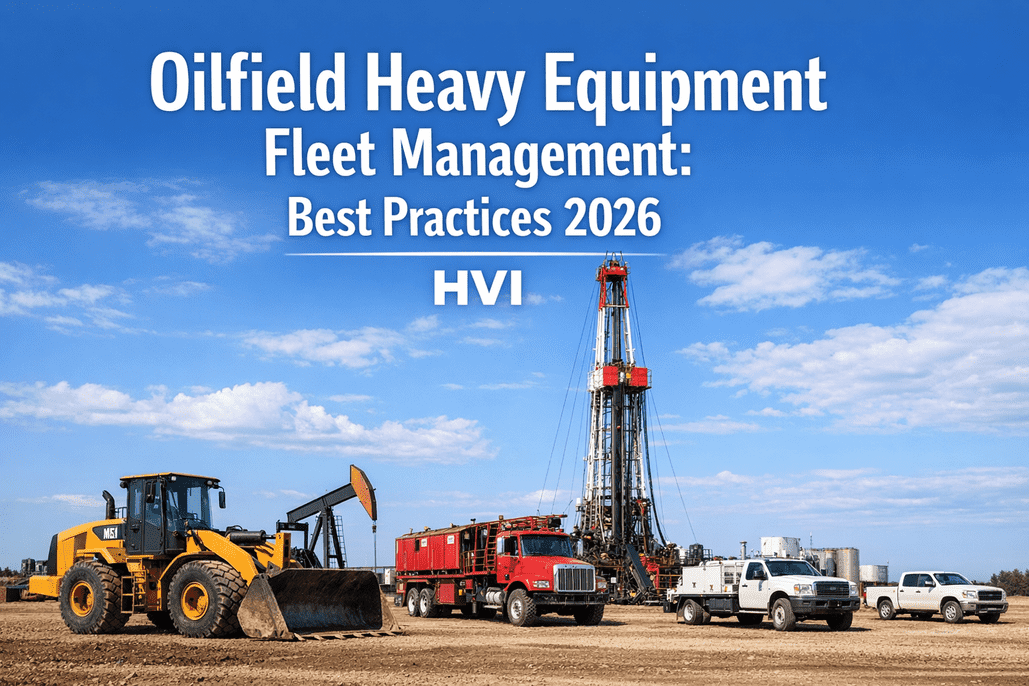
Oilfield operations run on heavy equipment that operates 24/7 in some of the most demanding environments on earth — remote well sites with no cellular signal, offshore platforms with salt spray corrosion, drilling pads with extreme vibration and H2S exposure, and service roads that destroy undercarriages in a single season. The equipment fleet spans drilling rigs, workover rigs, cranes, forklifts, pump trucks, coil tubing units, frac spreads, vacuum trucks, hot oil units, service trucks, and the light vehicles that move crews between locations. Each category has different inspection requirements, different failure modes, different regulatory obligations, and different consequences when something breaks — consequences that range from production downtime costing $50,000-$150,000+ per day for a shut-in well to catastrophic HSE incidents involving H2S exposure, dropped loads, or well control failures. HSE (Health, Safety, and Environment) compliance isn't optional in oil and gas — it's the operating license. Operators like Chevron, ExxonMobil, and ConocoPhillips require contractors to demonstrate documented inspection programs, equipment certification histories, and maintenance records as a condition of site access. A failed HSE audit doesn't just mean a fine — it means losing the contract. This guide covers the equipment types, HSE compliance frameworks, inspection protocols, remote site challenges, and how HVI provides the digital inspection and maintenance platform that oilfield operations require. Book a demo to see HVI configured for oil and gas operations, or start free.
HVI for Oil & Gas Fleet Operations
Digital inspections, HSE compliance tracking, equipment certification management, and maintenance scheduling — built for the equipment types, regulatory requirements, and remote environments that oilfield operations demand.
Oilfield Equipment Fleet: Types & Challenges
An oilfield fleet isn't a single category of equipment — it's a complex ecosystem of drilling, lifting, pumping, transport, and support equipment operating under extreme conditions. Each type has unique inspection requirements and failure consequences.
Drilling & Workover
Drilling rigs, workover rigs, coil tubing units, snubbing units, well servicing rigs
Well control failure, dropped objects, H2S exposure, high-pressure releases, structural collapse
Mast/derrick structure, BOP systems, crown/traveling blocks, drawworks, rotary equipment, guy wires, rig floor condition
Lifting & Hoisting
Rig cranes, mobile cranes, overhead cranes, winches, gin poles, tugger lines
Dropped loads (DROPS), structural failure, overloading, rigging failure, pinch/crush injuries
Wire rope per ASME B30.2, hook/block condition, LMI calibration, boom structure, outrigger integrity, loose gear (slings, shackles, eye bolts)
Pressure Pumping
Frac pumps, cement pumps, acid pumps, hot oil units, nitrogen units
High-pressure line failure (treating iron), chemical exposure, thermal burns, fluid injection injuries
Treating iron integrity, union connections, pressure testing records, safety relief valves, chemical containment, pump packing/fluid end
Transport & Hauling
Vacuum trucks, kill trucks, water haulers, sand haulers, winch trucks, bed trucks, Class 8 tractors
Rollover (loaded/unloaded), load securement failure, brake failure on grade, DOT compliance violations
FMCSA DVIRs (396.11), DOT annual (396.17), load securement, tanker integrity, PTO systems, fifth wheel, air brakes
Support Equipment
Forklifts, telehandlers, light plants, generators, compressors, pipe handling equipment
Struck-by, electrical hazards, H2S in confined spaces, fire/explosion near wellhead
OSHA pre-shift (1910.178 forklifts), spark arrestors on all equipment near wellhead, grounding/bonding verification, generator exhaust routing
Light Vehicles
Crew trucks, supervisor pickups, mechanics' service trucks, tool trucks
Rollover on lease roads, fatigue-related accidents, wildlife strikes, weather-related incidents
Pre-trip inspection, tire condition (lease road damage), lighting (night operations), emergency equipment (fire extinguisher, first aid, H2S monitors)
HSE Compliance: The Non-Negotiable Framework
Oil and gas HSE compliance operates at three levels: federal regulations, operator-specific requirements, and industry standards. Your equipment inspection and maintenance program must satisfy all three simultaneously — because any one can shut down your operation.
Federal & State Regulations
OSHA General Industry (29 CFR 1910): Equipment inspection, hazard communication, PPE, lockout/tagout, confined space, process safety management. OSHA penalties: up to $165,514 per willful violation.
OSHA Construction (29 CFR 1926): Crane inspections (1926.1412 — shift/monthly/annual), fall protection, scaffolding, electrical safety. Applies to construction-phase well pad activities.
FMCSA (49 CFR 390-399): DVIRs, DOT annual inspections, HOS compliance, ELD requirements for all CMVs. Vacuum trucks, kill trucks, and haul trucks are CMVs subject to full FMCSA compliance.
API RP 54: Occupational Safety for Oil and Gas Well Drilling and Servicing Operations. The foundational industry standard for drilling safety — including equipment inspection requirements.
State Oil & Gas Commissions: Texas RRC, Oklahoma OCC, North Dakota NDIC, New Mexico OCD, Colorado COGCC — each has state-specific equipment and safety requirements beyond federal standards.
Operator Requirements (ISNetworld / Veriforce / DISA)
Contractor qualification platforms: ISNetworld, Veriforce, PEC Safety, DISA — operators require contractors to maintain active profiles with documented HSE programs, inspection records, training certifications, and insurance.
Equipment certification requirements: Operators typically require current annual inspection documentation, lifting equipment certifications (crane, slings, rigging gear), pressure testing records, and maintenance histories for all equipment entering their sites.
HSE audits: Operators conduct periodic audits of contractor equipment and documentation — often unannounced. Failed audits result in suspension from the operator's approved vendor list. Reinstatement requires corrective action documentation.
Incident reporting: All equipment-related incidents, near-misses, and unsafe conditions must be reported through the operator's management-of-change (MOC) process. Documented inspection records are the first thing investigated after any incident.
Industry Standards & Certifications
ASME B30 series: Crane and lifting equipment standards. B30.5 mobile cranes, B30.2 wire rope, B30.10 hooks, B30.20 below-the-hook lifting devices. Annual certification required by OSHA reference.
IADC HSE Case Guidelines: International Association of Drilling Contractors framework for drilling operations safety — including equipment inspection, maintenance, and incident management protocols.
API Spec 4F/7K/8C: Specifications for drilling and well servicing structures (4F), drilling and production equipment (7K), and drill-through equipment (8C). Define design, manufacturing, and inspection requirements.
DROPS (Dropped Objects Prevention Scheme): Industry program for preventing dropped objects — the #2 cause of offshore fatalities. Requires inspection of all overhead equipment, securing methods, and barrier integrity.
HVI tracks equipment certifications, inspection schedules, and HSE compliance documentation across all regulatory levels — federal, operator-specific, and industry standards — on one platform.
Book a demo. Or
start free.
Inspection Protocols: Six Critical Zones
Oilfield equipment inspections follow a zone-based approach — each zone has different inspection items, different frequencies, and different consequences for missed defects. HVI provides zone-specific templates for each.
Frequency: Every shift (pre-tour)
Rig floor clean, free of oil/mud/tripping hazards
Tong dies and jaws — condition, safety lines attached
Drawworks brake bands, emergency brake function
Crown/traveling block sheaves — wear, alignment, guards
Rotary equipment — drive system, table condition, kelly bushing
Mast/derrick — visual for cracks, loose bolts, guy wire tension
Frequency: Per regulatory/operator schedule + pre-operation
BOP stack — function test per schedule (typically weekly), pressure test per regulation
Choke manifold — valve function, pressure rating verification
Kill line and choke line — integrity, connections, pressure tested
Accumulator unit — pre-charge pressure, fluid level, response time
Mud gas separator — structural integrity, venting, level indicators
Pit volume totalizer — calibration, alarm function
Frequency: Pre-use + monthly documented + annual certification
Crane: structural inspection, wire rope measurement, hook throat/twist, LMI calibration, anti-two-block
Loose gear: slings (wire rope, synthetic, chain) — color code current, no damage, capacity tags legible
Shackles — pin straight, no deformation, load rating legible, proper type for application
DROPS survey — all overhead items secured, no tools/equipment stored on rig floor grating without retention
Gin poles and A-frames — structural integrity, guy wires, sheave condition, capacity posted
Personnel hoisting — man-riding certification current, safety factor verified, secondary fall protection
Frequency: Pre-job pressure test + visual each use
Treating iron — union connections, hammer lug integrity, wall thickness (UT where required)
Pressure safety valves — calibration current, set pressure verified, test records available
Pump fluid ends — packing condition, valve seats, liner wear, pressure rating
Hoses and whip checks — rated for service pressure, whip checks installed on all connections
Manifold valves — full stroke function, no external leaks, position indicators correct
Pressure test records — documented for every high-pressure setup before operations begin
Frequency: Pre-trip DVIR daily + DOT annual + operator requirements
FMCSA DVIR (396.11): all 16 items, 3-signature chain, defect reporting and repair certification
DOT annual (396.17): 15 Appendix A categories, qualified inspector, 14-month retention
Tanker-specific: tank integrity, venting system, overfill protection, emergency shutoff valves
Load securement: pipe racks, toolbox securing, chain/binder condition, tarping where required
PTO and auxiliary equipment: pump drives, hydraulic systems, aerial devices mounted on service trucks
H2S monitoring equipment: personal H2S monitors on all vehicles entering sour operations areas
Z6
Electrical & Hazardous Area
Frequency: Pre-mobilization + periodic per classification
Ex-rated equipment — explosion-proof classification current, certification labels legible, enclosure integrity
Grounding and bonding — all equipment within 100ft of wellhead grounded, bonding straps intact, resistance tested
Spark arrestors — installed and functional on all ICE equipment within classified area
Generators — exhaust routing away from wellhead, fuel containment, emergency shutoff accessible
Lighting — intrinsically safe in classified zones, all temporary lighting properly rated
Gas detection — area monitors positioned per plan, calibration current, alarm setpoints verified
Remote Site Challenges & How HVI Solves Them
Oilfield operations present unique challenges that most fleet management platforms weren't designed to handle. HVI was built with these realities in mind.
⚠
No Cellular Signal
Remote well sites, offshore platforms, and rural lease roads often have zero cellular connectivity. Inspections that require internet = inspections that don't get done.
HVI Solution
Full offline capability. Complete inspections, capture photos, record defects, and sign off — all without cellular signal. Auto-sync when connectivity returns. Zero data loss.
⚠
24/7 Operations & Shift Changes
Drilling rigs and frac operations run continuous tours. Equipment inspections must happen at every shift change — days, evenings, and nights — with accountability for each crew.
HVI Solution
Shift-based inspection scheduling. Each tour crew completes their inspection before assuming control. Digital timestamps and signatures prove which crew inspected what and when.
⚠
Multiple Regulatory Frameworks
The same fleet needs FMCSA DVIRs for transport vehicles, OSHA compliance for construction equipment, ASME B30 for cranes, API standards for drilling equipment, and operator-specific requirements — all tracked on one system.
HVI Solution
Equipment-type-specific templates with the correct regulatory framework per asset. Transport vehicles get DVIR templates. Cranes get ASME B30 checklists. Drilling equipment gets API RP 54 items. One platform, correct standard per equipment type.
⚠
HSE Audit Readiness
Operator HSE audits can be unannounced. When the auditor arrives, you need every inspection record, every certification, every maintenance history instantly available — not in a filing cabinet at the yard office 200 miles away.
HVI Solution
All records digital, cloud-stored, searchable by equipment, date, inspector, or certification type. Pull any record from any device in seconds. ISNetworld/Veriforce documentation export-ready. Audit response time: seconds, not hours.
⚠
Equipment Moves Between Locations
Oilfield equipment moves between well sites, yards, and staging areas constantly. Tracking which equipment is where, what its inspection status is, and when its next service is due — across dozens of locations — is a logistical challenge.
HVI Solution
Asset tracking with location assignment. Every inspection stamps GPS coordinates. Equipment status (available, in-service, maintenance required, out-of-service) visible fleet-wide. Mobilization checklists ensure equipment is inspection-current before leaving the yard.
⚠
Harsh Environment Accelerated Wear
Sand, salt, H2S corrosion, extreme temperatures, and continuous vibration accelerate equipment degradation far beyond normal rates. Standard PM intervals are too long for oilfield conditions.
HVI Solution
Adjustable PM intervals per environment severity. Oilfield-specific severe-duty schedules with shorter intervals for equipment in corrosive or high-vibration environments. Defect trend analysis identifies which conditions drive the most wear.
HVI handles the unique challenges of oilfield fleet management: offline inspections, multi-regulation compliance, shift-based scheduling, instant audit retrieval, and severe-duty PM intervals.
Book a demo configured for oil and gas. Or
start free.
HVI Oil & Gas Fleet Features
HVI's platform is configured for the specific requirements of upstream oil and gas fleet operations — from the rig floor to the transport fleet to the support equipment on every well site.
Oilfield Equipment Templates: Pre-built inspection checklists for drilling rigs, workover rigs, cranes (ASME B30.5), forklifts (OSHA 1910.178), pump trucks, vacuum trucks, service vehicles (FMCSA DVIR), and support equipment — each with the correct items, frequencies, and regulatory references.
Full Offline Mobile: Complete inspections on remote well sites, offshore platforms, and lease roads with zero cellular signal. Photo capture with GPS/timestamp. Digital signatures. Auto-sync when connectivity returns. iOS and Android. No specialized hardware.
Certification & Expiration Management: Track crane certifications (ASME B30.5 annual), lifting gear color-code cycles, pressure equipment test dates, operator training certifications (H2S, SafeLand, well control), and equipment registration. Alert 90/60/30 days before expiration.
HSE Audit Documentation: Every inspection record, certification, maintenance history, and defect resolution documented digitally and retrievable in seconds. Exportable for ISNetworld, Veriforce, and operator audit packages. Timestamp-verified with photo evidence.
Shift-Based Inspection Scheduling: Configure inspections per tour/shift for 24/7 operations. Each crew completes their assigned inspection before assuming equipment control. Accountability per crew, per shift, per equipment — with escalation if inspections are overdue.
Severe-Duty PM Scheduling: Adjustable PM intervals for oilfield conditions — shorter intervals for equipment in sand, salt, H2S, or continuous-operation environments. Multi-trigger scheduling by hours, mileage, calendar, or whichever-comes-first.
Operator HSE Requirements Getting Stricter
Major operators are increasing documentation requirements for contractor equipment. ISNetworld and Veriforce profiles now require more granular equipment inspection evidence — including photo documentation, inspector qualifications, and real-time certification status. Paper-based records are increasingly rejected during audits.
DROPS Prevention Driving Lifting Equipment Scrutiny
Dropped objects remain the #2 cause of offshore fatalities. DROPS programs require documented inspection of all overhead equipment, securing methods, and lifting gear — with quarterly DROPS surveys becoming standard. Digital inspection with photo evidence is the documentation standard auditors now expect.
Book a demo.
eDVIR Authorization for Transport Fleet
FMCSA's February 2026 final rule (effective March 23, 2026) explicitly authorizes electronic DVIRs for all CMVs — including vacuum trucks, kill trucks, and haulers in oilfield operations. Digital DVIRs with auto-generated work orders eliminate the paper DVIRs that get lost in truck cabs between the well site and the yard.
Digital Oilfield Driving Maintenance Digitization
As oilfield operations digitize drilling data, production monitoring, and logistics, the equipment maintenance and inspection function is the next area moving from paper to digital. Fleets still using paper inspection books are increasingly outliers — and the ones most likely to fail HSE audits.
In Oil & Gas, Equipment Integrity Is Everything
Every piece of equipment on a well site is either inspected, certified, and maintained — or it's a liability waiting to become an incident. The cost of an HSE failure in oil and gas isn't measured in repair bills — it's measured in injuries, environmental damage, regulatory action, and lost contracts. HVI provides the digital inspection and maintenance platform that oilfield operations require: equipment-specific templates covering every asset type from the rig floor to the transport fleet, full offline capability for remote sites, multi-regulation compliance tracking (OSHA, FMCSA, ASME, API), shift-based scheduling for 24/7 operations, and the instant audit retrieval that keeps you on the operator's approved vendor list.
Digital Fleet Management for Oil & Gas Operations
HVI provides oilfield-specific inspection templates, HSE compliance tracking, equipment certification management, and full offline capability — for every equipment type in your upstream operation.
Frequently Asked Questions
Q: Does HVI work offline on remote well sites?
Yes — full offline capability is a core feature. Complete inspections, capture photos with GPS/timestamp, record defects, and sign off without any cellular signal. All data auto-syncs when connectivity returns. Zero data loss. This is essential for remote well sites, offshore platforms, and lease roads with no coverage.
Q: Can HVI handle different inspection requirements for different equipment types?
Yes — HVI provides equipment-type-specific templates. Drilling rigs get rig floor and well control checklists per API RP 54. Cranes get ASME B30.5 annual certification checklists. Transport vehicles get FMCSA DVIRs with 3-signature chain. Forklifts get OSHA 1910.178 pre-shift checks. One platform, correct template per equipment type.
Start free.
Q: How does HVI help with operator HSE audits?
Every inspection, certification, maintenance record, and defect resolution is stored digitally with timestamp, photo evidence, and inspector identification. Searchable by equipment, date, inspector, or certification type. Exportable for ISNetworld, Veriforce, and operator-specific audit packages. When the auditor arrives — announced or not — you can pull any record in seconds from any device.
Q: What about 24/7 shift operations?
HVI supports shift-based inspection scheduling for continuous operations. Configure inspections per tour — days, evenings, nights. Each crew completes their assigned inspection before assuming equipment control. Digital timestamps and signatures prove accountability per crew, per shift. Overdue inspections trigger escalation alerts to the rig manager or HSE coordinator.
Q: Does HVI track lifting gear and rigging certifications?
Yes — track crane annual certifications (ASME B30.5), wire rope inspection dates, loose gear color-code cycles (slings, shackles, eye bolts), and man-riding certifications. Alert 90/60/30 days before expiration. DROPS survey templates available for quarterly overhead equipment inspections. All certification records stored digitally for instant retrieval during audits.
Q: How do I get started with HVI for oil and gas?
Start with a demo configured for your specific equipment types and operational environment — onshore, offshore, or both. We'll configure your equipment templates, certification tracking, and PM schedules during onboarding. Most oilfield operations complete setup in 2-3 weeks and achieve full adoption within 30 days.
Book your demo.